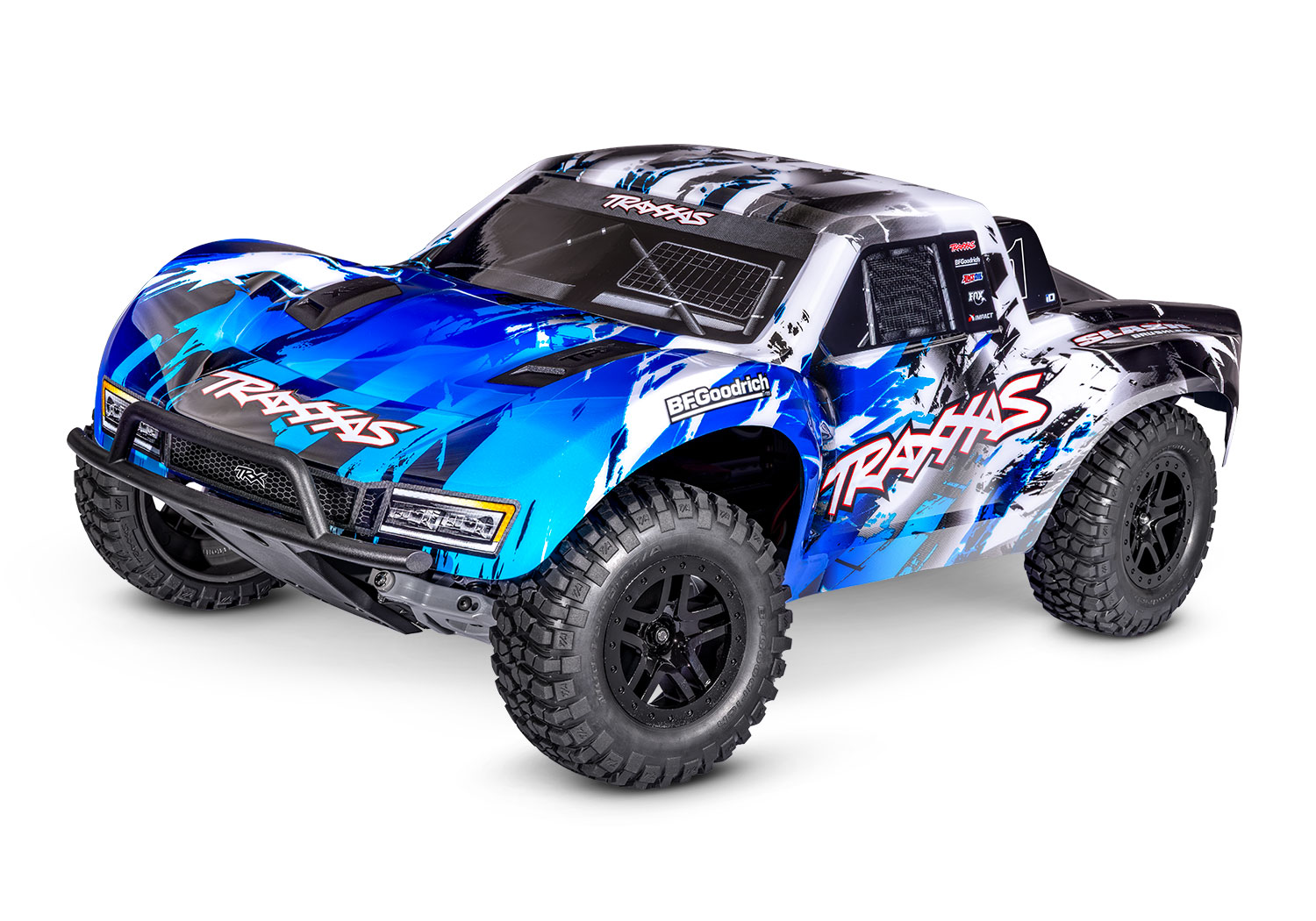
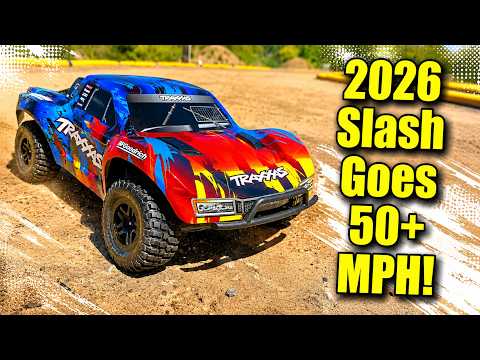
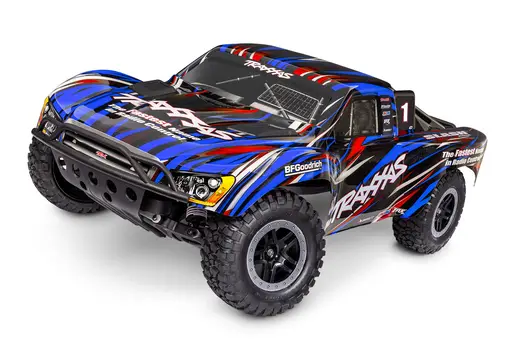
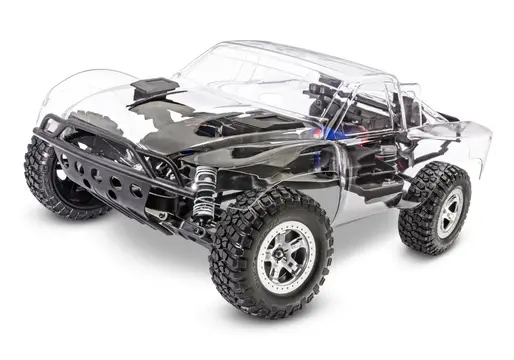
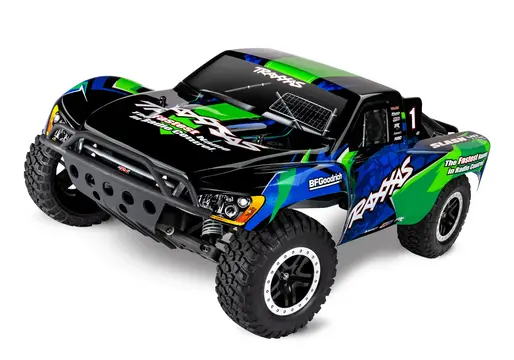
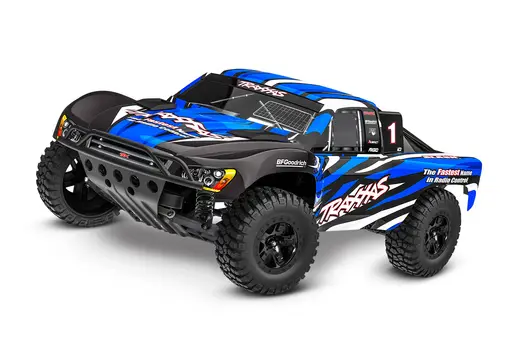
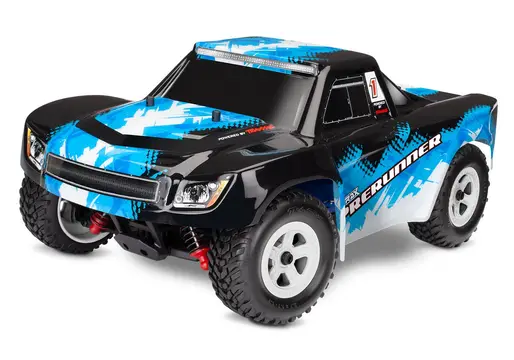
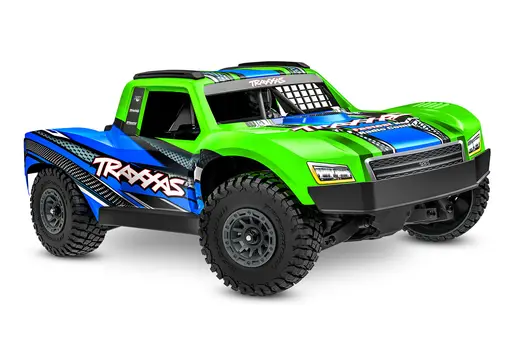
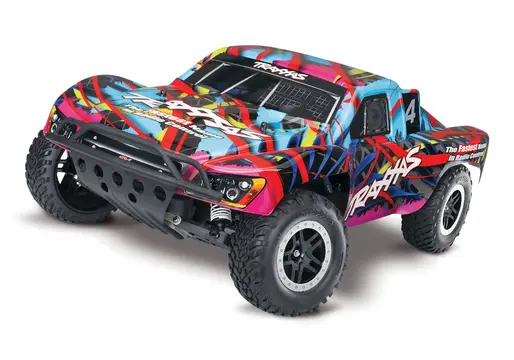
The 58434-4 brings a substantial chassis revision to the rear-drive Slash. The familiar short-course shape now sits over a low-CG chassis, with composite GTR shocks and a clipless body and battery restraint. Those details affect everyday ownership as well as appearance: the truck arrives with equipment that earlier owners often considered as separate projects, and access for a battery change no longer depends on loose body clips. Exact Traxxas configuration (opens in a new tab)
Read moreShow less
The V3200 motor and VX3 controller accept 2S or 3S LiPo power. Behind them, a Magnum 272 transmission and slipper clutch feed the rear wheels. That combination preserves the characteristic rear-drive challenge of finding traction and controlling rotation, even as the electronics give the truck more output. The 5 mm motor shaft and 32-pitch gears also distinguish this package from older 48-pitch Slash advice. Exact Traxxas configuration (opens in a new tab)
The Slash's wider significance began with its 2008 arrival and the spread of dedicated local short-course classes. This later truck carries that recognizable format into a more thoroughly equipped recreational package. It can be driven on a makeshift course, tuned for a club's permitted class or enjoyed on open dirt, but those uses lead to different choices. Decide which one matters before converting a complete ready-to-run truck into a collection of unrelated options. How the Slash helped build short-course racing (opens in a new tab)Exact Traxxas configuration (opens in a new tab)
Pros
The Slash line is widely rated as one of the best-known and most popular short course trucks, with a reputation built over many versions.6,7,8
A Torque-Control slipper clutch and planetary gear differential come installed for rough use, not added on later.1
The kind of vehicle the maker sells it as. It sets what the car is built to do and which cars it is fair to compare it with.
Short course trucks copy full-size desert race trucks, with bodies that cover the wheels so they can bump each other without tangling.
Drive
Only one axle is driven, the rear on almost every 2WD RC car.
It is lighter and simpler, and it takes more throttle control on loose ground.
Power
A brushless motor has no brushes to wear, so it makes more power and runs more efficiently than a brushed one.
It needs a brushless ESC.
Build
Ready to run: built at the factory with the electronics installed.
Some come without a battery or charger; the maker's box contents say which.
Scale
The maker's nominal size compared with a full-size vehicle. It works more as a class label than a measurement.
A 1/10 monster truck is far bigger than a 1/10 touring car, so compare length and weight for real size.
This one is 568 mm long.
Part number
The maker's product number for this exact version.
A V2, a new color, or a kit instead of an RTR usually has a different number, and parts can differ between them.
Check it against your box or receipt before ordering parts.
Class
Short course
Drive
2WD
Power
Brushless
Build
Ready to run
Scale
1/10
Part number
58434-4
Drivetrain
Pinion
The small gear on the motor shaft. Fewer teeth gear the car shorter: quicker acceleration, lower top speed and a cooler motor. More teeth do the opposite.
On this car one tooth changes the gearing by about 5.6%.
A bigger pinion loads the motor and ESC harder, so check the maker's gearing chart and feel the motor temperature after a run.
Spur
The large gear the pinion drives. A bigger spur with the same pinion gears the car shorter.
Pinion and spur need matching pitch, or explicit manufacturer confirmation that the exact gears are compatible.
The Gearing parts table below shows this car's pitch and part numbers.
Transmission & axle
Every reduction after the spur, multiplied together: transmission, differentials and axle gears.
It is fixed by the design; the gearing you change is the pinion and spur.
Spur ÷ pinion
Spur teeth divided by pinion teeth: the part of the gearing that a pinion or spur swap changes.
Here it is 3.000:1.
Final drive
How many times the motor turns for one turn of the wheels. A higher number is shorter gearing: more acceleration and pulling power, less top speed.
Among 1/10 short course trucks in the catalog, the middle half run between 10.2:1 and 12.1:1 on stock gearing; this one is 8.2:1, taller than most.
Differentials
The type of each differential, as the maker states it.
A gear or ball diff lets the wheels on one axle turn at different speeds in a corner; a spool or locked diff turns them together for straight-line drive and climbing, at the cost of steering.
Slipper clutch
A slipper clutch sits on the spur gear and slips under a sudden load, a hard landing or full throttle on grip, to protect the gears.
Set it too loose and it wastes power; too tight and it protects nothing.
Pinion range
The pinion sizes the maker lists for the stock setup.
Going larger than the maker's limit gears the car taller than the motor and ESC are meant to run, which risks overheating them.
The Target pinion calculator shows what each size does to speed.
Hub bearing size
Hub bearing size: The documented drivetrain connection or size for this exact model. Match the mating component before buying a replacement.
Pinion bore
The nominal size of the hole that mates with the motor shaft.
Match the pinion mounting method as well as its size. A press-fit hole cannot be inferred from motor shaft diameter.
Pinion pitch
The tooth spacing of the fitted gear, stated as metric module or diametral pitch.
Pinion and spur need matching pitch or explicit manufacturer confirmation of compatibility for the exact parts. Mod 0.8 and 32P are different standards; a compatibility statement for particular gears does not apply to every gear. A missing pitch can be inferred from the other fitted gear; module and diametral pitch are not silently converted.
Spur pitch
The tooth spacing of the fitted gear, stated as metric module or diametral pitch.
Pinion and spur need matching pitch or explicit manufacturer confirmation of compatibility for the exact parts. Mod 0.8 and 32P are different standards; a compatibility statement for particular gears does not apply to every gear. A missing pitch can be inferred from the other fitted gear; module and diametral pitch are not silently converted.
The outside diameter of the mounted tire, tread to tread. A taller tire covers more ground each turn, which gears the car taller.
At high speed tires can balloon and grow, so the real gearing gets taller as the car goes faster.
Rollout
How far the car moves for one turn of the motor: tire circumference divided by final drive.
It lets you compare gearing across different tire sizes; more rollout is taller gearing.
Here it is 42.0 mm.
Wheel hex
The hex on the axle that the wheel locks onto and is driven by. A wheel must match the hex size to fit.
12 mm is the common size on 1/10 cars, so most 1/10 wheels fit; offset and width still vary.
The wheel nut is a separate size, so check its thread too before buying nuts.
Stock tire width
Stock tire width: A documented stock wheel, tire, or axle measurement. Stock dimensions alone do not establish the largest size that will clear the body and suspension.
Stock wheel diameter
Stock wheel diameter: A documented stock wheel, tire, or axle measurement. Stock dimensions alone do not establish the largest size that will clear the body and suspension.
Axle thread
Axle thread: A documented stock wheel, tire, or axle measurement. Stock dimensions alone do not establish the largest size that will clear the body and suspension.
What the main chassis is made of and how it is built, as stated for this car. Braces, stiffeners and skid plates are not counted.
Composite is the makers' word for molded plastic, usually nylon with glass or other fibers: it flexes and shrugs off hits, and it is light and cheap to replace.
Shocks
What the shocks are and how they are built, as the maker describes them.
Oil-filled shocks damp with silicone oil; friction shocks, found on some entry-level cars, damp with a sprung plunger and cannot be tuned with oil.
Threaded bodies set ride height with a collar you turn, rather than clips.
The shaft size matters when buying seals, ends and rebuild kits.
Shock bore
The inside diameter of the shock body, where the piston moves through oil.
It is a shock measurement, separate from the motor pinion bore. Match the actual shock part when ordering pistons, seals or a replacement body.
Shock length, front
The stated length of the complete shock assembly. Sources may use mounting-eye centers or a nominal assembly length.
Compare fully extended mounting-eye spacing, compressed length and mounting hardware before ordering. A longer shock changes ride height and travel, and can bind at full droop or bottom out.
This approximate length comes from a replacement listed for the identified OEM shock set. Check the fitted shocks; their original dimensions may differ.
Shock length, rear
The same measure at the rear, which differs from the front on this car.
Longer rear shocks are common: they give the rear more travel for landings and put power down over rough ground.
Spring
The stock springs, in the maker's own wording: a color, a rate or a length.
A stiffer spring holds the car up and resists bottoming out; a softer one lets it squat and follow rough ground.
Rates are not comparable across makers unless they state the same unit.
Frontupper shock bolt
Front upper shock bolt: A documented shock mounting interface at the named end and eye. A ball stud or standoff is distinct from a through-bolt. Match the mounting type, thread and eye dimensions when choosing a replacement shock.
Frontlower shock bolt
Front lower shock bolt: A documented shock mounting interface at the named end and eye. A ball stud or standoff is distinct from a through-bolt. Match the mounting type, thread and eye dimensions when choosing a replacement shock.
Rearupper shock bolt
Rear upper shock bolt: A documented shock mounting interface at the named end and eye. A ball stud or standoff is distinct from a through-bolt. Match the mounting type, thread and eye dimensions when choosing a replacement shock.
Rearlower shock bolt
Rear lower shock bolt: A documented shock mounting interface at the named end and eye. A ball stud or standoff is distinct from a through-bolt. Match the mounting type, thread and eye dimensions when choosing a replacement shock.
Frontupper shock eye width
Front upper shock eye width: A documented shock mounting interface at the named end and eye. A ball stud or standoff is distinct from a through-bolt. Match the mounting type, thread and eye dimensions when choosing a replacement shock.
This working size comes from a replacement advertised for the identified OEM part. Confirm the fitted part before ordering; a replacement's size may differ.
Frontlower shock eye width
Front lower shock eye width: A documented shock mounting interface at the named end and eye. A ball stud or standoff is distinct from a through-bolt. Match the mounting type, thread and eye dimensions when choosing a replacement shock.
This working size comes from a replacement advertised for the identified OEM part. Confirm the fitted part before ordering; a replacement's size may differ.
Front spring inner diameter
Front spring inner diameter: A documented shock mounting interface at the named end and eye. A ball stud or standoff is distinct from a through-bolt. Match the mounting type, thread and eye dimensions when choosing a replacement shock.
This working size comes from a replacement advertised for the identified OEM part. Confirm the fitted part before ordering; a replacement's size may differ.
Rearupper shock eye width
Rear upper shock eye width: A documented shock mounting interface at the named end and eye. A ball stud or standoff is distinct from a through-bolt. Match the mounting type, thread and eye dimensions when choosing a replacement shock.
This working size comes from a replacement advertised for the identified OEM part. Confirm the fitted part before ordering; a replacement's size may differ.
Rearlower shock eye width
Rear lower shock eye width: A documented shock mounting interface at the named end and eye. A ball stud or standoff is distinct from a through-bolt. Match the mounting type, thread and eye dimensions when choosing a replacement shock.
This working size comes from a replacement advertised for the identified OEM part. Confirm the fitted part before ordering; a replacement's size may differ.
Rear spring inner diameter
Rear spring inner diameter: A documented shock mounting interface at the named end and eye. A ball stud or standoff is distinct from a through-bolt. Match the mounting type, thread and eye dimensions when choosing a replacement shock.
This working size comes from a replacement advertised for the identified OEM part. Confirm the fitted part before ordering; a replacement's size may differ.
Shock oil
The oil in the shocks slows how fast the suspension moves. Thicker oil settles the car more slowly and resists bottoming out; thinner oil lets the wheels follow bumps.
Front and rear run the same oil on this car, so both ends respond alike. Changing one end at a time is the usual way to shift the balance.
It is graded in wt here. A wt number is the oil maker's own grade and differs between brands, so match the brand, or use the oil maker's chart to convert.
5mm, Exact 7461-STGRY; approximate replacement-derived eye width, listed Ø3 × 5 mm. Not bolt length or mounting clearance.Derived from replacement part
7mm, Exact 7461-STGRY; approximate replacement-derived eye width, listed Ø3 × 7 mm. Not bolt length or mounting clearance.Derived from replacement part
5mm, Exact 7462-STGRY; approximate replacement-derived eye width, listed Ø3 × 5 mm. Not bolt length or mounting clearance.Derived from replacement part
7mm, Exact 7462-STGRY; approximate replacement-derived eye width, listed Ø3 × 7 mm. Not bolt length or mounting clearance.Derived from replacement part
Motor RPM times rollout, worked out on 3S at nominal voltage with stock gearing.
It assumes no load, no battery sag, no wheel slip and no drag, so read it as a ceiling for comparing setups.
A GPS usually reads below it; the gap is load, battery sag, tire slip and drag.
Motor speed
The motor's RPM with no load: KV times pack voltage.
Under load it drops, which is one reason real speed is lower than the theoretical figure.
Advertised top speed
The top speed the maker claims.
Makers often quote it with optional gearing, a bigger battery or a fully charged pack, so read their wording before comparing it with another car's claim or with the calculated figure.
Theoretical top speed
55.7mph on 3SCalculated
Calculated
Motor speed
35,520rpm, no loadCalculated
Calculated
Advertised top speed
50mphMaker's claim
Maker's claim
Size & weight
Weight
The maker prints two different weights for this vehicle, 2.41 kg and 2.64 kg, so the sheet shows the range between them.
The maker does not say whether it includes a battery.
More weight takes more power to accelerate and lands harder on the parts; it changes top speed very little.
Length
Overall length as the maker states it, usually with the body fitted.
Useful for comparing real size, since scale labels are loose.
Width
Overall width as the maker states it, usually with the body fitted.
A wider car is more stable in corners and harder to roll over.
Height
Overall height as the maker states it, usually with the body fitted.
Useful when checking it fits a shelf, a bag or a car trunk.
Wheelbase
The distance between the front and rear axle centers. A longer wheelbase is steadier at speed and over bumps; a shorter one turns more tightly.
Catalog stock FDR: 8.18:1. The grid uses the listed tooth counts and internal ratio, so rounding or source differences may change the result slightly.
Calculated final drive ratio for each pinion and spur pair
Pinion
52T spur
54T spur
56T spur
16T
17T
18T
19T
20T
21T
Select a pair to compare wheel travel per motor turn with stock. Other cells are mathematical examples, not verified gears or fits. Check pitch, mesh, clearance and motor temperature before changing parts.
About these specs
The owner's manual gear chart (p. 25) marks an 18T pinion on the 54T spur, 8.18:1, as the out-of-box setup, and the parts list sets the 18T pinion (5644) and 54T spur (9454) in regular type as supplied.
Read moreShow less
The manual gives the formula as spur divided by pinion times 2.72.
The product page prints 'Gear Ratio (Internal): 2.72 (final drive: 9.05)', but 9.05 matches no pinion and spur pair on the chart, so the manual's 8.18 is shown here.
The tire is the BFGoodrich Mud-Terrain T/A KM2 (6871), which Traxxas sizes at 4.3 x 1.7 in, so 109 mm.
Traxxas claims 35+ mph on 2S and 50+ mph on 3S LiPo with no gearing change, which sits at about 90% of the no-load speed worked out from these figures.
The spec table's weight line reads '5.82 pounds (2.41 kg)', two figures that do not agree (5.82 lb is 2.64 kg), so the weight is shown as a range between them.
Traxxas designates the fitted 5644 pinion and 9454 spur as 32-pitch, and also describes these parts as ‘0.8 metric pitch, compatible with 32-pitch’.
This compatibility applies to these parts; Mod 0.8 and 32P remain different standards.
How to read these figures
Stock is as the vehicle ships.
Calculated is worked from the recorded figures on this page.
Derived from replacement part uses the listed dimensions of a replacement advertised for the identified OEM part. Treat it as an approximate working size; the factory-fitted part may differ. Calculated performance uses that approximation.
Single report uses one outside source. It is useful as a starting figure, with the source and calculation described in the note.
The top speed is kinematic: an ideal no-load RPM with no slip and no loss under load, so a real car is slower.
The maker advertises 50 mph, which is their own claim on their own conditions.
Owner's manual, 58434-4 (Traxxas PDF) (opens in a new tab)traxxas.comPDFSupports 10 specificationsGearing p. 24-25; gearing chart p. 25Used forMain specsGearingBattery fitFluidsServiceDrivetrainSuspensionPowerSteering & radioIn the box
Checked task pages, documented requirements and recorded fluid references for this model. Follow the manufacturer's procedure for the exact assembly and revision.
Maintenance bundles
Manual pages, documented requirements and relevant specifications, together by task.
Use the cited instructions for your fitted equipment. These references are not a complete rebuild kit.
MotorReference
Own motor service reference
Exact manufacturer-linked traxxas-slash-2wd-brushless edition and documented component branch.
Own V3200 brushless bearing cleaning/oiling every10-15 runs. No internal rebuild or universal replacement basket. Own3200Kv stated24, not inferred from name.
No separate parts, tools or prerequisites have been indexed for this task. Read the cited reference before starting.
This is a partial service reference. Check the cited instructions for the full procedure and configuration-specific requirements. Mechanical tasks may need additional parts, quantities and reused hardware beyond the items listed here. Manual reviewed 2026-10-09.
DifferentialsReference
Own differential service reference
Exact manufacturer-linked traxxas-slash-2wd-brushless edition and documented component branch.
Own exact parts2380R differential and2381X/2382R/2388R planetary service identification. No sealed-fluid fill or internal differential procedure documented.
No separate parts, tools or prerequisites have been indexed for this task. Read the cited reference before starting.
This is a partial service reference. Check the cited instructions for the full procedure and configuration-specific requirements. Mechanical tasks may need additional parts, quantities and reused hardware beyond the items listed here. Manual reviewed 2026-10-09.
Indexed tasks link to checked physical PDF pages. Other links open full documents. Tasks and rebuild requirements not shown here still need review.
Upgrades and setup
Use the supplied low chassis and threaded GTR shocks before ordering a suspension conversion. Set ride height with the battery fitted, then separate spring support from damping: the collar changes preload, while oil and piston choices affect how quickly the suspension moves. Compare the truck over the same bumps and corner. Lower mass placement can help resist chassis roll, but it also leaves clearance to consider on rutted ground.[1] Exact stock configuration (opens in a new tab)
Begin on 2S and let tire behavior decide the next step. If the rear spins away on corner exit, more voltage adds another demand on the same contact patches. Match tread to the surface and check tire clearance through steering and compression. A larger or heavier combination also changes effective gearing and load. Short comparison runs and temperature checks give you a more useful basis for gearing changes than a speed target alone.[1] Exact stock configuration (opens in a new tab)
Read moreRead less about upgrades and setup for Slash 2WD Brushless
The truck already includes a metal-gear steering servo and Extreme HD components. Follow a loose or damaged joint when spending on repairs, keeping the bearing, hinge-pin and transmission-case interfaces together. An older owner's arm conversion can illustrate a clearance problem without proving the same problem exists here. If changing the motor later, retain the distinction between gear pitch and pinion bore; both have to match, and the controller, connectors and battery must support the complete installation.[1] Exact stock configuration (opens in a new tab)[2] Installed parts and setup context (opens in a new tab)
Conversions & shared parts
Brushless steering servo
This replaces the factory steering servo with a higher-torque alternative. It is worth considering when steering load exceeds what the current setup can handle, after checking the receiver power supply and the matching horn or servo saver.
Traxxas lists this package for the stated vehicle configuration. Check previously fitted upgrades and modifications before ordering.
Explains the VX3 power system, low-CG chassis, composite GTR shocks and updated factory package, then shows track and jump running. Helps identify which older Slash upgrades are already included.
Reviews the 2026 Slash 2WD VX3 package, including the revised chassis and suspension. Useful for distinguishing its factory equipment from the older VXL and BL-2s trucks.
Common numbers cover selected core components, not every part. A shared family, manual or listing does not mean the parts fit both vehicles. Check the comparison and upgrade notes before ordering.