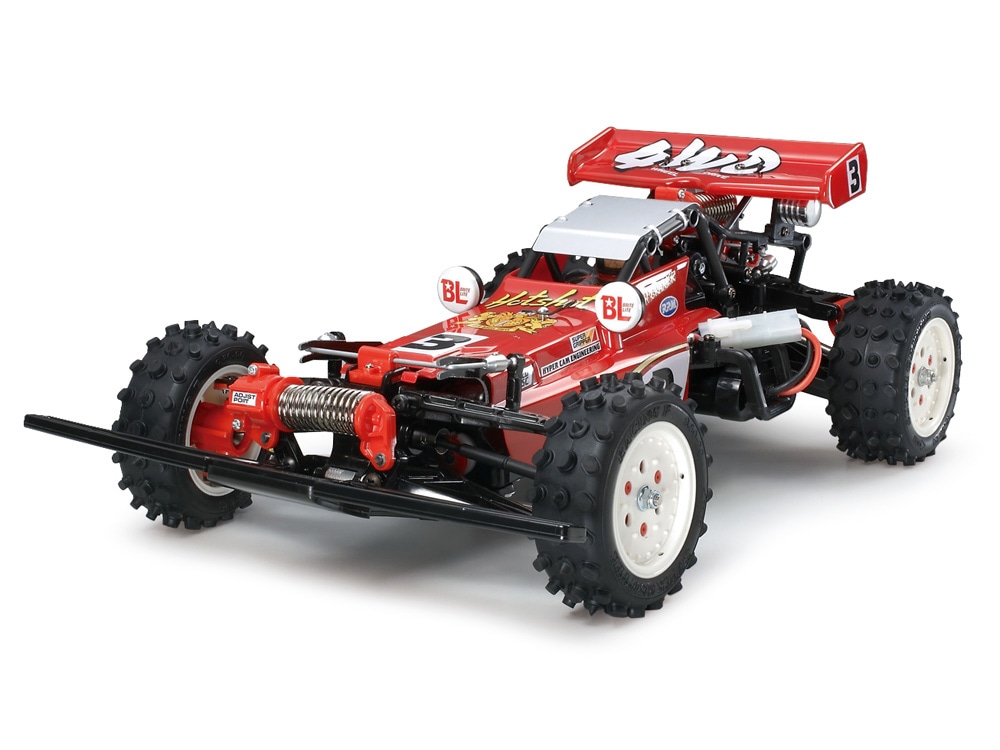
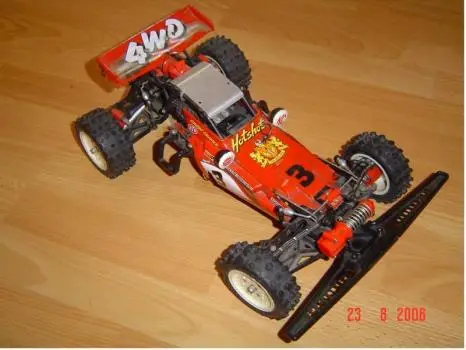
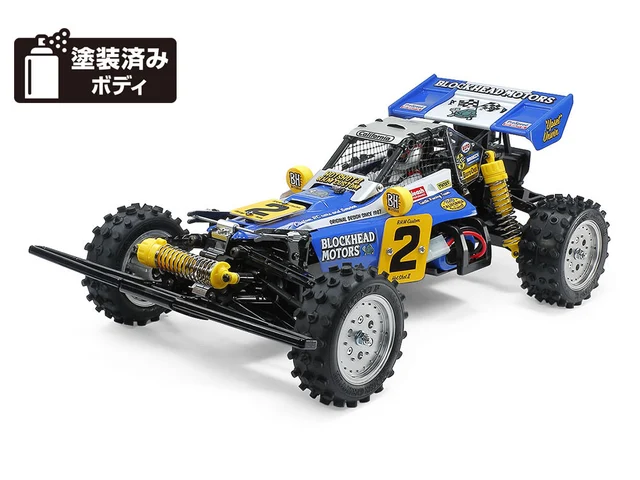
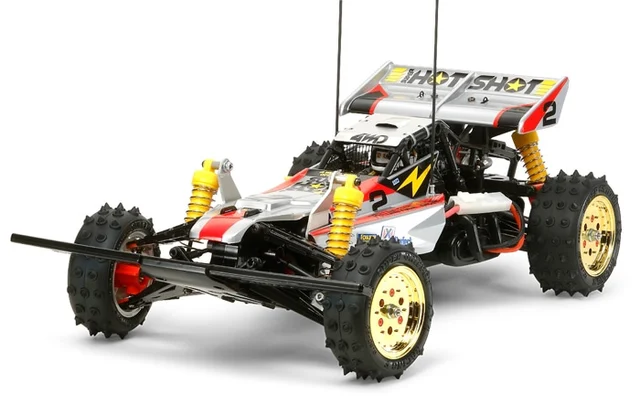
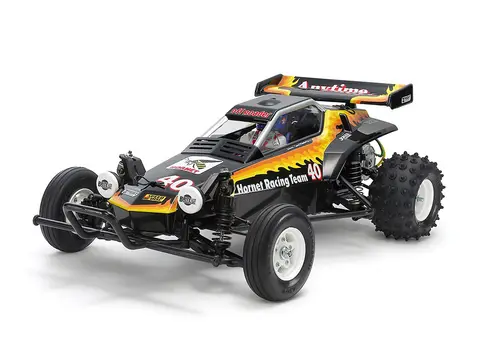
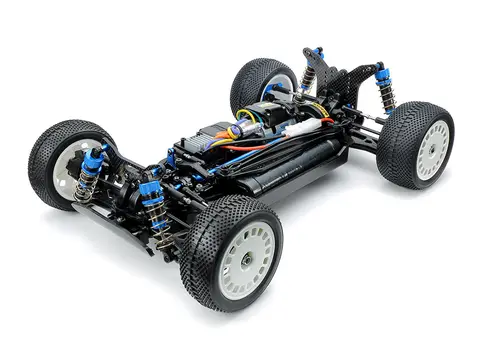
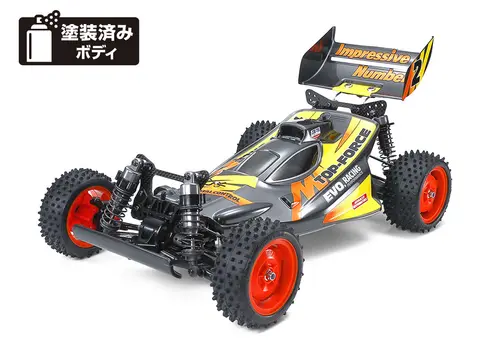
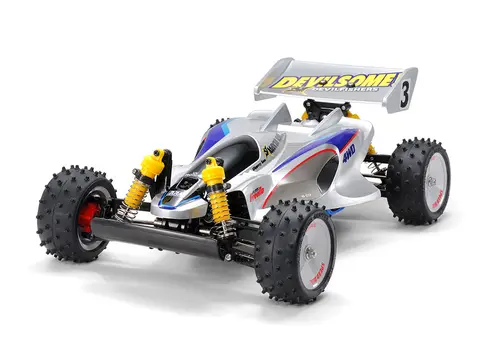
The Hotshot (2007) recreates Tamiya's first shaft-driven four-wheel-drive buggy from 1985 while updating selected mechanisms. It retains the central monocoque, separate gearboxes and the distinctive front and rear monoshock suspension. Stabilizers work with the double wishbones, and a linkage operates the longitudinal rear damper. The construction is a large part of the attraction for someone who wants to understand an early four-wheel-drive design. Tamiya model information (opens in a new tab)
Read moreShow less
The changes are more than cosmetic. Tamiya replaced older drive and propeller-shaft arrangements with dogbone-style joints and moved the oil dampers to diaphragm construction. Electronic speed control removed the need for the original functional rear heatsink, but the remake keeps a dummy part to preserve the silhouette. These details distinguish the 2007 service parts and instructions from those of an original 58047 restoration. Tamiya model information (opens in a new tab)
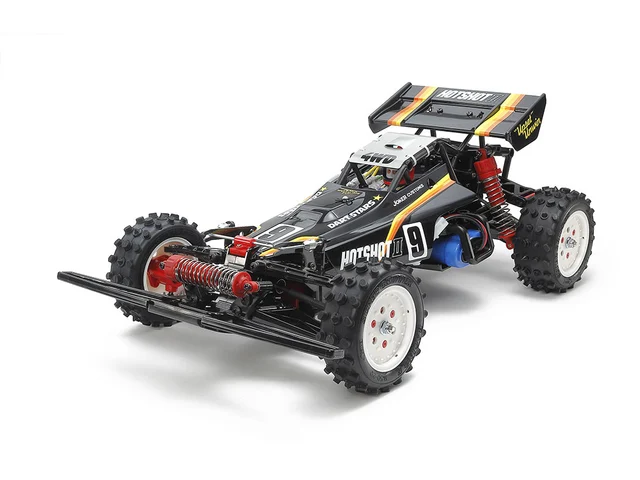
Within the family, the plain Hotshot keeps the most unusual damper arrangement. The Super Hotshot has an individual damper at each corner, and Hotshot II combines one front damper with two rears. Those are different suspension projects, not body-color choices. The Hotshot's attraction is the coordinated mechanism itself; begin with its intended linkage motion before considering a conversion that changes how the suspension works. Factory manual (opens in a new tab)
For regular running, check free movement, steering travel and gearbox alignment during assembly. The manual supplies alternative gearing and motor-position details, so a pinion change also needs the matching mount arrangement. Keep the existing brushed motor while establishing that baseline. Modern electronics can make the car more convenient, but greater motor power does not remove the packaging and suspension decisions inherited from the original design. Tamiya model information (opens in a new tab)
The kind of vehicle the maker sells it as. It sets what the car is built to do and which cars it is fair to compare it with.
Buggies are low, light off-road cars built for jumps and fast corners on dirt, clay or turf tracks.
Drive
All four wheels are driven. That gives more grip under power, especially on loose ground.
The cost is more parts to maintain.
Power
A brushed motor carries current through carbon brushes that rub on the commutator.
It is cheaper and smooth at low speed.
The brushes wear and the motor loses power over time.
Build
A kit you build yourself from parts.
Most kits come without motor, ESC, servo, radio and battery, and many without tires or a painted body.
The manual lists what to add.
Scale
The maker's nominal size compared with a full-size vehicle. It works more as a class label than a measurement.
A 1/10 monster truck is far bigger than a 1/10 touring car, so compare length and weight for real size.
This one is 390 mm long.
Part number
The maker's product number for this exact version.
A V2, a new color, or a kit instead of an RTR usually has a different number, and parts can differ between them.
Check it against your box or receipt before ordering parts.
Class
Buggy
Drive
4WD
Power
Brushed
Build
Kit
Scale
1/10
Part number
58391
Drivetrain
Pinion
The small gear on the motor shaft. Fewer teeth gear the car shorter: quicker acceleration, lower top speed and a cooler motor. More teeth do the opposite.
On this car one tooth changes the gearing by about 7.7%.
Racers change the pinion to suit the track and the class's motor rules, and often compare setups by rollout rather than tooth count.
Spur
The large gear the pinion drives. A bigger spur with the same pinion gears the car shorter.
Pinion and spur must have the same pitch, or tooth size, to mesh.
Differentials
The type of each differential, as the maker states it.
A gear or ball diff lets the wheels on one axle turn at different speeds in a corner; a spool or locked diff turns them together for straight-line drive and climbing, at the cost of steering.
Pinion range
The pinion sizes the maker lists for the stock setup.
Going larger than the maker's limit gears the car taller than the motor and ESC are meant to run, which risks overheating them.
The Target pinion calculator shows what each size does to speed.
Axle drive, front
Whether the front axle is driven by the motor.
The calculator uses this axle's own tire size and complete recorded gear path.
Axle drive, rear
Whether the rear axle is driven by the motor.
The calculator uses this axle's own tire size and complete recorded gear path.
Transmission & axle, front
Every reduction after the spur, multiplied together: transmission, differentials and axle gears.
It is fixed by the design; the gearing you change is the pinion and spur.
Transmission & axle, rear
Every reduction after the spur, multiplied together: transmission, differentials and axle gears.
It is fixed by the design; the gearing you change is the pinion and spur.
Final drive
How many times the motor turns for one turn of the wheels. A higher number is shorter gearing: more acceleration and pulling power, less top speed.
Among 1/10 buggies in the catalog, the middle half run between 8.2:1 and 10.0:1 on stock gearing; this one is 10.0:1.
Axle coupling
How the driven axles are connected.
The coupling has not been established from a source. It is not inferred from 4WD or from the axle differentials.
The outside diameter of the mounted tire, tread to tread. A taller tire covers more ground each turn, which gears the car taller.
Race tires wear down over a day, and a smaller tire gears the car shorter.
Tire width, front
The outside width of the stock tire on the front axle.
Width and outside diameter are separate measurements; neither is the wheel's bead diameter.
Tire width, rear
The outside width of the stock tire on the rear axle.
Width and outside diameter are separate measurements; neither is the wheel's bead diameter.
Stock tire width
Stock tire width: A documented stock wheel, tire, or axle measurement. Stock dimensions alone do not establish the largest size that will clear the body and suspension.
Rollout, front
Distance at the front axle per motor turn through its recorded gear path.
This follows the listed gear reduction and tire diameter; it does not account for tire slip or deflection.
Rollout, rear
Distance at the rear axle per motor turn through its recorded gear path.
This follows the listed gear reduction and tire diameter; it does not account for tire slip or deflection.
25.7mm per motor turn, nominal axle inputsCalculated
Calculated
Rollout, rear
25.7mm per motor turn, nominal axle inputsCalculated
Calculated
Suspension
Chassis
What the main chassis is made of and how it is built, as stated for this car. Braces, stiffeners and skid plates are not counted.
Composite is the makers' word for molded plastic, usually nylon with glass or other fibers: it flexes and shrugs off hits, and it is light and cheap to replace.
The rollout difference needs both tire diameters and axle reductions. The connection between axle inputs is not recorded, so its ability to accommodate a mismatch is unknown. These figures do not predict vehicle road speed.
Stock is as the vehicle ships.
Calculated is worked from the stock figures on this page rather than stored beside them, so the two cannot drift apart.
Not published means it exists but no source we could find prints it.
Checked task pages, documented requirements and recorded factory fluids for this model. Follow the manufacturer's procedure for the exact assembly and revision.
MotorReference
13T/15T and optional16T/17T motor-position arrangements
Exact kit 58391; original and rerelease editions separate
13T/15T and optional16T/17T motor-position arrangements. Assembly reference only; fitted electronics and their limits need a separate check.
No separate parts, tools or prerequisites have been indexed for this task. Read the cited reference before starting.
This is a partial service reference. Check the cited instructions for the full procedure and configuration-specific requirements. Mechanical tasks may need additional parts, quantities and reused hardware beyond the items listed here. Manual reviewed 2026-10-16.
No factory fluid grades are recorded here. That does not establish whether this vehicle uses oil, grease or friction components.
Indexed tasks link to checked physical PDF pages. Other links open full documents. Tasks and rebuild requirements not shown here still need review.
Build and setup
Factory setup guide for this configuration.
Keep the Hotshot's monoshock system while checking its assembly. Both suspension ends need free movement through their linkages and stabilizers. A damper that will not return can reflect friction elsewhere in the mechanism, so separate the moving parts and locate the restriction before buying a stronger spring or a shock conversion.[1] Tamiya 58391 exact-edition instructions (opens in a new tab)
Choose gearing from the exact motor-mount drawings. The manual shows 13T and 15T builds and separate 16T and 17T options, each with a particular set-plate arrangement. Position the pinion and motor hardware as shown; fitting a different tooth count without moving the plates is not the documented adjustment.[1] Tamiya 58391 exact-edition instructions (opens in a new tab)
Read moreRead less about build and setup for Hotshot (2007)
The kit uses a mixture of plain bearings, ball bearings and thrust bearings. Inspect the positions before buying a complete conversion, and keep already fitted ball bearings if they are sound. Confirm shaft movement and the steering limits after assembly rather than assuming more servo travel will always produce a smaller turning circle.[1] Tamiya 58391 exact-edition instructions (opens in a new tab)
The dummy heatsink belongs to the rerelease's appearance, while the motor and ESC determine the running setup. Test-fit the chosen control equipment and wiring before closing the central compartment. Keep the original 58047 drivetrain and damper differences in mind when buying spares advertised against the broader Hotshot family.[1] Tamiya 58391 exact-edition instructions (opens in a new tab)
Option suppliers
RC Channel
Aluminum suspension-arm kit listed for 58391. Confirm A-type arms; the B-type kit serves different models.
117 collected part numbers. Collected . Unmarked parts are recorded listings, without a claim about factory installation; optional and upgrade listings are tagged. Key assemblies include recorded gear and shock identifiers. Open a part for its listing sources.
Assembly diagrams 7 views
About these specs
The kit is assembled by its owner.
Read moreShow less
The 13T pinion build shown here gives 10.043:1; the manual illustrates 13T and 15T configurations without identifying one as an assembled factory setting.
Keep the motor-mount set plates and hardware matched to the chosen tooth count.
Spur tooth count and the complete reduction after it remain unknown.
Supplied brushed motor Kv is unpublished; regional electronics vary.
Hotshot family. Shaft-driven four-wheel-drive buggies developed from the Hotshot architecture. Monoshock, four-damper and Hotshot II suspension layouts differ; remake joints, electronics and custom upper parts also vary. Source (opens in a new tab)