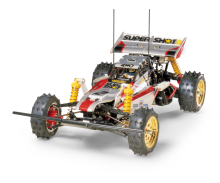
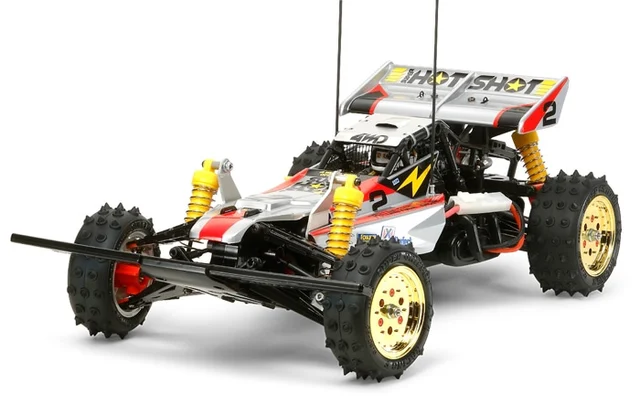
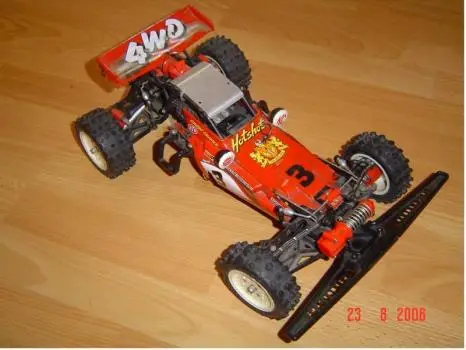
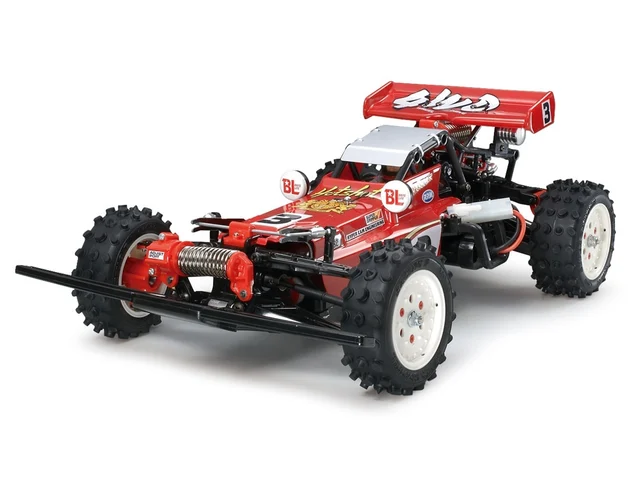
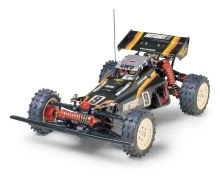
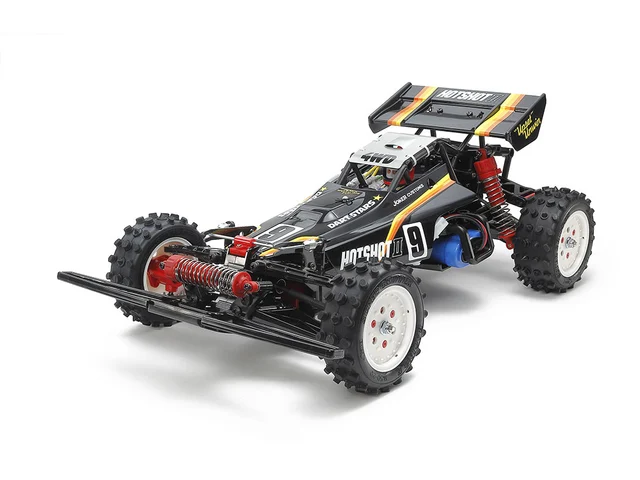
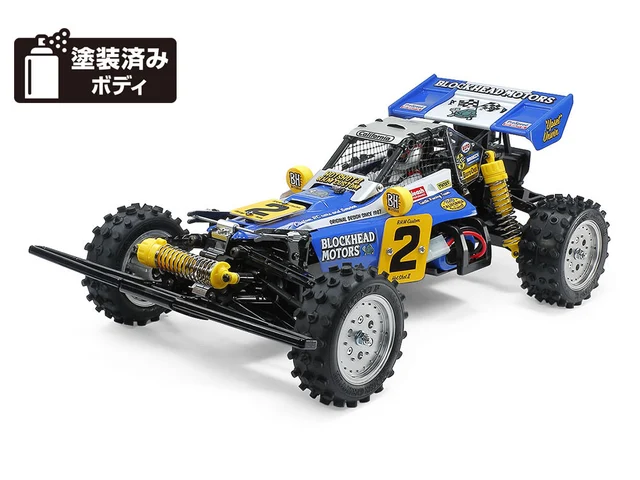
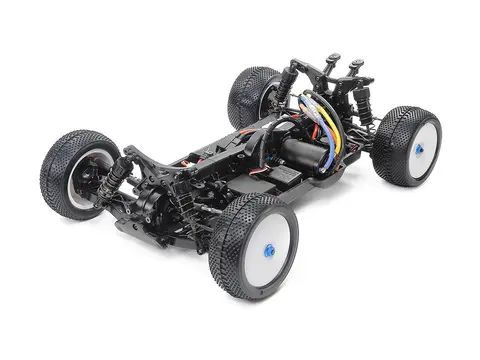
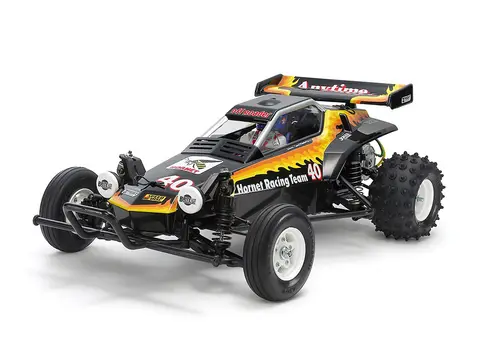
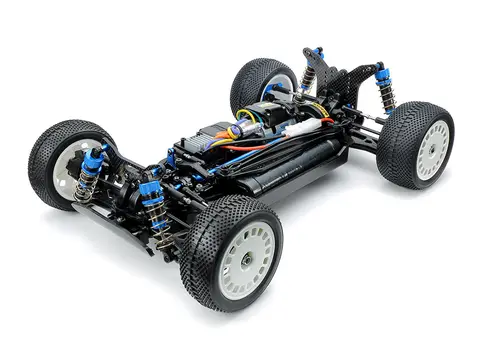
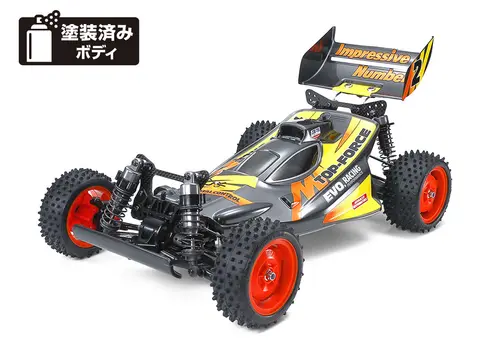
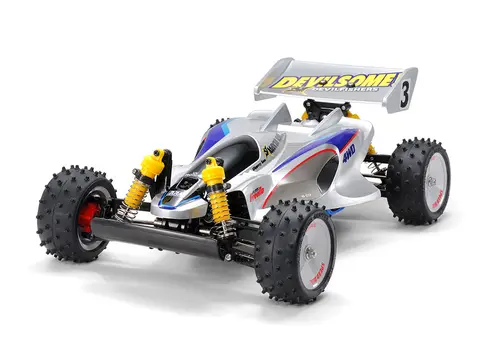
The Supershot arrived in 1986 as the more extensively equipped development of the Hotshot. It kept the same broad shaft-driven four-wheel-drive architecture, but supplied individual oil dampers at all four corners, full ball bearings and a Technipower motor. The silver body and gold-colored wheels made the different specification visible, while the underguard covered more of the chassis beneath it. Factory manual (opens in a new tab)
Read moreShow less
This was a distinct equipment package within Tamiya's early four-wheel-drive range. The individual dampers removed the original Hotshot's front and rear monoshock arrangement, giving each wheel its own shock to assemble and service. That change did not replace the underlying central monocoque and separate gearboxes. A Supershot still presents the same kind of compact radio packaging and an involved mechanical build. Factory manual (opens in a new tab)
Historic restoration reports emphasize the importance of the original motor, body and plated wheels when buying an incomplete example. They also describe the care needed around front suspension parts and the time involved in getting a used chassis back together. The condition and completeness of these components help determine the work a restoration needs. A complete, sound example can be a better starting point than one assembled around a few surviving signature parts. Model history (opens in a new tab)
The later Super Hotshot (2012) is a revised return of this design with a different named motor and updated drive components. Keep the original 58054 and modern 58517 equipment separate when ordering parts. For an original runner, service the bearings and dampers already supplied, inspect the drive joints and retain the correct spacers for the chosen pinion. Adding more metal or power before these checks risks paying for changes that leave the actual problem untouched. Factory manual (opens in a new tab)
The kind of vehicle the maker sells it as. It sets what the car is built to do and which cars it is fair to compare it with.
Buggies are low, light off-road cars built for jumps and fast corners on dirt, clay or turf tracks.
Drive
All four wheels are driven. That gives more grip under power, especially on loose ground.
The cost is more parts to maintain.
Power
A brushed motor carries current through carbon brushes that rub on the commutator.
It is cheaper and smooth at low speed.
The brushes wear and the motor loses power over time.
Build
A kit you build yourself from parts.
Most kits come without motor, ESC, servo, radio and battery, and many without tires or a painted body.
The manual lists what to add.
Scale
The maker's nominal size compared with a full-size vehicle. It works more as a class label than a measurement.
A 1/10 monster truck is far bigger than a 1/10 touring car, so compare length and weight for real size.
This one is 390 mm long.
Part number
The maker's product number for this exact version.
A V2, a new color, or a kit instead of an RTR usually has a different number, and parts can differ between them.
Check it against your box or receipt before ordering parts.
Class
Buggy
Drive
4WD
Power
Brushed
Build
Kit
Scale
1/10
Part number
58054
Drivetrain
Pinion
The small gear on the motor shaft. Fewer teeth gear the car shorter: quicker acceleration, lower top speed and a cooler motor. More teeth do the opposite.
It depends on the motor you fit, so the maker does not list one.
Spur
The large gear the pinion drives. A bigger spur with the same pinion gears the car shorter.
Pinion and spur must have the same pitch, or tooth size, to mesh.
Axle drive, front
Whether the front axle is driven by the motor.
The calculator uses this axle's own tire size and complete recorded gear path.
Axle drive, rear
Whether the rear axle is driven by the motor.
The calculator uses this axle's own tire size and complete recorded gear path.
Transmission & axle, front
Every reduction after the spur, multiplied together: transmission, differentials and axle gears.
It is fixed by the design; the gearing you change is the pinion and spur.
Transmission & axle, rear
Every reduction after the spur, multiplied together: transmission, differentials and axle gears.
It is fixed by the design; the gearing you change is the pinion and spur.
Final drive, front
How many times the motor turns for one turn of the wheels. A higher number is shorter gearing: more acceleration and pulling power, less top speed.
Final drive, rear
How many times the motor turns for one turn of the wheels. A higher number is shorter gearing: more acceleration and pulling power, less top speed.
Axle coupling
How the driven axles are connected.
The coupling has not been established from a source. It is not inferred from 4WD or from the axle differentials.
Pinion
Not published
Spur
Not published
Axle drive, front
DrivenStock
Stock
Axle drive, rear
DrivenStock
Stock
Transmission & axle, front
Not published
Transmission & axle, rear
Not published
Final drive, front
Not published
Final drive, rear
Not published
Axle coupling
Not published
Wheels & tires
Tire diameter
The outside diameter of the mounted tire, tread to tread. A taller tire covers more ground each turn, which gears the car taller.
This figure is not from the maker's documents, so treat it as close rather than exact.
Race tires wear down over a day, and a smaller tire gears the car shorter.
Tire width, front
The outside width of the stock tire on the front axle.
Width and outside diameter are separate measurements; neither is the wheel's bead diameter.
Tire width, rear
The outside width of the stock tire on the rear axle.
Width and outside diameter are separate measurements; neither is the wheel's bead diameter.
Stock tire width
Stock tire width: A documented stock wheel, tire, or axle measurement. Stock dimensions alone do not establish the largest size that will clear the body and suspension.
Rollout, front
Distance at the front axle per motor turn through its recorded gear path.
This follows the listed gear reduction and tire diameter; it does not account for tire slip or deflection.
The selected axle has missing tire or gearing inputs.
Rollout, rear
Distance at the rear axle per motor turn through its recorded gear path.
This follows the listed gear reduction and tire diameter; it does not account for tire slip or deflection.
The selected axle has missing tire or gearing inputs.
What the main chassis is made of and how it is built, as stated for this car. Braces, stiffeners and skid plates are not counted.
Composite is the makers' word for molded plastic, usually nylon with glass or other fibers: it flexes and shrugs off hits, and it is light and cheap to replace.
This is from one outside source, not the maker's own page.
The rollout difference needs both tire diameters and axle reductions. The connection between axle inputs is not recorded, so its ability to accommodate a mismatch is unknown. These figures do not predict vehicle road speed.
Stock is as the vehicle ships.
Calculated is worked from the stock figures on this page rather than stored beside them, so the two cannot drift apart.
Single report uses one outside source. It is useful as a starting figure, with the source and calculation described in the note.
Not published means it exists but no source we could find prints it.
Build and setup
Factory setup guide for this configuration.
An original Supershot already supplied ball bearings and four oil dampers. Inspect and service that equipment before buying a generic bearing or shock upgrade package. Check worn wheel shafts, front upright joints and damper seals individually, keeping the period Technipower motor and plated wheels identified if they are part of the restoration.[1] Tamiya 58054 exact-edition instructions (opens in a new tab)
Use the exact original motor-position and pinion arrangement. The gearbox and its spacers must agree with the chosen gear, and the center drive must turn freely after assembly. Extra power is not a substitute for removing binding or setting the steering travel correctly.[1] Tamiya 58054 exact-edition instructions (opens in a new tab)
Read moreRead less about build and setup for Supershot (1986)
The original mechanical controller, resistor and receiver-power arrangement need their own checks. A modern ESC conversion changes the electrical requirements without changing the age and condition of the chassis. Choose a battery from the fitted controller's specification and measure its packaging before purchase; the period 7.2V NiCd reference is not a modern cell-count approval.[1] Tamiya 58054 exact-edition instructions (opens in a new tab)
Keep the original and 2012 rear drive parts separate when ordering replacements. Tamiya updated drive components and changed the named motor in the rerelease. A bag bearing the same family name is a lead to check against the diagrams, rather than evidence that every original assembly should be replaced with it.[1] Tamiya 58054 exact-edition instructions (opens in a new tab)
Forums & communities
TamiyaClub
Exact original edition; historical experience is distinct from current component availability.
122 collected part numbers. Collected . Unmarked parts are recorded listings, without a claim about factory installation; optional and upgrade listings are tagged. Key assemblies include recorded gear and shock identifiers. Open a part for its listing sources.
Assembly diagrams 7 views
About these specs
Original 58054 edition; later rerelease specifications are kept separate.
Read moreShow less
The retained factory instructions describe period mechanical speed control and NiCd batteries.
Motor Kv and a modern LiPo cell rating remain unknown.
Original-edition size and tire figures are a single historical TamiyaClub reference; front and rear tire sizes remain distinct.
Hotshot family. Shaft-driven four-wheel-drive buggies developed from the Hotshot architecture. Monoshock, four-damper and Hotshot II suspension layouts differ; remake joints, electronics and custom upper parts also vary. Source (opens in a new tab)