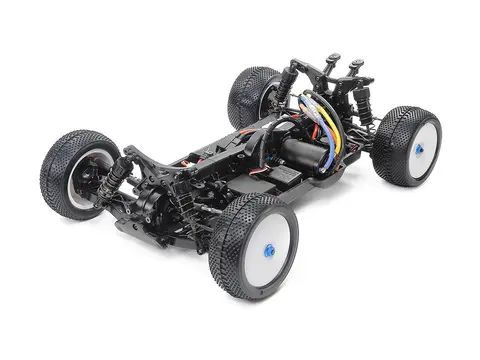
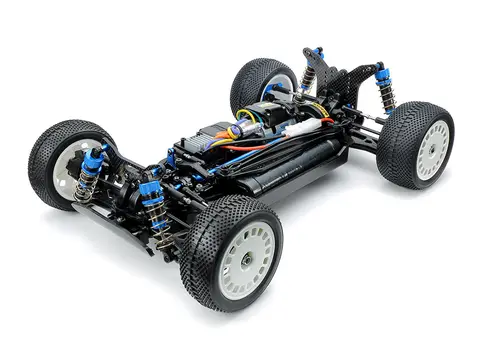
- Chassis
What the main chassis is made of and how it is built, as stated for this car. Braces, stiffeners and skid plates are not counted. - Carbon fiber is light and stiff, and costs more; edges can chip in a crash.
- Shocks
What the shocks are and how they are built, as the maker describes them. - Oil-filled shocks damp with silicone oil; friction shocks, found on some entry-level cars, damp with a sprung plunger and cannot be tuned with oil.
- Shock bore, front
The inside diameter of the shock body, where the piston moves through oil. - It is a shock measurement, separate from the motor pinion bore. Match the actual shock part when ordering pistons, seals or a replacement body.
- Shock bore, rear
The same measure at the rear, which differs from the front on this car. - Shock length, front
The stated length of the complete shock assembly. Sources may use mounting-eye centers or a nominal assembly length. - Compare fully extended mounting-eye spacing, compressed length and mounting hardware before ordering. A longer shock changes ride height and travel, and can bind at full droop or bottom out.
- This length is from one outside source. Check the linked listing and measure the fitted shocks before buying.
- Shock length, rear
The same measure at the rear, which differs from the front on this car. - Longer rear shocks are common: they give the rear more travel for landings and put power down over rough ground.
- Shock stroke, front
How far the shaft travels from fully extended to fully compressed. - More stroke means more suspension travel, which soaks up bigger bumps and landings.
- Shock stroke, rear
The same measure at the rear, which differs from the front on this car. - Shock oil
The oil in the shocks slows how fast the suspension moves. Thicker oil settles the car more slowly and resists bottoming out; thinner oil lets the wheels follow bumps. - Front and rear run the same oil on this car, so both ends respond alike. Changing one end at a time is the usual way to shift the balance.
- This is the maker's printed oil grade. Its viscosity unit has not been established, so it is not presented as cSt or cps. Grade numbers alone do not establish equivalent oils or relative thickness.
|