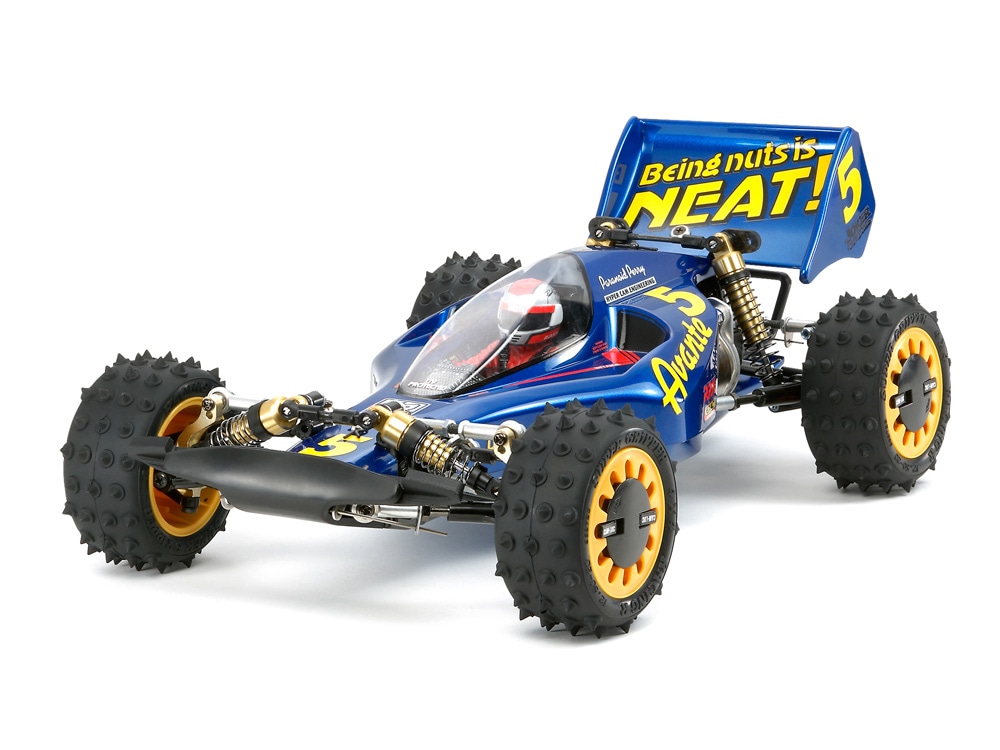
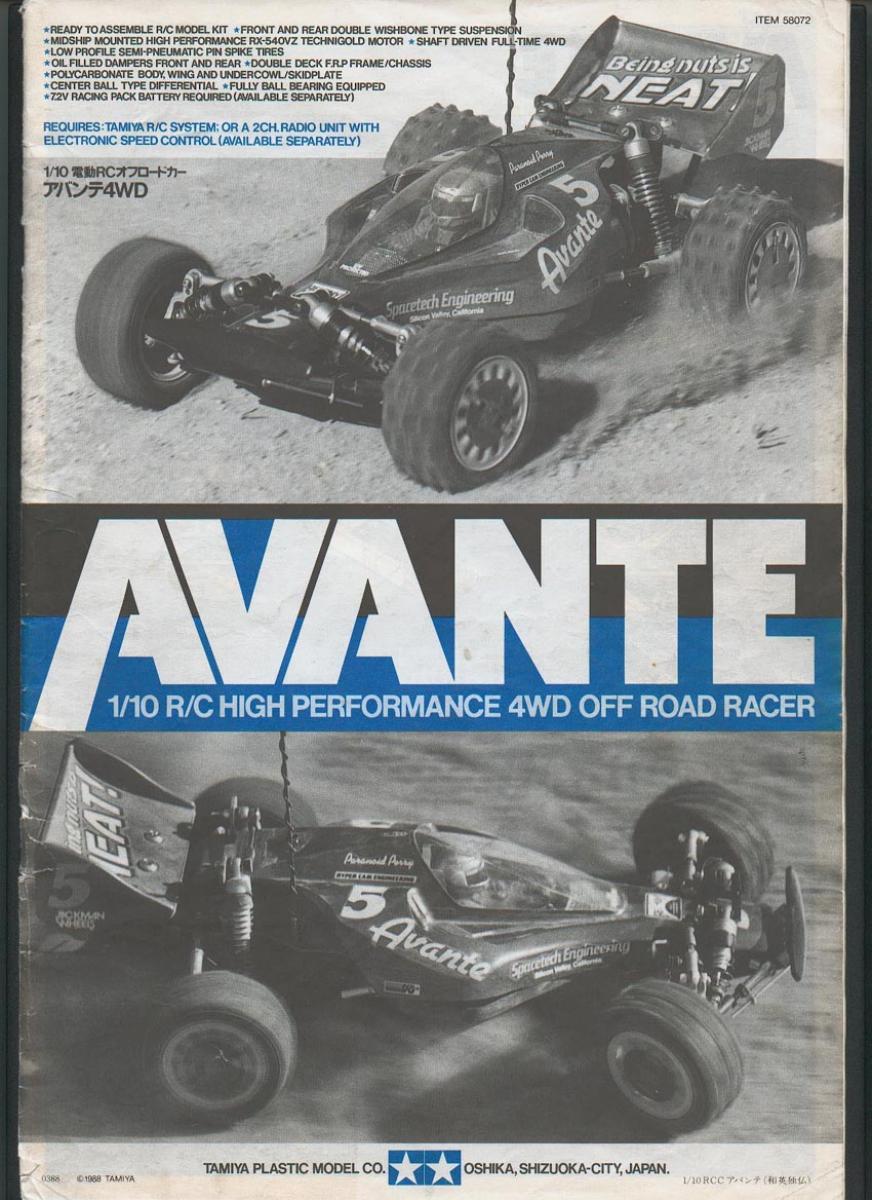
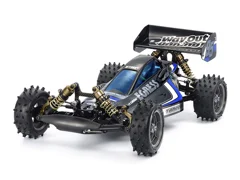
The Avante (2011) brings back Tamiya's ambitious 1988 four-wheel-drive buggy with a carefully revised mechanical specification. The original was conceived with major competition in mind, combining an unusually intricate chassis with an equally distinctive low body and cam-lock wheels. The rerelease preserves that identity while addressing materials, durability and service access. It first appeared in January 2011; later production dates on the maker's page describe further runs of the same 58489 kit.
Read moreShow less
The attraction is a chance to build this particular engineering project with updated factory parts, rather than to turn it into a conventional current race buggy. Exact 58489 design and equipment (opens in a new tab)
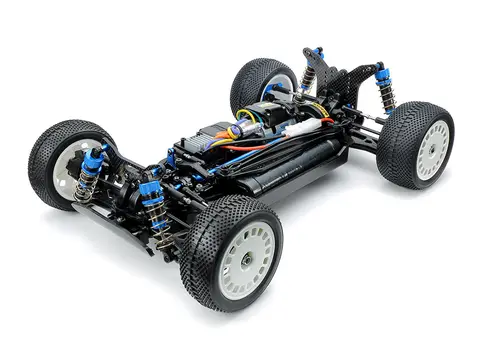
Upper and lower decks are now 2 mm carbon, with a 3.5 mm carbon rear damper stay. Machined aluminum uprights and assembly universal shafts update important suspension and driveline details. The layout still has front and rear planetary differentials and a center ball differential, with 23 ball bearings supporting the drivetrain. Gearbox inspection hatches permit maintenance without removing the complete gearboxes. Adjustable metal suspension links, radius-arm impact protectors and metal-bodied oil dampers provide plenty to set up before optional parts enter the picture. The Japanese specification includes a 25-turn motor, with an electronic controller selected separately. Exact 58489 design and equipment (opens in a new tab)
This combination makes assembly quality and restrained power useful ownership choices. A correctly built center differential, free steering and properly oriented suspension arms allow the chassis to do what its unusual layout was intended to do. The existing bearings, universals and machined uprights should not be mistaken for missing upgrades. Changes such as a revised steering system or modern wheels have their own clearance and matching-parts requirements. Keeping the standard layout as a recorded baseline preserves both its historical character and the ability to tell whether a later modification actually suits the way the car is used. Exact 58489 design and equipment (opens in a new tab)
The kind of vehicle the maker sells it as. It sets what the car is built to do and which cars it is fair to compare it with.
Buggies are low, light off-road cars built for jumps and fast corners on dirt, clay or turf tracks.
Drive
All four wheels are driven. That gives more grip under power, especially on loose ground.
The cost is more parts to maintain.
Build
A kit you build yourself from parts.
Most kits come without motor, ESC, servo, radio and battery, and many without tires or a painted body.
The manual lists what to add.
Scale
The maker's nominal size compared with a full-size vehicle. It works more as a class label than a measurement.
A 1/10 monster truck is far bigger than a 1/10 touring car, so compare length and weight for real size.
This one is 420 mm long.
Part number
The maker's product number for this exact version.
A V2, a new color, or a kit instead of an RTR usually has a different number, and parts can differ between them.
Check it against your box or receipt before ordering parts.
Class
Buggy
Drive
4WD
Build
Kit
Scale
1/10
Part number
58489
Drivetrain
Pinion
The small gear on the motor shaft. Fewer teeth gear the car shorter: quicker acceleration, lower top speed and a cooler motor. More teeth do the opposite.
On this car one tooth changes the gearing by about 4.5%.
Racers change the pinion to suit the track and the class's motor rules, and often compare setups by rollout rather than tooth count.
Spur
The large gear the pinion drives. A bigger spur with the same pinion gears the car shorter.
Pinion and spur need matching pitch, or explicit manufacturer confirmation that the exact gears are compatible.
The Gearing parts table below shows this car's pitch and part numbers.
Transmission & axle
Every reduction after the spur, multiplied together: transmission, differentials and axle gears.
It is fixed by the design; the gearing you change is the pinion and spur.
This one is worked out from the tooth counts the maker publishes.
Spur ÷ pinion
Spur teeth divided by pinion teeth: the part of the gearing that a pinion or spur swap changes.
Here it is 3.000:1.
Final drive
How many times the motor turns for one turn of the wheels. A higher number is shorter gearing: more acceleration and pulling power, less top speed.
Among 1/10 buggies in the catalog, the middle half run between 8.1:1 and 9.5:1 on stock gearing; this one is 8.3:1.
Differentials
The type of each differential, as the maker states it.
A gear or ball diff lets the wheels on one axle turn at different speeds in a corner; a spool or locked diff turns them together for straight-line drive and climbing, at the cost of steering.
Pinion bore
The nominal size of the hole that mates with the motor shaft.
Match the pinion mounting method as well as its size. A press-fit hole cannot be inferred from motor shaft diameter.
Pinion pitch
The tooth spacing of the fitted gear, stated as metric module or diametral pitch.
Pinion and spur need matching pitch or explicit manufacturer confirmation of compatibility for the exact parts. Mod 0.8 and 32P are different standards; a compatibility statement for particular gears does not apply to every gear. A missing pitch can be inferred from the other fitted gear; module and diametral pitch are not silently converted.
Spur pitch
The tooth spacing of the fitted gear, stated as metric module or diametral pitch.
Pinion and spur need matching pitch or explicit manufacturer confirmation of compatibility for the exact parts. Mod 0.8 and 32P are different standards; a compatibility statement for particular gears does not apply to every gear. A missing pitch can be inferred from the other fitted gear; module and diametral pitch are not silently converted.
The outside diameter of the mounted tire, tread to tread. A taller tire covers more ground each turn, which gears the car taller.
Race tires wear down over a day, and a smaller tire gears the car shorter.
Rollout
How far the car moves for one turn of the motor: tire circumference divided by final drive.
It lets you compare gearing across different tire sizes; more rollout is taller gearing.
Here it is 33.2 mm.
Wheel hex
The hex on the axle that the wheel locks onto and is driven by. A wheel must match the hex size to fit.
12 mm is the common size on 1/10 cars, so most 1/10 wheels fit; offset and width still vary.
The wheel nut is a separate size, so check its thread too before buying nuts.
Stock tire width
Stock tire width: A documented stock wheel, tire, or axle measurement. Stock dimensions alone do not establish the largest size that will clear the body and suspension.
Stock wheel diameter
Stock wheel diameter: A documented stock wheel, tire, or axle measurement. Stock dimensions alone do not establish the largest size that will clear the body and suspension.
What the shocks are and how they are built, as the maker describes them.
Oil-filled shocks damp with silicone oil; friction shocks, found on some entry-level cars, damp with a sprung plunger and cannot be tuned with oil.
Shock oil
The oil in the shocks slows how fast the suspension moves. Thicker oil settles the car more slowly and resists bottoming out; thinner oil lets the wheels follow bumps.
Front and rear run the same oil on this car, so both ends respond alike. Changing one end at a time is the usual way to shift the balance.
This is the maker's printed oil grade. Its viscosity unit has not been established, so it is not presented as cSt or cps. Grade numbers alone do not establish equivalent oils or relative thickness.
Calculated final drive ratio for each pinion and spur pair
Pinion
64T spur
66T spur
68T spur
20T
21T
22T
23T
24T
25T
Select a pair to compare wheel travel per motor turn with stock. Other cells are mathematical examples, not verified gears or fits. Check pitch, mesh, clearance and motor temperature before changing parts.
About these specs
Tamiya publishes 'Gear Ratio: 8.33:1' and 'Tire Width/Diameter 38/88mm'.
Read moreShow less
The manual fits a 22T pinion (PB2, sold as the 22T and 23T set 50357); no spur tooth count is printed, so the spur and the transmission and axle ratio are left blank.
The included motor is a brushed Type 540 (25T); a turn count cannot be converted to KV.
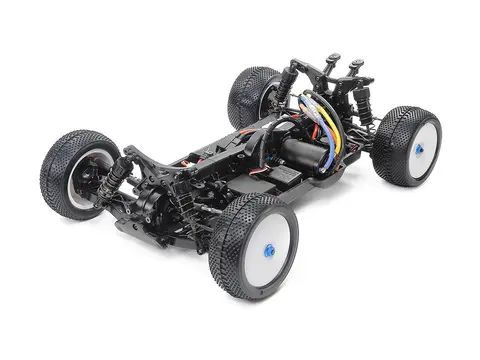
Carbon double-deck shaft-driven 4WD.
Unassembled kit with no battery; the motor is brushed, its Kv remains unknown and cell count does not apply.
How to read these figures
Stock is as the vehicle ships.
Calculated is worked from the recorded figures on this page.
Derived uses recorded dimensions or arithmetic. The row explains the inference. A nominal mating size is not a measured tolerance or a complete fitment guarantee.
Single report uses one outside source. It is useful as a starting figure, with the source and calculation described in the note.
Not applicable means the vehicle does not come with it, like the motor on a roller or the tires on a race kit.
Not published means it exists but no source we could find prints it.
Instruction manual (Tamiya PDF) (opens in a new tab)tamiya.comPDFSupports 6 specifications22T pinion PB2, step 2, p. 4; parts list Gear bag BG and blister pack B, p. 29Used forMain specsGearingMotor shaftBattery fitFluidsDrivetrain
Checked task pages, documented requirements and recorded fluid references for this model. Follow the manufacturer's procedure for the exact assembly and revision.
Maintenance bundles
Manual pages, documented requirements and relevant specifications, together by task.
No separate parts, tools or prerequisites have been indexed for this task. Read the cited reference before starting.
This is a partial service reference. Check the cited instructions for the full procedure and configuration-specific requirements. Mechanical tasks may need additional parts, quantities and reused hardware beyond the items listed here. Manual reviewed 2026-10-09.
DrivetrainReference
Kit drivetrain
Avante (2011) kit 58489; exact 32-page manufacturer PDF edition
Manufacturer cleaning and grease maintenance reference for the suspension, gears and drivetrain. No fixed replacement interval is specified.
No separate parts, tools or prerequisites have been indexed for this task. Read the cited reference before starting.
This is a partial service reference. Check the cited instructions for the full procedure and configuration-specific requirements. Mechanical tasks may need additional parts, quantities and reused hardware beyond the items listed here. Manual reviewed 2026-10-10.
Steering servoReference
Steering servo installation
Avante (2011) kit 58489; exact 32-page manufacturer PDF edition
Servo neutral-position check, horn/linkage and mounting reference. This is chassis installation, not radio binding or internal servo rebuilding.
No separate parts, tools or prerequisites have been indexed for this task. Read the cited reference before starting.
This is a partial service reference. Check the cited instructions for the full procedure and configuration-specific requirements. Mechanical tasks may need additional parts, quantities and reused hardware beyond the items listed here. Manual reviewed 2026-10-10.
Common numbers cover selected core components, not every part. A shared family, manual or listing does not mean the parts fit both vehicles. Check the comparison and upgrade notes before ordering.
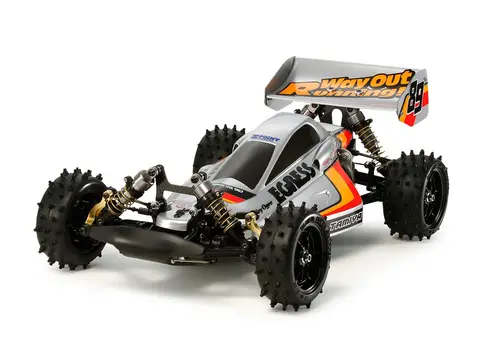
Avante / Egress racing lineage. Egress was the racing development of the original Avante. These catalog rows are separate modern reissues, with different differential and chassis specifications. Source (opens in a new tab)