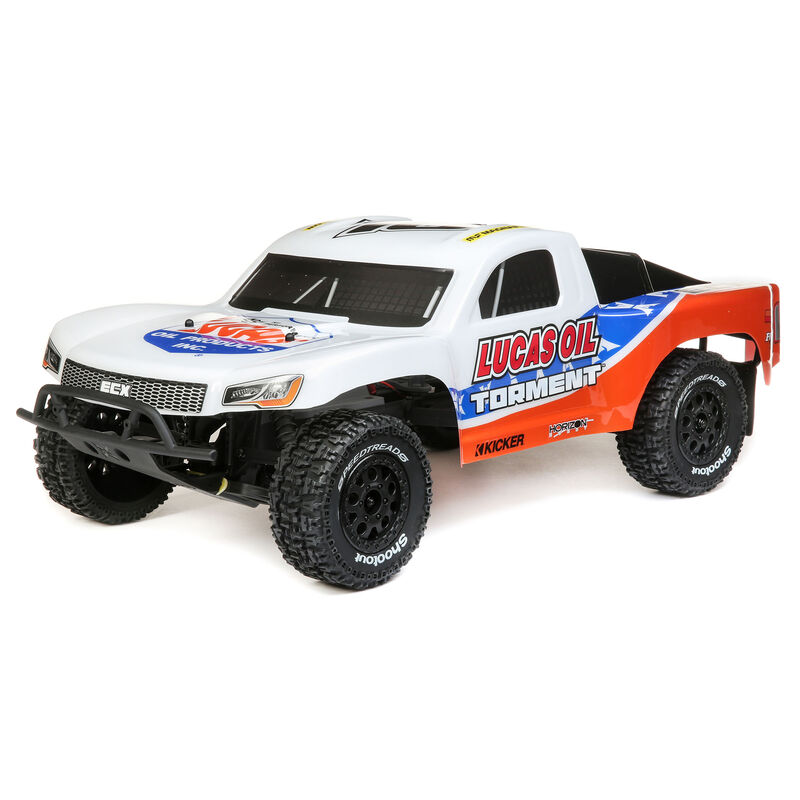
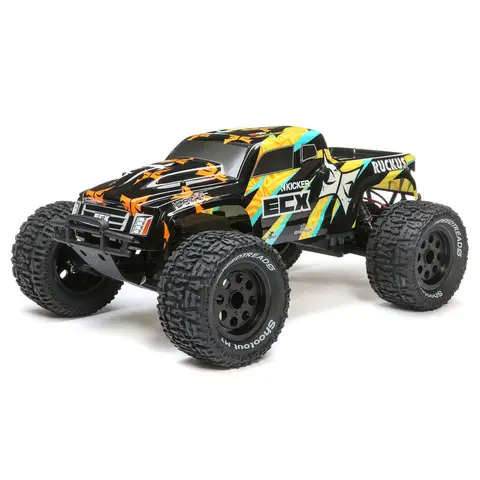
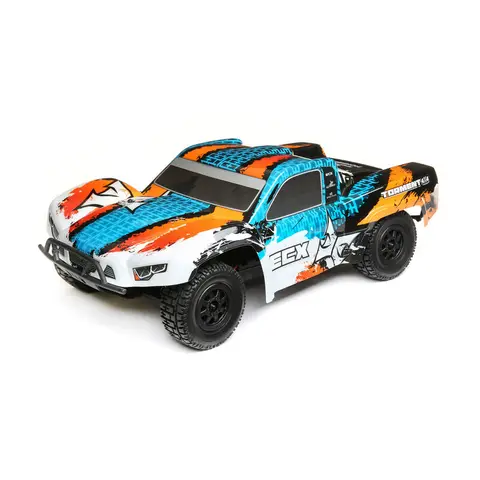
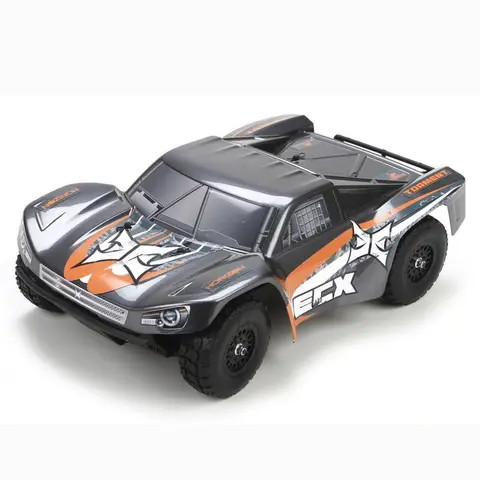
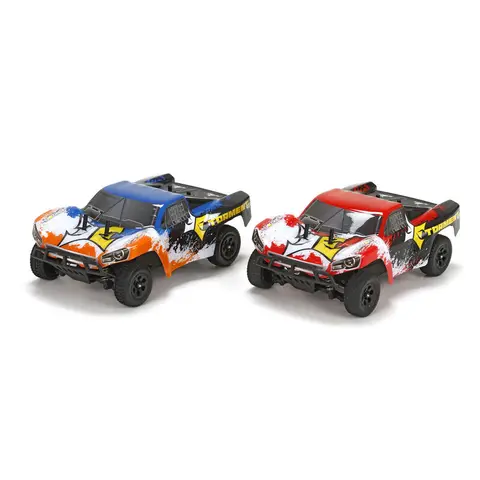
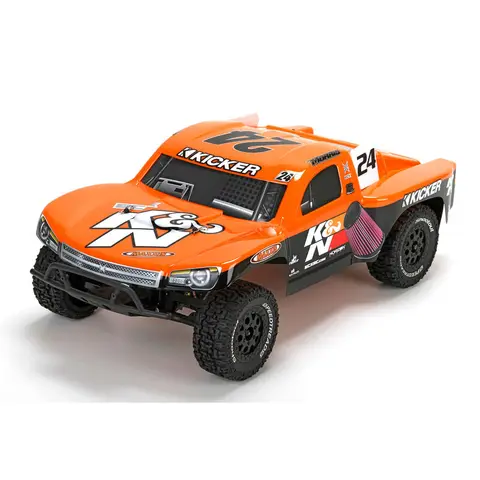
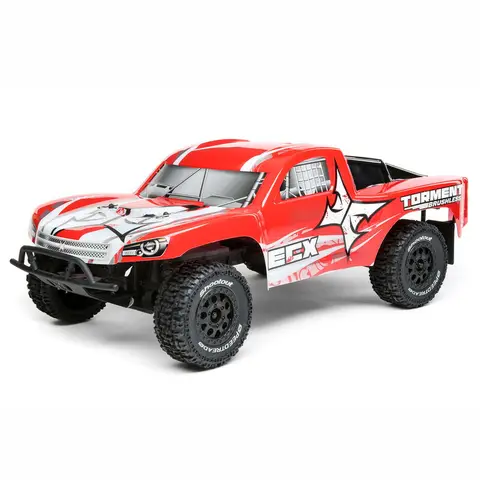
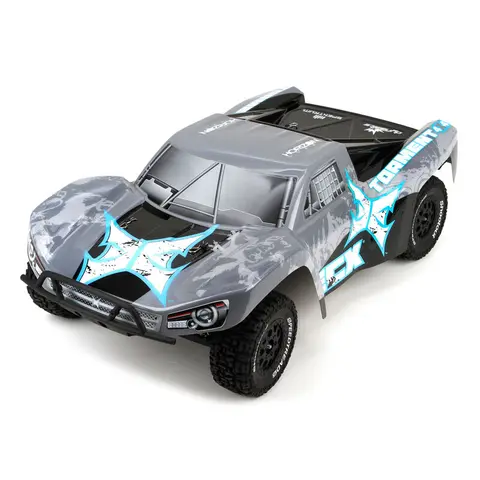
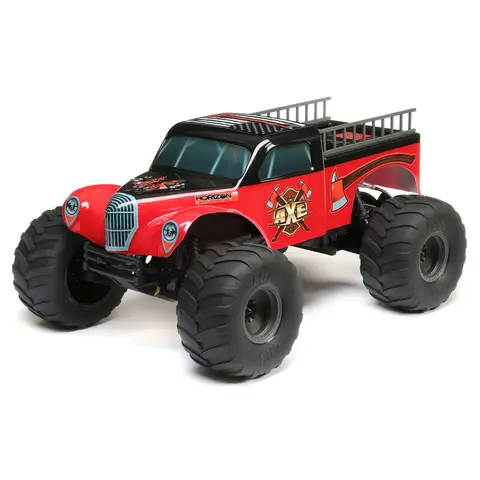
The brushed Torment 2WD gives ECX's rear-driven platform a short-course body and ready-to-run equipment. Its off-road truck shape suits an owner who wants a complete starting vehicle for a small course, with steering and traction to learn before adding output. Sound original hardware can remain the center of that ownership experience. Model and background reference (opens in a new tab)
Read moreShow less
The Torment 2WD is the 15-turn brushed version with a 60A controller and separate SRX200 receiver. That electrical arrangement differs from a combined-unit AMP and from factory brushless or four-wheel-drive Torments. A later motor-and-controller choice can therefore be planned around retaining suitable existing controls. Model and background reference (opens in a new tab)
Cons
The RTR package needs a separate 2S LiPo or 6 to 7 cell NiMH pack and charger, which are not included.1
The kind of vehicle the maker sells it as. It sets what the car is built to do and which cars it is fair to compare it with.
Short course trucks copy full-size desert race trucks, with bodies that cover the wheels so they can bump each other without tangling.
Drive
Only one axle is driven, the rear on almost every 2WD RC car.
It is lighter and simpler, and it takes more throttle control on loose ground.
Power
A brushed motor carries current through carbon brushes that rub on the commutator.
It is cheaper and smooth at low speed.
The brushes wear and the motor loses power over time.
Build
Ready to run: built at the factory with the electronics installed.
Some come without a battery or charger; the maker's box contents say which.
Scale
The maker's nominal size compared with a full-size vehicle. It works more as a class label than a measurement.
A 1/10 monster truck is far bigger than a 1/10 touring car, so compare length and weight for real size.
This one is 507 mm long.
Part number
The maker's product number for this exact version.
A V2, a new color, or a kit instead of an RTR usually has a different number, and parts can differ between them.
Check it against your box or receipt before ordering parts.
Class
Short course
Drive
2WD
Power
Brushed
Build
Ready to run
Scale
1/10
Part number
ECX03433
Drivetrain
Pinion
The small gear on the motor shaft. Fewer teeth gear the car shorter: quicker acceleration, lower top speed and a cooler motor. More teeth do the opposite.
On this car one tooth changes the gearing by about 5.3%.
A bigger pinion loads the motor and ESC harder, so check the maker's gearing chart and feel the motor temperature after a run.
Spur
The large gear the pinion drives. A bigger spur with the same pinion gears the car shorter.
Pinion and spur need matching pitch, or explicit manufacturer confirmation that the exact gears are compatible.
The Gearing parts table below shows this car's pitch and part numbers.
Transmission & axle
Every reduction after the spur, multiplied together: transmission, differentials and axle gears.
It is fixed by the design; the gearing you change is the pinion and spur.
Spur ÷ pinion
Spur teeth divided by pinion teeth: the part of the gearing that a pinion or spur swap changes.
Here it is 4.579:1.
Final drive
How many times the motor turns for one turn of the wheels. A higher number is shorter gearing: more acceleration and pulling power, less top speed.
Among 1/10 short course trucks in the catalog, the middle half run between 10.2:1 and 12.1:1 on stock gearing; this one is 11.9:1.
Differentials
The type of each differential, as the maker states it.
A gear or ball diff lets the wheels on one axle turn at different speeds in a corner; a spool or locked diff turns them together for straight-line drive and climbing, at the cost of steering.
Slipper clutch
A slipper clutch sits on the spur gear and slips under a sudden load, a hard landing or full throttle on grip, to protect the gears.
Set it too loose and it wastes power; too tight and it protects nothing.
Hub bearing size
Hub bearing size: The documented drivetrain connection or size for this exact model. Match the mating component before buying a replacement.
Pinion bore
The nominal size of the hole that mates with the motor shaft.
A nominal shaft fit comes from the exact replacement pinion listing. It does not specify a measured finished hole or manufacturing tolerance.
Match the pinion mounting method as well as its size. A press-fit hole cannot be inferred from motor shaft diameter.
Pinion pitch
The tooth spacing of the fitted gear, stated as metric module or diametral pitch.
Pinion and spur need matching pitch or explicit manufacturer confirmation of compatibility for the exact parts. Mod 0.8 and 32P are different standards; a compatibility statement for particular gears does not apply to every gear. A missing pitch can be inferred from the other fitted gear; module and diametral pitch are not silently converted.
Spur pitch
The tooth spacing of the fitted gear, stated as metric module or diametral pitch.
Pinion and spur need matching pitch or explicit manufacturer confirmation of compatibility for the exact parts. Mod 0.8 and 32P are different standards; a compatibility statement for particular gears does not apply to every gear. A missing pitch can be inferred from the other fitted gear; module and diametral pitch are not silently converted.
The outside diameter of the mounted tire, tread to tread. A taller tire covers more ground each turn, which gears the car taller.
At high speed tires can balloon and grow, so the real gearing gets taller as the car goes faster.
Rollout
How far the car moves for one turn of the motor: tire circumference divided by final drive.
It lets you compare gearing across different tire sizes; more rollout is taller gearing.
Here it is 28.8 mm.
Wheel hex
The hex on the axle that the wheel locks onto and is driven by. A wheel must match the hex size to fit.
12 mm is the common size on 1/10 cars, so most 1/10 wheels fit; offset and width still vary.
The wheel nut is a separate size, so check its thread too before buying nuts.
Stock wheel width
Stock wheel width: A documented stock wheel, tire, or axle measurement. Stock dimensions alone do not establish the largest size that will clear the body and suspension.
Axle thread
Axle thread: A documented stock wheel, tire, or axle measurement. Stock dimensions alone do not establish the largest size that will clear the body and suspension.
This working size comes from a replacement advertised for the identified OEM part. Confirm the fitted part before ordering; a replacement's size may differ.
Stock wheel diameter
Stock wheel diameter: A documented stock wheel, tire, or axle measurement. Stock dimensions alone do not establish the largest size that will clear the body and suspension.
What the main chassis is made of and how it is built, as stated for this car. Braces, stiffeners and skid plates are not counted.
Composite is the makers' word for molded plastic, usually nylon with glass or other fibers: it flexes and shrugs off hits, and it is light and cheap to replace.
Shocks
What the shocks are and how they are built, as the maker describes them.
Oil-filled shocks damp with silicone oil; friction shocks, found on some entry-level cars, damp with a sprung plunger and cannot be tuned with oil.
The shaft size matters when buying seals, ends and rebuild kits.
Shock bore
The inside diameter of the shock body, where the piston moves through oil.
It is a shock measurement, separate from the motor pinion bore. Match the actual shock part when ordering pistons, seals or a replacement body.
Shock length, front
The stated length of the complete shock assembly. Sources may use mounting-eye centers or a nominal assembly length.
Compare fully extended mounting-eye spacing, compressed length and mounting hardware before ordering. A longer shock changes ride height and travel, and can bind at full droop or bottom out.
This length is from owners' measurements that agree, not from the maker.
Shock length, rear
The same measure at the rear, which differs from the front on this car.
Longer rear shocks are common: they give the rear more travel for landings and put power down over rough ground.
Spring
The stock springs, in the maker's own wording: a color, a rate or a length.
A stiffer spring holds the car up and resists bottoming out; a softer one lets it squat and follow rough ground.
Rates are not comparable across makers unless they state the same unit.
Oil-filledcomposite body, 3 mm shaft, front and rear; Nominal 3 mm shaft fit inferred from the shared original piston/guide and seal stack plus one stock Boost shaft measurement. Not a direct ECX diameter rating or an interchangeability claim for different-length rods.Single report
10mm, front and rear; Approximate 10 mm working bore based on a 9.9 mm measurement of the shared stock piston. Body diameter and taper were not measured.Single report
Catalog stock FDR: 11.90:1. The grid uses the listed tooth counts and internal ratio, so rounding or source differences may change the result slightly.
Calculated final drive ratio for each pinion and spur pair
Pinion
85T spur
87T spur
89T spur
17T
18T
19T
20T
21T
22T
Select a pair to compare wheel travel per motor turn with stock. Other cells are mathematical examples, not verified gears or fits. Check pitch, mesh, clearance and motor temperature before changing parts.
About these specs
Horizon's spec table prints a 19T pinion, an 87T spur and a 4.3in (109.2mm) outer tire diameter.
Read moreShow less
The transmission and diff ratio of 2.6 is the figure Horizon prints for this family of ECX 1/10 2WD trucks (the Ruckus and Torment 2WD Brushless pages and the AMP MT kit page, where 18T on 87T is printed as a 12.6 total); this truck's manual lists the same ECX1022 transmission gear set, which Horizon sells as the gear set for all ECX 1/10 2WD models.
The total is worked out as 87/19 x 2.6 = 11.91.
The manual rates the 60A ESC for 2 to 3S LiPo or 5 to 9 cell NiMH.
The motor is a Dynamite 15T brushed 540, which has no supported published Kv rating.
The fitted pinion’s nominal shaft fit is 3.175 mm.
How to read these figures
Stock is as the vehicle ships.
Calculated is worked from the recorded figures on this page.
Derived from replacement part uses the listed dimensions of a replacement advertised for the identified OEM part. Treat it as an approximate working size; the factory-fitted part may differ. Calculated performance uses that approximation.
Single report uses one outside source. It is useful as a starting figure, with the source and calculation described in the note.
Community uses independent outside reports that agree.
Not published means it exists but no source we could find prints it.
Owner's manual, Torment 2WD (Horizon PDF) (opens in a new tab)horizonhobby.comPDFSupports 10 specificationsGear mesh, p. 8; exploded view Pinion and spur, p. 49; parts list Items 40-42, p. 50Used forMain specsGearingMotor shaftBattery fitFluidsElectronicsDrivetrainSuspensionPowerSteering & radio
Match the installed steering part number before ordering RPM's rigid replacement. Its ECX1028 design removes saver action, with a servo-mounted alternative potentially needing chassis or skid clearance work. Plan that installation as a complete assembly. The original steering remains a useful choice if its response meets the need, with no exact ECX03433 interface established by the related owner thread alone.[3] Exact brushed stock package (opens in a new tab)[2] RPM servo-saver removal caveat (opens in a new tab)
Conversions & shared parts
Metal transmission gear set
This replaces the rear gearbox's original gears with a matched metal set. It is an option when rebuilding the transmission around serviceable housing and bearings, although the discontinued set needs to be obtainable before you start.
Manufacturer-documented option for the specified vehicle configuration.
Common numbers cover selected core components, not every part. A shared family, manual or listing does not mean the parts fit both vehicles. Check the comparison and upgrade notes before ordering.