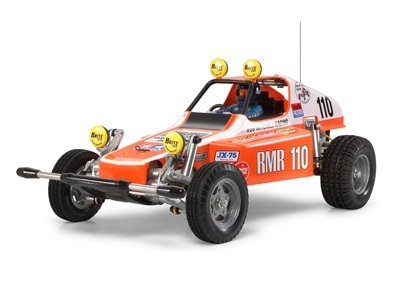
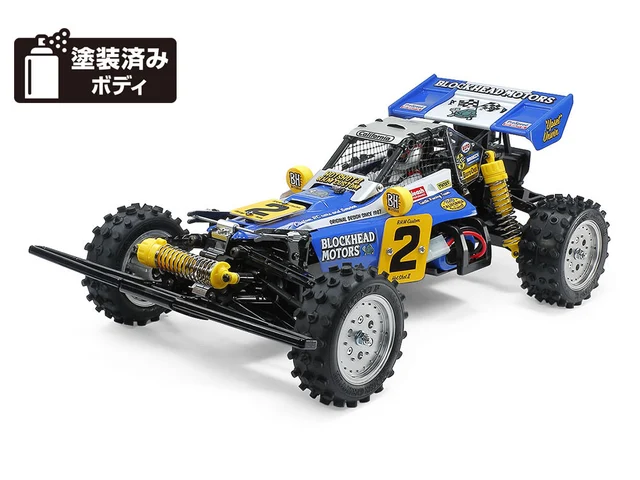
Buggy Champ (2009), known historically as the Rough Rider in some markets, revives Tamiya's 1979 off-road buggy. The revised kit keeps the early car's Baja-inspired shape and mechanical layout, with renewed molds and strengthened details rather than a modern racing chassis under a retro shell. Model details (opens in a new tab).
Read moreShow less
A 2 mm FRP plate and duralumin reinforcement support metal suspension arms, front double trailing arms and rear swing axles. Four oil dampers and a clear electronics enclosure preserve the period-style appearance. The drivetrain is fully ball-raced and has no differential, an important distinction from most later two-wheel-drive buggies. Model details (opens in a new tab).
The motor choice is restricted to the included unit or Tamiya's specified 540J replacement. Its two gear combinations and battery enclosure also deserve attention before planning a faster runner. The original 1979 kit and this revised 2009 model should be treated as separate restoration projects, even where their visible parts look familiar. Model details (opens in a new tab).
The kind of vehicle the maker sells it as. It sets what the car is built to do and which cars it is fair to compare it with.
Buggies are low, light off-road cars built for jumps and fast corners on dirt, clay or turf tracks.
Drive
Only one axle is driven, the rear on almost every 2WD RC car.
It is lighter and simpler, and it takes more throttle control on loose ground.
Power
A brushed motor carries current through carbon brushes that rub on the commutator.
It is cheaper and smooth at low speed.
The brushes wear and the motor loses power over time.
Build
A kit you build yourself from parts.
Most kits come without motor, ESC, servo, radio and battery, and many without tires or a painted body.
The manual lists what to add.
Scale
The maker's nominal size compared with a full-size vehicle. It works more as a class label than a measurement.
A 1/10 monster truck is far bigger than a 1/10 touring car, so compare length and weight for real size.
This one is 400 mm long.
Part number
The maker's product number for this exact version.
A V2, a new color, or a kit instead of an RTR usually has a different number, and parts can differ between them.
Check it against your box or receipt before ordering parts.
Class
Buggy
Drive
2WD
Power
Brushed
Build
Kit
Scale
1/10
Part number
58441
Drivetrain
Pinion
The small gear on the motor shaft. Fewer teeth gear the car shorter: quicker acceleration, lower top speed and a cooler motor. More teeth do the opposite.
It depends on the motor you fit, so the maker does not list one.
Spur
The large gear the pinion drives. A bigger spur with the same pinion gears the car shorter.
Pinion and spur must have the same pitch, or tooth size, to mesh.
Transmission & axle
Every reduction after the spur, multiplied together: transmission, differentials and axle gears.
It is fixed by the design; the gearing you change is the pinion and spur.
Final drive
How many times the motor turns for one turn of the wheels. A higher number is shorter gearing: more acceleration and pulling power, less top speed.
Among 1/10 buggies in the catalog, the middle half run between 7.8:1 and 9.5:1 on stock gearing; this one is 6.5:1, taller than most.
22 collected part numbers. Collected . Unmarked parts are recorded listings, without a claim about factory installation; optional and upgrade listings are tagged. Key assemblies include recorded gear and shock identifiers. Open a part for its listing sources.
About these specs
Revised 2009 Buggy Champ.
Read moreShow less
Manufacturer restricts the motor to the supplied unit or 53689 540J.
Alternative 6.5 and 9.3 ratios require their matching gear combinations; rear tires are 83 mm.