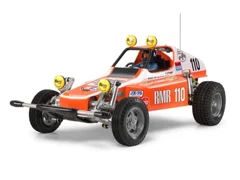
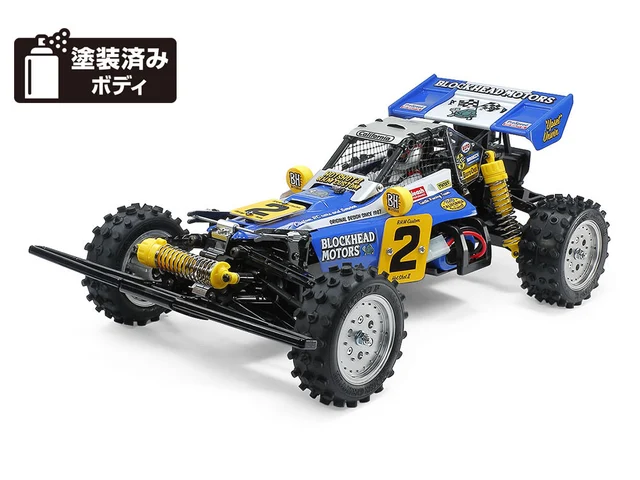
The Rough Rider is the original 1979 Tamiya off-road racing buggy later revisited as Buggy Champ. Its open-wheel shape and scale body draw on the desert-racing buggies described in the factory instructions. The original manual identifies the kit as RA-1015, preserving the early item-number format. Original instructions (opens in a new tab). Rerelease history (opens in a new tab).
Read moreShow less
Its visible metal suspension, enclosed electronics housing and mechanical layout make it a different building experience from later plastic bathtub buggies. The original parts drawing groups the gearbox, dampers, shafts and torsion-bar components for assembly. Those local drawing labels are assembly references, not automatically modern sellable spare-part numbers. Original instructions (opens in a new tab).
A restoration should begin with the original instructions and the condition of the metal and plastic components. The 2009 Buggy Champ revises parts and materials, so a similar appearance is not enough to transfer its full service list or motor restrictions to a 1979 car. Preserve original pieces where possible and verify each replacement against the actual edition. Original instructions (opens in a new tab).
The kind of vehicle the maker sells it as. It sets what the car is built to do and which cars it is fair to compare it with.
Buggies are low, light off-road cars built for jumps and fast corners on dirt, clay or turf tracks.
Drive
Only one axle is driven, the rear on almost every 2WD RC car.
It is lighter and simpler, and it takes more throttle control on loose ground.
Power
Sold without a motor, so you choose the motor, ESC and battery yourself.
Rows that depend on the motor say so.
Build
A kit you build yourself from parts.
Most kits come without motor, ESC, servo, radio and battery, and many without tires or a painted body.
The manual lists what to add.
Scale
The maker's nominal size compared with a full-size vehicle. It works more as a class label than a measurement.
A 1/10 monster truck is far bigger than a 1/10 touring car, so compare length and weight for real size.
Part number
The maker's product number for this exact version.
A V2, a new color, or a kit instead of an RTR usually has a different number, and parts can differ between them.
Check it against your box or receipt before ordering parts.
Class
Buggy
Drive
2WD
Power
Motor not included
Build
Kit
Scale
1/10
Part number
58015
Drivetrain
Pinion
The small gear on the motor shaft. Fewer teeth gear the car shorter: quicker acceleration, lower top speed and a cooler motor. More teeth do the opposite.
It depends on the motor you fit, so the maker does not list one.
Spur
The large gear the pinion drives. A bigger spur with the same pinion gears the car shorter.
Pinion and spur must have the same pitch, or tooth size, to mesh.
Transmission & axle
Every reduction after the spur, multiplied together: transmission, differentials and axle gears.
It is fixed by the design; the gearing you change is the pinion and spur.
Final drive
How many times the motor turns for one turn of the wheels. A higher number is shorter gearing: more acceleration and pulling power, less top speed.
Pinion
Not published
Spur
Not published
Transmission & axle
Not published
Final drive
Not published
Wheels & tires
Tire diameter
The outside diameter of the mounted tire, tread to tread. A taller tire covers more ground each turn, which gears the car taller.
Race tires wear down over a day, and a smaller tire gears the car shorter.
Tire diameter
Not published
Power
Motor
Motor KV is the RPM a motor turns per volt with no load.
This vehicle comes without a motor, so there is no stock KV; it depends on the one you fit.
Battery
The highest LiPo cell count the maker rates the electronics for.
This vehicle comes without electronics, so it depends on the ESC and motor you fit.
Motor
Not published
Battery
Not applicable
Performance
Theoretical top speed
It needs a motor KV, and this vehicle comes without a motor. Fit one and the calculator works it out from the motor's KV and the gearing.
Theoretical top speed
Not published
How to read these figures
Stock is as the vehicle ships.
Calculated is worked from the stock figures on this page rather than stored beside them, so the two cannot drift apart.
Not applicable means the vehicle does not come with it, like the motor on a roller or the tires on a race kit.
Not published means it exists but no source we could find prints it.
Upgrades and setup
Plan the radio-box layout before changing the battery or electronics. A period Rough Rider report described a crowded enclosure with the original controller and battery arrangement, and warned against drilling access holes simply to make charging easier. Inspect the small threaded front-suspension locations as well. Use compact, appropriately mounted equipment for a runner and avoid forcing the lid over wiring or a poorly fitting pack.[1] TamiyaClub 58015 original-model reports (opens in a new tab)
Forums & communities
TamiyaClub
Historical original-model reviews; individual modified cars and old availability claims are not universal facts.