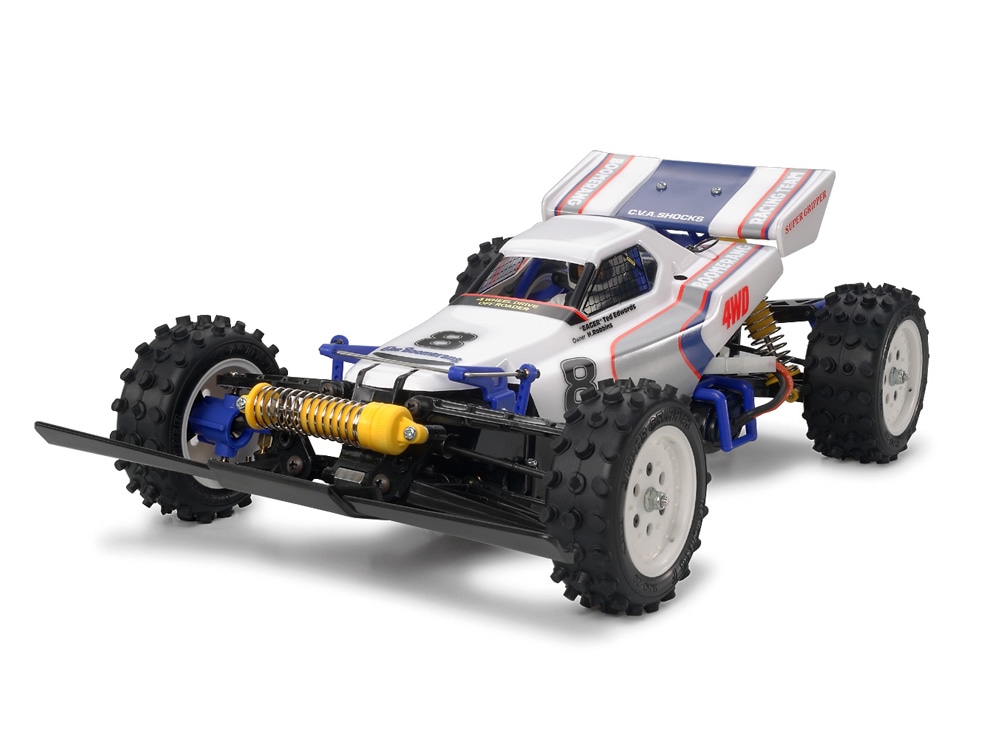
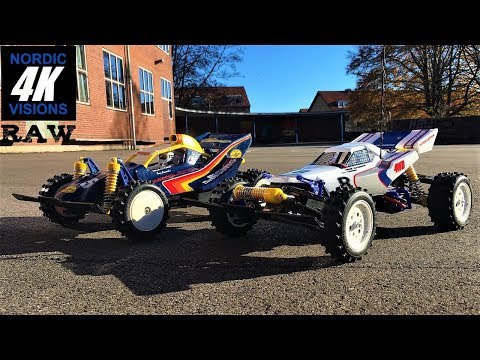
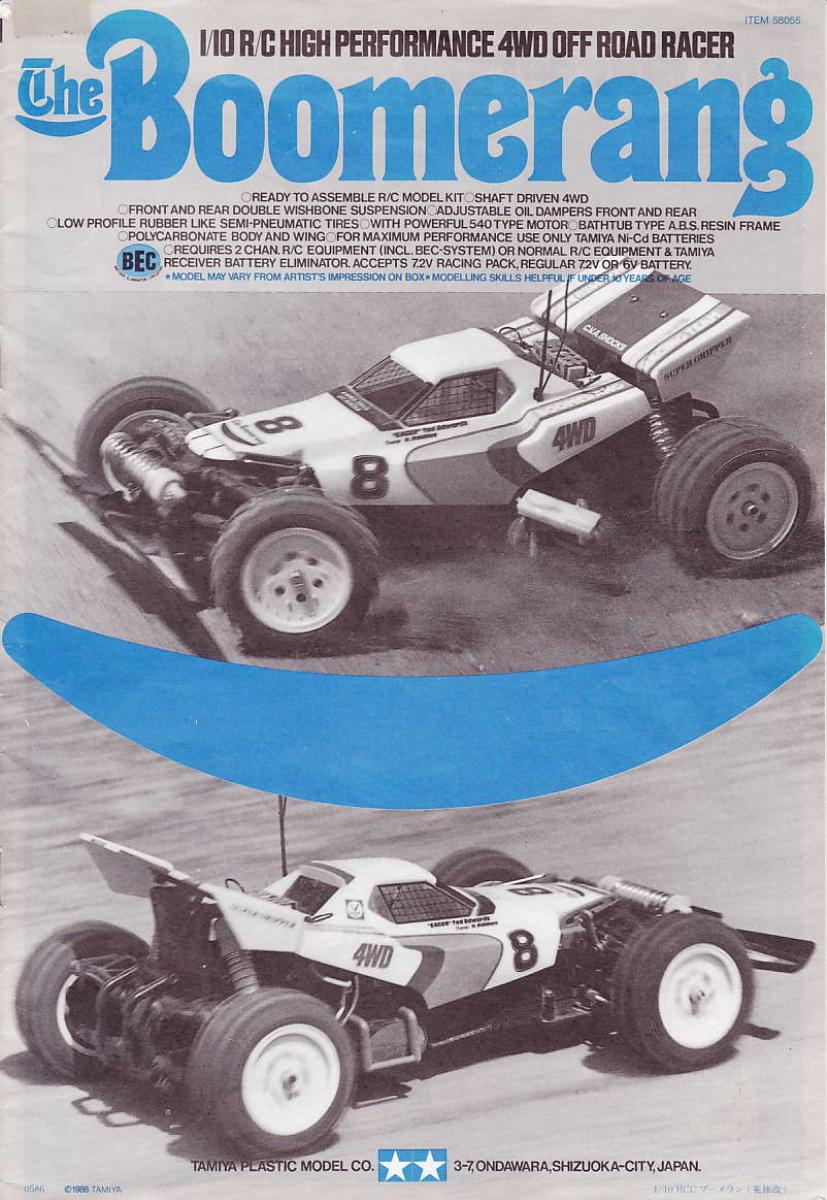
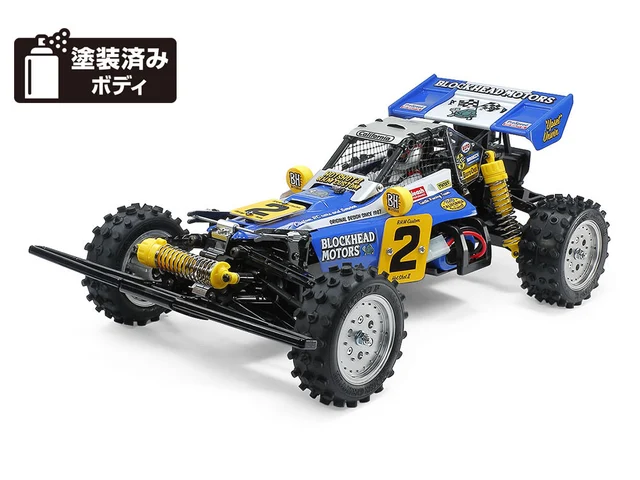
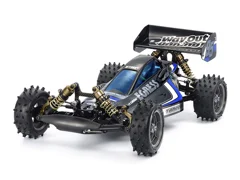
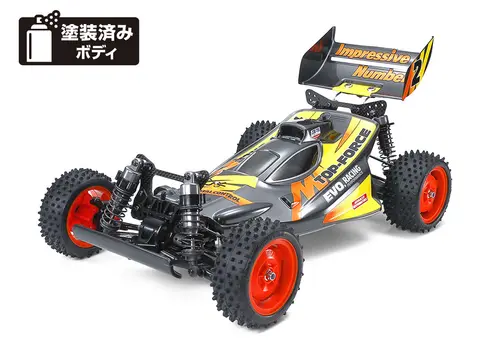
The Boomerang (2008) returns Tamiya's accessible 1986 four-wheel-drive buggy with its wedge-shaped body and distinctive three-damper suspension. The shaft-driven powertrain descends from the Hotshot, while separate front and rear gearboxes attach to the molded bathtub frame. That arrangement gives the model its own appearance and maintenance character within the older Tamiya four-wheel-drive family. Kit 58418 is a rerelease with selected updates, not a new chassis that merely borrows a vintage body.
The front suspension combines one oil damper with a stabilizer; two long CVA oil dampers support the rear. The reissue adds ball and thrust bearings inside the gearboxes and a chassis cover intended to limit the entry of dirt and small stones. That does not mean every bushing in the car has been replaced by a ball bearing. A standard 540 motor powers the kit, and the Japanese product specification calls for a separately selected electronic controller. Regional equipment and service-card references need to be checked before assuming that every package contains the same ESC. Exact 58418 history and equipment (opens in a new tab)
The original suspension gives the owner a useful baseline to preserve. Tire condition, damper oil and steering play can change how a runner feels before a two-shock front conversion or more motor power becomes relevant. Bearing replacement is a targeted job while the hubs and gearbox are accessible, with the original option insert giving additional guidance when changing the motor or gearing. Body protection, battery clearance and compatible wheel hubs are similarly practical choices. The Boomerang remains approachable because its individual assemblies can be inspected and serviced, while retaining the front monoshock keeps an important part of its identity intact. Exact 58418 history and equipment (opens in a new tab)
The kind of vehicle the maker sells it as. It sets what the car is built to do and which cars it is fair to compare it with.
Buggies are low, light off-road cars built for jumps and fast corners on dirt, clay or turf tracks.
Drive
All four wheels are driven. That gives more grip under power, especially on loose ground.
The cost is more parts to maintain.
Build
A kit you build yourself from parts.
Most kits come without motor, ESC, servo, radio and battery, and many without tires or a painted body.
The manual lists what to add.
Scale
The maker's nominal size compared with a full-size vehicle. It works more as a class label than a measurement.
A 1/10 monster truck is far bigger than a 1/10 touring car, so compare length and weight for real size.
This one is 385 mm long.
Part number
The maker's product number for this exact version.
A V2, a new color, or a kit instead of an RTR usually has a different number, and parts can differ between them.
Check it against your box or receipt before ordering parts.
Class
Buggy
Drive
4WD
Build
Kit
Scale
1/10
Part number
58418
Drivetrain
Pinion
The small gear on the motor shaft. Fewer teeth gear the car shorter: quicker acceleration, lower top speed and a cooler motor. More teeth do the opposite.
On this car one tooth changes the gearing by about 6.7%.
Racers change the pinion to suit the track and the class's motor rules, and often compare setups by rollout rather than tooth count.
Spur
The large gear the pinion drives. A bigger spur with the same pinion gears the car shorter.
Pinion and spur need matching pitch, or explicit manufacturer confirmation that the exact gears are compatible.
The Gearing parts table below shows this car's pitch and part numbers.
Transmission & axle
Every reduction after the spur, multiplied together: transmission, differentials and axle gears.
It is fixed by the design; the gearing you change is the pinion and spur.
This one is worked out from the tooth counts the maker publishes.
Spur ÷ pinion
Spur teeth divided by pinion teeth: the part of the gearing that a pinion or spur swap changes.
Here it is 3.333:1.
Final drive
How many times the motor turns for one turn of the wheels. A higher number is shorter gearing: more acceleration and pulling power, less top speed.
Among 1/10 buggies in the catalog, the middle half run between 8.1:1 and 9.5:1 on stock gearing; this one is 8.7:1.
Differentials
The type of each differential, as the maker states it.
A gear or ball diff lets the wheels on one axle turn at different speeds in a corner; a spool or locked diff turns them together for straight-line drive and climbing, at the cost of steering.
Pinion bore
The nominal size of the hole that mates with the motor shaft.
A nominal shaft fit comes from the exact replacement pinion listing. It does not specify a measured finished hole or manufacturing tolerance.
Match the pinion mounting method as well as its size. A press-fit hole cannot be inferred from motor shaft diameter.
Pinion pitch
The tooth spacing of the fitted gear, stated as metric module or diametral pitch.
Pinion and spur need matching pitch or explicit manufacturer confirmation of compatibility for the exact parts. Mod 0.8 and 32P are different standards; a compatibility statement for particular gears does not apply to every gear. A missing pitch can be inferred from the other fitted gear; module and diametral pitch are not silently converted.
Spur pitch
The tooth spacing of the fitted gear, stated as metric module or diametral pitch.
Pinion and spur need matching pitch or explicit manufacturer confirmation of compatibility for the exact parts. Mod 0.8 and 32P are different standards; a compatibility statement for particular gears does not apply to every gear. A missing pitch can be inferred from the other fitted gear; module and diametral pitch are not silently converted.
The outside diameter of the mounted tire, tread to tread. A taller tire covers more ground each turn, which gears the car taller.
Race tires wear down over a day, and a smaller tire gears the car shorter.
Rollout
How far the car moves for one turn of the motor: tire circumference divided by final drive.
It lets you compare gearing across different tire sizes; more rollout is taller gearing.
Here it is 31.8 mm.
Stock tire width
Stock tire width: A documented stock wheel, tire, or axle measurement. Stock dimensions alone do not establish the largest size that will clear the body and suspension.
Stock wheel diameter
Stock wheel diameter: A documented stock wheel, tire, or axle measurement. Stock dimensions alone do not establish the largest size that will clear the body and suspension.
Stock wheel width
Stock wheel width: A documented stock wheel, tire, or axle measurement. Stock dimensions alone do not establish the largest size that will clear the body and suspension.
What the main chassis is made of and how it is built, as stated for this car. Braces, stiffeners and skid plates are not counted.
Composite is the makers' word for molded plastic, usually nylon with glass or other fibers: it flexes and shrugs off hits, and it is light and cheap to replace.
A tub is one molded piece with raised sides that hold the parts and keep dirt out.
Shock bore
The inside diameter of the shock body, where the piston moves through oil.
It is a shock measurement, separate from the motor pinion bore. Match the actual shock part when ordering pistons, seals or a replacement body.
Calculated final drive ratio for each pinion and spur pair
Pinion
48T spur
50T spur
52T spur
13T
14T
15T
16T
17T
18T
Select a pair to compare wheel travel per motor turn with stock. Other cells are mathematical examples, not verified gears or fits. Check pitch, mesh, clearance and motor temperature before changing parts.
About these specs
Two kit ratios.
Read moreShow less
Tamiya's Japanese spec gives 8.7:1 and 10.04:1; the kit contains both pinions and the builder picks one.
The first-listed 8.7:1 is used here; set 10.04:1 in the calculator if the low-gear pinion is fitted.
The manual prints 'Gear ratio 8.704:1' with the 15T pinion and 10.043:1 with the 13T, so 8.7:1 is the 15T build; the spur has no printed tooth count, so it and the transmission and axle ratio are left blank.
Brushed RS-540 motor, ESC sold separately, shaft-drive 4WD.
The tire diameter is the driven rear pair, 38/88mm; the front is 30/88mm, the same outside diameter.
Unassembled kit with no battery; the motor is brushed, its Kv remains unknown and cell count does not apply.
How to read these figures
Stock is as the vehicle ships.
Calculated is worked from the recorded figures on this page.
Derived uses recorded dimensions or arithmetic. The row explains the inference. A nominal mating size is not a measured tolerance or a complete fitment guarantee.
Derived from replacement part uses the listed dimensions of a replacement advertised for the identified OEM part. Treat it as an approximate working size; the factory-fitted part may differ. Calculated performance uses that approximation.
Single report uses one outside source. It is useful as a starting figure, with the source and calculation described in the note.
Not applicable means the vehicle does not come with it, like the motor on a roller or the tires on a race kit.
Not published means it exists but no source we could find prints it.
Instruction manual (Tamiya PDF) (opens in a new tab)d7z22c0gz59ng.cloudfront.netPDFSupports 10 specificationsPinion and gear ratio, steps 4-5, p. 5; gearing chart Step 5 and Options, p. 5; parts list Parts code list, PDF p. 24Used forMain specsGearingMotor shaftSizeBattery fitFluidsElectronicsWheels & tiresSuspensionDrivetrain
Checked task pages, documented requirements and recorded fluid references for this model. Follow the manufacturer's procedure for the exact assembly and revision.
Maintenance bundles
Manual pages, documented requirements and relevant specifications, together by task.
Use the cited instructions for your fitted equipment. These references are not a complete rebuild kit.
DifferentialsReference
Kit differential assembly
The Boomerang (2008) kit 58418; exact 24-page manufacturer PDF edition
Exact kit differential assembly reference. Follow the documented front/rear configurations; locked or direct front drives do not receive rear differential oil by inference.
No separate parts, tools or prerequisites have been indexed for this task. Read the cited reference before starting.
This is a partial service reference. Check the cited instructions for the full procedure and configuration-specific requirements. Mechanical tasks may need additional parts, quantities and reused hardware beyond the items listed here. Manual reviewed 2026-10-10.
DrivetrainReference
Kit drivetrain
The Boomerang (2008) kit 58418; exact 24-page manufacturer PDF edition
Drivetrain assembly reference for this exact kit. Follow the documented joints, bearings and shaft or belt arrangement.
No separate parts, tools or prerequisites have been indexed for this task. Read the cited reference before starting.
This is a partial service reference. Check the cited instructions for the full procedure and configuration-specific requirements. Mechanical tasks may need additional parts, quantities and reused hardware beyond the items listed here. Manual reviewed 2026-10-10.
MotorReference
Motor mounting and pinion
The Boomerang (2008) kit 58418; exact 24-page manufacturer PDF edition
Motor mounting and pinion installation reference. Refer to this kit's required equipment; these pages do not identify an owner-selected motor as factory equipment.
No separate parts, tools or prerequisites have been indexed for this task. Read the cited reference before starting.
This is a partial service reference. Check the cited instructions for the full procedure and configuration-specific requirements. Mechanical tasks may need additional parts, quantities and reused hardware beyond the items listed here. Manual reviewed 2026-10-10.
Steering servoReference
Steering servo installation
The Boomerang (2008) kit 58418; exact 24-page manufacturer PDF edition
Servo neutral-position check, horn/linkage and mounting reference. This is chassis installation, not radio binding or internal servo rebuilding.
No separate parts, tools or prerequisites have been indexed for this task. Read the cited reference before starting.
This is a partial service reference. Check the cited instructions for the full procedure and configuration-specific requirements. Mechanical tasks may need additional parts, quantities and reused hardware beyond the items listed here. Manual reviewed 2026-10-10.
No fluid grades are recorded here. That does not establish whether this vehicle uses oil, grease or friction components.
Boomerang and Super Sabre suspension, shafts, dampers and battery brackets. Check the tower and damper pairing: the lowered CF95257 tower does not fit the standard rear shocks.