Pinion
PinionStock gear25T · 48P · 3.175 mm (nominal shaft fit; Derived from replacement part) boreKyosho
VehiclesKyosho Optima Mid

1/10 scale · 4WD buggy chassis kit · 30622
Currency estimate using ECB rates (opens in a new tab) (2026-10-06). Regional taxes, shipping and import costs are not adjusted.
Reference prices; current prices may differ.
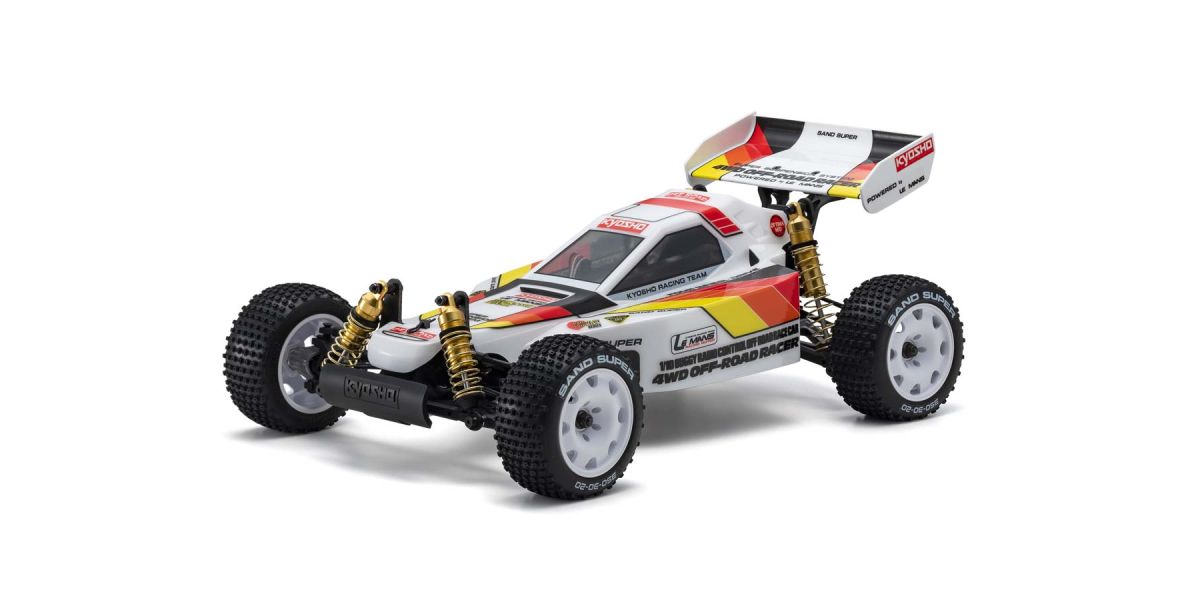
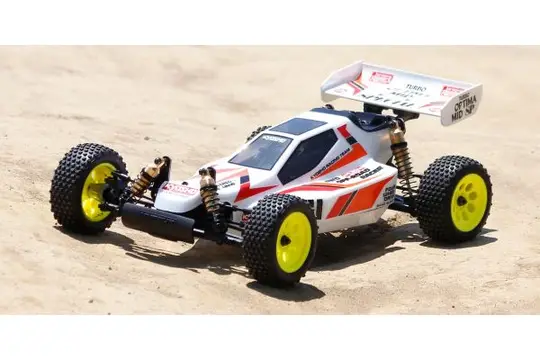
The Optima Mid marks a clear change of direction within Kyosho's buggy history. Moving the motor toward the middle of the chassis concentrated the major components around a new belt-driven layout. Kyosho records that the prototype occupied five of the ten A-final places at the 1987 electric off-road World Championships in England and finished second.
That is a specific racing achievement behind the car's reputation, rather than a claim that every later Optima won the event. The 30622 recreation returns to this 1987 design as the tenth model in the Vintage Series. Kyosho model history and equipment (opens in a new tab)
Its engineering is more than a preserved outline. The modern kit has an adjustable belt tensioner and a moulded belt cover in place of the original vacuum-formed arrangement, alongside a reinforced slipper clutch and 48-pitch gearing. FRP shock towers draw on the later Turbo Optima Mid specification, while gold oil dampers retain the period look and allow ride-height adjustment. The aluminium chassis and central motor give the owner a visibly different machine from the rear-motor Optima or cage-bodied Javelin. The stock equipment already contains much of the hardware that might otherwise become a shopping list. Kyosho model history and equipment (opens in a new tab)
The remaining choices concern how the completed buggy will be used. Radio, motor, controller and battery have to fit under a relatively low body and alongside the belt enclosure, so installation planning matters as much as the power rating. For a running build, preserve a smooth belt drive, suitable cooling and a repeatable tire-and-suspension baseline. The appeal is the chance to work with a significant racing layout while giving it equipment appropriate to today's owner. Re-release assembly context (opens in a new tab)
| Spec | Value | Basis |
|---|---|---|
| Vehicle | ||
| ||
| Class | Buggy | |
| Drive | 4WD | |
| Power | Motor not included | |
| Build | Kit | |
| Scale | 1/10 | |
| Part number | 30622 | |
| Drivetrain | ||
| ||
| Pinion | Stock | |
| Spur | Stock | |
| Transmission & axle | Stock | |
| Spur ÷ pinion | 3.280:1Calculated | Calculated |
| Final drive | Stock | |
| Slipper clutch | YesStock | Stock |
| Pinion bore | 3.175 mm (nominal shaft fit)Derived from replacement part | Derived from replacement part |
| Pinion pitch | Stock | |
| Spur pitch | Stock | |
| Wheels & tires | ||
| ||
| Tire diameter | Stock | |
| Rollout | 31.1mm per motor turnCalculated | Calculated |
| Wheel hex | Derived from replacement part | |
| Stock tire width | Front 36; rear 36mmStock | Stock |
| Stock wheel diameter | 50 mm front and rearKyosho nominal rim designationStock | Stock |
| Suspension | ||
| ||
| Shocks | Oil-filledthreaded, aluminum body, 3 mm shaft, front and rear; Original shock drawing shows the threaded cylinder and adjustable preload ring.; Approximate nominal 3 mm working-shaft size inferred from the original shaft and its documented sealing/guide interface; not a measured outside diameter or tolerance.Derived from replacement part | Derived from replacement part |
| Shock bore | 12mm, front and rear; Nominal Kyosho 12 mm oil shock family size. The exact assembly manual shows the shared 12 mm stock gasket.Derived from replacement part | Derived from replacement part |
| Spring, front | OTW123(c): H, goldStock | Stock |
| Spring, rear | OTW124(c): H, goldStock | Stock |
| Power | ||
| ||
| Motor | Not applicable | |
| Motor shaft | Not applicable | |
| Battery | Not applicable | |
| Battery space | 140 × 50 × 25 mmmax pack, L × W × HStock | Stock |
| Motor size | 540 classStock | Stock |
| Battery retention | Hook-and-loop battery strapRetention method only; no maximum pack envelope established.Stock | Stock |
| Performance | ||
| ||
| Theoretical top speed | Not applicable | |
| Size & weight | ||
| ||
| Weight | 1.6 kg (3.5 lb)with batteryStock | Stock |
| Length | 375 mm14.8 inStock | Stock |
| Width | 244 mm9.6 inStock | Stock |
| Height | 142 mm5.6 inStock | Stock |
| Wheelbase | 255 mm10 inStock | Stock |
Alternative gear fitment is unverified.
Stock 25T pinion / 82T spur Internal ratio 2.52:1 fixed
| Pinion | 80T spur | 82T spur | 84T spur |
|---|---|---|---|
| 23T | |||
| 24T | |||
| 25T | |||
| 26T | |||
| 27T | |||
| 28T |
Select a pair to compare wheel travel per motor turn with stock. Other cells are mathematical examples, not verified gears or fits. Check pitch, mesh, clearance and motor temperature before changing parts.
Reissue of the 1987 midship 4WD buggy.
17 source links for this model.
Checked task pages, documented requirements and recorded fluid references for this model. Follow the manufacturer's procedure for the exact assembly and revision.
Manual pages, documented requirements and relevant specifications, together by task.
Use the cited instructions for your fitted equipment. These references are not a complete rebuild kit.
30622 assembly kit; owner-selected electronics
The assembly documents grease points. Silicone5000–30000 is separately purchased optional tuning oil; ball differential is an optional conversion. Neither is promoted to factory fill.
No separate parts, tools or prerequisites have been indexed for this task. Read the cited reference before starting.
This is a partial service reference. Check the cited instructions for the full procedure and configuration-specific requirements. Mechanical tasks may need additional parts, quantities and reused hardware beyond the items listed here. Manual reviewed 2026-10-09.
30622 assembly kit; owner-selected electronics
Exact linked assembly documents gearbox and slipper installation. Belt covers and belt-tension adjustment are specific to this mid-motor4WD chassis.
No separate parts, tools or prerequisites have been indexed for this task. Read the cited reference before starting.
This is a partial service reference. Check the cited instructions for the full procedure and configuration-specific requirements. Mechanical tasks may need additional parts, quantities and reused hardware beyond the items listed here. Manual reviewed 2026-10-09.
30622 assembly kit; owner-selected electronics
Motor is separately chosen. Install the25T pinion on the shaft flat and set mesh using one sheet of paper. Internal motor rebuild depends on the selected motor.
No separate parts, tools or prerequisites have been indexed for this task. Read the cited reference before starting.
This is a partial service reference. Check the cited instructions for the full procedure and configuration-specific requirements. Mechanical tasks may need additional parts, quantities and reused hardware beyond the items listed here. Manual reviewed 2026-10-09.
30622 assembly kit; owner-selected electronics
Center the chosen servo before attaching the compatible horn. Exact bracket orientation and linkage dimensions are documented. No factory servo or internal rebuild is inferred.
No separate parts, tools or prerequisites have been indexed for this task. Read the cited reference before starting.
This is a partial service reference. Check the cited instructions for the full procedure and configuration-specific requirements. Mechanical tasks may need additional parts, quantities and reused hardware beyond the items listed here. Manual reviewed 2026-10-09.
No fluid grades are recorded here. That does not establish whether this vehicle uses oil, grease or friction components.
Indexed tasks link to checked physical PDF pages. Other links open full documents. Tasks and rebuild requirements not shown here still need review.
The 30622 Optima Mid re-release already has gold oil dampers, FRP shock towers, an adjustable belt tensioner and a slipper clutch. Start with tires, spring and oil settings suited to your surface. Set the suspension to move freely and keep the belt covers sealed before replacing the supplied chassis or towers.[1] Exact re-release factory equipment and required electronics (opens in a new tab)[2] All original owner reviews including independent actual runners (opens in a new tab)[3] Full rolling display chassis assembly (opens in a new tab)
Plan the electronics installation before choosing the ESC. Check the controller, fan, motor wires and sensor cable beneath the body and belt cover. A separate ESC tray can help position the controller, but it does not guarantee clearance for every case or connector. Keep cooling suitable for the actual motor and gearing instead of treating fan removal as a universal fit solution.[2] All original owner reviews including independent actual runners (opens in a new tab)[4] Completed re-release build and indoor first movement (opens in a new tab)[1] Exact re-release factory equipment and required electronics (opens in a new tab)
Use the supplied tensioner to set the belt correctly, then check for smooth rotation and secure covers. Tightening a belt further adds drag and is not a substitute for inspecting worn teeth, pulleys and assembly. Choose differential oil and slipper settings for grip and power delivery; a brushless installation still needs temperature and drivetrain checks after a full run.[1] Exact re-release factory equipment and required electronics (opens in a new tab)[2] All original owner reviews including independent actual runners (opens in a new tab)[3] Full rolling display chassis assembly (opens in a new tab)
Use parts listed for the 2022 re-release and check the exact kit number. The original 1987 Mid, 30622, anniversary Worlds-spec kits and Turbo Mid versions differ. Carbon trays, short-pack mounts, wider hubs and steering conversions change fit or geometry, so retain the original setup measurements and check body, wheel and suspension clearance after each change.[1] Exact re-release factory equipment and required electronics (opens in a new tab)[2] All original owner reviews including independent actual runners (opens in a new tab)[5] Current exact-model aftermarket compatibility chart (opens in a new tab)[6] Targeted Optima family aftermarket range (opens in a new tab)

Exact 30622 factory service and option parts. Check the kit number before using original or anniversary Mid parts.
Browse parts at Kyosho (opens in a new tab)
Re-release Mid trays, mounts, steering, shafts and suspension options. Select the 30622 column; the ESC tray may require top-deck modification.
Browse parts at Koswork (opens in a new tab)
Optima Mid carbon decks, steering, hubs, motor plate and drivetrain options. Check generation and supporting hardware for each part.
Browse parts at Yeah Racing (opens in a new tab)
Completed re-release chassis with a Koswork tray and smaller replacement ESC. First movement is indoors; later follow-up access remains incomplete.
Read an Optima Mid re-release build and electronics-fit discussion (opens in a new tab)
Follows the 30622 Optima Mid build and running with added steering and carbon parts. The Hobbywing combo and custom wing differ from a bare factory kit.

A build review explicitly identifying the 2022 Optima Mid re-release.
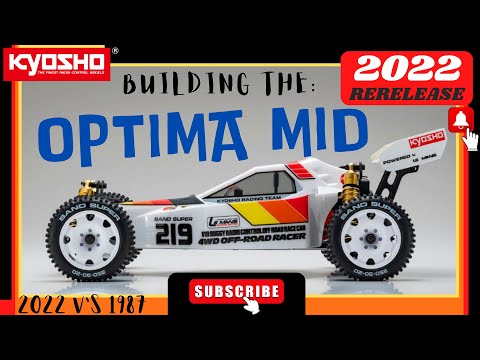
A separate creator assembly video for the 2022 Optima Mid.
Loading parts…
4 spec-only records. Key assemblies include recorded gear and shock identifiers. Open a part for its listing sources.
1 other version of this chassis.
Browse 6 more Kyosho models.