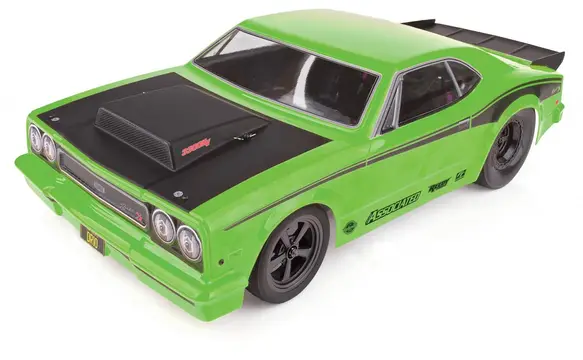
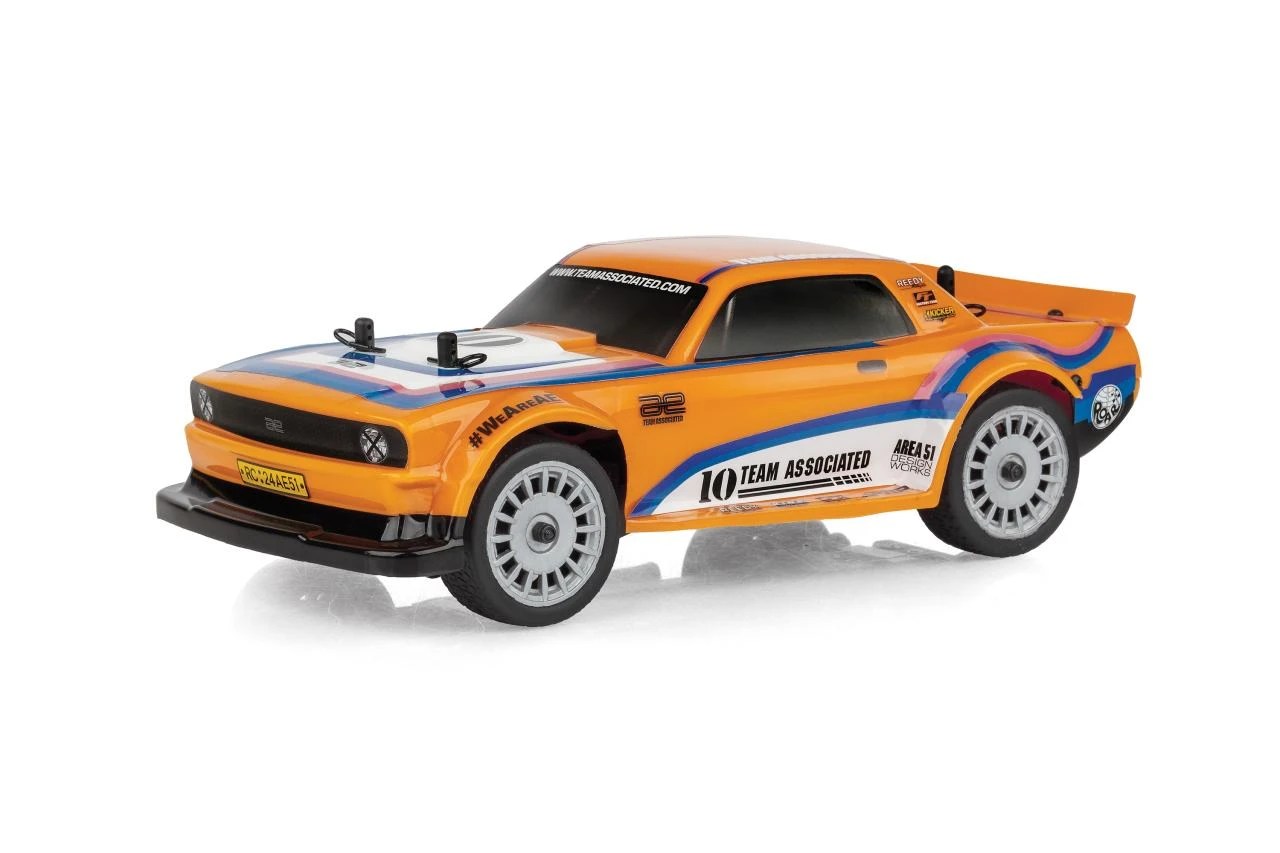
The Street joins the RC24 ZOOM Rally as a compact, ready-to-run car built around the same small-scale touring layout. Gear differentials and the compact steering servo give it recognizable hobby-grade hardware in a package that can run in a small area. Model reference (opens in a new tab)
Read moreShow less
The street version has its own body and trim. Replaceable electronics and chassis parts leave room to maintain the car as it wears. Check the gear supplied with your car before ordering a replacement pinion. The manual and parts listing give different tooth counts for the same part. Technical reference (opens in a new tab)
The kind of vehicle the maker sells it as. It sets what the car is built to do and which cars it is fair to compare it with.
Street covers on-road bashers: speed-run, muscle and drag cars built for straight-line speed rather than racing.
Drive
All four wheels are driven, which puts power down more evenly and keeps the car steadier accelerating out of corners.
The cost is more parts to maintain.
Power
A brushed motor carries current through carbon brushes that rub on the commutator.
It is cheaper and smooth at low speed.
The brushes wear and the motor loses power over time.
Build
Ready to run: built at the factory with the electronics installed.
Some come without a battery or charger; the maker's box contents say which.
Scale
The maker's nominal size compared with a full-size vehicle. It works more as a class label than a measurement.
A 1/10 monster truck is far bigger than a 1/10 touring car, so compare length and weight for real size.
This one is 194 mm long.
Part number
The maker's product number for this exact version.
A V2, a new color, or a kit instead of an RTR usually has a different number, and parts can differ between them.
Check it against your box or receipt before ordering parts.
Class
Street
Drive
4WD
Power
Brushed
Build
Ready to run
Scale
1/24
Part number
20211
Drivetrain
Pinion
The small gear on the motor shaft. Fewer teeth gear the car shorter: quicker acceleration, lower top speed and a cooler motor. More teeth do the opposite.
It depends on the motor you fit, so the maker does not list one.
Spur
The large gear the pinion drives. A bigger spur with the same pinion gears the car shorter.
Pinion and spur need matching pitch, or explicit manufacturer confirmation that the exact gears are compatible.
The Gearing parts table below shows this car's pitch and part numbers.
Transmission & axle
Every reduction after the spur, multiplied together: transmission, differentials and axle gears.
It is fixed by the design; the gearing you change is the pinion and spur.
Final drive
How many times the motor turns for one turn of the wheels. A higher number is shorter gearing: more acceleration and pulling power, less top speed.
Pinion
Not published
Spur
Not published
Transmission & axle
Not published
Final drive
Not published
Wheels & tires
Tire diameter
The outside diameter of the mounted tire, tread to tread. A taller tire covers more ground each turn, which gears the car taller.
At high speed tires can balloon and grow, so the real gearing gets taller as the car goes faster.
Tire diameter
Not published
Power
Motor
Brushed motors are commonly described by can size and turns. No motor KV is published for this vehicle; turns alone cannot supply an exact value.
Battery
The highest LiPo cell count the maker rates the electronics for.
The maker does not publish it.
Stock motor
The motor fitted at the factory, as the maker names it.
Brushed motors are often named by can size, such as 540 or 550, and by turns: fewer turns is faster.
Stock ESC
The electronic speed control. It feeds power from the battery to the motor as you work the throttle, and usually powers the receiver and servo too.
An amp figure in its name is normally the maker's continuous rating.
A brushed ESC cannot run a brushless motor.
Set its low-voltage cutoff for LiPo, so a pack is not run flat.
Theoretical top speed is unavailable because motor KV, rated battery cell count, stock tire outside diameter and complete final drive ratio are missing.
Enter the missing inputs in the calculator to work out a theoretical speed.
Theoretical top speed
Not published
Size & weight
Length
Overall length as the maker states it, usually with the body fitted.
Useful for comparing real size, since scale labels are loose.
Width
Overall width as the maker states it, usually with the body fitted.
A wider car is more stable in corners and harder to roll over.
Wheelbase
The distance between the front and rear axle centers. A longer wheelbase is steadier at speed and over bumps; a shorter one turns more tightly.


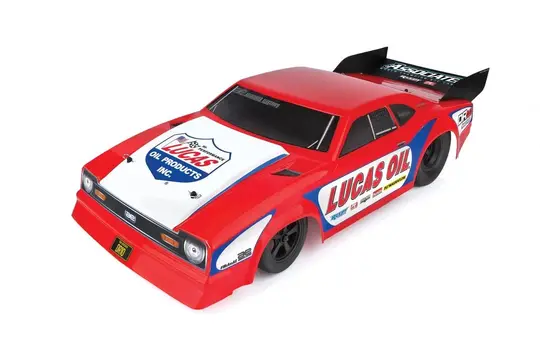 DR10 Pro Reakt Lucas Oil RTR1/10 · Street
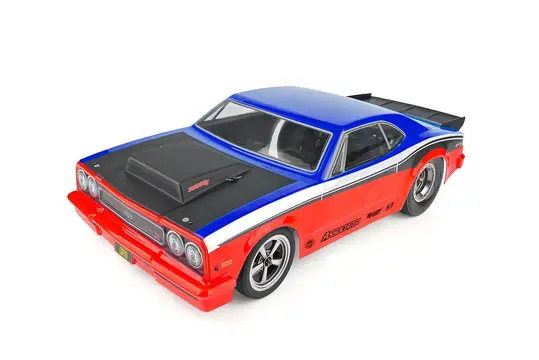 DR10 Drag Race Car Team Kit1/10 · Street
 RC12L3 Oval Kit1/12 · Street