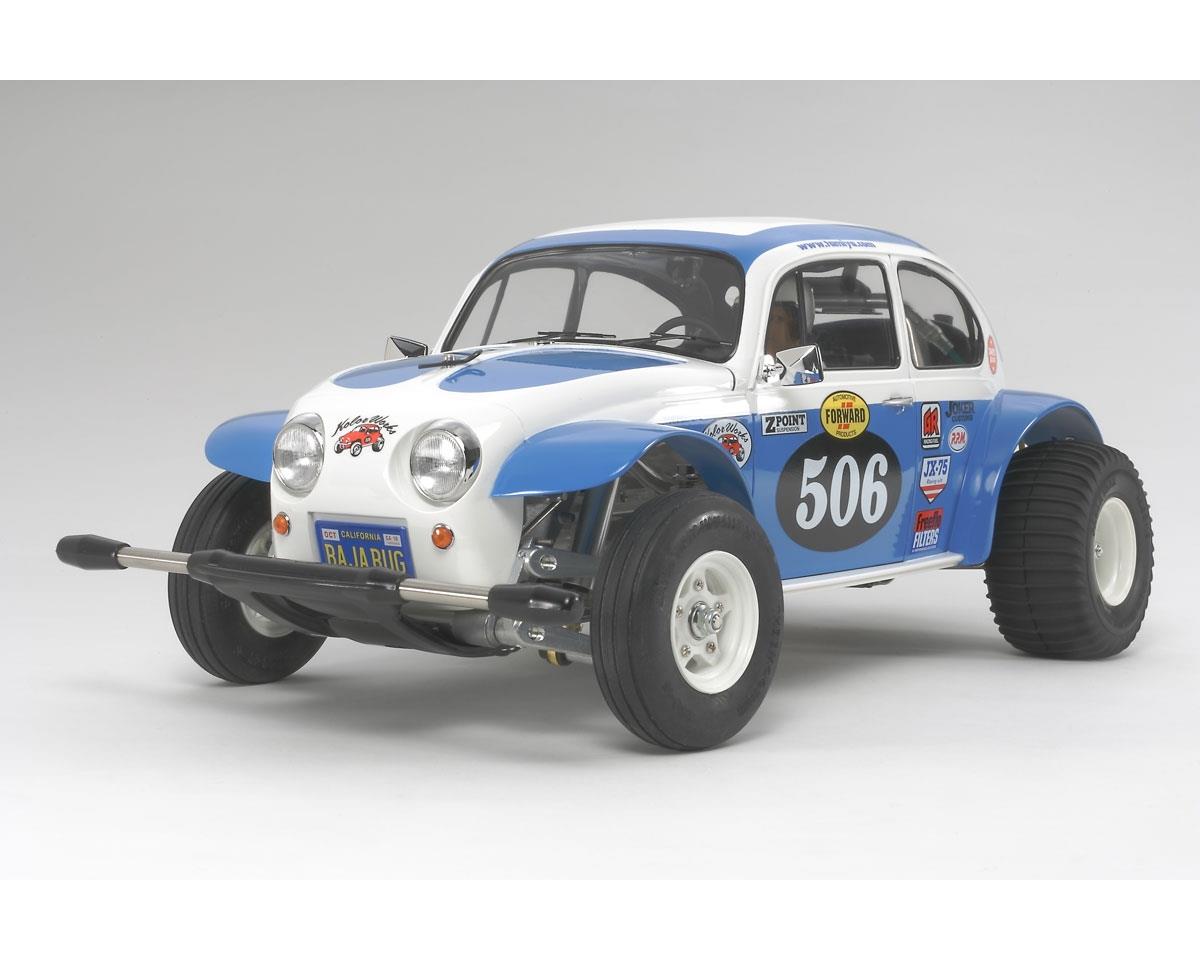
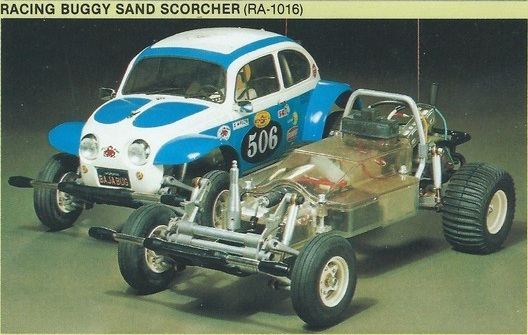
The Sand Scorcher's return in 2010 offered a new build of an unusually mechanical piece of Tamiya history. The 1979 original had joined a young RC range that already included the Porsche 934, bringing a Baja-style Beetle subject to off-road running. The revised kit kept the recognizable white hard body and broad chassis arrangement while refining parts.
Read moreShow less
It gives a builder access to that construction and appearance without requiring an untouched original as the starting point. Rerelease history (opens in a new tab)
Much of its character sits below the body. The reinforced FRP plate carries metal suspension arms, front trailing-arm and rear swing-axle layouts, oil dampers and an enclosed electronics installation. Full bearings are already included. The rear drive has no differential, so the rear wheels do not accommodate a corner in the same way as a differential-equipped touring car. Loose ground, measured throttle and room for the body to move are relevant to the driving you are setting up. Factory mechanism (opens in a new tab)
The kind of vehicle the maker sells it as. It sets what the car is built to do and which cars it is fair to compare it with.
Buggies are low, light off-road cars built for jumps and fast corners on dirt, clay or turf tracks.
Drive
Only one axle is driven, the rear on almost every 2WD RC car.
It is lighter and simpler, and it takes more throttle control on loose ground.
Build
A kit you build yourself from parts.
Most kits come without motor, ESC, servo, radio and battery, and many without tires or a painted body.
The manual lists what to add.
Scale
The maker's nominal size compared with a full-size vehicle. It works more as a class label than a measurement.
A 1/10 monster truck is far bigger than a 1/10 touring car, so compare length and weight for real size.
This one is 400 mm long.
Part number
The maker's product number for this exact version.
A V2, a new color, or a kit instead of an RTR usually has a different number, and parts can differ between them.
Check it against your box or receipt before ordering parts.
Class
Buggy
Drive
2WD
Build
Kit
Scale
1/10
Part number
58452
Drivetrain
Pinion
The small gear on the motor shaft. Fewer teeth gear the car shorter: quicker acceleration, lower top speed and a cooler motor. More teeth do the opposite.
On this car one tooth changes the gearing by about 5.0%.
Racers change the pinion to suit the track and the class's motor rules, and often compare setups by rollout rather than tooth count.
Spur
The large gear the pinion drives. A bigger spur with the same pinion gears the car shorter.
Pinion and spur need matching pitch, or explicit manufacturer confirmation that the exact gears are compatible.
The Gearing parts table below shows this car's pitch and part numbers.
Spur ÷ pinion
Spur teeth divided by pinion teeth: the part of the gearing that a pinion or spur swap changes.
Here it is 3.250:1.
Differentials
The type of each differential, as the maker states it.
A gear or ball diff lets the wheels on one axle turn at different speeds in a corner; a spool or locked diff turns them together for straight-line drive and climbing, at the cost of steering.
Hub bearing size
Hub bearing size: The documented drivetrain connection or size for this exact model. Match the mating component before buying a replacement.
Pinion bore
The nominal size of the hole that mates with the motor shaft.
Match the pinion mounting method as well as its size. A press-fit hole cannot be inferred from motor shaft diameter.
Pinion pitch
The tooth spacing of the fitted gear, stated as metric module or diametral pitch.
Pinion and spur need matching pitch or explicit manufacturer confirmation of compatibility for the exact parts. Mod 0.8 and 32P are different standards; a compatibility statement for particular gears does not apply to every gear. A missing pitch can be inferred from the other fitted gear; module and diametral pitch are not silently converted.
Spur pitch
The tooth spacing of the fitted gear, stated as metric module or diametral pitch.
Pinion and spur need matching pitch or explicit manufacturer confirmation of compatibility for the exact parts. Mod 0.8 and 32P are different standards; a compatibility statement for particular gears does not apply to every gear. A missing pitch can be inferred from the other fitted gear; module and diametral pitch are not silently converted.
Axle drive, front
Whether the front axle is driven by the motor.
Unpowered wheels can have tire dimensions but have no motor-to-wheel gear reduction.
Axle drive, rear
Whether the rear axle is driven by the motor.
The calculator uses this axle's own tire size and complete recorded gear path.
Transmission & axle, front
This axle is unpowered and has no motor-to-wheel drive ratio.
Transmission & axle, rear
Every reduction after the spur, multiplied together: transmission, differentials and axle gears.
It is fixed by the design; the gearing you change is the pinion and spur.
This one is worked out from the tooth counts the maker publishes.
Final drive, front
This axle is unpowered and has no motor-to-wheel drive ratio.
Final drive, rear
How many times the motor turns for one turn of the wheels. A higher number is shorter gearing: more acceleration and pulling power, less top speed.
Among 1/10 buggies in the catalog, the middle half run between 8.1:1 and 9.5:1 on stock gearing; this one is 6.5:1, taller than most.
Axle coupling
How the driven axles are connected.
The coupling has not been established from a source. It is not inferred from 4WD or from the axle differentials.
The outside diameter of the mounted tire, tread to tread. A taller tire covers more ground each turn, which gears the car taller.
Race tires wear down over a day, and a smaller tire gears the car shorter.
Tire diameter, rear
The outside diameter of the mounted tire, tread to tread. A taller tire covers more ground each turn, which gears the car taller.
Race tires wear down over a day, and a smaller tire gears the car shorter.
Tire width, front
The outside width of the stock tire on the front axle.
Width and outside diameter are separate measurements; neither is the wheel's bead diameter.
Tire width, rear
The outside width of the stock tire on the rear axle.
Width and outside diameter are separate measurements; neither is the wheel's bead diameter.
Axle thread
Axle thread: A documented stock wheel, tire, or axle measurement. Stock dimensions alone do not establish the largest size that will clear the body and suspension.
Rollout, front
This axle is unpowered and has no motor-to-wheel drive ratio.
Rollout, rear
Distance at the rear axle per motor turn through its recorded gear path.
This follows the listed gear reduction and tire diameter; it does not account for tire slip or deflection.
39.6mm per motor turn, nominal axle inputsCalculated
Calculated
Suspension
Chassis
What the main chassis is made of and how it is built, as stated for this car. Braces, stiffeners and skid plates are not counted.
Fiberglass (G10) plate is stiff and light, and flexes a little more than carbon fiber.
A plate chassis is a flat sheet the parts bolt to.
Shocks
What the shocks are and how they are built, as the maker describes them.
Oil-filled shocks damp with silicone oil; friction shocks, found on some entry-level cars, damp with a sprung plunger and cannot be tuned with oil.
Frontupper shock bolt
Front upper shock bolt: A documented shock mounting interface at the named end and eye. A ball stud or standoff is distinct from a through-bolt. Match the mounting type, thread and eye dimensions when choosing a replacement shock.
Frontlower shock bolt
Front lower shock bolt: A documented shock mounting interface at the named end and eye. A ball stud or standoff is distinct from a through-bolt. Match the mounting type, thread and eye dimensions when choosing a replacement shock.
Rearupper shock bolt
Rear upper shock bolt: A documented shock mounting interface at the named end and eye. A ball stud or standoff is distinct from a through-bolt. Match the mounting type, thread and eye dimensions when choosing a replacement shock.
Rearlower shock bolt
Rear lower shock bolt: A documented shock mounting interface at the named end and eye. A ball stud or standoff is distinct from a through-bolt. Match the mounting type, thread and eye dimensions when choosing a replacement shock.
Shock oil
The oil in the shocks slows how fast the suspension moves. Thicker oil settles the car more slowly and resists bottoming out; thinner oil lets the wheels follow bumps.
Front and rear run the same oil on this car, so both ends respond alike. Changing one end at a time is the usual way to shift the balance.
This is the maker's printed oil grade. Its viscosity unit has not been established, so it is not presented as cSt or cps. Grade numbers alone do not establish equivalent oils or relative thickness.
Calculated final drive ratio for each pinion and spur pair
Pinion
63T spur
65T spur
67T spur
18T
19T
20T
21T
22T
23T
Select a pair to compare wheel travel per motor turn with stock. Other cells are mathematical examples, not verified gears or fits. Check pitch, mesh, clearance and motor temperature before changing parts.
About these specs
Two kit ratios.
Read moreShow less
Tamiya prints 'Gear Ratio: 6.5:1 or 9.3:1' on the English page and the same pair on the Japanese page.
The first-listed 6.5:1 is used here; set 9.3:1 in the calculator for the low-gear build.
The manual's high ratio setting is a 20T pinion on the 65T spur and its low setting a 15T pinion on the 70T spur, which fit the printed 6.5:1 and 9.3:1 with 2.0 after the spur.
Brushed Type 540 motor included, rear-wheel drive.
The tire diameter is the driven rear pair, 41/82mm; the front is 21/73mm.
Unassembled kit with no battery; the motor is brushed, its Kv remains unknown and cell count does not apply.
How to read these figures
Only the driven axle supplies a motor-to-wheel calculation. Unpowered wheels have tire dimensions but no drive ratio.
Stock is as the vehicle ships.
Calculated is worked from the recorded figures on this page.
Derived uses recorded dimensions or arithmetic. The row explains the inference. A nominal mating size is not a measured tolerance or a complete fitment guarantee.
Single report uses one outside source. It is useful as a starting figure, with the source and calculation described in the note.
Not applicable means the vehicle does not come with it, like the motor on a roller or the tires on a race kit.
Not published means it exists but no source we could find prints it.
Instruction manual (Tamiya PDF) (opens in a new tab)d7z22c0gz59ng.cloudfront.netPDFSupports 7 specificationsHigh and low ratio settings, step 4, p. 5; parts list Parts code list, PDF p. 20Used forMain specsGearingMotor shaftBattery fitWheel hexFluidsElectronics
Checked task pages, documented requirements and recorded fluid references for this model. Follow the manufacturer's procedure for the exact assembly and revision.
Maintenance bundles
Manual pages, documented requirements and relevant specifications, together by task.
No separate parts, tools or prerequisites have been indexed for this task. Read the cited reference before starting.
This is a partial service reference. Check the cited instructions for the full procedure and configuration-specific requirements. Mechanical tasks may need additional parts, quantities and reused hardware beyond the items listed here. Manual reviewed 2026-10-09.
Steering servoReference
Steering servo installation
Sand Scorcher (2010) kit 58452; exact 20-page manufacturer PDF edition
Servo neutral-position check, horn/linkage and mounting reference. This is chassis installation, not radio binding or internal servo rebuilding.
No separate parts, tools or prerequisites have been indexed for this task. Read the cited reference before starting.
This is a partial service reference. Check the cited instructions for the full procedure and configuration-specific requirements. Mechanical tasks may need additional parts, quantities and reused hardware beyond the items listed here. Manual reviewed 2026-10-10.
Indexed tasks link to checked physical PDF pages. Other links open full documents. Tasks and rebuild requirements not shown here still need review.
Upgrades and setup
Keep the kit motor or Tamiya's specified 540J replacement as the power baseline. The factory restriction is important here: a stronger controller does not make an unsupported motor a factory-approved choice. Use a complete matched gear combination and its corresponding mounting position when changing the reduction, choosing for the load and ground rather than top speed alone.[1] Sand Scorcher2010 factory design and motor limit (opens in a new tab)
Read moreRead less about upgrades and setup for Sand Scorcher (2010)
Let the intended finish guide cosmetic additions. A detailed engine, alternative bumper or wheel cover can add to the model, but it also changes clearance and what is exposed in a rollover. The documented build found a conflict between an engine detail and part of a rear guard, while a narrow front bumper offered less wheel coverage. Check your complete combination rather than copying the appearance of a finished photograph.[2] Assembly and installed rear conversion (opens in a new tab)[3] Later cosmetic installation (opens in a new tab)
A rear-suspension conversion is a larger project than a service replacement. It changes geometry and the relationship between links, dampers and body clearance. The owner build's uncertain result at stock power is a reason to define the limitation you want to solve first. A carefully assembled stock runner preserves the swing-axle movement and scale character that make this particular rerelease interesting.[2] Assembly and installed rear conversion (opens in a new tab)
Option suppliers
RC Channel
SRB suspension, dampers, guards and detail parts. The current TA58410 conversion is listed for 58452, but some range items fit only RC Channel arms or Fighting Buggy.
Sand Scorcher driver, scale engines and body conversion files. These are digital downloads; check printing, mounting and gearbox-cover clearance for the chosen design.