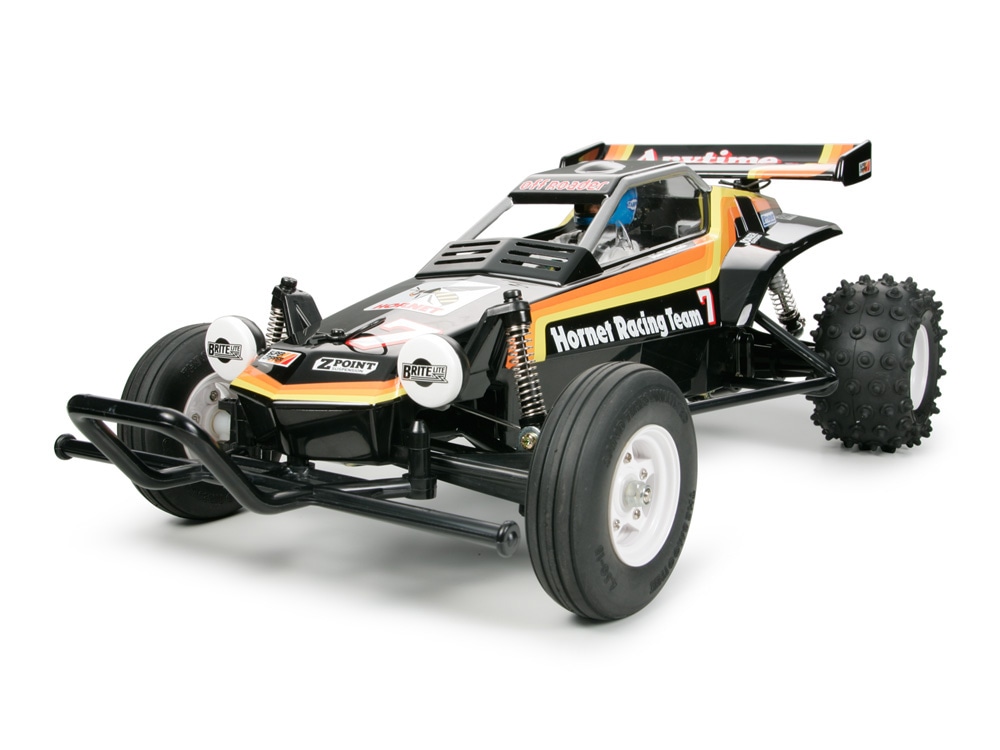
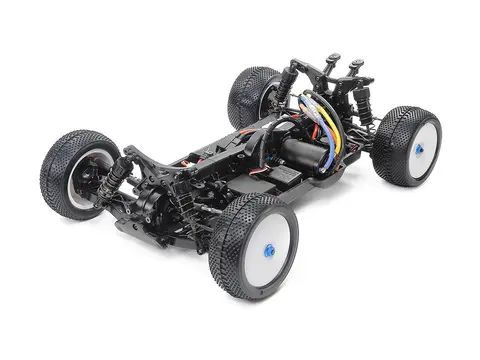
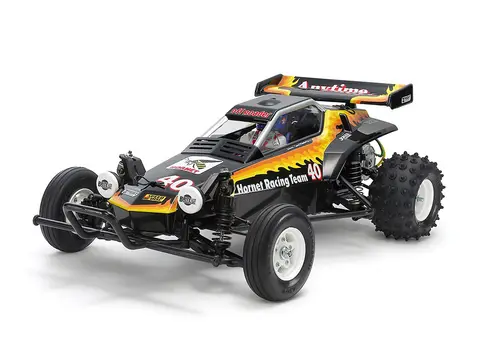
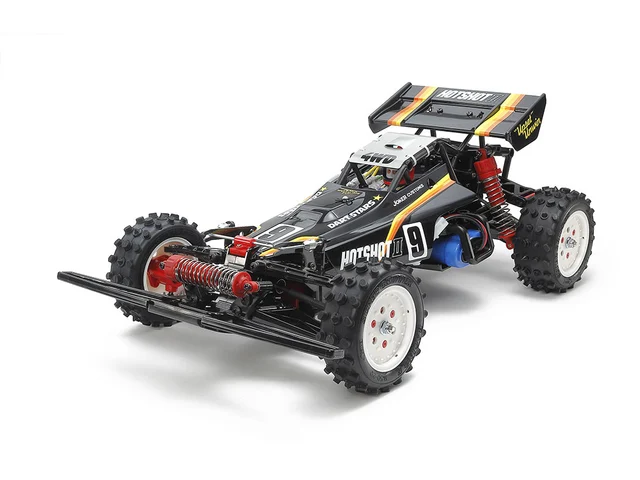
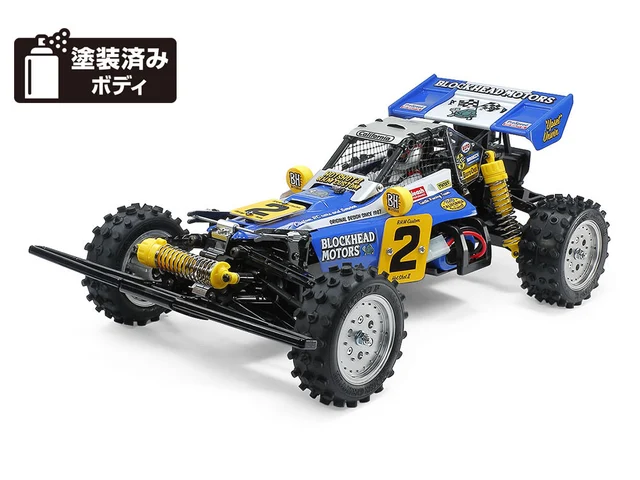
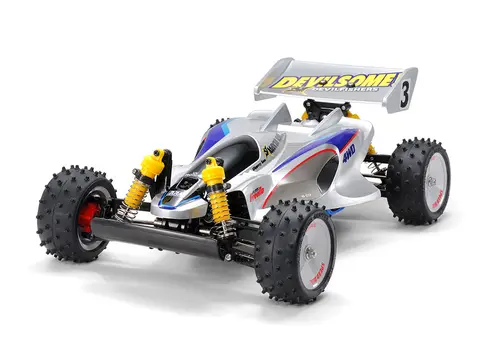
The Hornet rerelease brings the 1984 rear-drive buggy back as an assembly kit with its familiar bathtub chassis, low polycarbonate body and rear-mounted brushed motor. It keeps the original combination of independent swing-axle front suspension and a rolling rigid rear axle. Rear oil dampers and spiked tires remain part of the package, distinguishing it from the smaller-motor Grasshopper without changing the basic family layout. Tamiya model information (opens in a new tab)
Read moreShow less
The result is deliberately closer to the old Hornet than the later Hornet Evo. The original-style rear axle moves with the gearbox, and the front uses friction dampers. Those mechanisms are part of the driving and building experience. The Evo's independent rear suspension, adjustable links and different gearbox are a separate development, so an Evo upgrade discussion should not be treated as instructions for this version. Tamiya model information (opens in a new tab)
The instruction edition reviewed for this kit includes an electronic speed controller, while Tamiya's Japanese product listing requires the radio and control equipment separately. That regional difference matters when choosing batteries and motors. The chassis name alone does not identify the speed controller in a new box, and a used example may have changed electronics again. Confirm the fitted controller and its supported battery chemistry before buying a pack. Factory manual (opens in a new tab)
For a relaxed runner, establish a baseline with the kit wheels and brushed motor. Bearings can replace the identified wheel and gearbox bushings, and the rear dampers can be serviced before complete replacements are considered. Taller modern wheels change both gearing and the balance of grip, while a faster motor leaves the same swing-axle and rigid-axle mechanisms to manage the extra speed. Change one thing at a time and keep the parts needed to return to the original setup. Tamiya model information (opens in a new tab)
The kind of vehicle the maker sells it as. It sets what the car is built to do and which cars it is fair to compare it with.
Buggies are low, light off-road cars built for jumps and fast corners on dirt, clay or turf tracks.
Drive
Only one axle is driven, the rear on almost every 2WD RC car.
It is lighter and simpler, and it takes more throttle control on loose ground.
Power
A brushed motor carries current through carbon brushes that rub on the commutator.
It is cheaper and smooth at low speed.
The brushes wear and the motor loses power over time.
Build
A kit you build yourself from parts.
Most kits come without motor, ESC, servo, radio and battery, and many without tires or a painted body.
The manual lists what to add.
Scale
The maker's nominal size compared with a full-size vehicle. It works more as a class label than a measurement.
A 1/10 monster truck is far bigger than a 1/10 touring car, so compare length and weight for real size.
This one is 400 mm long.
Part number
The maker's product number for this exact version.
A V2, a new color, or a kit instead of an RTR usually has a different number, and parts can differ between them.
Check it against your box or receipt before ordering parts.
Class
Buggy
Drive
2WD
Power
Brushed
Build
Kit
Scale
1/10
Part number
58336
Drivetrain
Pinion
The small gear on the motor shaft. Fewer teeth gear the car shorter: quicker acceleration, lower top speed and a cooler motor. More teeth do the opposite.
On this car one tooth changes the gearing by about 5.6%.
Racers change the pinion to suit the track and the class's motor rules, and often compare setups by rollout rather than tooth count.
Spur
The large gear the pinion drives. A bigger spur with the same pinion gears the car shorter.
Pinion and spur must have the same pitch, or tooth size, to mesh.
The Gearing parts table below shows this car's pitch and part numbers.
Transmission & axle
Every reduction after the spur, multiplied together: transmission, differentials and axle gears.
It is fixed by the design; the gearing you change is the pinion and spur.
Final drive
How many times the motor turns for one turn of the wheels. A higher number is shorter gearing: more acceleration and pulling power, less top speed.
The outside diameter of the mounted tire, tread to tread. A taller tire covers more ground each turn, which gears the car taller.
Race tires wear down over a day, and a smaller tire gears the car shorter.
Tire diameter
Not published
Suspension
Chassis
What the main chassis is made of and how it is built, as stated for this car. Braces, stiffeners and skid plates are not counted.
Composite is the makers' word for molded plastic, usually nylon with glass or other fibers: it flexes and shrugs off hits, and it is light and cheap to replace.
Shocks, front
What the shocks are and how they are built, as the maker describes them.
Oil-filled shocks damp with silicone oil; friction shocks, found on some entry-level cars, damp with a sprung plunger and cannot be tuned with oil.
Shocks, rear
The same measure at the rear, which differs from the front on this car.
Theoretical top speed is unavailable because motor KV, rated battery cell count, stock tire outside diameter and complete final drive ratio are missing.
Enter the missing inputs in the calculator to work out a theoretical speed.
Theoretical top speed
Not published
Size & weight
Length
Overall length as the maker states it, usually with the body fitted.
Useful for comparing real size, since scale labels are loose.
Width
Overall width as the maker states it, usually with the body fitted.
A wider car is more stable in corners and harder to roll over.
Height
Overall height as the maker states it, usually with the body fitted.
Useful when checking it fits a shelf, a bag or a car trunk.
Calculated is worked from the stock figures on this page rather than stored beside them, so the two cannot drift apart.
Not published means it exists but no source we could find prints it.
Service reference
Tamiya The Hornet (2004 reissue)58336
Checked task pages, documented requirements and recorded factory fluids for this model. Follow the manufacturer's procedure for the exact assembly and revision.
ShocksReference
Rear oil-damper assembly and filling
Exact kit 58336; original and rerelease editions separate
Rear oil-damper assembly and filling. Assembly reference only; fitted electronics and their limits need a separate check.
No separate parts, tools or prerequisites have been indexed for this task. Read the cited reference before starting.
This is a partial service reference. Check the cited instructions for the full procedure and configuration-specific requirements. Mechanical tasks may need additional parts, quantities and reused hardware beyond the items listed here. Manual reviewed 2026-10-16.
No factory fluid grades are recorded here. That does not establish whether this vehicle uses oil, grease or friction components.
Indexed tasks link to checked physical PDF pages. Other links open full documents. Tasks and rebuild requirements not shown here still need review.
Build and setup
Factory setup guide for this configuration.
Service the Hornet's rear oil dampers before buying replacements. The manual shows the free piston, seals, damper spring and piston shaft as separate pieces, so clean movement and proper assembly are the first checks. The front remains a friction-damper swing-axle arrangement; filling a rear damper does not alter how the front works.[1] Tamiya 58336 exact-edition instructions (opens in a new tab)
The service card identifies plastic wheel and gearbox bushings alongside the available bearing options. Check the full set of positions and quantities for this kit, keeping any already fitted bearings that are sound. A worn shaft or loose pivot needs attention too; replacing bushings alone will not remove every source of play.[1] Tamiya 58336 exact-edition instructions (opens in a new tab)
Read moreRead less about build and setup for The Hornet (2004 reissue)
Use the supplied 18T motor-pinion arrangement as a reference when replacing the brushed motor. Confirm pinion position and gearbox movement during assembly. Radio and speed-control contents can vary by region, so choose the battery chemistry and motor rating from the actual controller in the box, not simply from the Hornet name.[1] Tamiya 58336 exact-edition instructions (opens in a new tab)
Keep the original-style wheel and tire combination while learning the chassis. A taller wheel changes effective gearing as well as clearance, and greater grip changes the way the rigid rear axle behaves. The later Hornet Evo is a separate mechanical version, so order suspension components against this exact kit rather than assuming Evo parts are a complete upgrade package.[1] Tamiya 58336 exact-edition instructions (opens in a new tab)
81 collected part numbers. Collected . Unmarked parts are recorded listings, without a claim about factory installation; optional and upgrade listings are tagged. Key assemblies include recorded gear and shock identifiers. Open a part for its listing sources.
Assembly diagrams 7 views
About these specs
Assembly kit supplied with a brushed motor.
Read moreShow less
Motor Kv remains unpublished.
Radio and power equipment depend on the regional package; check the exact box contents before selecting a battery.
Common numbers cover selected core components, not every part. A shared family, manual or listing does not mean the parts fit both vehicles. Check the comparison and upgrade notes before ordering.