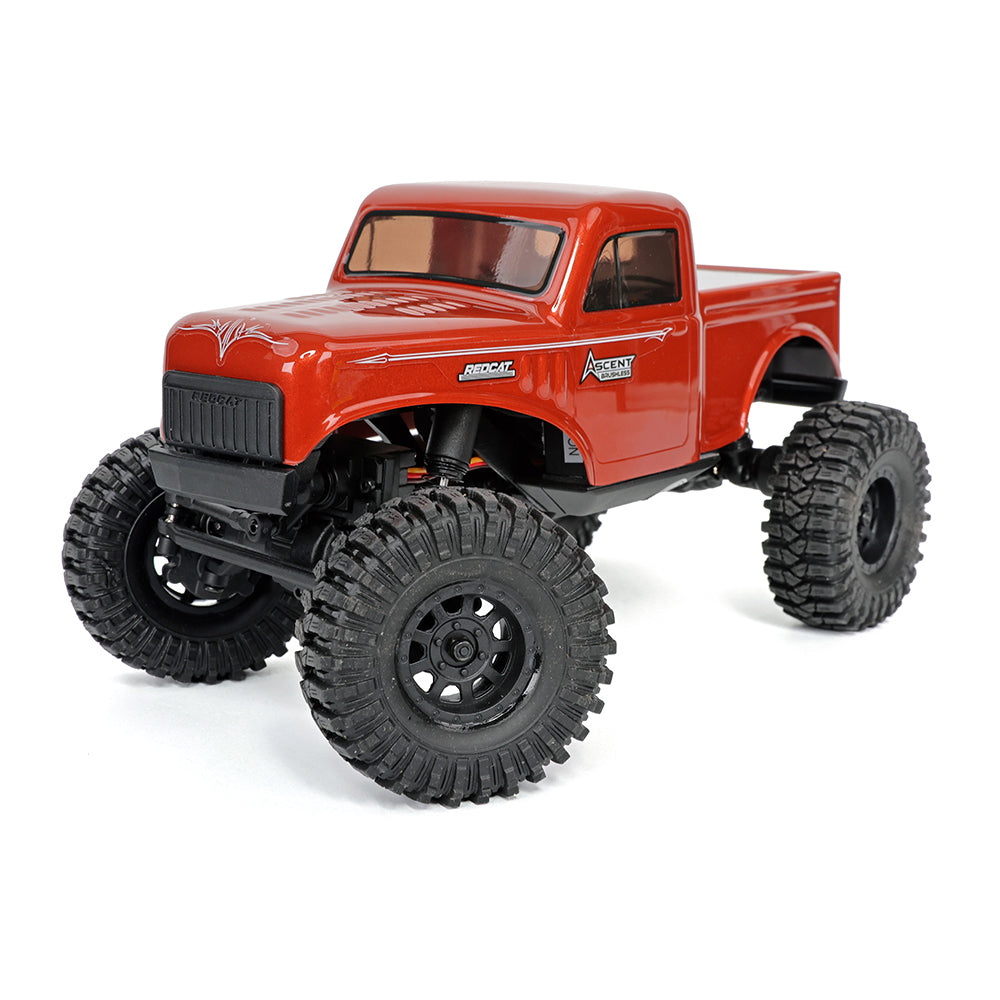
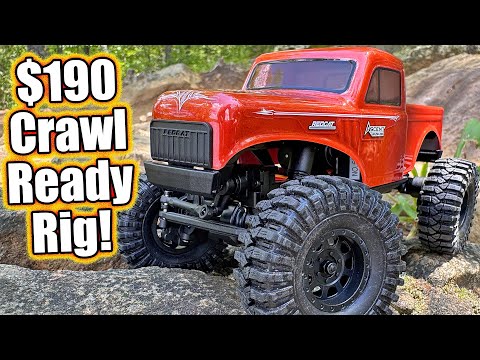
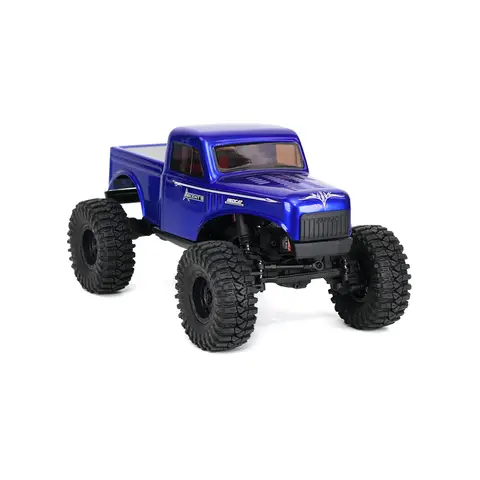
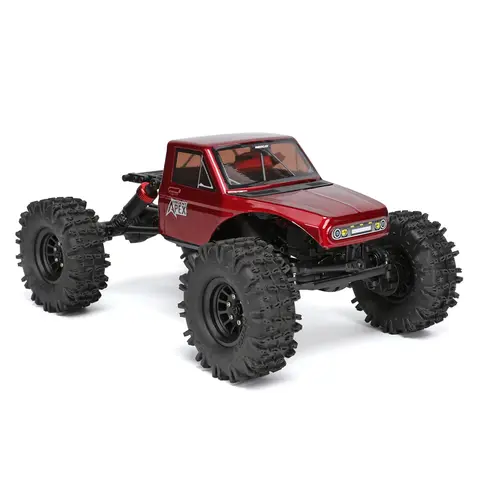
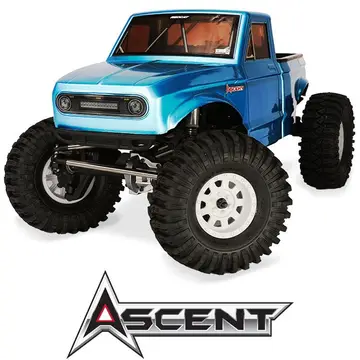
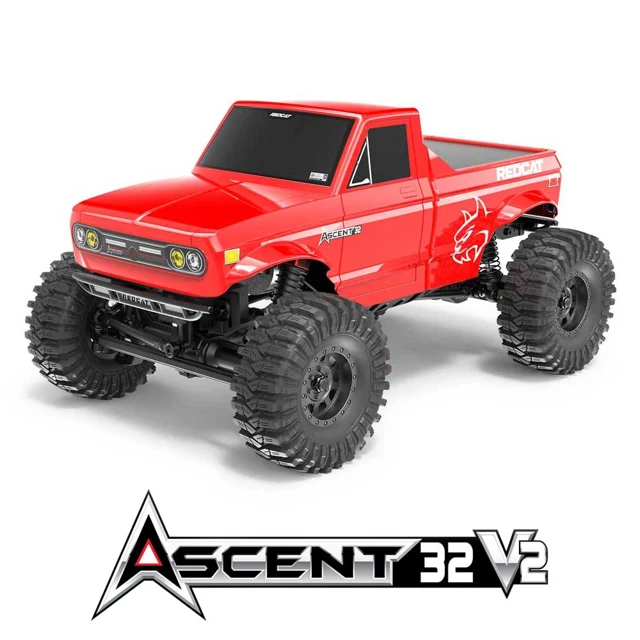
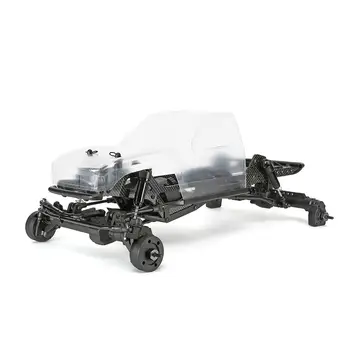
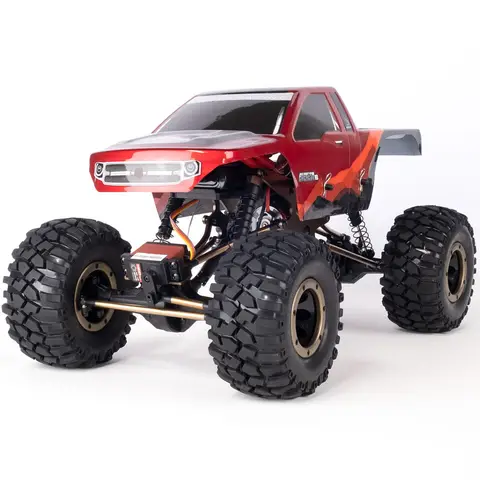
Redcat's Ascent-18 Brushless packages a more developed small crawler beneath a compact Power Wagon-style pickup body. The 1/18 RTR retains the recognizable Ascent layout of aluminum frame rails, four-link suspension and portal axles, while adding a 3450Kv outrunner motor and the revised High Steer front end. Model RER39150 matters here: this is the brushless truck, not the original 2024 brushed Ascent with a different paint scheme.
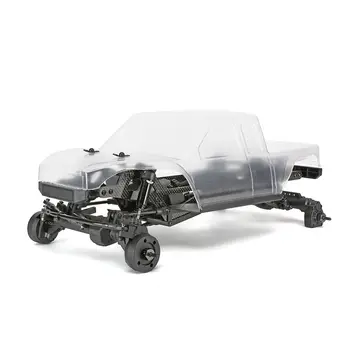
The portals put part of the reduction at the wheels, helping the axle housings clear obstacles without requiring a large truck. Oil-filled dampers, full ball bearings and metal axle gearing give this small vehicle a useful mechanical specification. The front-tilting body provides access to a compact two-in-one ESC and receiver, with a supplied 2S 750mAh battery and USB charger. That integration keeps completion work modest, although future radio or controller changes need to account for the combined unit. Factory equipment and electrical limits (opens in a new tab)
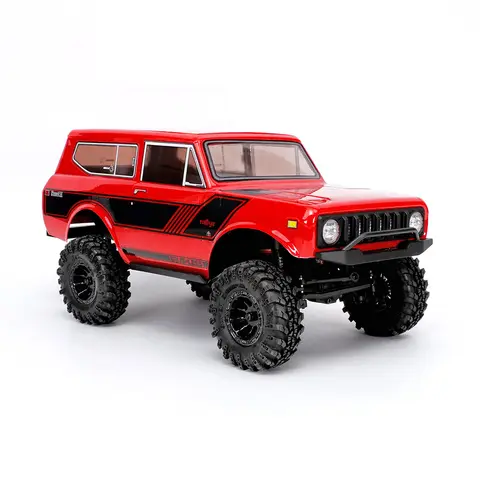
The pickup's character also differs from the Scout-bodied brushless version. It uses smaller side plates and its own tire and body arrangement. The stock brushless power and accessible chassis give the owner a credible place to begin before choosing a particular crawling direction. RC Driver's Power Wagon-style review (opens in a new tab)
The kind of vehicle the maker sells it as. It sets what the car is built to do and which cars it is fair to compare it with.
Crawlers are built for slow, controlled climbing over rocks: very low gearing, flexible suspension and locked axles.
Drive
All four wheels are driven. That gives more grip under power, especially on loose ground.
The cost is more parts to maintain.
A crawler needs every wheel pulling to climb.
Power
A brushless motor has no brushes to wear, so it makes more power and runs more efficiently than a brushed one.
It needs a brushless ESC.
Crawler brushless systems are usually sensored, so the motor turns smoothly from a standstill.
Build
Ready to run: built at the factory with the electronics installed.
Some come without a battery or charger; the maker's box contents say which.
Scale
The maker's nominal size compared with a full-size vehicle. It works more as a class label than a measurement.
A 1/10 monster truck is far bigger than a 1/10 touring car, so compare length and weight for real size.
This one is 265 mm long.
Part number
The maker's product number for this exact version.
A V2, a new color, or a kit instead of an RTR usually has a different number, and parts can differ between them.
Check it against your box or receipt before ordering parts.
Class
Crawler
Drive
4WD
Power
Brushless
Build
Ready to run
Scale
1/18
Part number
RER39150
Drivetrain
Pinion
The small gear on the motor shaft. Fewer teeth gear the car shorter: quicker acceleration, lower top speed and a cooler motor. More teeth do the opposite.
On this car one tooth changes the gearing by about 9.1%.
Crawlers run small pinions for slow, precise wheel speed on climbs; a bigger one is quicker on the trail but harder to control on rocks.
Spur
The large gear the pinion drives. A bigger spur with the same pinion gears the car shorter.
Pinion and spur need matching pitch, or explicit manufacturer confirmation that the exact gears are compatible.
The Gearing parts table below shows this car's pitch and part numbers.
Transmission & axle
Every reduction after the spur, multiplied together: transmission, transfer case and axle gears.
That chain is why a crawler's figure is much higher than other classes'.
It is fixed by the design; the gearing you change is the pinion and spur.
This one is worked out from the tooth counts the maker publishes.
Spur ÷ pinion
Spur teeth divided by pinion teeth: the part of the gearing that a pinion or spur swap changes.
Here it is 3.455:1.
Final drive
How many times the motor turns for one turn of the wheels. A higher number is shorter gearing: more acceleration and pulling power, less top speed.
Among 1/18 crawlers & trail trucks in the catalog, the middle half run between 20.4:1 and 42.8:1 on stock gearing; this one is 67.4:1, shorter than most.
Crawlers run far higher ratios than other classes, so the truck can creep and hold on a climb.
Differentials
The type of each differential, as the maker states it.
A gear or ball diff lets the wheels on one axle turn at different speeds in a corner; a spool or locked diff turns them together for straight-line drive and climbing, at the cost of steering.
Crawlers often lock both axles so every tire pulls on a climb.
Hub bearing size
Hub bearing size: The documented drivetrain connection or size for this exact model. Match the mating component before buying a replacement.
Pinion bore
The nominal size of the hole that mates with the motor shaft.
A nominal shaft fit comes from the exact replacement pinion listing. It does not specify a measured finished hole or manufacturing tolerance.
Match the pinion mounting method as well as its size. A press-fit hole cannot be inferred from motor shaft diameter.
Pinion pitch
The tooth spacing of the fitted gear, stated as metric module or diametral pitch.
Pinion and spur need matching pitch or explicit manufacturer confirmation of compatibility for the exact parts. Mod 0.8 and 32P are different standards; a compatibility statement for particular gears does not apply to every gear. A missing pitch can be inferred from the other fitted gear; module and diametral pitch are not silently converted.
Spur pitch
The tooth spacing of the fitted gear, stated as metric module or diametral pitch.
Pinion and spur need matching pitch or explicit manufacturer confirmation of compatibility for the exact parts. Mod 0.8 and 32P are different standards; a compatibility statement for particular gears does not apply to every gear. A missing pitch can be inferred from the other fitted gear; module and diametral pitch are not silently converted.
The outside diameter of the mounted tire, tread to tread. A taller tire covers more ground each turn, which gears the car taller.
Crawler wheels are named by rim size, such as 1.9 or 2.2 inches; that is the wheel, not this tire diameter.
Rollout
How far the car moves for one turn of the motor: tire circumference divided by final drive.
It lets you compare gearing across different tire sizes; more rollout is taller gearing.
Here it is 2.8 mm.
Wheel hex
The hex on the axle that the wheel locks onto and is driven by. A wheel must match the hex size to fit.
A small hex like this is used on mini and micro cars.
The wheel nut is a separate size, so check its thread too before buying nuts.
Stock wheel diameter
Stock wheel diameter: A documented stock wheel, tire, or axle measurement. Stock dimensions alone do not establish the largest size that will clear the body and suspension.
Stock wheel width
Stock wheel width: A documented stock wheel, tire, or axle measurement. Stock dimensions alone do not establish the largest size that will clear the body and suspension.
Axle thread
Axle thread: A documented stock wheel, tire, or axle measurement. Stock dimensions alone do not establish the largest size that will clear the body and suspension.
This working size comes from a replacement advertised for the identified OEM part. Confirm the fitted part before ordering; a replacement's size may differ.
Stock tire width
Stock tire width: A documented stock wheel, tire, or axle measurement. Stock dimensions alone do not establish the largest size that will clear the body and suspension.
What the main chassis is made of and how it is built, as stated for this car. Braces, stiffeners and skid plates are not counted.
Aluminum is stiffer than composite, which keeps the handling consistent; it can bend in a hard crash, and a bent chassis is usually replaced rather than straightened.
A ladder frame is two rails joined by cross members, as on a full-size truck.
Shocks
What the shocks are and how they are built, as the maker describes them.
Oil-filled shocks damp with silicone oil; friction shocks, found on some entry-level cars, damp with a sprung plunger and cannot be tuned with oil.
Shock length
The stated length of the complete shock assembly. Sources may use mounting-eye centers or a nominal assembly length.
Compare fully extended mounting-eye spacing, compressed length and mounting hardware before ordering. A longer shock changes ride height and travel, and can bind at full droop or bottom out.
This length is from one outside source. Check the linked listing and measure the fitted shocks before buying.
Frontupper shock mount
Front upper shock mount: A documented shock mounting interface at the named end and eye. A ball stud or standoff is distinct from a through-bolt. Match the mounting type, thread and eye dimensions when choosing a replacement shock.
Frontlower shock mount
Front lower shock mount: A documented shock mounting interface at the named end and eye. A ball stud or standoff is distinct from a through-bolt. Match the mounting type, thread and eye dimensions when choosing a replacement shock.
Rearupper shock mount
Rear upper shock mount: A documented shock mounting interface at the named end and eye. A ball stud or standoff is distinct from a through-bolt. Match the mounting type, thread and eye dimensions when choosing a replacement shock.
Rearlower shock mount
Rear lower shock mount: A documented shock mounting interface at the named end and eye. A ball stud or standoff is distinct from a through-bolt. Match the mounting type, thread and eye dimensions when choosing a replacement shock.
55mm listed length, front and rear; Owner-reported Redcat support figure for RER28868, 55mm eye to eye. Extension state was not specified; not a factory-published measurement.Single report
Catalog stock FDR: 67.44:1. The grid uses the listed tooth counts and internal ratio, so rounding or source differences may change the result slightly.
Calculated final drive ratio for each pinion and spur pair
Pinion
36T spur
38T spur
40T spur
9T
10T
11T
12T
13T
14T
Select a pair to compare wheel travel per motor turn with stock. Other cells are mathematical examples, not verified gears or fits. Check pitch, mesh, clearance and motor temperature before changing parts.
About these specs
The manual's spare-parts page lists the transmission as RER39670, which Redcat's parts page describes as 'Low Range Transmission Gears 20.52:1' made up of an 11T pinion, a 38T/16T drive gear, a 39T/16T idler and a 39T output gear.
Read moreShow less
The 11T pinion drives the 38T gear, so 38T is recorded as the spur.
The printed 20.52:1 checks against the teeth: 38/11 x 39/16 x 39/16 = 20.52.
The same page lists the 10T diff pinion (RER29169), the 20T ring gears (RER29170) and the 14T and 23T portal gears (RER29265, RER29266), and Redcat's parts pages list all four as fitting the Ascent 18 Brushless.
The ratio after the spur is therefore 39/16 x 39/16 x 20/10 x 23/14 = 19.52, and the total 38/11 x 19.52 = 67.44.
This is not the brushed Ascent-18's gearing: that car lists the plastic RER29168 set, whose tooth counts are not published.
The 60mm tire and the FS-MD1212 3450KV outrunner are from Redcat's product page.
The built-in ESC is rated for 2S LiPo only, on the product page and in the manual.
RER39150 and RER39151 are colour versions of the same truck.
The7mm wheel hex uses INJORA’s specification for its stock-equivalent Ascent18 hub.
The RER39462 motor shaft is one owner report of 2 mm, labelled Single report; the press-fit pinion bore tolerance remains unconfirmed.
Mofo RC identifies the Ascent-18 stock gear pitch as Mod 0.4 and lists an 11T long APEX pinion.
The same original RER39670 transmission gearset is documented for this version.
The pitch is an aftermarket specification; the meshing spur pitch is inferred.
The replacement pinion's press-fit bore does not establish a factory hole tolerance.
How to read these figures
Stock is as the vehicle ships.
Calculated is worked from the recorded figures on this page.
Derived uses recorded dimensions or arithmetic. The row explains the inference. A nominal mating size is not a measured tolerance or a complete fitment guarantee.
Derived from replacement part uses the listed dimensions of a replacement advertised for the identified OEM part. Treat it as an approximate working size; the factory-fitted part may differ. Calculated performance uses that approximation.
Aftermarket spec is a direct, exact-stock-part statement from an established aftermarket maker. The maker of this vehicle has not confirmed it.
Single report uses one outside source. It is useful as a starting figure, with the source and calculation described in the note.
The top speed is kinematic: an ideal no-load RPM with no slip and no loss under load, so a real car is slower.
Redcat's brushless model (opens in a new tab)redcatracing.comPart pageSupports 13 specificationsUsed forMain specsMotor shaftWeightSizeWheel hexElectronicsDrivetrainWheels & tiresSuspensionPowerSteering & radioBodyIn the boxBackground
Checked task pages, documented requirements and recorded fluid references for this model. Follow the manufacturer's procedure for the exact assembly and revision.
Maintenance bundles
Manual pages, documented requirements and relevant specifications, together by task.
Read moreRead less about upgrades and setup for Redcat Racing Ascent-18 Brushless
Keep the oil-filled dampers and inspect their movement before buying longer replacements. More travel can introduce tire, body or driveshaft interference, so check full steering and suspension movement after any change. This truck's pickup shell and smaller side plates are part of that clearance check; the Scout's body arrangement is different. The High Steer revision also changed the front housing, portal parts, steering links and shafts, making exact part identification important when servicing the front end.[1] Redcat: Power Wagon-style brushless High Steer factory page (opens in a new tab)[2] RC Driver: Power Wagon-style Ascent18 written driving review (opens in a new tab)
This changes the front and rear portal gearing to create a difference in wheel speed between the two axles. It gives you another crawling setup option, using the matched gear pairs at the ends specified by the manufacturer.
Manufacturer-documented option for the specified vehicle configuration.
This is a complete gearbox option with an aluminum housing and stainless-steel gears. The 24:1 version favors slower crawling. INJORA explicitly lists the stock brushless motor as compatible, while excluding the original Redcat 180 brushed motor.
INJORA offers ASC18-37UD for this factory-brushless edition and its stock motor as a component option. The original 180 brushed motor is excluded; 24:1 and 13:1 are separate variants.
Common numbers cover selected core components, not every part. A shared family, manual or listing does not mean the parts fit both vehicles. Check the comparison and upgrade notes before ordering.