Pinion
PinionStock gear13TKyosho
VehiclesKyosho Inferno MP10 SPEC A

1/8 scale · buggy · 33020
Currency estimate using ECB rates (opens in a new tab) (2026-10-06). Regional taxes, shipping and import costs are not adjusted.
Reference prices; current prices may differ.
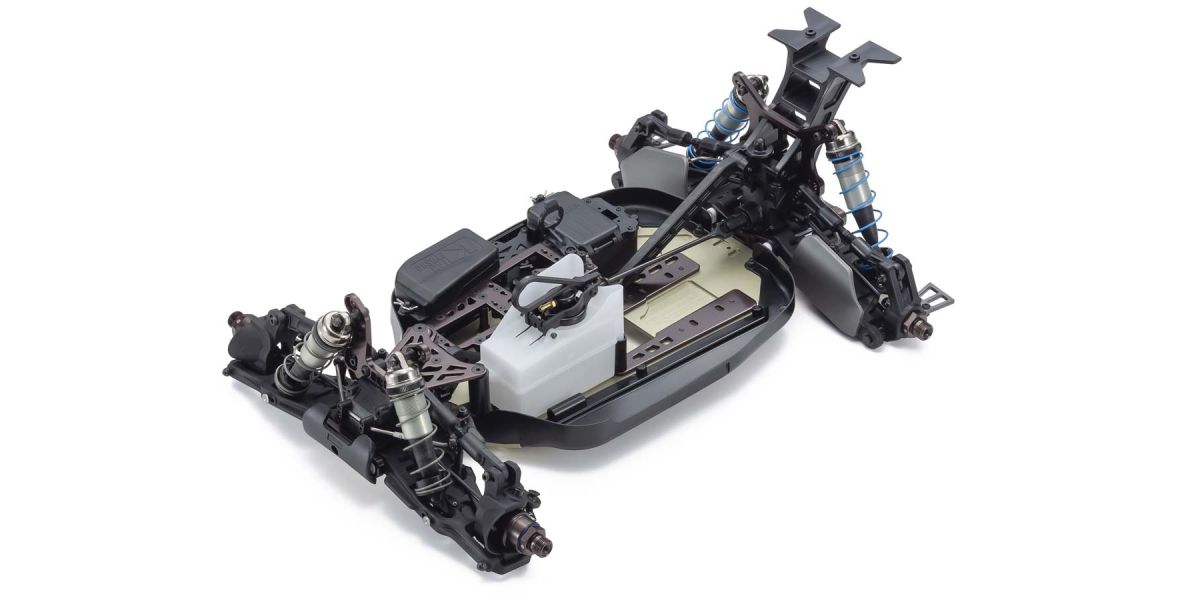
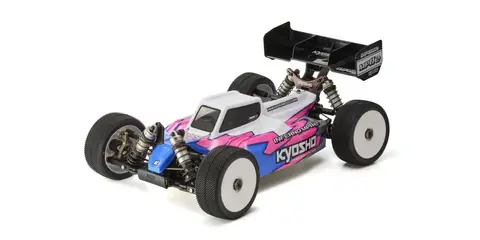
The MP10 SPEC A offers a particular route into Kyosho's .21-powered competition buggy: the major chassis assemblies arrive built, leaving the driver to complete the engine and radio installation. Listed in January 2020, it belongs to the first MP10 generation that followed the MP9. Kyosho credits Yuichi Kanai with the MP10's development and says the SPEC A assemblies were built by specialist staff and individually checked by him.
That preparation reduces the initial assembly workload while leaving the finished specification in the owner's hands. Kyosho MP10 SPEC A (opens in a new tab)
The design addresses contemporary high-grip racing through revised chassis, suspension arms, towers, radio plate and rear wing mounting. Hard-coated threaded big-bore shocks are supplied, along with a pre-cut clear body and wheels. Suspension adjustment includes rear hub collar positions and rear tread changes, so the basic car already provides ways to alter its response. These are reasons to learn the supplied geometry and damping before committing to a later-generation suspension conversion. Architecture and adjustments (opens in a new tab)
Preassembly still leaves consequential work. The engine, clutch, manifold and muffler must be installed; throttle and brake linkages need setting; tires and inserts require selection and gluing. The body needs painting and openings matched to the chosen engine head and exhaust. The SPEC A suits someone who wants a competition chassis with less initial construction, while accepting the fitting, maintenance and tuning that accompany a nitro race car. Understanding those completed assemblies also matters when the time comes to rebuild them. Finishing the kit (opens in a new tab)
| Spec | Value | Basis |
|---|---|---|
| Vehicle | ||
| ||
| Class | Buggy | |
| Drive | 4WD | |
| Power | Nitro | |
| Build | Kit | |
| Scale | 1/8 | |
| Part number | 33020 | |
| Drivetrain | ||
| ||
| Pinion | Stock | |
| Spur | Stock | |
| Transmission & axle | 3.31:1Derived | Derived |
| Spur ÷ pinion | 3.538:1Calculated | Calculated |
| Final drive | 11.70:1Stock | Stock |
| Differentials | Gearfront, center and rearStock | Stock |
| Wheels & tires | ||
| ||
| Tire diameter | Not applicable | |
| Wheel hex | 17 mmDerived from replacement part | Derived from replacement part |
| Stock wheel diameter | Approximately 83 mm outside diameterApproximate IFH006-family reference for wheel outside diameter; bead-seat diameter is a separate measurement.Single report | Single report |
| Suspension | ||
| ||
| Shocks | Threadedbig bore, front and rearStock | Stock |
| Shock bore | 16mm, front and rear; Nominal 16 mm stock shock size derived from the documented stock piston family and a dimensioned piston for the same Kyosho big-shock family.Aftermarket spec | Aftermarket spec |
| Power | ||
| ||
| Motor | Not applicable | |
| Motor shaft | Not applicable | |
| Battery | Not applicable | |
| Performance | ||
| ||
| Theoretical top speed | Not applicable | |
| Size & weight | ||
| ||
| Weight | 3.36 kg (7.4 lb)Stock | Stock |
| Length | 490 mm19.3 inStock | Stock |
| Width | 307 mm12.1 inStock | Stock |
| Height | 180 mm7.1 inStock | Stock |
| Wheelbase | 328 mm12.9 inStock | Stock |
Alternative gear fitment is unverified.
Stock 13T pinion / 46T spur Internal ratio 3.31:1 fixed
| Pinion | 44T spur | 46T spur | 48T spur |
|---|---|---|---|
| 11T | |||
| 12T | |||
| 13T | |||
| 14T | |||
| 15T | |||
| 16T |
Select a pair to compare wheel travel per motor turn with stock. Other cells are mathematical examples, not verified gears or fits. Check pitch, mesh, clearance and motor temperature before changing parts.
Nitro kit; the 21 class engine and the tires are sold separately.
9 source links for this model.
The MP10 SPEC A arrives with its main chassis assemblies built, but it still needs an engine, exhaust, radio equipment and tires. Finish the throttle and brake linkages, body openings and tire assembly carefully before choosing race options. Its aluminum oil shocks and standard MP10 suspension provide a usable starting point.[1] Exact numbered kit equipment and completion requirements (opens in a new tab)[2] Factory assembly and service requirements (opens in a new tab)
Treat the preassembled chassis as a first-generation MP10 when ordering suspension parts. Later TKI2 shock towers, cases and shafts change suspension length, so replace the matching assembly rather than adding one longer part. Check free suspension movement and consistent shock action before changing spring or oil settings.[1] Exact numbered kit equipment and completion requirements (opens in a new tab)[2] Factory assembly and service requirements (opens in a new tab)[3] Reno Savoya nine-month TKI2 race follow-up (opens in a new tab)
Tune steering, rear support and differential behavior together as grip and bumps change. Longer-shock and front-geometry choices can change how readily the car turns, so compare consistent runs before keeping them. Use a setup from similar ground and grip rather than copying a race build unchanged.[3] Reno Savoya nine-month TKI2 race follow-up (opens in a new tab)[4] Full first-generation and TKI3 owner comparison (opens in a new tab)
Skid plates provide replaceable front and rear wear surfaces. Inspect their screw holes during differential service as well as the underside: repeated removal can wear the mounting area before the sliding surface is exhausted. Replace a plate that no longer sits securely rather than relying on its remaining thickness.[5] DE Racing MP10 front wear plate (opens in a new tab)[6] DE Racing MP10 rear wear plates (opens in a new tab)[7] All five original wear-plate owner reviews (opens in a new tab)

Factory suspension, drivetrain and service options for this numbered MP10 kit. Match the installed assembly.
Browse parts at Kyosho (opens in a new tab)
MP10 front BumpSkid wear plate. Check the mounting area during differential service.
Browse parts at DE Racing (opens in a new tab)
MP10 titanium threaded lower shock pins, with right and left threads.
Browse parts at Klinik RC (opens in a new tab)
First-generation and TKI3 builds, longer shocks, dirt-track settings and modified front suspension. French-language discussion.
Read MP10 generation and suspension setup discussions (opens in a new tab)
Covers the first MP10 build and its new parts. Later TKI versions and the preassembled Readyset use different equipment.

Explains nine months of MP10 TKI2 setup and option choices. It covers a race build with different equipment from the first MP10 and the Readyset.
Loading parts…
1 spec-only records. Key assemblies include recorded gear and shock identifiers. Open a part for its listing sources.
No reviewed platform or substantial structural connection is recorded for this exact model yet.
Browse 7 more Kyosho models.