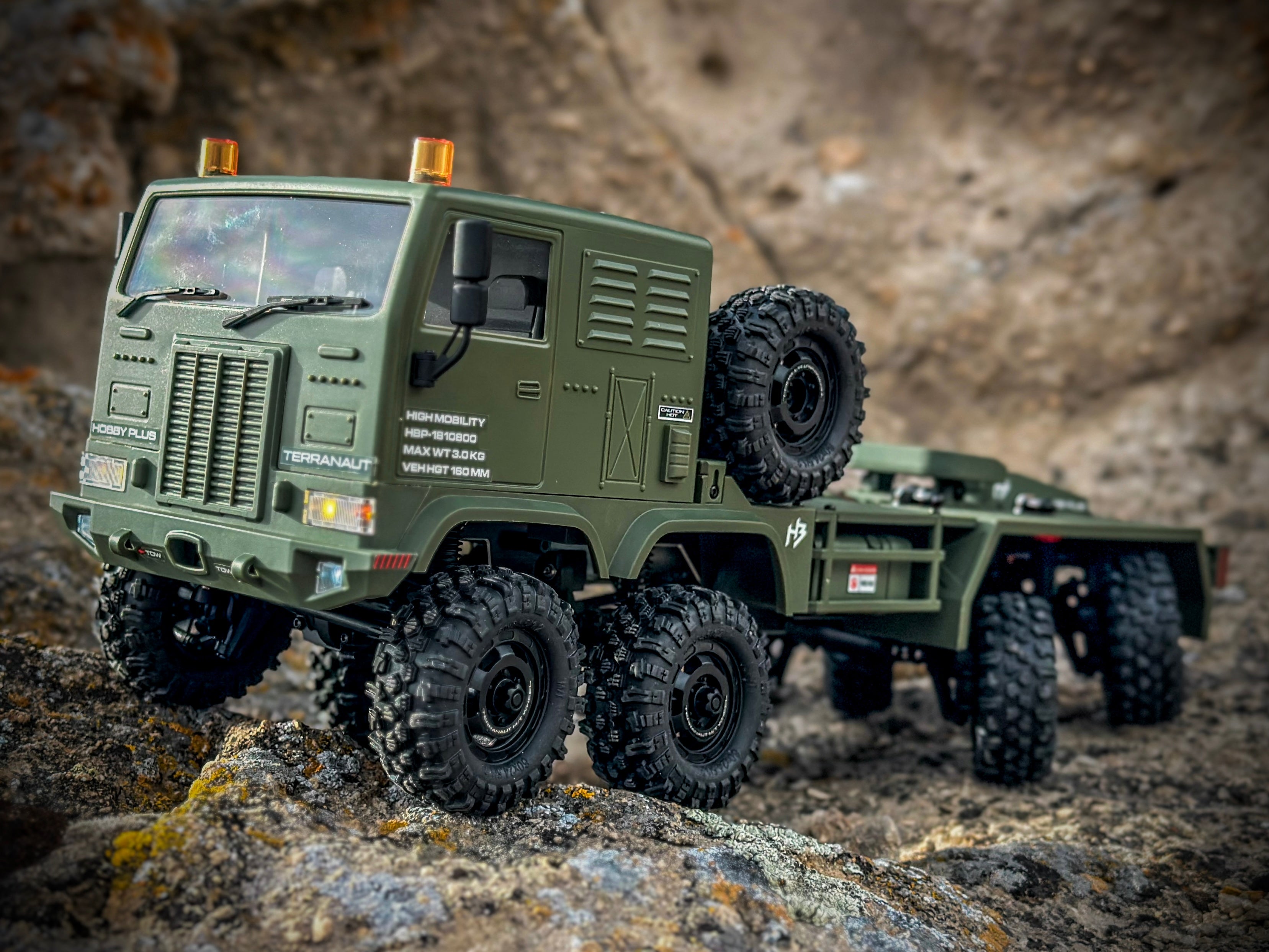
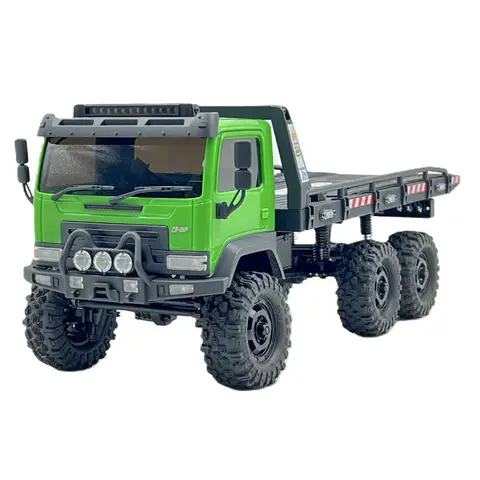
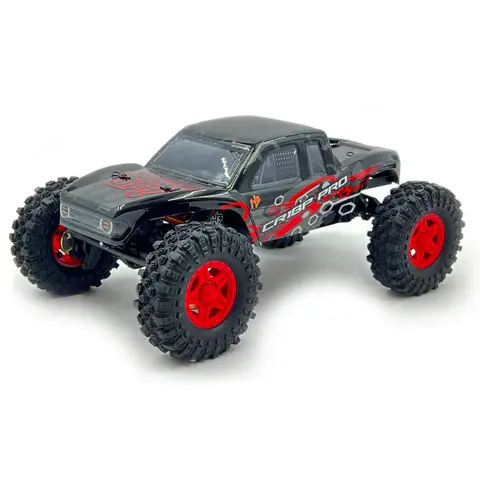
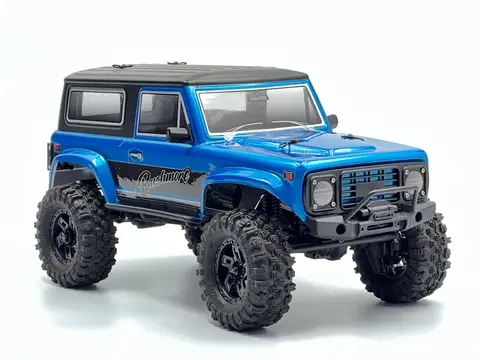
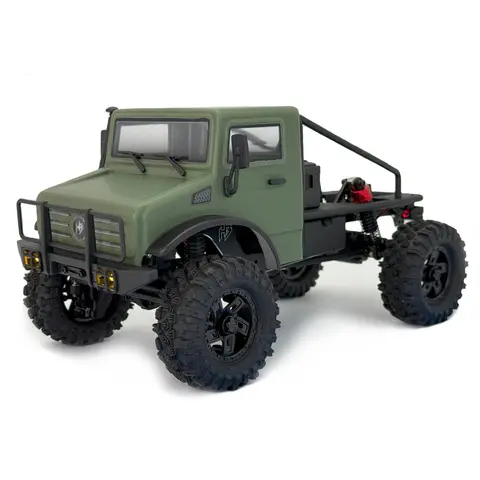
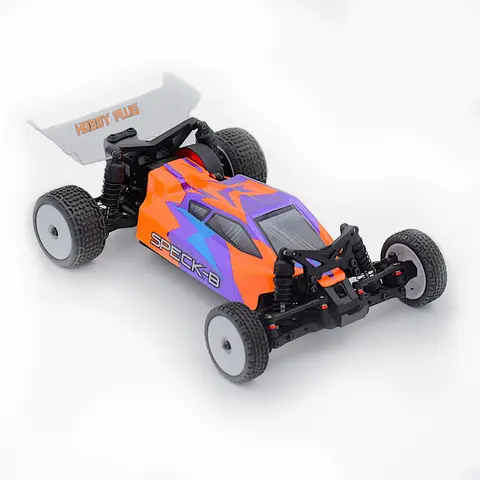
The Hobby Plus CR18P Terranaut is an eight-wheel-drive crawler with remotely controlled rear steering, a working winch and a two-speed transmission.
Its brushed motor turns 60mm tires through a 31.15:1 high gear or a 124.6:1 low gear. The receiver and speed controller support packs up to 2S through an XT30 connector. Save the published total reduction with your chosen gear range when comparing tire changes, and measure the battery space before selecting a replacement pack.
The kind of vehicle the maker sells it as. It sets what the car is built to do and which cars it is fair to compare it with.
Crawlers are built for slow, controlled climbing over rocks: very low gearing, flexible suspension and locked axles.
Power
A brushed motor carries current through carbon brushes that rub on the commutator.
It is cheaper and smooth at low speed.
The brushes wear and the motor loses power over time.
That low-speed smoothness is why so many crawlers use one.
Build
Ready to run: built at the factory with the electronics installed.
Some come without a battery or charger; the maker's box contents say which.
Scale
The maker's nominal size compared with a full-size vehicle. It works more as a class label than a measurement.
A 1/10 monster truck is far bigger than a 1/10 touring car, so compare length and weight for real size.
Class
Crawler
Power
Brushed
Build
Ready to run
Scale
1/18
Drivetrain
Pinion
The small gear on the motor shaft. Fewer teeth gear the car shorter: quicker acceleration, lower top speed and a cooler motor. More teeth do the opposite.
It depends on the motor you fit, so the maker does not list one.
Spur
The large gear the pinion drives. A bigger spur with the same pinion gears the car shorter.
Pinion and spur must have the same pitch, or tooth size, to mesh.
Transmission & axle, high range
Every reduction after the spur, multiplied together: transmission, transfer case and axle gears.
That chain is why a crawler's figure is much higher than other classes'.
It is fixed by the design; the gearing you change is the pinion and spur.
This is the high range, which sets top speed and is what the calculators load first.
Final drive, high range
How many times the motor turns for one turn of the wheels. A higher number is shorter gearing: more acceleration and pulling power, less top speed.
Among 1/18 crawlers & trail trucks in the catalog, the middle half run between 20.4:1 and 38.5:1 on stock gearing; this one is 31.2:1.
Crawlers run far higher ratios than other classes, so the truck can creep and hold on a climb.
This is the high range, which sets top speed and is what the calculators load first.
Final drive, low range
The final drive in low range, where a crawler spends most of its time: slower and stronger, for climbs and fine control.
It is 4.0 times the high range.
Switch the calculators to Low to work in this range.
Range change
This vehicle has a two-speed transmission: a high range for speed and a low range for crawling.
A small servo moves the shift fork, so the range changes from a switch on the transmitter, even on the move.
Both ranges share the pinion and spur.
Pinion
Not published
Spur
Not published
Transmission & axle, High range
Not published
Final drive, High range
31.15:1Stock
Stock
Final drive, Low range
124.60:1Stock
Stock
Range change
Two-speed, switched from the transmitterStock
Stock
Wheels & tires
Tire diameter
The outside diameter of the mounted tire, tread to tread. A taller tire covers more ground each turn, which gears the car taller.
Crawler wheels are named by rim size, such as 1.9 or 2.2 inches; that is the wheel, not this tire diameter.
Rollout, high range
How far the car moves for one turn of the motor: tire circumference divided by final drive.
It lets you compare gearing across different tire sizes; more rollout is taller gearing.
Here it is 6.1 mm.
This is the high range, which sets top speed and is what the calculators load first.
Rollout, low range
How far the truck moves for one turn of the motor in low range.
Here it is 1.5 mm.
Tire diameter
60mmStock
Stock
Rollout, High range
6.1mm per motor turnCalculated
Calculated
Rollout, Low range
1.5mm per motor turnCalculated
Calculated
Suspension
Shocks
What the shocks are and how they are built, as the maker describes them.
Oil-filled shocks damp with silicone oil; friction shocks, found on some entry-level cars, damp with a sprung plunger and cannot be tuned with oil.
Shocks
Oil-filledfront and rearStock
Stock
Power
Motor
Brushed motors are rated by can size and turns rather than KV, so there is no KV to show.
Battery
The highest LiPo cell count the maker rates the electronics for. Each cell is 3.7 V nominal and 4.2 V fully charged.
2S is 7.4 V nominal and 8.4 V off the charger.
Running more cells than this risks the ESC and motor.
Many cars also run on fewer cells, only slower.
Stock motor
The motor fitted at the factory, as the maker names it.
Brushed motors are often named by can size, such as 540 or 550, and by turns: fewer turns is faster.
Stock ESC
The electronic speed control. It feeds power from the battery to the motor as you work the throttle, and usually powers the receiver and servo too.
An amp figure in its name is normally the maker's continuous rating.
A brushed ESC cannot run a brushless motor.
Crawler ESCs usually have a strong drag brake, which holds the truck still on a slope when you let off the throttle.
Set its low-voltage cutoff for LiPo, so a pack is not run flat.
Battery connector
The plug on the battery lead. Your battery needs the same plug.
An adapter works, but it adds resistance and another joint that can work loose.
Motor size
The size of the stock motor's can, as the maker names it.
280 is a standard can size; a larger number is a longer can with more torque.
ESC rating
The current the stock speed control is rated to carry, as the maker states it.
The continuous figure is what it can carry all run; the burst figure only for moments, such as a launch.
A motor or pack that pulls more than this risks the ESC.
Motor
Not applicable
Battery
2SLiPoStock
Stock
Stock motor
Big Block 280 sizeStock
Stock
Stock ESC
FS-HBP-R6A4-BSStock
Stock
Battery connector
XT30Stock
Stock
Motor size
280canStock
Stock
ESC rating
10 Acontinuous, 50 A burstStock
Stock
Steering & radio
Transmitter
The stock transmitter, the radio you hold.
Two channels are steering and throttle; more channels work extras such as a two-speed, lights or a winch.
Receiver
The stock receiver in the car, which takes the transmitter's signal to the servo and ESC.
Another transmitter works with it only if it speaks the same protocol.
Transmitter
FS-HBP-MG6A-BS6-channelStock
Stock
Receiver
FS-HBP-R6A4-BS6-channelStock
Stock
Performance
Theoretical top speed
A brushed motor has no KV rating, so no theoretical top speed is worked out. Compare gearing by rollout instead.
Theoretical top speed
Not applicable
Size & weight
Weight
The vehicle's weight as the maker states it.
The maker does not say whether it includes a battery.
On a crawler, where the weight sits matters as much as how much: weight low and in the axles helps it climb.
Weight
1.18 kg (2.6 lb)Stock
Stock
How to read these figures
Stock is as the vehicle ships.
Calculated is worked from the stock figures on this page rather than stored beside them, so the two cannot drift apart.
Not applicable means the vehicle does not come with it, like the motor on a roller or the tires on a race kit, or does not have one, like a KV rating on a brushed motor.
Not published means it exists but no source we could find prints it.