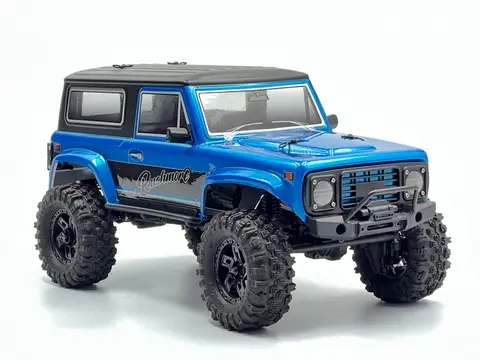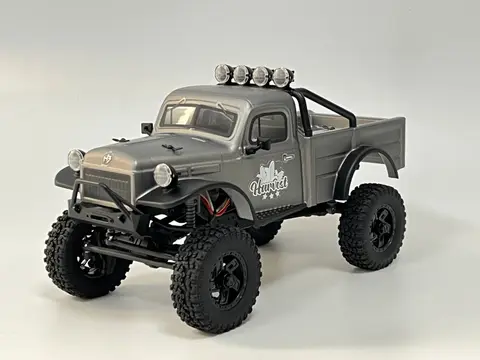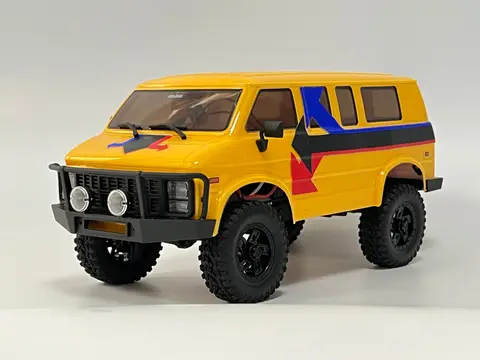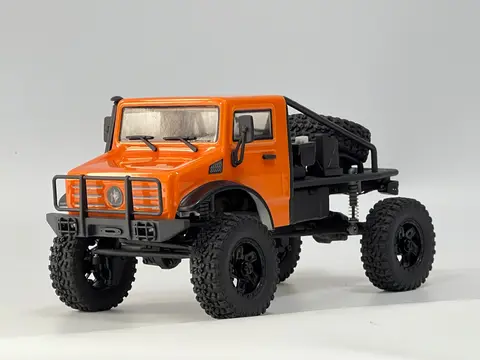
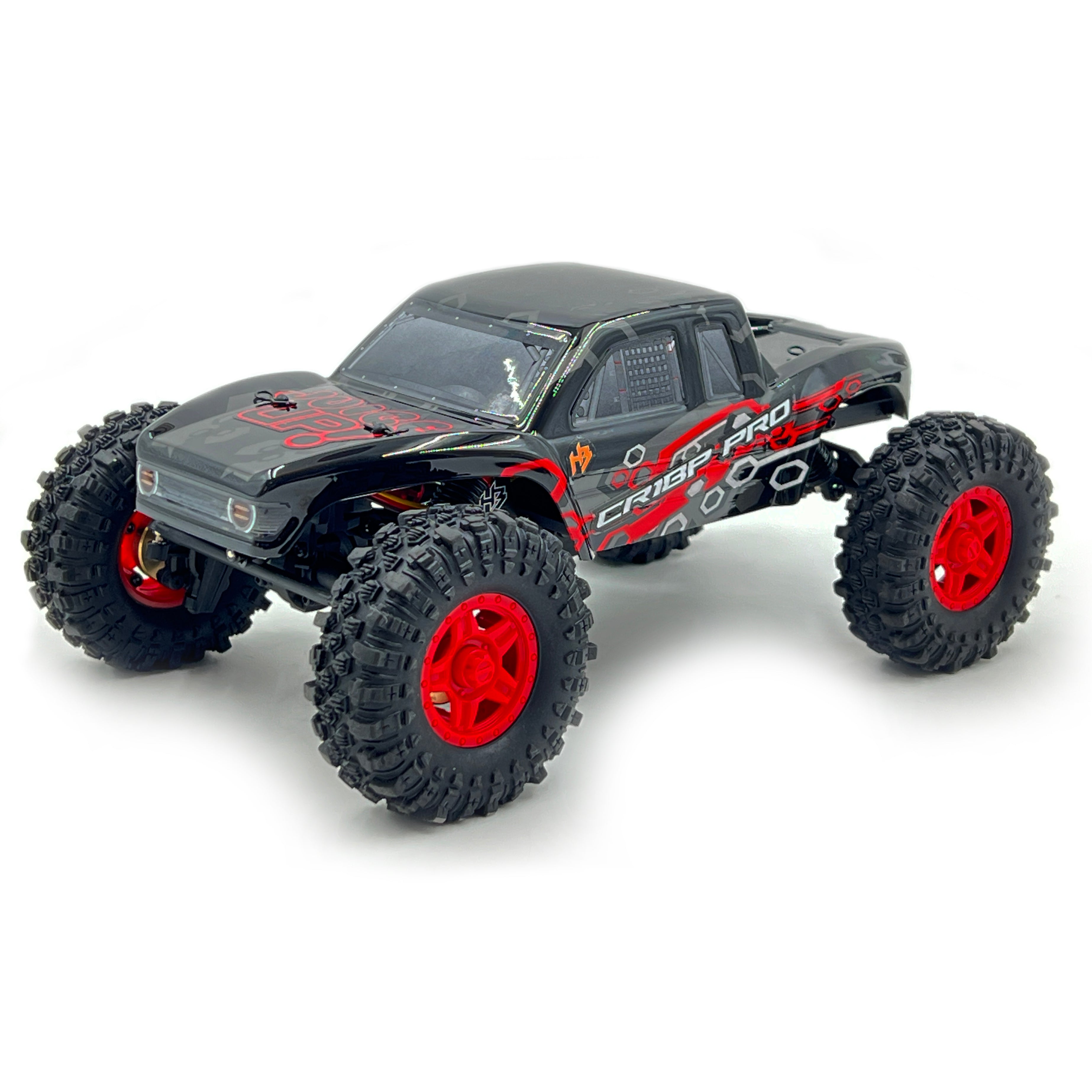



The CR18P Pro Juice Up Edition is a 1/18-scale four-wheel-drive trail and crawling model in Hobby Plus's range. It is supplied assembled with factory running equipment. Source details (opens in a new tab)
Read moreShow less
Portal reduction gears sit at the wheel ends rather than using a straight axle layout. Keep the portal gear assemblies and their covers in mind when identifying axle service parts. Source details (opens in a new tab)
Drive the Juice Up in its factory form before adding a full set of brass parts. It already has weighted wheels, front brass hexes and slower rear-axle gearing, so there is no empty starting point to fill. Extra low-mounted weight can help a particular obstacle, but it also asks more of the steering and drivetrain. Compare the same lines before and after a change rather than treating the parts list as a performance score. Source details (opens in a new tab)Supporting source (opens in a new tab)
The kind of vehicle the maker sells it as. It sets what the car is built to do and which cars it is fair to compare it with.
Crawlers are built for slow, controlled climbing over rocks: very low gearing, flexible suspension and locked axles.
Drive
All four wheels are driven. That gives more grip under power, especially on loose ground.
The cost is more parts to maintain.
A crawler needs every wheel pulling to climb.
Power
A brushless motor has no brushes to wear, so it makes more power and runs more efficiently than a brushed one.
It needs a brushless ESC.
Crawler brushless systems are usually sensored, so the motor turns smoothly from a standstill.
Build
Ready to run: built at the factory with the electronics installed.
Some come without a battery or charger; the maker's box contents say which.
Scale
The maker's nominal size compared with a full-size vehicle. It works more as a class label than a measurement.
A 1/10 monster truck is far bigger than a 1/10 touring car, so compare length and weight for real size.
This one is 225 mm long.
Part number
The maker's product number for this exact version.
A V2, a new color, or a kit instead of an RTR usually has a different number, and parts can differ between them.
Check it against your box or receipt before ordering parts.
Class
Crawler
Drive
4WD
Power
Brushless
Build
Ready to run
Scale
1/18
Part number
HBP1810360
Drivetrain
Pinion
The small gear on the motor shaft. Fewer teeth gear the car shorter: quicker acceleration, lower top speed and a cooler motor. More teeth do the opposite.
On this car one tooth changes the gearing by about 9.1%.
Crawlers run small pinions for slow, precise wheel speed on climbs; a bigger one is quicker on the trail but harder to control on rocks.
Spur
The large gear the pinion drives. A bigger spur with the same pinion gears the car shorter.
Pinion and spur need matching pitch, or explicit manufacturer confirmation that the exact gears are compatible.
The Gearing parts table below shows this car's pitch and part numbers.
Spur ÷ pinion
Spur teeth divided by pinion teeth: the part of the gearing that a pinion or spur swap changes.
Here it is 4.000:1.
Differentials
The type of each differential, as the maker states it.
A gear or ball diff lets the wheels on one axle turn at different speeds in a corner; a spool or locked diff turns them together for straight-line drive and climbing, at the cost of steering.
Crawlers often lock both axles so every tire pulls on a climb.
Pinion pitch
The tooth spacing of the fitted gear, stated as metric module or diametral pitch.
Pinion and spur need matching pitch or explicit manufacturer confirmation of compatibility for the exact parts. Mod 0.8 and 32P are different standards; a compatibility statement for particular gears does not apply to every gear. A missing pitch can be inferred from the other fitted gear; module and diametral pitch are not silently converted.
Spur pitch
The tooth spacing of the fitted gear, stated as metric module or diametral pitch.
Pinion and spur need matching pitch or explicit manufacturer confirmation of compatibility for the exact parts. Mod 0.8 and 32P are different standards; a compatibility statement for particular gears does not apply to every gear. A missing pitch can be inferred from the other fitted gear; module and diametral pitch are not silently converted.
Axle drive, front
Whether the front axle is driven by the motor.
The calculator uses this axle's own tire size and complete recorded gear path.
Axle drive, rear
Whether the rear axle is driven by the motor.
The calculator uses this axle's own tire size and complete recorded gear path.
Transmission & axle, front
Every reduction after the spur, multiplied together: transmission, transfer case and axle gears.
That chain is why a crawler's figure is much higher than other classes'.
It is fixed by the design; the gearing you change is the pinion and spur.
This one is worked out from the tooth counts the maker publishes.
Transmission & axle, rear
Every reduction after the spur, multiplied together: transmission, transfer case and axle gears.
That chain is why a crawler's figure is much higher than other classes'.
It is fixed by the design; the gearing you change is the pinion and spur.
This one is worked out from the tooth counts the maker publishes.
Final drive, front
How many times the motor turns for one turn of the wheels. A higher number is shorter gearing: more acceleration and pulling power, less top speed.
Among 1/18 crawlers & trail trucks in the catalog, the middle half run between 20.4:1 and 42.8:1 on stock gearing; this one is 97.9:1, shorter than most.
Crawlers run far higher ratios than other classes, so the truck can creep and hold on a climb.
Final drive, rear
How many times the motor turns for one turn of the wheels. A higher number is shorter gearing: more acceleration and pulling power, less top speed.
Among 1/18 crawlers & trail trucks in the catalog, the middle half run between 20.4:1 and 42.8:1 on stock gearing; this one is 124.6:1, shorter than most.
Crawlers run far higher ratios than other classes, so the truck can creep and hold on a climb.
Axle coupling
How the driven axles are connected.
The coupling has not been established from a source. It is not inferred from 4WD or from the axle differentials.
Front/rear rollout difference
Front rollout divided by rear rollout, minus one, expressed as a percentage at equal axle-input RPM.
The front tires cover 27.3% more distance than the rear at equal axle-input RPM, using the listed diameters and reductions. The connection between axle inputs is not recorded, so its ability to accommodate a mismatch is unknown. These figures do not predict vehicle road speed.
Positive means the front covers more distance per input turn. Zero means matching rollout, rather than matching wheel RPM.
The outside diameter of the mounted tire, tread to tread. A taller tire covers more ground each turn, which gears the car taller.
Crawler wheels are named by rim size, such as 1.9 or 2.2 inches; that is the wheel, not this tire diameter.
Wheel hex
The hex on the axle that the wheel locks onto and is driven by. A wheel must match the hex size to fit.
A small hex like this is used on mini and micro cars.
The wheel nut is a separate size, so check its thread too before buying nuts.
Stock wheel diameter
Stock wheel diameter: A documented stock wheel, tire, or axle measurement. Stock dimensions alone do not establish the largest size that will clear the body and suspension.
Stock tire width
Stock tire width: A documented stock wheel, tire, or axle measurement. Stock dimensions alone do not establish the largest size that will clear the body and suspension.
This working size comes from a replacement advertised for the identified OEM part. Confirm the fitted part before ordering; a replacement's size may differ.
Rollout, front
Distance at the front axle per motor turn through its recorded gear path.
This follows the listed gear reduction and tire diameter; it does not account for tire slip or deflection.
Rollout, rear
Distance at the rear axle per motor turn through its recorded gear path.
This follows the listed gear reduction and tire diameter; it does not account for tire slip or deflection.
2.2mm per motor turn, nominal axle inputsCalculated
Calculated
Rollout, rear
1.7mm per motor turn, nominal axle inputsCalculated
Calculated
Suspension
Shocks
What the shocks are and how they are built, as the maker describes them.
Oil-filled shocks damp with silicone oil; friction shocks, found on some entry-level cars, damp with a sprung plunger and cannot be tuned with oil.
Threaded bodies set ride height with a collar you turn, rather than clips.
A bigger bore moves more oil for the same travel, which damps more consistently and runs cooler.
Shock length
The stated length of the complete shock assembly. Sources may use mounting-eye centers or a nominal assembly length.
Compare fully extended mounting-eye spacing, compressed length and mounting hardware before ordering. A longer shock changes ride height and travel, and can bind at full droop or bottom out.
This length is from one outside source. Check the linked listing and measure the fitted shocks before buying.
55mm listed length, front and rear; Listed stock damper length. The supplier leaves the adjustment setting and measurement endpoints unspecified.Single report
Calculated final drive ratio for each pinion and spur pair
Pinion
42T spur
44T spur
46T spur
9T
10T
11T
12T
13T
14T
Select a pair to compare wheel travel per motor turn with stock. Other cells are mathematical examples, not verified gears or fits. Check pitch, mesh, clearance and motor temperature before changing parts.
About these specs
The front and rear axles are geared differently, so there is no single overall ratio.
Read moreShow less
This truck uses the EVO transmission's low gear, with a 13T/26T front ring and pinion, an 11T/28T rear ring and pinion, and 15T/23T portal gears at both ends.
The resulting final drives are 97.9:1 at the front and 124.6:1 at the rear, where the underdrive slows the wheels for crawling.
The single-speed transmission uses an 11T motor pinion and a 0.4-module gear mesh.
The motor is a Hobbywing 1621 3500kv outrunner on a waterproof Mini 24 ESC; Hobby Plus calls it a 2-3S power system and ships it with a 3S 360mAh pack.
The 68mm tire is from both the product page and the chart.
Colour variants carry JURD and JUYW suffixes on this base number.
The original motor drives the 44T outer gear of the large 240305 compound spur, counted from the exact Hobby Plus replacement image.
How to read these figures
The front tires cover 27.3% more distance than the rear at equal axle-input RPM, using the listed diameters and reductions. The connection between axle inputs is not recorded, so its ability to accommodate a mismatch is unknown. These figures do not predict vehicle road speed.
Stock is as the vehicle ships.
Calculated is worked from the recorded figures on this page.
Derived uses recorded dimensions or arithmetic. The row explains the inference. A nominal mating size is not a measured tolerance or a complete fitment guarantee.
Derived from replacement part uses the listed dimensions of a replacement advertised for the identified OEM part. Treat it as an approximate working size; the factory-fitted part may differ. Calculated performance uses that approximation.
Single report uses one outside source. It is useful as a starting figure, with the source and calculation described in the note.
Not published means it exists but no source we could find prints it.
The top speed is kinematic: an ideal no-load RPM with no slip and no loss under load, so a real car is slower.
Source details (opens in a new tab)hbplusrc.comPart pageSupports 11 specificationsUsed forMain specsMotor shaftWeightSizeFluidsElectronicsDrivetrainSuspensionPowerSteering & radioIn the boxBackground
Source details (opens in a new tab)cdn.shopify.comPDFSupports 7 specificationsUsed forMain specsWeightSizeBattery fitElectronicsWheels & tiresSteering & radioBackground
Drive the Juice Up in its factory form before adding a full set of brass parts. It already has weighted wheels, front brass hexes and slower rear-axle gearing, so there is no empty starting point to fill. Extra low-mounted weight can help a particular obstacle, but it also asks more of the steering and drivetrain. In the linked repair thread, the first brief run after adding weights showed little difference; a later outing felt more planted. Compare the same lines before and after a change rather than treating the parts list as a performance score.[1] Exact Juice Up factory equipment and transmission (opens in a new tab)[2] Juice Up repair, brass, steering and link follow-through (opens in a new tab)
If the drivetrain clicks or loses drive, inspect the damaged gears and clear every loose fragment before running it again. The repair thread followed several failures, and a later reverse-only click was traced to debris left in the transmission. Case flex and drivetrain slack were discussed, but neither was established as the cause. Another owner in the same discussion had no comparable failures. That makes careful inspection worthwhile without turning an isolated repair sequence into a claim that every Juice Up needs a new gearbox.[2] Juice Up repair, brass, steering and link follow-through (opens in a new tab)
Read moreRead less about upgrades and setup for CR18P Pro Juice Up Edition
After changing shock position or links, check that the steering servo clears the frame rails through the full suspension movement. The same build gained articulation but then caught the stock servo's mounting ears on the chassis. A direct-mount replacement later improved clearance and was reported to work well, although that is one build's result rather than a durability ranking. Check the servo's mount, horn, connector and permitted supply voltage together, then set the steering travel so it stops before the linkage binds.[2] Juice Up repair, brass, steering and link follow-through (opens in a new tab)
Route the servo wires away from the rotating outside of the outrunner motor. The repair thread found wire rubbing before a later servo failure, but did not establish that the rubbing caused it. Keep enough slack for axle movement while securing the wire where the motor cannot touch it. Higher servo voltage is a separate compatibility decision, not a cure for mechanical interference or a setting to copy without checking the servo and receiver ratings.[2] Juice Up repair, brass, steering and link follow-through (opens in a new tab)
Aluminum links still need attention to the supplied bushings. In the completed installation, a bushing had to be turned for shock and frame clearance, and one O-ring gave freer movement than either two rings or none. That is a useful reminder to check the joint with the screws tight, rather than applying the same ring arrangement everywhere. A separate French Juice Up build installed heavier wheels, portal weights and steering parts, but its later update offered only a short outdoor video and no long-term comparison. Keep weight and clearance changes separate so you can tell what actually helped.[2] Juice Up repair, brass, steering and link follow-through (opens in a new tab)[3] French Juice Up installed parts and later follow-up (opens in a new tab)
Option suppliers
Hobby Plus
Maker option parts for this edition; retain each part’s axle, wheel-pin and electronics requirements.
Do U RC introduces the single-speed Juice Up with Hobbywing brushless electronics, portal axles and the factory tire setup. The focus is the performance-oriented RTR rather than the earlier two-speed EVO Pro.
Cape Crawlers looks at the Juice Up as a performance-focused RTR, including its brushless system, factory brass and slower rear axle. It gives a complementary introduction to the model before moving into aftermarket projects.