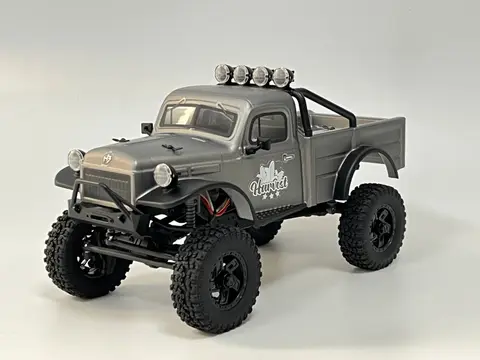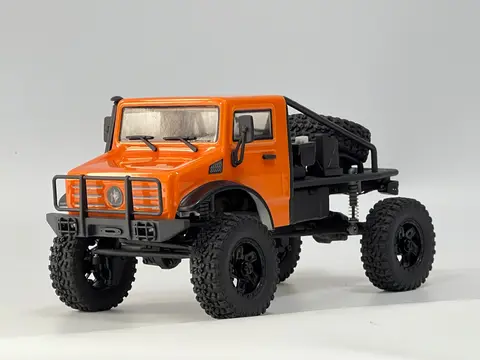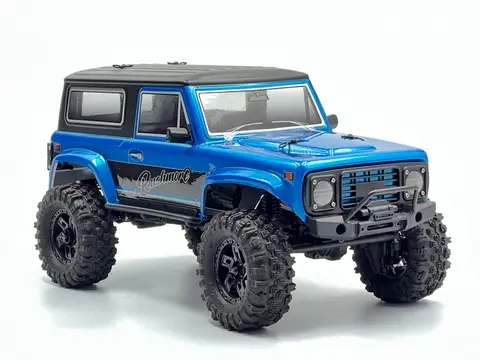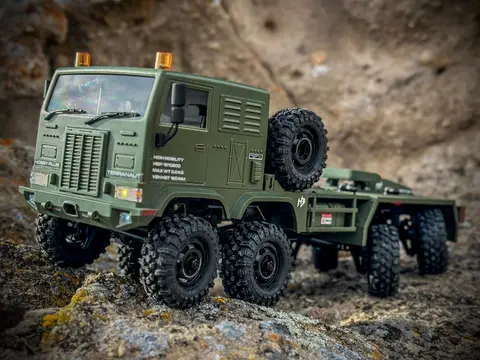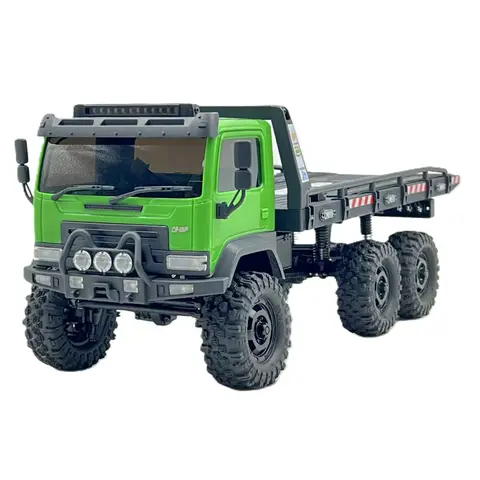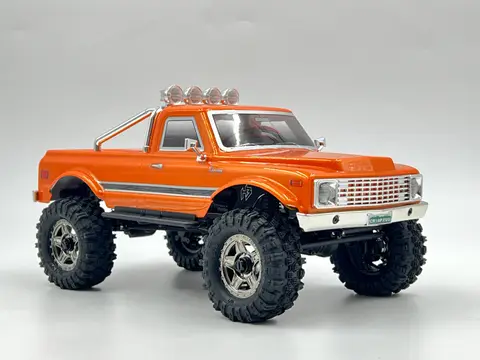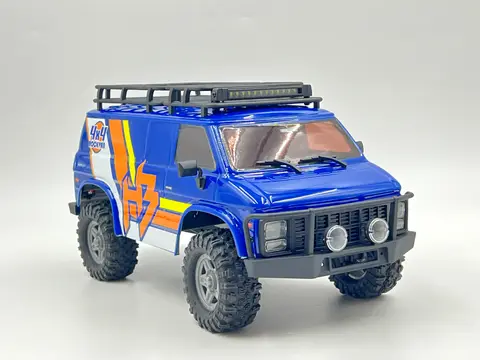
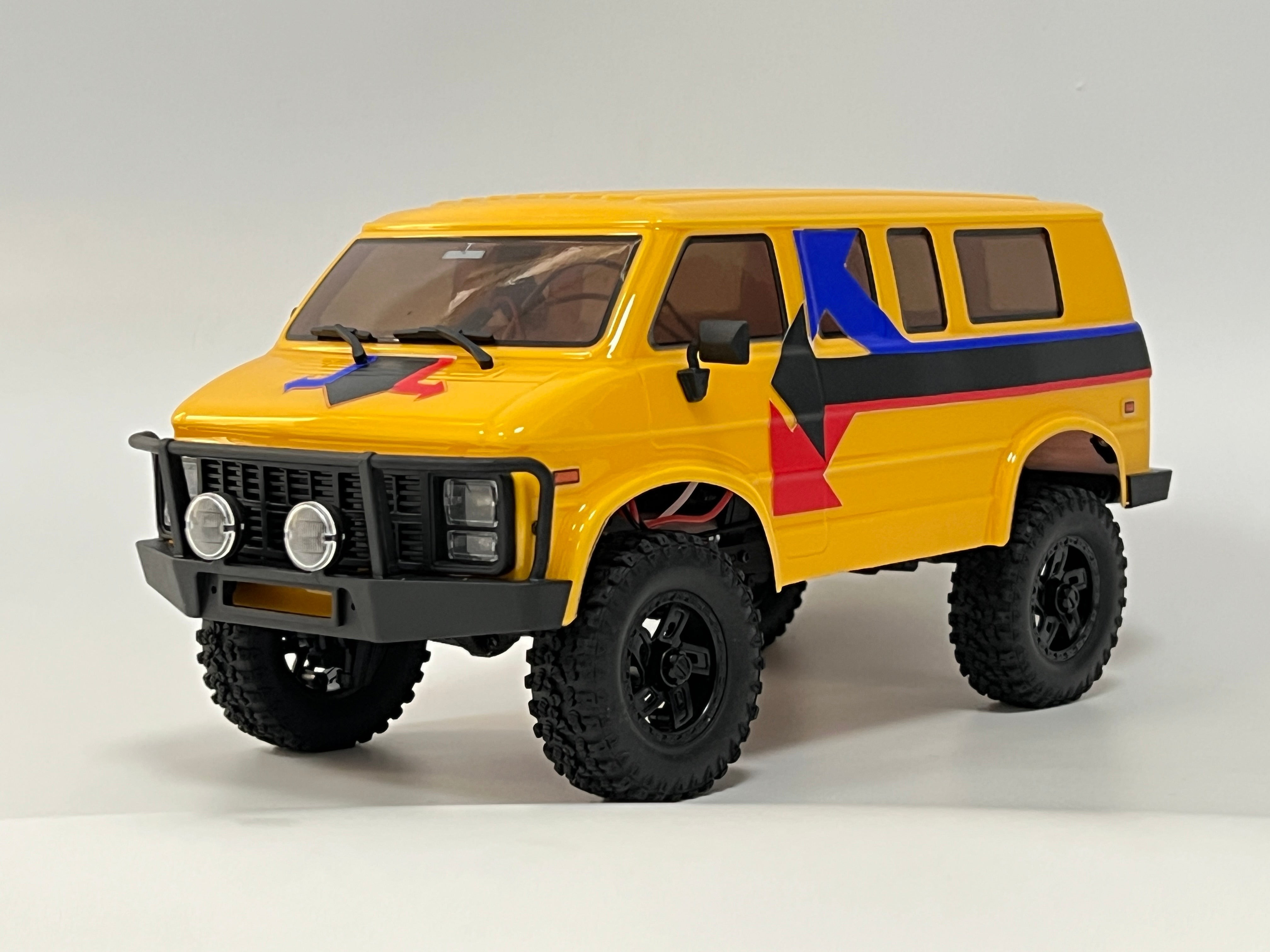
The original CR18P EVO Rock Van combines the van body with a metal-geared, two-speed micro trail drivetrain. A 130-size 100-turn brushed motor is the standard power equipment. Its rear driveshaft counter-rotates relative to the front, and Hobby Plus describes a lower, more forward chassis weight bias than the earlier CR18P. Source details (opens in a new tab)
Read moreShow less
Use the selected gear range as part of the starting setup when comparing slow obstacle work and trail driving. The original EVO, later V2 and brushless V3 packages need their own equipment checks even where a Rock Van body is shared. Space for an optional larger motor does not establish that every motor and controller combination completes the conversion. Source details (opens in a new tab)
The kind of vehicle the maker sells it as. It sets what the car is built to do and which cars it is fair to compare it with.
Crawlers are built for slow, controlled climbing over rocks: very low gearing, flexible suspension and locked axles.
Drive
All four wheels are driven. That gives more grip under power, especially on loose ground.
The cost is more parts to maintain.
A crawler needs every wheel pulling to climb.
Power
A brushed motor carries current through carbon brushes that rub on the commutator.
It is cheaper and smooth at low speed.
The brushes wear and the motor loses power over time.
That low-speed smoothness is why so many crawlers use one.
Build
Ready to run: built at the factory with the electronics installed.
Some come without a battery or charger; the maker's box contents say which.
Scale
The maker's nominal size compared with a full-size vehicle. It works more as a class label than a measurement.
A 1/10 monster truck is far bigger than a 1/10 touring car, so compare length and weight for real size.
This one is 232 mm long.
Part number
The maker's product number for this exact version.
A V2, a new color, or a kit instead of an RTR usually has a different number, and parts can differ between them.
Check it against your box or receipt before ordering parts.
Class
Crawler
Drive
4WD
Power
Brushed
Build
Ready to run
Scale
1/18
Part number
HBP1810302
Drivetrain
Pinion
The small gear on the motor shaft. Fewer teeth gear the car shorter: quicker acceleration, lower top speed and a cooler motor. More teeth do the opposite.
On this car one tooth changes the gearing by about 9.1%.
Crawlers run small pinions for slow, precise wheel speed on climbs; a bigger one is quicker on the trail but harder to control on rocks.
Spur
The large gear the pinion drives. A bigger spur with the same pinion gears the car shorter.
Pinion and spur need matching pitch, or explicit manufacturer confirmation that the exact gears are compatible.
The Gearing parts table below shows this car's pitch and part numbers.
Transmission & axle, high range
Every reduction after the spur, multiplied together: transmission, transfer case and axle gears.
That chain is why a crawler's figure is much higher than other classes'.
It is fixed by the design; the gearing you change is the pinion and spur.
It includes the portal reduction shown below.
This one is worked out from the tooth counts the maker publishes.
This is the high range, which sets top speed and is what the calculators load first.
Transmission & axle, low range
The same chain in low range: the transmission's second, lower set of gears.
The pinion and spur are shared, so a pinion swap changes both ranges by the same share.
This one is worked out from the low-range final drive the maker publishes.
Portal reduction (included above)
Portal axles add a gear reduction at each wheel, which raises the axle above the wheel center for more ground clearance.
This one reduces 1.53:1.
It is part of the transmission and axle ratio above, not an extra step, so do not multiply it in again.
Spur ÷ pinion
Spur teeth divided by pinion teeth: the part of the gearing that a pinion or spur swap changes.
Here it is 4.000:1.
Final drive, high range
How many times the motor turns for one turn of the wheels. A higher number is shorter gearing: more acceleration and pulling power, less top speed.
Among 1/18 crawlers & trail trucks in the catalog, the middle half run between 20.4:1 and 42.8:1 on stock gearing; this one is 24.5:1.
Crawlers run far higher ratios than other classes, so the truck can creep and hold on a climb.
This is the high range, which sets top speed and is what the calculators load first.
Final drive, low range
The final drive in low range, where a crawler spends most of its time: slower and stronger, for climbs and fine control.
It is 4.0 times the high range.
Switch the calculators to Low to work in this range.
Range change
This vehicle has a two-speed transmission: a high range for speed and a low range for crawling.
A small servo moves the shift fork, so the range changes from a switch on the transmitter, even on the move.
Both ranges share the pinion and spur.
Pinion pitch
The tooth spacing of the fitted gear, stated as metric module or diametral pitch.
Pinion and spur need matching pitch or explicit manufacturer confirmation of compatibility for the exact parts. Mod 0.8 and 32P are different standards; a compatibility statement for particular gears does not apply to every gear. A missing pitch can be inferred from the other fitted gear; module and diametral pitch are not silently converted.
Spur pitch
The tooth spacing of the fitted gear, stated as metric module or diametral pitch.
Pinion and spur need matching pitch or explicit manufacturer confirmation of compatibility for the exact parts. Mod 0.8 and 32P are different standards; a compatibility statement for particular gears does not apply to every gear. A missing pitch can be inferred from the other fitted gear; module and diametral pitch are not silently converted.
The outside diameter of the mounted tire, tread to tread. A taller tire covers more ground each turn, which gears the car taller.
Crawler wheels are named by rim size, such as 1.9 or 2.2 inches; that is the wheel, not this tire diameter.
Rollout, high range
How far the car moves for one turn of the motor: tire circumference divided by final drive.
It lets you compare gearing across different tire sizes; more rollout is taller gearing.
Here it is 7.4 mm.
This is the high range, which sets top speed and is what the calculators load first.
Rollout, low range
How far the truck moves for one turn of the motor in low range.
Here it is 1.9 mm.
Wheel hex
The hex on the axle that the wheel locks onto and is driven by. A wheel must match the hex size to fit.
A small hex like this is used on mini and micro cars.
The wheel nut is a separate size, so check its thread too before buying nuts.
Stock wheel diameter
Stock wheel diameter: A documented stock wheel, tire, or axle measurement. Stock dimensions alone do not establish the largest size that will clear the body and suspension.
Stock tire width
Stock tire width: A documented stock wheel, tire, or axle measurement. Stock dimensions alone do not establish the largest size that will clear the body and suspension.
Brushed motors are commonly described by can size and turns. No motor KV is published for this vehicle; turns alone cannot supply an exact value.
Motor shaft
The diameter of the motor's output shaft. A pinion's bore, the hole in its middle, must match it.
Battery
The highest LiPo cell count the maker rates the electronics for. Each cell is 3.7 V nominal and 4.2 V fully charged.
2S is 7.4 V nominal and 8.4 V off the charger.
Running more cells than this risks the ESC and motor.
Many cars also run on fewer cells, only slower.
Stock motor
The motor fitted at the factory, as the maker names it.
Brushed motors are often named by can size, such as 540 or 550, and by turns: fewer turns is faster.
Stock ESC
The electronic speed control. It feeds power from the battery to the motor as you work the throttle, and usually powers the receiver and servo too.
An amp figure in its name is normally the maker's continuous rating.
A brushed ESC cannot run a brushless motor.
Crawler ESCs usually have a strong drag brake, which holds the truck still on a slope when you let off the throttle.
Set its low-voltage cutoff for LiPo, so a pack is not run flat.
Battery connector
The plug on the battery lead. Your battery needs the same plug.
An adapter works, but it adds resistance and another joint that can work loose.
ESC rating
The current the stock speed control is rated to carry, as the maker states it.
The continuous figure is what it can carry all run; the burst figure only for moments, such as a launch.
A motor or pack that pulls more than this risks the ESC.
Battery space
The published size of the battery compartment or the stated maximum pack dimensions.
Read the dimension labels beside the value, then compare with the battery's case size rather than its capacity.
Allow room for the leads and the battery restraint.
Motor
Not published
Motor shaft
Basis & sources(4)
A single original-EVO technical report gives a 2 mm shaft on the 130 motor. The factory identifies the same complete numbered motor for these original variants.
Stock 11T pinion / 44T spur · Internal ratio 6.12:1 fixed in high range
Calculated stock FDR24.48:1
Selected FDR24.48:111T / 44T
Change from stockSame as stock
Calculated final drive ratio for each pinion and spur pair
Pinion
42T spur
44T spur
46T spur
9T
10T
11T
12T
13T
14T
Select a pair to compare wheel travel per motor turn with stock. Other cells are mathematical examples, not verified gears or fits. Check pitch, mesh, clearance and motor temperature before changing parts.
About these specs
This is the original CR18P EVO body package, distinct from the later EVO V2 and V3 packages.
Read moreShow less
The two-speed drivetrain gives about 24.48:1 in high and 97.9:1 in low with the original 11T motor pinion.
Both axles use the same 13T/26T ring and pinion and 15T/23T portal gears.
The original 240233 rim is the same rim documented in the 7 mm hex Mudder wheel set.
The original motor drives the 44T outer gear of the large 240305 compound spur, counted from the exact Hobby Plus replacement image.
Original EVO owner reports agree on an 11T motor pinion.
The factory used a 0.4-module gear mesh.
How to read these figures
Stock is as the vehicle ships.
Calculated is worked from the recorded figures on this page.
Derived uses recorded dimensions or arithmetic. The row explains the inference. A nominal mating size is not a measured tolerance or a complete fitment guarantee.
Derived from replacement part uses the listed dimensions of a replacement advertised for the identified OEM part. Treat it as an approximate working size; the factory-fitted part may differ. Calculated performance uses that approximation.
Single report uses one outside source. It is useful as a starting figure, with the source and calculation described in the note.
Community uses independent outside reports that agree.
Not published means it exists but no source we could find prints it.
Use the original CR18P EVO mechanical chapters when servicing this version's two-speed transmission and portal axles. The factory drawing separates the gearbox's shafts and shift mechanism from the portal gear pairs, bearings and drive pins at each wheel. Keep those assemblies organized during a rebuild and restore their shown orientation before closing the housings. A gearbox problem and a portal bearing problem occur in different assemblies even though both can restrict drive.[1] CR18P original EVO factory manual, shared mechanical chapters (opens in a new tab)
Check the wheel and suspension construction before choosing a replacement. The EVO manual illustrates the 240237 tire set with a separate foam insert, retaining ring and wheel pieces, while the 240235 suspension drawing shows the spring, body and shaft as an assembly. Match those components to the installed truck rather than assuming a later EVO or a different CR18P release has the same wheel mounting or damping arrangement.[1] CR18P original EVO factory manual, shared mechanical chapters (opens in a new tab)
Read moreRead less about build and setup for CR18P Evo Rock Van 4x4 RTR
The Rock Van EVO body opens from its rear attachment points. The factory drawing marks the removable 240029 clips there and shows the shell lifting forward for chassis access. Retain the van-specific mounts when replacing bumpers or adding accessories so the body can still open without straining the wiring. Its body diagram is separate from the Harvest and T-Hunter branches in the same book.[2] CR18P Evo Rock Van 4x4 RTR factory body/chassis branch, manual part 2 (opens in a new tab)
Common numbers cover selected core components, not every part. A shared family, manual or listing does not mean the parts fit both vehicles. Check the comparison and upgrade notes before ordering.
More connections & sourcesShow less
Platform family
CR18P EVO two-speed chassis family. These CR18P EVO body packages use the original two-speed portal chassis. Body fittings and supplied equipment vary. Source (opens in a new tab)