
VehiclesFMS FCX18 II Ford F-100 Brushed

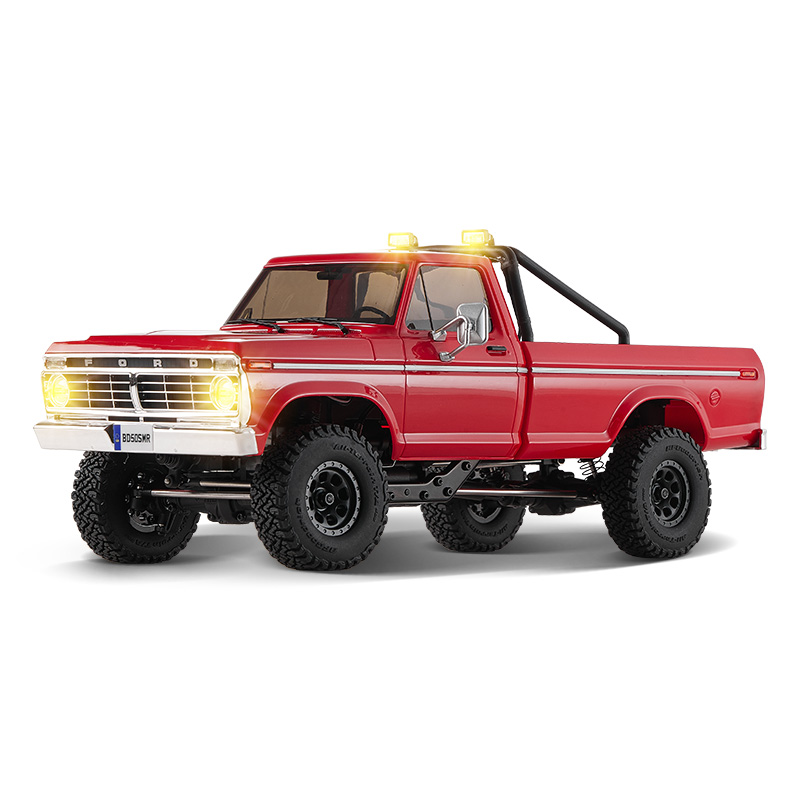
FMS FCX18 II Ford F-100 Brushed
1/18 scale · scale crawler · 118L01BDRD
- Final drive
- 17.70:1
- Tire
- 58mm
Specifications
Last modified
| Spec | Value | Basis |
|---|---|---|
| Drivetrain | ||
| Pinion | Not published | |
| Spur | Not published | |
| Transmission & axle | Not published | |
| Final drive | 17.70:1Stock | Stock |
| Wheels & tires | ||
| Tire diameter | 58mmStock | Stock |
| Rollout | 10.3mm per motor turnCalculated | Calculated |
| Power | ||
| Motor | Not applicable | |
| Motor shaft | Not published | |
| Battery | Up to 2SLiPoStock | Stock |
| Performance | ||
| Theoretical top speed | Not applicable | |
| Vehicle | ||
| Part number | 118L01BDRD | |
| Scale | 1/18 | |
| Class | Scale crawler | |
Stock is as the vehicle ships. Calculated is worked from the stock figures on this page rather than stored beside them, so the two cannot drift apart. Not applicable means the vehicle does not come with it, like the motor on a roller or the tires on a race kit, or does not have one, like a KV rating on a brushed motor. Not published means it exists but no source we could find prints it.
Gearing parts
| Component | Teeth | Pitch | Bore | Part number |
|---|---|---|---|---|
| Fitted at the factory | ||||
| Pinion | Not published | Not published | Not published | C4089 (opens in a new tab) |
| Spur | Not published | Not published | Not applicable | C4087 (opens in a new tab) |
Tooth counts are the ones in the specifications above. Pitch is given as metric module (Mod 1, Mod 0.8) or diametral pitch (32P, 48P). They are different standards and are not interchangeable, even where the numbers look close. Bore is the pinion’s hole, listed separately from the motor shaft. Linked part numbers go to the maker's or official distributor's page for that part.
How these numbers were settled
FMS prints the two-speed gearing as totals: 'High Gear: 17.7, Low Gear: 94.2', on the product page and in the manual; the high gear is used here and the low gear of 94.2 is the crawl ratio.
- The motor is a 180-size brushed can, so there is no KV.
- The FMS-R3D-BS receiver and ESC unit is rated for '2S LiPo' at 10A continuous and 40A peak in the manual, and the truck ships with a 2S 7.4V 900mAh pack.
- The tire is the licensed BFGoodrich KO3 at 'Φ 58*19 mm' in FMS's own specification table.
- FMS lists the pinion (C4089) and the transmission and axle gear sets (C4087, C4088) as spare parts but prints no tooth counts, so the pinion, the spur and the ratio after it are left blank.
- The Special Edition (118L01BDCRL) prints the identical specification table, so it shares these figures. 118L01BDRD is the red edition's SKU; no colour-free SKU is published.
Documents
- ManualInstruction manual, FCX18 II F-100 (FMS PDF) (opens in a new tab)Specifications PDF p. 10
- Exploded viewExploded view, transmission (in FMS manual PDF) (opens in a new tab)Pinion and spur, PDF p. 32
- Parts listSpare parts list (in FMS manual PDF) (opens in a new tab)Pinion C4089, gear set C4087, PDF p. 29
Sources
- fms-1-18-fcx18ii-ford-f-100…fmshobby.com (opens in a new tab)
- fms-1-18-fcx18-ii-ford-f-10…fmshobby.com (opens in a new tab)
- Manual (PDF)cdn-files.myshopline.com (opens in a new tab)
- fcx18ii-pinion-gearfmshobby.com (opens in a new tab)
- fcx18ii-gear-set-for-transm…fmshobby.com (opens in a new tab)
- fcx18ii-180-brushed-motorfmshobby.com (opens in a new tab)
Every figure on this page traces to one of these. Where they disagreed, the note above says which was used and why.