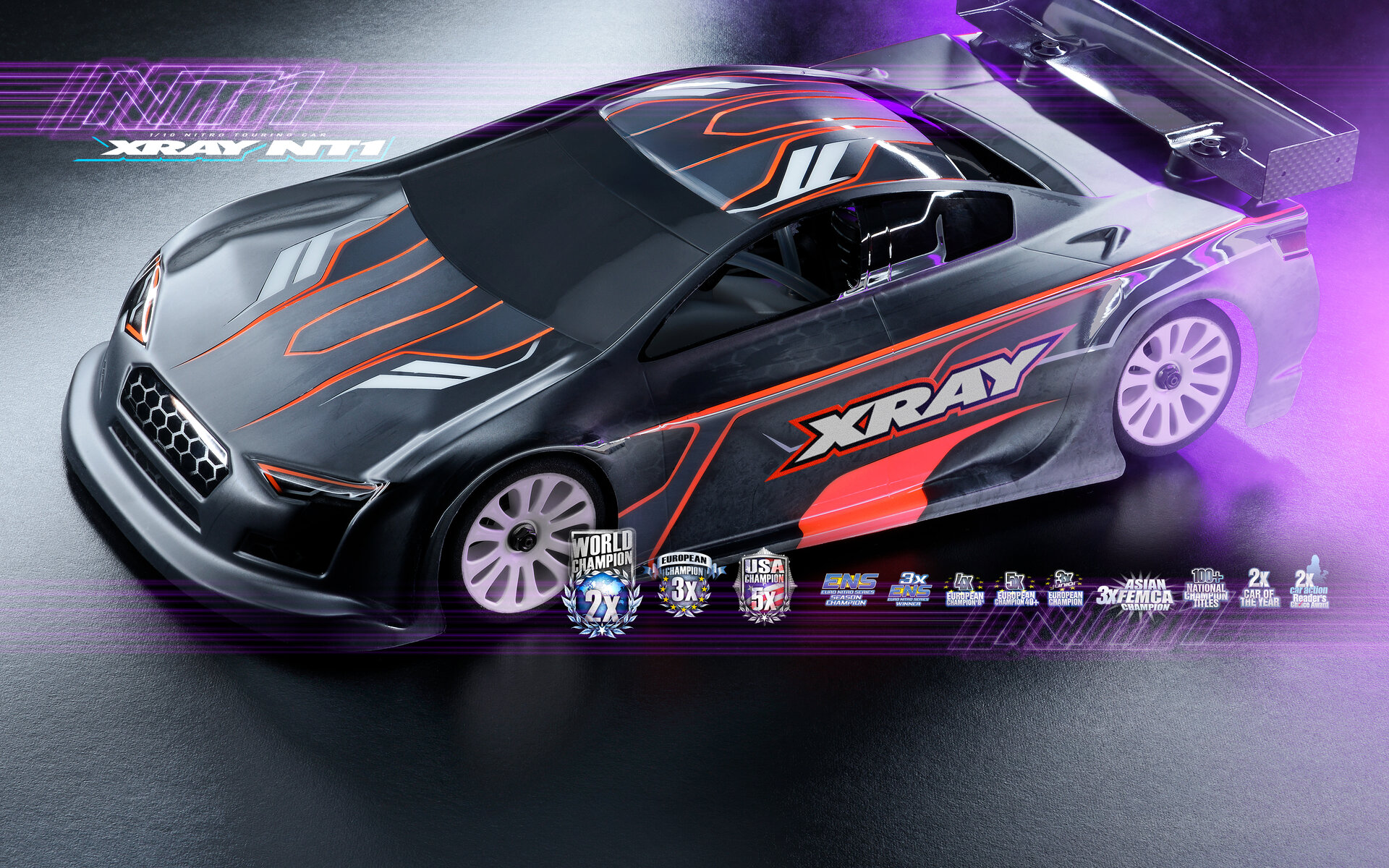
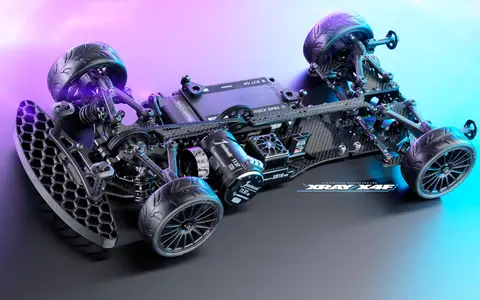
XRAY's NT1'27 is a 1/10 nitro touring car kit with a two-speed gearbox, sold without an engine, wheels or tires.
In second gear a 21T clutch bell drives a 54T spur, and a 2.05:1 reduction after the spur takes that to a 5.27:1 final drive. First gear uses a smaller pinion on a larger gear for the slow corners. The diffs are set up with 500K front and 60K rear. Set the shift point once the engine is run in, and change one gear pair at a time.
The kind of vehicle the maker sells it as. It sets what the car is built to do and which cars it is fair to compare it with.
Touring cars are 4WD on-road cars for asphalt and carpet tracks, often raced in classes with fixed motor and battery rules.
Power
A small two-stroke engine running glow fuel (methanol, nitromethane and oil).
It needs fuel, a glow igniter and some tuning.
It has no motor KV or battery rating.
Build
A kit you build yourself from parts.
Most kits come without motor, ESC, servo, radio and battery, and many without tires or a painted body.
The manual lists what to add.
Scale
The maker's nominal size compared with a full-size vehicle. It works more as a class label than a measurement.
A 1/10 monster truck is far bigger than a 1/10 touring car, so compare length and weight for real size.
Part number
The maker's product number for this exact version.
A V2, a new color, or a kit instead of an RTR usually has a different number, and parts can differ between them.
Check it against your box or receipt before ordering parts.
Class
Touring
Power
Nitro
Build
Kit
Scale
1/10
Part number
330018
Drivetrain
Pinion
On a nitro car the gear on the engine is the clutch bell.
Its teeth work like a pinion's: more teeth gear the car taller, for more top speed and slower acceleration.
Spur
The large gear the pinion drives. A bigger spur with the same pinion gears the car shorter.
Pinion and spur must have the same pitch, or tooth size, to mesh.
The Gearing parts table below shows this car's pitch and part numbers.
On a nitro car the clutch bell drives it.
Transmission & axle
Every reduction after the spur, multiplied together: transmission, differentials and axle gears.
It is fixed by the design; the gearing you change is the pinion and spur.
This one is worked out from the tooth counts the maker publishes.
Final drive
How many times the motor turns for one turn of the wheels. A higher number is shorter gearing: more acceleration and pulling power, less top speed.
Among 1/10 touring and pan cars in the catalog, the middle half run between 6.5:1 and 8.3:1 on stock gearing; this one is 5.3:1, taller than most.
On-road racers often compare gearing by rollout instead, because tire sizes differ between cars.
Diff oil, front
Silicone oil sealed inside the differential. A diff lets the wheels on one axle turn at different speeds in a corner; thicker oil makes it act more like a solid axle.
At the front, thicker oil keeps both front wheels pulling out of a corner but makes the car turn in less willingly; thinner oil steers more easily.
It is graded in cSt (centistokes), a measure of thickness that means the same across brands. K means thousands, so 500K is 500,000 cSt.
Diff oil, rear
The rear diff mostly shapes drive out of corners.
Thicker oil there puts power down more evenly on loose or slippery ground; thinner oil lets the car rotate more easily through a corner.
This car runs thicker oil in the front diff (500K) than the rear (60K): steadier on turn-in, with a rear that lets the car rotate.
Pinion
21TStock
Stock
Spur
54TStock
Stock
Transmission & axle
2.05:1Derived
Derived
Final drive
5.27:1Stock
Stock
Diff oil, front
500KStock
Stock
Diff oil, rear
60KStock
Stock
Wheels & tires
Tire diameter
The outside diameter of the mounted tire, tread to tread. A taller tire covers more ground each turn, which gears the car taller.
Race tires wear down over a day, and a smaller tire gears the car shorter.
Tire diameter
Not applicable
Suspension
Shock oil, front
The oil in the shocks slows how fast the suspension moves. Thicker oil settles the car more slowly and resists bottoming out; thinner oil lets the wheels follow bumps.
At the front it mostly shapes the steering: thicker oil makes the car turn in more calmly and dive less under braking; thinner oil turns in sharper and keeps the front tires on the ground over bumps.
On smooth tracks racers change oil in small steps to fine-tune how the car rolls into a corner.
It is graded in cSt (centistokes), a measure of thickness that is the same across brands.
Shock oil, rear
The rear shocks mostly shape grip under power and how the car lands.
Thicker oil at the rear holds the back up on landings and keeps it steadier on the throttle; thinner oil lets it squat and follow rough or loose ground for more grip.
Front and rear run the same oil here (450 cSt), so both ends respond alike. Changing one end at a time is the usual way to shift the balance.
Shock oil, front
450 cStStock
Stock
Shock oil, rear
450 cStStock
Stock
Power
Motor
An engine has no KV rating.
Nitro engines are sized by displacement in cubic inches, such as .21.
Motor shaft
An engine drives the gears through a clutch, so there is no motor shaft.
The clutch bell takes the place of the pinion.
Battery
An engine car has no drive battery.
A small receiver pack or a BEC powers the radio and servos.
Motor
Not applicable
Motor shaft
Not applicable
Battery
Not applicable
Performance
Theoretical top speed
An engine has no KV, so a theoretical top speed cannot be worked out from the gearing alone.
Theoretical top speed
Not applicable
How to read these figures
Stock is as the vehicle ships.
Calculated is worked from the stock figures on this page rather than stored beside them, so the two cannot drift apart.
Derived is worked out from gear tooth counts the maker publishes rather than printed as a ratio; the notes below say how.
Not applicable means the vehicle does not come with it, like the motor on a roller or the tires on a race kit, or does not have one, like a KV rating on a brushed motor.
Pinion and spur parts for the XRAY NT1'27: fitted, and optional gearing supplied in the box
Component
Teeth
Pitch
Bore
Part number
Fitted at the factory
Pinion
21T
Not published
Not applicable
338521
Spur
54T
Not published
Not applicable
335554
About teeth, pitch and bore
Tooth counts are the ones in the specifications above.
Pitch is given as metric module (Mod 1, Mod 0.8) or diametral pitch (32P, 48P). They are different standards and are not interchangeable, even where the numbers look close.
Bore is the pinion’s hole, listed separately from the motor shaft.
Nitro touring kit with a two-speed gearbox; the engine, wheels and tires are on the manual's list of items to buy, so the tire size is left blank.
The kit fits a 16T first and a 21T second clutch bell pinion (#338516, #338521) with a 59T first and a 54T second two-speed gear (#335559, #335554), and second gear, the taller one, is shown as the fitted set.
XRAY's basic setup sheet for the NT1'27 prints the kit gearing as ratio 7.56 in first and 5.27 in second.
The ratio after the spur is worked out from those printed ratios as 2.05, and both gears agree (5.27 x 21 / 54 and 7.56 x 16 / 59); the setup sheet marks the 25T mid-side pulley as the kit setting.
The NT1'27 supplementary instructions supply 500K and 60K diff oils and 450 cSt shock oil, and the setup sheet puts the 500K in the front diff and the 60K in the rear.
The car is built with the NT1'23 instruction manual plus the NT1'27 supplementary instructions.
Sources
Every figure on this page traces to one of these; where they disagreed, the note above says which was used and why. Links open in a new tab.