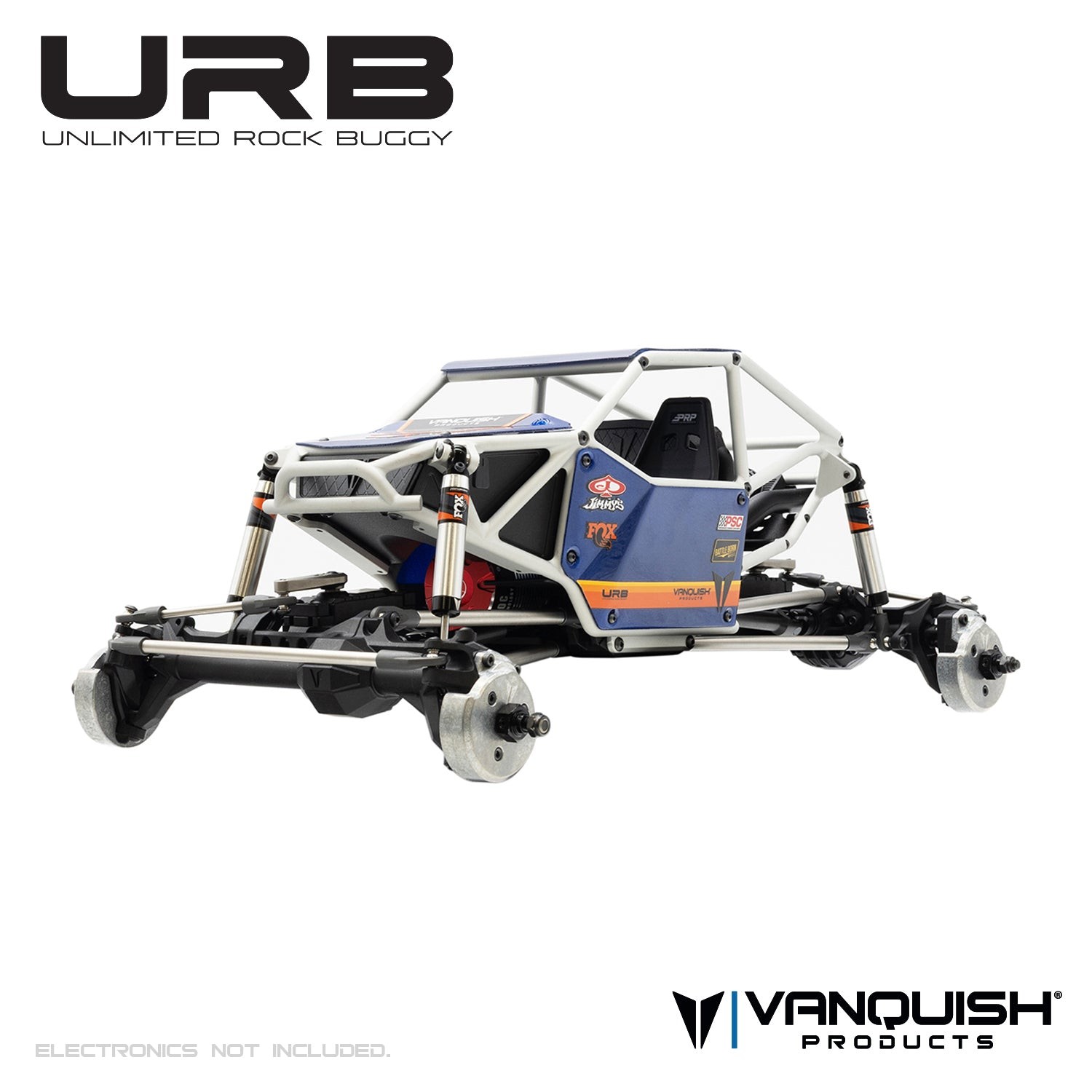
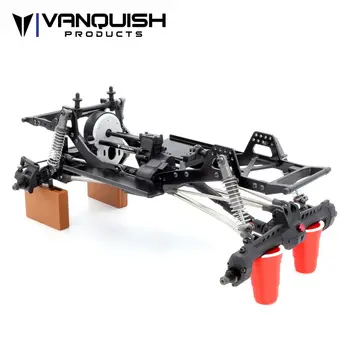
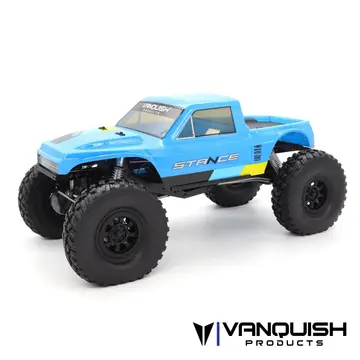
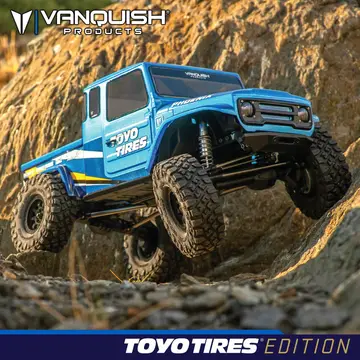
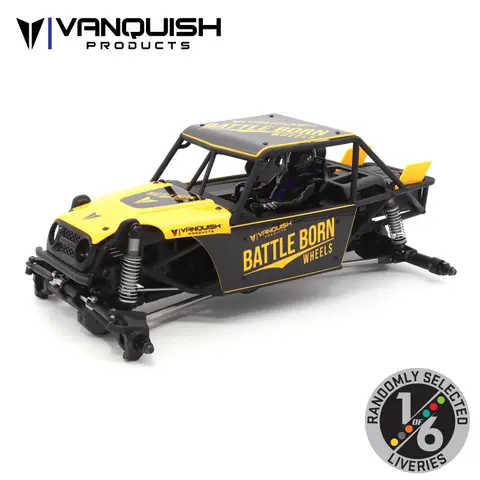
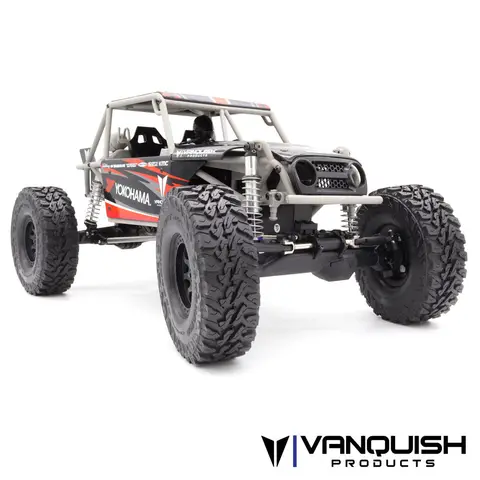
The URB is Vanquish's Unlimited Rock Buggy platform, developed around an officially licensed Jimmy's 4x4 aluminum cage, four-wheel steering and the compact LFD transmission. Molded F10W portal axle housings distinguish the base kit from the machined-axle Ultra and Spec Ops versions. The detailed engine and interior are part of a buggy build rather than a conventional removable truck body. URB Jimmys 4x4 Moonbuggy product information (opens in a new tab)
Read moreShow less
The LFD uses hardened 48P gears and incorporates rear dig. Its matched front and rear axle gearing provides the factory's modest overdrive baseline, while both steering axles and the dig mechanism require a deliberate radio and servo plan. A second steering axle changes the control problem as well as the turning circle; predictable centers and accessible controls matter before chasing more torque. Exact model product information (opens in a new tab)
The kit leaves wheels, tires, foams and electronics to the builder. Its S8I internal-spring shocks and cage packaging also differ from a VS4-10 truck, so an external-spring conversion or another servo bracket needs its own fit check. Keep access to the battery disconnect and leave the cage removable without pulling the leads tight. Exact model product information (opens in a new tab)
The kind of vehicle the maker sells it as. It sets what the car is built to do and which cars it is fair to compare it with.
Crawlers are built for slow, controlled climbing over rocks: very low gearing, flexible suspension and locked axles.
Drive
All four wheels are driven. That gives more grip under power, especially on loose ground.
The cost is more parts to maintain.
A crawler needs every wheel pulling to climb.
Power
Sold without a motor, so you choose the motor, ESC and battery yourself.
Rows that depend on the motor say so.
Build
A kit you build yourself from parts.
Most kits come without motor, ESC, servo, radio and battery, and many without tires or a painted body.
The manual lists what to add.
Scale
The maker's nominal size compared with a full-size vehicle. It works more as a class label than a measurement.
A 1/10 monster truck is far bigger than a 1/10 touring car, so compare length and weight for real size.
Part number
The maker's product number for this exact version.
A V2, a new color, or a kit instead of an RTR usually has a different number, and parts can differ between them.
Check it against your box or receipt before ordering parts.
Class
Crawler
Drive
4WD
Power
Motor not included
Build
Kit
Scale
1/10
Part number
VPS09029A
Drivetrain
Pinion
The small gear on the motor shaft. Fewer teeth gear the car shorter: quicker acceleration, lower top speed and a cooler motor. More teeth do the opposite.
On this car one tooth changes the gearing by about 7.1%.
Crawlers run small pinions for slow, precise wheel speed on climbs; a bigger one is quicker on the trail but harder to control on rocks.
Spur
The large gear the pinion drives. A bigger spur with the same pinion gears the car shorter.
Pinion and spur need matching pitch, or explicit manufacturer confirmation that the exact gears are compatible.
The Gearing parts table below shows this car's pitch and part numbers.
Spur ÷ pinion
Spur teeth divided by pinion teeth: the part of the gearing that a pinion or spur swap changes.
Here it is 3.357:1.
Differentials
The type of each differential, as the maker states it.
A gear or ball diff lets the wheels on one axle turn at different speeds in a corner; a spool or locked diff turns them together for straight-line drive and climbing, at the cost of steering.
Crawlers often lock both axles so every tire pulls on a climb.
Hub bearing size
Hub bearing size: The documented drivetrain connection or size for this exact model. Match the mating component before buying a replacement.
Pinion bore
The nominal size of the hole that mates with the motor shaft.
Match the pinion mounting method as well as its size. A press-fit hole cannot be inferred from motor shaft diameter.
Pinion pitch
The tooth spacing of the fitted gear, stated as metric module or diametral pitch.
Pinion and spur need matching pitch or explicit manufacturer confirmation of compatibility for the exact parts. Mod 0.8 and 32P are different standards; a compatibility statement for particular gears does not apply to every gear. A missing pitch can be inferred from the other fitted gear; module and diametral pitch are not silently converted.
Spur pitch
The tooth spacing of the fitted gear, stated as metric module or diametral pitch.
Pinion and spur need matching pitch or explicit manufacturer confirmation of compatibility for the exact parts. Mod 0.8 and 32P are different standards; a compatibility statement for particular gears does not apply to every gear. A missing pitch can be inferred from the other fitted gear; module and diametral pitch are not silently converted.
Axle drive, front
Whether the front axle is driven by the motor.
The calculator uses this axle's own tire size and complete recorded gear path.
Axle drive, rear
Whether the rear axle is driven by the motor.
The calculator uses this axle's own tire size and complete recorded gear path.
Transmission & axle, front
Every reduction after the spur, multiplied together: transmission, transfer case and axle gears.
That chain is why a crawler's figure is much higher than other classes'.
It is fixed by the design; the gearing you change is the pinion and spur.
This one is worked out from the tooth counts the maker publishes.
Transmission & axle, rear
Every reduction after the spur, multiplied together: transmission, transfer case and axle gears.
That chain is why a crawler's figure is much higher than other classes'.
It is fixed by the design; the gearing you change is the pinion and spur.
This one is worked out from the tooth counts the maker publishes.
Final drive, front
How many times the motor turns for one turn of the wheels. A higher number is shorter gearing: more acceleration and pulling power, less top speed.
Among 1/10 crawlers & trail trucks in the catalog, the middle half run between 30.2:1 and 49.5:1 on stock gearing; this one is 59.9:1, shorter than most.
Crawlers run far higher ratios than other classes, so the truck can creep and hold on a climb.
Final drive, rear
How many times the motor turns for one turn of the wheels. A higher number is shorter gearing: more acceleration and pulling power, less top speed.
Among 1/10 crawlers & trail trucks in the catalog, the middle half run between 30.2:1 and 49.5:1 on stock gearing; this one is 65.9:1, shorter than most.
Crawlers run far higher ratios than other classes, so the truck can creep and hold on a climb.
Axle coupling
How the driven axles are connected.
Fixed gears set the relationship between axle drive paths. A mismatch is accommodated through tire slip or drivetrain deflection.
Spoolfront and rear; Fixed drive inferred from the original one-piece ring-gear/output assembly shown for the base URB kit.Derived from replacement part
Front/rear portal output: 6 × 12 × 4 inner; 5 × 11 × 4 outermm, Front and rear portal output bearings, ID × OD × width. Inner and outer refer to the wheel-output shaft supports, not the axle-input pinion bearings.Stock
What the main chassis is made of and how it is built, as stated for this car. Braces, stiffeners and skid plates are not counted.
Aluminum is stiffer than composite, which keeps the handling consistent; it can bend in a hard crash, and a bent chassis is usually replaced rather than straightened.
Shocks
What the shocks are and how they are built, as the maker describes them.
Oil-filled shocks damp with silicone oil; friction shocks, found on some entry-level cars, damp with a sprung plunger and cannot be tuned with oil.
Shock bore
The inside diameter of the shock body, where the piston moves through oil.
It is a shock measurement, separate from the motor pinion bore. Match the actual shock part when ordering pistons, seals or a replacement body.
Shock length
The stated length of the complete shock assembly. Sources may use mounting-eye centers or a nominal assembly length.
Compare fully extended mounting-eye spacing, compressed length and mounting hardware before ordering. A longer shock changes ride height and travel, and can bind at full droop or bottom out.
Compressed length
The shock's length eye to eye when fully compressed.
The gap between this and the extended length is the travel the shock allows.
Shock stroke
How far the shaft travels from fully extended to fully compressed.
More stroke means more suspension travel, which soaks up bigger bumps and landings.
Front drag link 60 mm; rear drag link 76 mm; tie rods 140.5 mmManual link-size callouts; endpoints are unspecified, not assembled lengths including rod ends. Front and rear four-wheel-steering arrangement.Stock
Calculated final drive ratio for each pinion and spur pair
Pinion
45T spur
47T spur
49T spur
12T
13T
14T
15T
16T
17T
Select a pair to compare wheel travel per motor turn with stock. Other cells are mathematical examples, not verified gears or fits. Check pitch, mesh, clearance and motor temperature before changing parts.
About these specs
The included 14T 48P motor pinion drives a 47T input gear.
Read moreShow less
The factory chart gives simultaneous final drive ratios of 59.93:1 front and 65.92:1 rear.
Internal ratios are derived from those rounded totals and the 47/14 primary gearing; they are not an independent count of every gearbox tooth.
Vanquish advertises 9.6 percent final overdrive, while its rounded totals imply about 10 percent more front-wheel RPM.
Motor, ESC and tires are supplied separately.
Four-wheel steering is supported.
How to read these figures
The rollout difference needs both tire diameters and axle reductions. Fixed gearing connects the axles. A rollout mismatch requires tire slip or drivetrain deflection. These figures do not predict vehicle road speed.
Stock is as the vehicle ships.
Calculated is worked from the recorded figures on this page.
Derived uses recorded dimensions or arithmetic. The row explains the inference. A nominal mating size is not a measured tolerance or a complete fitment guarantee.
Derived from replacement part uses the listed dimensions of a replacement advertised for the identified OEM part. Treat it as an approximate working size; the factory-fitted part may differ. Calculated performance uses that approximation.
Not applicable means the vehicle does not come with it, like the motor on a roller or the tires on a race kit.
Not published means it exists but no source we could find prints it.
The useful preparation for a four-wheel-steering URB is a control plan before the cage fills with electronics. An original German build account documents the base kit with separate front and rear servos and a separate dig-control arrangement.[3] Original owner or reviewer build context (opens in a new tab)
Read moreRead less about upgrades and setup for URB Jimmys 4x4 Moonbuggy
Leave the wiring serviceable while the electronics choices settle. The base build removes the assembled cage by releasing the shocks and four screws, then stores spare cable below the dig servo instead of immediately cutting every lead. Keep the battery disconnect reachable and allow the cage to lift without pulling a connector. A neatly hidden power switch is less useful if a driver figure or interior panel makes it difficult to reach.[2] URB base-kit assembly, first drive and October setup updates (opens in a new tab)[1] Exact VPS09029A maker reference (opens in a new tab)
The base kit’s molded axles are an important fitment boundary. Use the actual housings and brackets when checking the rear servo and battery route. Machined-axle Ultra or Spec Ops parts may change clearances and included hardware. A premium replacement is justified only by the part you need and a confirmed compatible mounting arrangement; the shared owner build gives no comparative failure or handling data.[1] Exact VPS09029A maker reference (opens in a new tab)[3] Original owner or reviewer build context (opens in a new tab)
Extra overdrive needs a reason even with dig and rear steering available. In the base-kit first outing, the builder reported the rear pushing the front away on steep climbs, then installed slower rear portal gears and front brass. Another contributor cautioned that more overdrive can make side slopes and reversing less predictable. Try the stock controls on those same kinds of obstacles first; change the gearing only if the climb benefit matters more than that compromise.[2] URB base-kit assembly, first drive and October setup updates (opens in a new tab)[1] Exact VPS09029A maker reference (opens in a new tab)
Treat front weight and gearing as separate experiments. The base build changed both, so there is no isolated before-and-after result proving which change helped. Keep a record of the actual tires, wheel and insert widths, front weight and gearing, then compare a steep climb, side slope and reverse approach after each change. The owner initially kept wide inserts despite a difficult wheel assembly; that does not establish that the same insert width suits another tire or wheel.[2] URB base-kit assembly, first drive and October setup updates (opens in a new tab)
Check the stock internal-spring shocks before replacing them. The base build describes smooth action once moving, with some initial resistance after the buggy has stood still. Cycle both shocks on each axle and compare their motion, leakage and mounting freedom before blaming a spring rate. The current S8I design uses internal springs and a bleed screw, so an external-spring conversion changes the suspension package rather than simply curing an assembly problem.[2] URB base-kit assembly, first drive and October setup updates (opens in a new tab)[1] Exact VPS09029A maker reference (opens in a new tab)
Conversions & shared parts
Rear replacement axle and matched axle gearing
The replacement rear steering axle uses 5.25:1 gearing instead of the original rear axle’s 5.78:1. With the original front axle retained, it removes the factory front-to-rear speed difference. Keep the original rear underdrive gears when repairing the axle without changing that bias.
Maker-listed rear steering axle replacement. Its 5.25:1 gearing changes the original 5.775:1 rear ratio; this reference does not specify a new electronics package.
The publisher identifies this build or configuration overview. Use it to locate the assembly context for this edition; a title alone does not establish a tested upgrade benefit.
The publisher identifies this build or configuration overview. Use it to locate the assembly context for this edition; a title alone does not establish a tested upgrade benefit.
Common numbers cover selected core components, not every part. A shared family, manual or listing does not mean the parts fit both vehicles. Check the comparison and upgrade notes before ordering.
More connections & sourcesShow less
Platform family
URB Jimmy's 4x4 Moonbuggy family. URB 4WS buggy architecture with an LFD transmission and Jimmy's 4x4 cage. Standard, Ultra and Spec Ops versions use different axle, finish and wheel packages. Source (opens in a new tab)