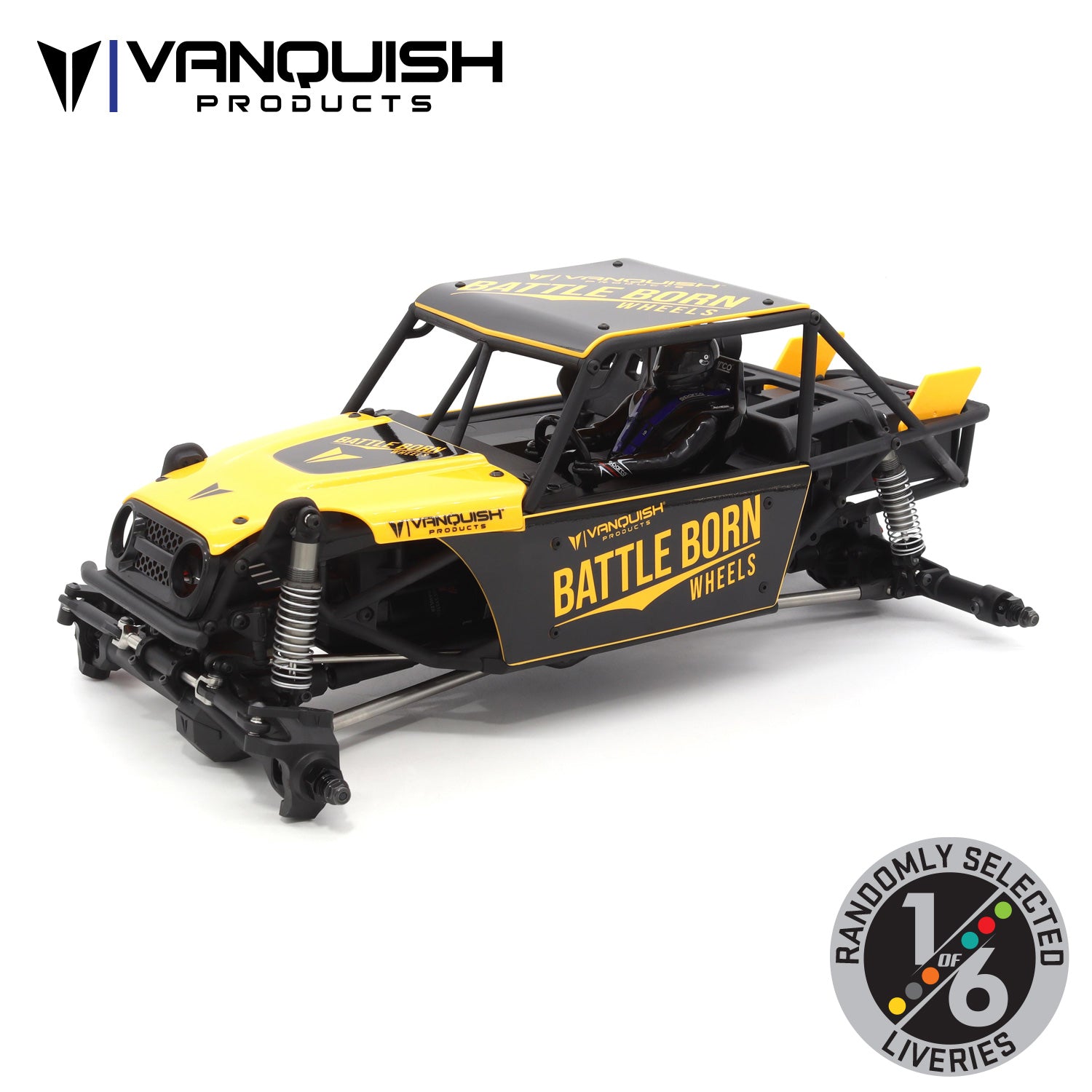
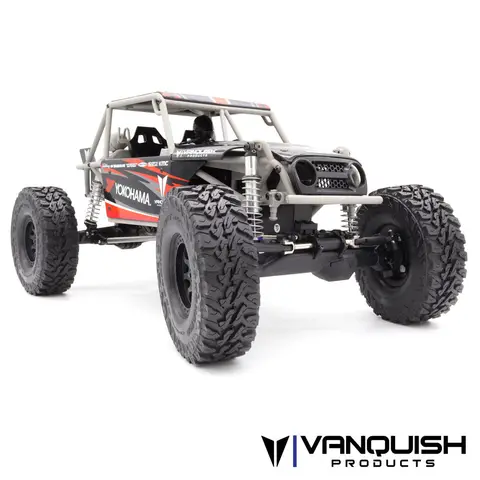
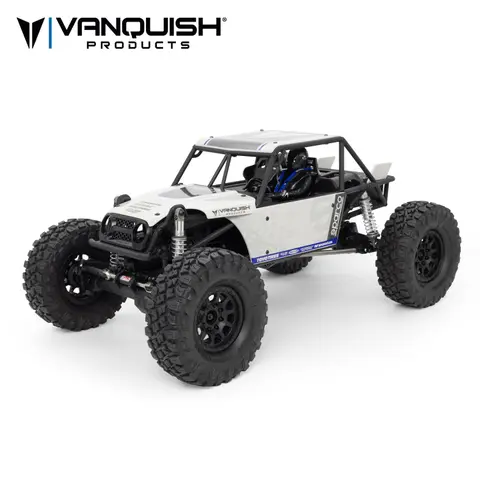
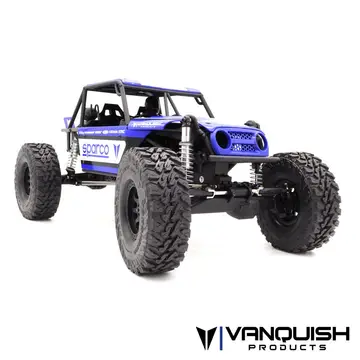
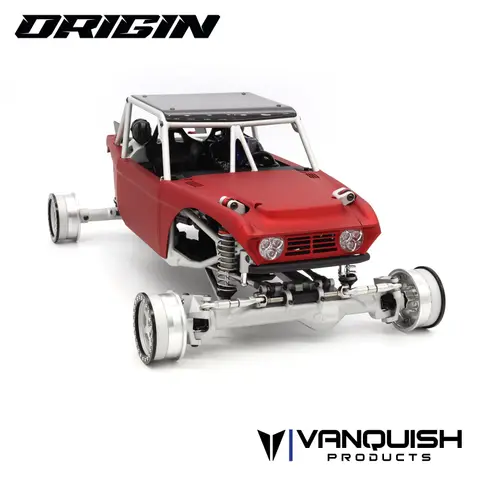
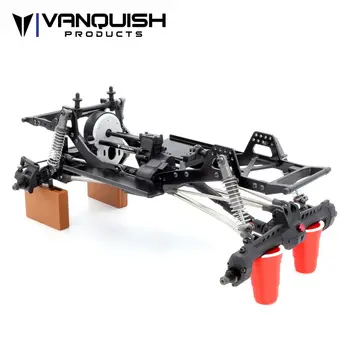
The H10 Optic kit is for someone who wants to assemble the trail buggy and choose its running equipment from the start. It retains the molded cage, hard ABS body panels and ram-style front steering of the H10 concept, while leaving the motor, electronics, wheels and tires to the builder. Its color and graphic package is selected at random, so the finished appearance begins with an element of surprise rather than a guaranteed livery.
The mechanical package includes machined axle gears and chromoly spools, plus machined motor and bearing plates and standoffs in the VFD transmission. The motor sits low and forward, with the cabin and cage above it. Wide H10 axles and four-link suspension give the build its trail-buggy proportions; the steering servo hides behind the front axle and operates a linkage styled to resemble a hydraulic ram. Optic kit equipment and completion (opens in a new tab)
This kit makes sense when you already know which electronics and tires suit your driving, or want the assembly itself to be part of ownership. The separate battery compartments and detailed interior encourage a careful trial layout before wires are shortened. Choose a battery that fits the compartment and leaves its connections accessible. The supplied transmission hardware also makes it worth checking the box before ordering upgrades: some commonly advertised machined pieces are already included. Optic kit equipment and completion (opens in a new tab)
The kind of vehicle the maker sells it as. It sets what the car is built to do and which cars it is fair to compare it with.
Crawlers are built for slow, controlled climbing over rocks: very low gearing, flexible suspension and locked axles.
Power
Sold without a motor, so you choose the motor, ESC and battery yourself.
Rows that depend on the motor say so.
Build
A kit you build yourself from parts.
Most kits come without motor, ESC, servo, radio and battery, and many without tires or a painted body.
The manual lists what to add.
Scale
The maker's nominal size compared with a full-size vehicle. It works more as a class label than a measurement.
A 1/10 monster truck is far bigger than a 1/10 touring car, so compare length and weight for real size.
Part number
The maker's product number for this exact version.
A V2, a new color, or a kit instead of an RTR usually has a different number, and parts can differ between them.
Check it against your box or receipt before ordering parts.
Class
Crawler
Power
Motor not included
Build
Kit
Scale
1/10
Part number
VPS09027
Drivetrain
Pinion
The small gear on the motor shaft. Fewer teeth gear the car shorter: quicker acceleration, lower top speed and a cooler motor. More teeth do the opposite.
On this car one tooth changes the gearing by about 7.7%.
Crawlers run small pinions for slow, precise wheel speed on climbs; a bigger one is quicker on the trail but harder to control on rocks.
Spur
The large gear the pinion drives. A bigger spur with the same pinion gears the car shorter.
Pinion and spur need matching pitch, or explicit manufacturer confirmation that the exact gears are compatible.
The Gearing parts table below shows this car's pitch and part numbers.
Spur ÷ pinion
Spur teeth divided by pinion teeth: the part of the gearing that a pinion or spur swap changes.
Here it is 4.308:1.
Differentials
The type of each differential, as the maker states it.
A gear or ball diff lets the wheels on one axle turn at different speeds in a corner; a spool or locked diff turns them together for straight-line drive and climbing, at the cost of steering.
Crawlers often lock both axles so every tire pulls on a climb.
Slipper clutch
This car has no slipper clutch, so sudden loads go straight through the drivetrain.
Pinion bore
The nominal size of the hole that mates with the motor shaft.
Match the pinion mounting method as well as its size. A press-fit hole cannot be inferred from motor shaft diameter.
Pinion pitch
The tooth spacing of the fitted gear, stated as metric module or diametral pitch.
Pinion and spur need matching pitch or explicit manufacturer confirmation of compatibility for the exact parts. Mod 0.8 and 32P are different standards; a compatibility statement for particular gears does not apply to every gear. A missing pitch can be inferred from the other fitted gear; module and diametral pitch are not silently converted.
Spur pitch
The tooth spacing of the fitted gear, stated as metric module or diametral pitch.
Pinion and spur need matching pitch or explicit manufacturer confirmation of compatibility for the exact parts. Mod 0.8 and 32P are different standards; a compatibility statement for particular gears does not apply to every gear. A missing pitch can be inferred from the other fitted gear; module and diametral pitch are not silently converted.
Axle drive, front
Whether the front axle is driven by the motor.
The calculator uses this axle's own tire size and complete recorded gear path.
Axle drive, rear
Whether the rear axle is driven by the motor.
The calculator uses this axle's own tire size and complete recorded gear path.
Transmission & axle, front
Every reduction after the spur, multiplied together: transmission, transfer case and axle gears.
That chain is why a crawler's figure is much higher than other classes'.
It is fixed by the design; the gearing you change is the pinion and spur.
Transmission & axle, rear
Every reduction after the spur, multiplied together: transmission, transfer case and axle gears.
That chain is why a crawler's figure is much higher than other classes'.
It is fixed by the design; the gearing you change is the pinion and spur.
Final drive, front
How many times the motor turns for one turn of the wheels. A higher number is shorter gearing: more acceleration and pulling power, less top speed.
Among 1/10 crawlers & trail trucks in the catalog, the middle half run between 30.2:1 and 49.5:1 on stock gearing; this one is 47.6:1.
Crawlers run far higher ratios than other classes, so the truck can creep and hold on a climb.
Final drive, rear
How many times the motor turns for one turn of the wheels. A higher number is shorter gearing: more acceleration and pulling power, less top speed.
Among 1/10 crawlers & trail trucks in the catalog, the middle half run between 30.2:1 and 49.5:1 on stock gearing; this one is 50.8:1, shorter than most.
Crawlers run far higher ratios than other classes, so the truck can creep and hold on a climb.
Axle coupling
How the driven axles are connected.
Fixed gears set the relationship between axle drive paths. A mismatch is accommodated through tire slip or drivetrain deflection.
What the main chassis is made of and how it is built, as stated for this car. Braces, stiffeners and skid plates are not counted.
Composite is the makers' word for molded plastic, usually nylon with glass or other fibers: it flexes and shrugs off hits, and it is light and cheap to replace.
Shocks
What the shocks are and how they are built, as the maker describes them.
Oil-filled shocks damp with silicone oil; friction shocks, found on some entry-level cars, damp with a sprung plunger and cannot be tuned with oil.
Threaded bodies set ride height with a collar you turn, rather than clips.
Shock bore
The inside diameter of the shock body, where the piston moves through oil.
It is a shock measurement, separate from the motor pinion bore. Match the actual shock part when ordering pistons, seals or a replacement body.
Shock length
The stated length of the complete shock assembly. Sources may use mounting-eye centers or a nominal assembly length.
Compare fully extended mounting-eye spacing, compressed length and mounting hardware before ordering. A longer shock changes ride height and travel, and can bind at full droop or bottom out.
90mm listed length, front and rear; Manufacturer nominal complete shock length; no compressed or independently measured installed eye-to-eye value.Stock
Catalog stock FDR: 50.80:1. The grid uses the listed tooth counts and internal ratio, so rounding or source differences may change the result slightly.
Calculated final drive ratio for each pinion and spur pair
Pinion
54T spur
56T spur
58T spur
11T
12T
13T
14T
15T
16T
Select a pair to compare wheel travel per motor turn with stock. Other cells are mathematical examples, not verified gears or fits. Check pitch, mesh, clearance and motor temperature before changing parts.
About these specs
The assembly step and current product specifications use a 13T pinion with the 56T spur.
Read moreShow less
At 13/56, the manual lists 47.6:1 front and 50.8:1 rear.
Its spare-parts list and highlighted chart row also show a 15T version, giving 41.3:1 front and 44:1 rear.
Check the pinion supplied before calculating wheel speed or ordering a replacement.
Wheels, tires and electronics are completion parts; the supplied livery is packed at random.
The listed 198 mm reference height assumes 4.75-inch tires; finished height depends on tires and suspension setup.
How to read these figures
The rollout difference needs both tire diameters and axle reductions. Fixed gearing connects the axles. A rollout mismatch requires tire slip or drivetrain deflection. These figures do not predict vehicle road speed.
Stock is as the vehicle ships.
Calculated is worked from the recorded figures on this page.
Not applicable means the vehicle does not come with it, like the motor on a roller or the tires on a race kit.
Not published means it exists but no source we could find prints it.
The Optic makes most sense as a trail buggy that can take a proper rock section along the way. Its wide stance and cage are part of the appeal; turning it into a dedicated competition crawler can become a much bigger project. If technical rock lines are the main focus, compare a VRD before starting that parts project. Decide which part of the Optic’s trail and crawl mix matters before buying a basket of parts.[1] Optic and VRD owner priorities (opens in a new tab)[2] Exact H10 build and factory equipment (opens in a new tab)
The kit leaves the motor, electronics, wheels and tires to you, but already includes a machined motor plate, standoffs and bearing plates. A smooth crawler power system and a suitably powered steering servo belong on the build list; buying those transmission pieces again does not. A Fusion Pro, low-profile steering servo and optional dig have appeared together in a completed Optic build, but that build list is an installation reference, not a long-term test.[2] Exact H10 build and factory equipment (opens in a new tab)[7] Completed Optic kit electronics and dig installation (opens in a new tab)
Rear steering is an involved next step rather than a bolt-on servo change. An Optic kit conversion used a front axle at the rear, longer upper-link ends and removal of the fuel-cell brace. That is useful evidence of the work involved, but check the axle, links, servo clearance, radio control and power supply as a complete project for your own version. Dig is another way to help on tight lines without rebuilding the rear axle.[3] Optic kit setup and installed rear steering (opens in a new tab)[2] Exact H10 build and factory equipment (opens in a new tab)
Conversions & shared parts
Machined steering linkage
This replaces the steering links with machined links and adjustable, rebuildable joints. It is useful when you want to set joint tension and service the linkage, while keeping the narrow original pivot balls where the instructions require them.
Manufacturer-documented option for the specified vehicle configuration.
The long-wheelbase panels retain the stock cage and links. The short-wheelbase version changes the rear body, cage, rear links and driveshaft. The maker documents the assembly sequence and hardware; the shorter version requires permanent cage cuts. Optional LED wiring is a separate task.
Manufacturer-documented component or mechanical configuration; no independent physical test or measured performance is claimed.
RC Driver introduces the earlier brushed Sparco RTR VPS09010B and takes it to a park for off-road driving. It is a related reference for this build; electronics, wheels or kit-supplied equipment differ.
West Desert Wheeler presents a full review of the original H10 Optic RTR. The publisher title does not identify the body code, and this earlier review does not cover the later brushless RTR or kit equipment.
Common numbers cover selected core components, not every part. A shared family, manual or listing does not mean the parts fit both vehicles. Check the comparison and upgrade notes before ordering.
More connections & sourcesShow less
Platform family
H10 platform family. H10 trail-buggy architecture. Optic uses a molded cage; Origin uses machined aluminum cage and body parts. Axle, transmission and electronics packages differ. Source (opens in a new tab)