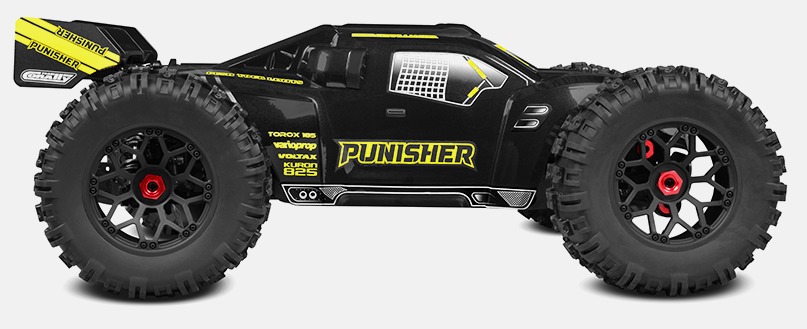
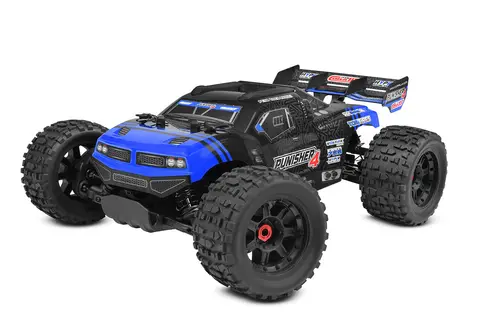
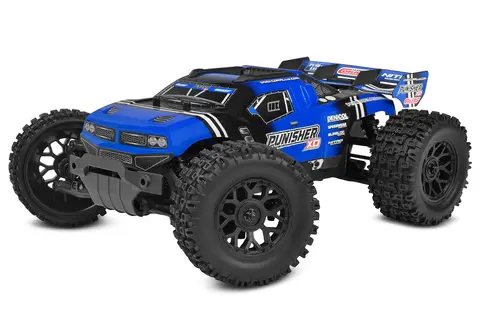
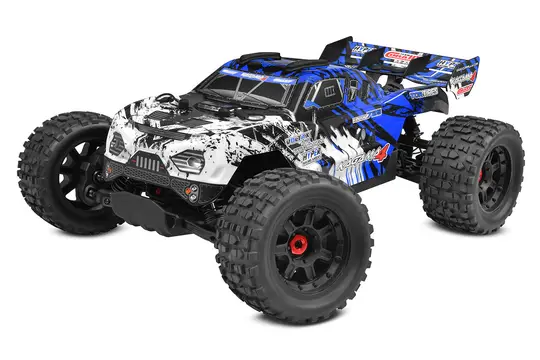
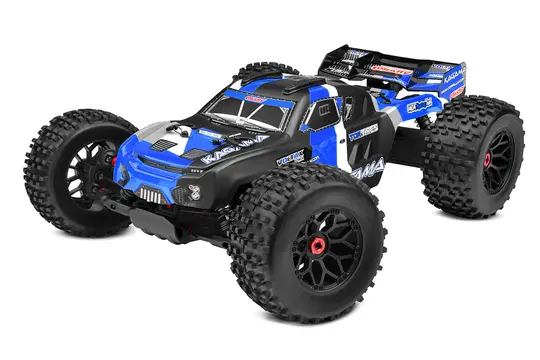
The 2021 Punisher XP 6S combines Team Corally's long-wheelbase Kronos platform with a different truck body and tire presentation. Its 388 mm wheelbase gives it a longer chassis footprint than the company's compact stunt trucks. This is the large brushless C-00171, with the motor, controller, steering servo and radio installed. The owner supplies a suitable driving pack and charger, keeping the initial electrical installation close to a complete factory arrangement. Design and factory equipment (opens in a new tab)
Read moreShow less
An aluminum chassis supports four-wheel drive through three fluid-filled gear differentials. Front CVD shafts, threaded aluminum shocks and a tower brace form part of the standard mechanical package. The 2050Kv Kuron 825 motor and Torox 185 controller support the manufacturer's 4S and 6S battery choices. The controller's model name is separate from its stated 150 A rating. Pack fit and connector routing still matter when selecting a battery for the adjustable holder. Design and factory equipment (opens in a new tab)
The long chassis and large wheels make repair access and alignment useful ownership considerations. After an impact, check a released hub or bent mounting point before replacing several neighboring parts. Bracing, servo speed and body protection address different problems, so a combined upgrade package can obscure which change was needed. Start with smooth suspension travel, secure pivot-ball retention and a centered steering linkage. Retain working factory equipment while choosing a focused repair or setup change for the way this particular truck is used. Design and factory equipment (opens in a new tab)
The kind of vehicle the maker sells it as. It sets what the car is built to do and which cars it is fair to compare it with.
Monster trucks have tall tires and long suspension travel, built for jumping and rough ground rather than a race track.
Drive
All four wheels are driven. That gives more grip under power, especially on loose ground.
The cost is more parts to maintain.
Power
A brushless motor has no brushes to wear, so it makes more power and runs more efficiently than a brushed one.
It needs a brushless ESC.
Build
Ready to run: built at the factory with the electronics installed.
Some come without a battery or charger; the maker's box contents say which.
Scale
The maker's nominal size compared with a full-size vehicle. It works more as a class label than a measurement.
A 1/10 monster truck is far bigger than a 1/10 touring car, so compare length and weight for real size.
This one is 577 mm long.
Part number
The maker's product number for this exact version.
A V2, a new color, or a kit instead of an RTR usually has a different number, and parts can differ between them.
Check it against your box or receipt before ordering parts.
Class
Monster truck
Drive
4WD
Power
Brushless
Build
Ready to run
Scale
1/8
Part number
C-00171
Drivetrain
Pinion
The small gear on the motor shaft. Fewer teeth gear the car shorter: quicker acceleration, lower top speed and a cooler motor. More teeth do the opposite.
On this car one tooth changes the gearing by about 7.7%.
A bigger pinion loads the motor and ESC harder, so check the maker's gearing chart and feel the motor temperature after a run.
Spur
The large gear the pinion drives. A bigger spur with the same pinion gears the car shorter.
Pinion and spur need matching pitch, or explicit manufacturer confirmation that the exact gears are compatible.
The Gearing parts table below shows this car's pitch and part numbers.
Transmission & axle
Every reduction after the spur, multiplied together: transmission, differentials and axle gears.
It is fixed by the design; the gearing you change is the pinion and spur.
This one is worked out from the tooth counts the maker publishes.
Spur ÷ pinion
Spur teeth divided by pinion teeth: the part of the gearing that a pinion or spur swap changes.
Here it is 4.000:1.
Final drive
How many times the motor turns for one turn of the wheels. A higher number is shorter gearing: more acceleration and pulling power, less top speed.
Among 1/8 monster trucks in the catalog, the middle half run between 13.2:1 and 17.9:1 on stock gearing; this one is 13.2:1.
Differentials
The type of each differential, as the maker states it.
A gear or ball diff lets the wheels on one axle turn at different speeds in a corner; a spool or locked diff turns them together for straight-line drive and climbing, at the cost of steering.
Pinion bore
The nominal size of the hole that mates with the motor shaft.
Match the pinion mounting method as well as its size. A press-fit hole cannot be inferred from motor shaft diameter.
Pinion pitch
The tooth spacing of the fitted gear, stated as metric module or diametral pitch.
Pinion and spur need matching pitch or explicit manufacturer confirmation of compatibility for the exact parts. Mod 0.8 and 32P are different standards; a compatibility statement for particular gears does not apply to every gear. A missing pitch can be inferred from the other fitted gear; module and diametral pitch are not silently converted.
Spur pitch
The tooth spacing of the fitted gear, stated as metric module or diametral pitch.
Pinion and spur need matching pitch or explicit manufacturer confirmation of compatibility for the exact parts. Mod 0.8 and 32P are different standards; a compatibility statement for particular gears does not apply to every gear. A missing pitch can be inferred from the other fitted gear; module and diametral pitch are not silently converted.
The outside diameter of the mounted tire, tread to tread. A taller tire covers more ground each turn, which gears the car taller.
At high speed tires can balloon and grow, so the real gearing gets taller as the car goes faster.
Rollout
How far the car moves for one turn of the motor: tire circumference divided by final drive.
It lets you compare gearing across different tire sizes; more rollout is taller gearing.
Here it is 40.6 mm.
Wheel hex
The hex on the axle that the wheel locks onto and is driven by. A wheel must match the hex size to fit.
17 mm is the standard size on 1/8 cars.
The wheel nut is a separate size, so check its thread too before buying nuts.
Stock tire width
Stock tire width: A documented stock wheel, tire, or axle measurement. Stock dimensions alone do not establish the largest size that will clear the body and suspension.
Stock wheel diameter
Stock wheel diameter: A documented stock wheel, tire, or axle measurement. Stock dimensions alone do not establish the largest size that will clear the body and suspension.
This working size comes from a replacement advertised for the identified OEM part. Confirm the fitted part before ordering; a replacement's size may differ.
What the shocks are and how they are built, as the maker describes them.
Oil-filled shocks damp with silicone oil; friction shocks, found on some entry-level cars, damp with a sprung plunger and cannot be tuned with oil.
Threaded bodies set ride height with a collar you turn, rather than clips.
The shaft size matters when buying seals, ends and rebuild kits.
Shock bore
The inside diameter of the shock body, where the piston moves through oil.
It is a shock measurement, separate from the motor pinion bore. Match the actual shock part when ordering pistons, seals or a replacement body.
Shock length, rear
The stated length of the complete shock assembly. Sources may use mounting-eye centers or a nominal assembly length.
Compare fully extended mounting-eye spacing, compressed length and mounting hardware before ordering. A longer shock changes ride height and travel, and can bind at full droop or bottom out.
This length is from one outside source. Check the linked listing and measure the fitted shocks before buying.
Oil-filledthreaded, aluminum body, 3.5 mm shaft, front and rear; Manufacturer-listed 3.5 mm nominal shaft thickness, interpreted as the diameter of the cylindrical shock shaft.Stock
Motor RPM times rollout, worked out on 6S at nominal voltage with stock gearing.
It assumes no load, no battery sag, no wheel slip and no drag, so read it as a ceiling for comparing setups.
A GPS usually reads below it; the gap is load, battery sag, tire slip and drag.
Motor speed
The motor's RPM with no load: KV times pack voltage.
Under load it drops, which is one reason real speed is lower than the theoretical figure.
Advertised top speed
The top speed the maker claims.
Makers often quote it with optional gearing, a bigger battery or a fully charged pack, so read their wording before comparing it with another car's claim or with the calculated figure.
Theoretical top speed
68.8mph on 6SCalculated
Calculated
Motor speed
45,510rpm, no loadCalculated
Calculated
Advertised top speed
62mphMaker's claim
Maker's claim
Size & weight
Weight
The vehicle's weight as the maker states it, without the battery.
Add your pack's weight for running weight.
More weight takes more power to accelerate and lands harder on the parts; it changes top speed very little.
Length
Overall length as the maker states it, usually with the body fitted.
Useful for comparing real size, since scale labels are loose.
Width
Overall width as the maker states it, usually with the body fitted.
A wider car is more stable in corners and harder to roll over.
Height
Overall height as the maker states it, usually with the body fitted.
Useful when checking it fits a shelf, a bag or a car trunk.
Wheelbase
The distance between the front and rear axle centers. A longer wheelbase is steadier at speed and over bumps; a shorter one turns more tightly.
Catalog stock FDR: 13.23:1. The grid uses the listed tooth counts and internal ratio, so rounding or source differences may change the result slightly.
Calculated final drive ratio for each pinion and spur pair
Pinion
50T spur
52T spur
54T spur
11T
12T
13T
14T
15T
16T
Select a pair to compare wheel travel per motor turn with stock. Other cells are mathematical examples, not verified gears or fits. Check pitch, mesh, clearance and motor temperature before changing parts.
About these specs
Corally publishes 'Gear Ratio (out of the box): 13.23 (MOD.1)' and 'Wheel Size (diameter, width): 171x88mm'.
Read moreShow less
The advertised 100+ km/h (62 mph) is 79% of the 78.2 mph this gearing allows at 4.2V/cell.
Corally's spares list for this truck names the 13T pinion C-72813 ('M1.0 Pinion, 13 Teeth, Shaft Dia. 5mm'), and the 52T spur C-00180-607 lists this car among those it fits; 52/13 x 3.31 = 13.24, the printed total, and the sister Dementor 2021 manual marks the same 13T/52T pair as factory fitted.
How to read these figures
Stock is as the vehicle ships.
Calculated is worked from the recorded figures on this page.
Derived uses recorded dimensions or arithmetic. The row explains the inference. A nominal mating size is not a measured tolerance or a complete fitment guarantee.
Derived from replacement part uses the listed dimensions of a replacement advertised for the identified OEM part. Treat it as an approximate working size; the factory-fitted part may differ. Calculated performance uses that approximation.
Single report uses one outside source. It is useful as a starting figure, with the source and calculation described in the note.
The top speed is kinematic: an ideal no-load RPM with no slip and no loss under load, so a real car is slower.
The maker advertises 62 mph, which is their own claim on their own conditions.
Design and factory equipment (opens in a new tab)world.corally.comPart pageSupports 10 specificationsUsed forMain specsWeightSizeBattery fitWheel hexElectronicsWheels & tiresSuspensionPowerSteering & radioBackground
On an older Punisher, hub retention deserves attention before the first big jump. Check which hubs are fitted, look for cracks or loose pivot-ball retention, and make sure the suspension moves freely. The owner’s maiden outing ended with a ball releasing from a hub; HD hubs were available but had not yet been installed. That is a useful inspection priority, without establishing that every stock hub fails the same way.[1] Original SyncR and Jeffwazz owner report (opens in a new tab)[2] Factory model information (opens in a new tab)
Treat an HD-hub retrofit as a repair or protection choice after checking the correct edition and supporting parts. A later Punisher build also lists a tower brace, HD shock ends and an Ackermann-plate doubler. It shows an installed package without isolating the benefit of each component. Repair the worn or failed assembly first and leave further bracing until the intended use justifies its cost.[1] Original SyncR and Jeffwazz owner report (opens in a new tab)[2] Factory model information (opens in a new tab)
Read moreRead less about upgrades and setup for Punisher XP 6S
Keep steering, suspension damage and power interruptions as separate jobs. The same build had an ESC stop that required a reboot, but it never established the cause. Check the power system and connections before swapping the entire system or adding speed. This guidance covers the 2021 C-00171 baseline; later Punisher models and retrofits need their own hardware check.[1] Original SyncR and Jeffwazz owner report (opens in a new tab)[2] Factory model information (opens in a new tab)
Conversions & shared parts
Steering rack doubler
This adds a second stiffener to support the steering rack. It is an option when you want to reduce flex in that part of the steering, with free movement checked after fitting the matching fasteners.
Manufacturer-documented option for the specified vehicle configuration.
RC Driver describes the original Punisher body, tires and chassis, followed by a winter driving session. The description explains its relationship to the Kronos, making it useful for checking which truck is being discussed.