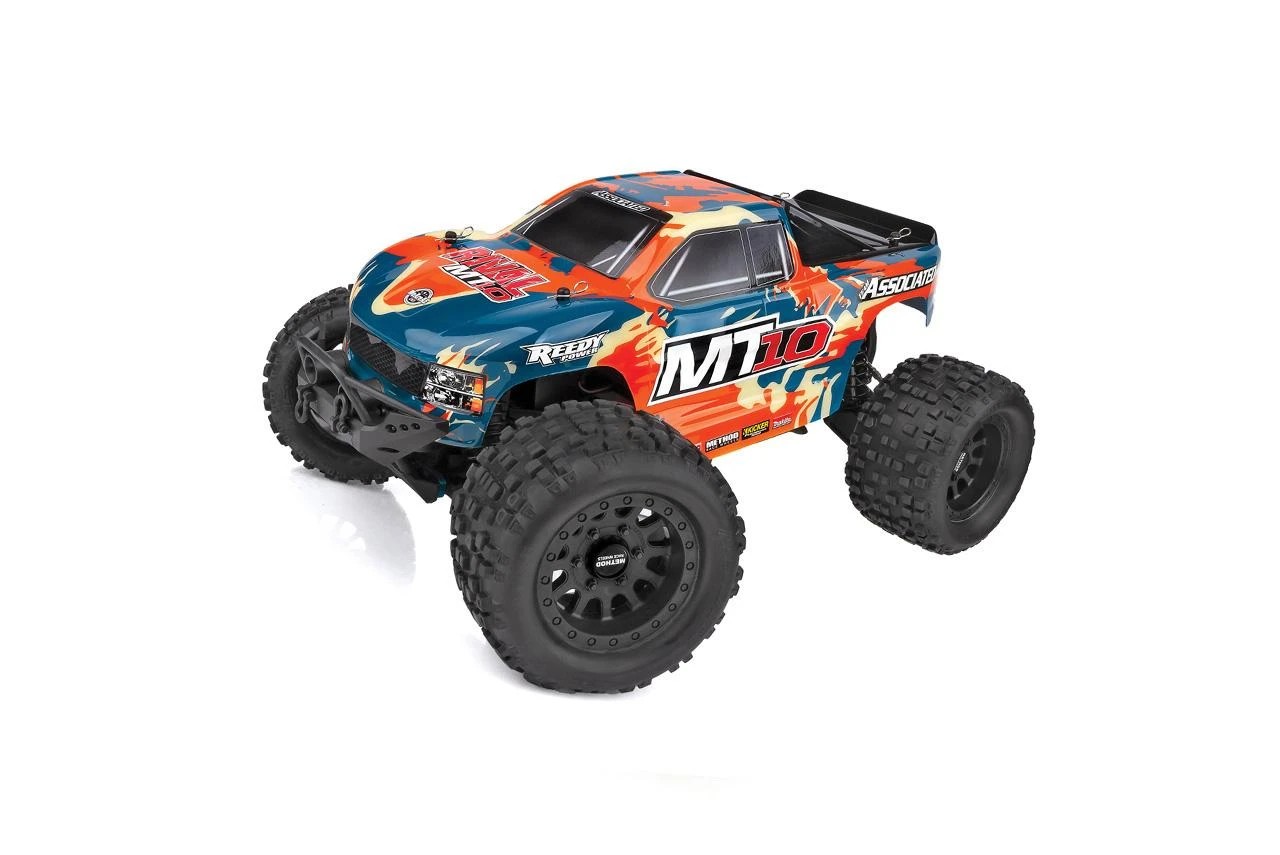
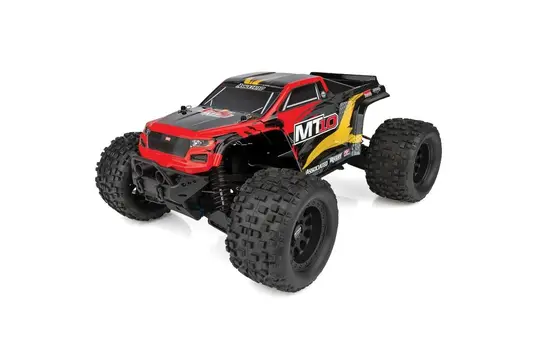
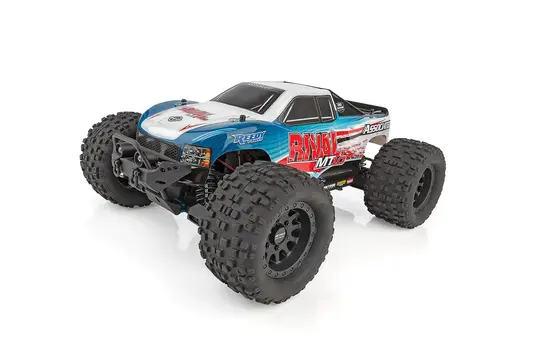
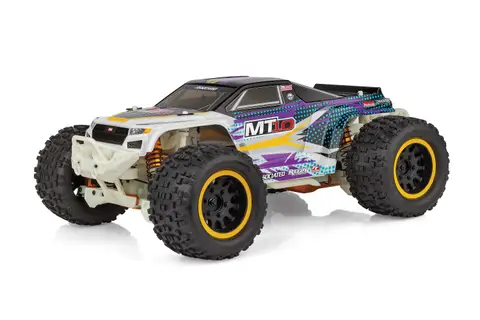
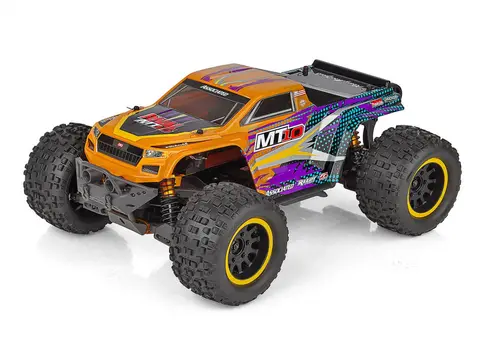
The brushed Rival MT10 offered a complete route into Associated's compact four-wheel-drive monster truck. The 20517C LiPo combo supplied a brushed Reedy Sport 550 15-turn motor, a 2S battery and a charger, leaving fewer major items to choose before driving. It retained the family layout of independent suspension, three sealed gear differentials and large all-terrain tires.
That mechanical layout gives the brushed truck more setup scope than its modest power system might suggest. Oil-filled threaded shocks, steel turnbuckles and a center differential provide ways to adjust how the truck carries its weight and shares traction. The short wheelbase and tall tires suit informal running across grass, dirt and pavement. They also make control and landing attitude important: extra motor power cannot compensate for binding suspension or a damaged wheel corner. Brushed LiPo combo (opens in a new tab)
The exact completion package matters. This is the 20517C brushed combo, not a brushless RTR advertised under the same MT10 name. Associated lists the stock brushed motor for 2S LiPo use. The ESC's broader input rating is a separate specification, so a 3S-capable controller alone does not establish a suitable 3S stock truck. Staying with the supplied 2S arrangement is a useful starting point while deciding whether the existing pace meets the intended use. Brushed LiPo combo (opens in a new tab)Stock brushed motor limits (opens in a new tab)
Pros
A fully sealed transmission with an all-metal shaft drive and center differential adds durability for regular bashing.1
The kind of vehicle the maker sells it as. It sets what the car is built to do and which cars it is fair to compare it with.
Monster trucks have tall tires and long suspension travel, built for jumping and rough ground rather than a race track.
Drive
All four wheels are driven. That gives more grip under power, especially on loose ground.
The cost is more parts to maintain.
Power
A brushed motor carries current through carbon brushes that rub on the commutator.
It is cheaper and smooth at low speed.
The brushes wear and the motor loses power over time.
Build
Ready to run: built at the factory with the electronics installed.
Some come without a battery or charger; the maker's box contents say which.
Scale
The maker's nominal size compared with a full-size vehicle. It works more as a class label than a measurement.
A 1/10 monster truck is far bigger than a 1/10 touring car, so compare length and weight for real size.
This one is 507 mm long.
Part number
The maker's product number for this exact version.
A V2, a new color, or a kit instead of an RTR usually has a different number, and parts can differ between them.
Check it against your box or receipt before ordering parts.
Class
Monster truck
Drive
4WD
Power
Brushed
Build
Ready to run
Scale
1/10
Part number
20517C
Drivetrain
Pinion
The small gear on the motor shaft. Fewer teeth gear the car shorter: quicker acceleration, lower top speed and a cooler motor. More teeth do the opposite.
On this car one tooth changes the gearing by about 8.3%.
A bigger pinion loads the motor and ESC harder, so check the maker's gearing chart and feel the motor temperature after a run.
Spur
The large gear the pinion drives. A bigger spur with the same pinion gears the car shorter.
Pinion and spur need matching pitch, or explicit manufacturer confirmation that the exact gears are compatible.
The Gearing parts table below shows this car's pitch and part numbers.
On this car the spur is mounted on the center differential.
Transmission & axle
Every reduction after the spur, multiplied together: transmission, differentials and axle gears.
It is fixed by the design; the gearing you change is the pinion and spur.
Spur ÷ pinion
Spur teeth divided by pinion teeth: the part of the gearing that a pinion or spur swap changes.
Here it is 4.500:1.
Final drive
How many times the motor turns for one turn of the wheels. A higher number is shorter gearing: more acceleration and pulling power, less top speed.
Among 1/10 monster trucks in the catalog, the middle half run between 11.4:1 and 15.2:1 on stock gearing; this one is 12.8:1.
Differentials
The type of each differential, as the maker states it.
A gear or ball diff lets the wheels on one axle turn at different speeds in a corner; a spool or locked diff turns them together for straight-line drive and climbing, at the cost of steering.
Hub bearing size
Hub bearing size: The documented drivetrain connection or size for this exact model. Match the mating component before buying a replacement.
Pinion bore
The nominal size of the hole that mates with the motor shaft.
A nominal shaft fit comes from the exact replacement pinion listing. It does not specify a measured finished hole or manufacturing tolerance.
Match the pinion mounting method as well as its size. A press-fit hole cannot be inferred from motor shaft diameter.
Pinion pitch
The tooth spacing of the fitted gear, stated as metric module or diametral pitch.
Pinion and spur need matching pitch or explicit manufacturer confirmation of compatibility for the exact parts. Mod 0.8 and 32P are different standards; a compatibility statement for particular gears does not apply to every gear. A missing pitch can be inferred from the other fitted gear; module and diametral pitch are not silently converted.
Spur pitch
The tooth spacing of the fitted gear, stated as metric module or diametral pitch.
Pinion and spur need matching pitch or explicit manufacturer confirmation of compatibility for the exact parts. Mod 0.8 and 32P are different standards; a compatibility statement for particular gears does not apply to every gear. A missing pitch can be inferred from the other fitted gear; module and diametral pitch are not silently converted.
Diff oil, front
Silicone oil sealed inside the differential. A diff lets the wheels on one axle turn at different speeds in a corner; thicker oil makes it act more like a solid axle.
At the front, thicker oil keeps both front wheels pulling out of a corner but makes the car turn in less willingly; thinner oil steers more easily.
It is graded in cSt (centistokes), a measure of thickness that means the same across brands. K means thousands, so 60K cSt is 60,000 cSt.
Diff oil, center
The center diff splits power between front and rear. Thicker oil there sends more drive to the end that has grip and helps acceleration; thinner oil lets the car steer more easily off the throttle.
Diff oil, rear
The rear diff mostly shapes drive out of corners.
Thicker oil there puts power down more evenly on loose or slippery ground; thinner oil lets the car rotate more easily through a corner.
This car runs thicker oil in the front diff (60K cSt) than the rear (3K cSt): steadier on turn-in, with a rear that lets the car rotate.
The outside diameter of the mounted tire, tread to tread. A taller tire covers more ground each turn, which gears the car taller.
This figure is not from the maker's documents, so treat it as close rather than exact.
At high speed tires can balloon and grow, so the real gearing gets taller as the car goes faster.
Rollout
How far the car moves for one turn of the motor: tire circumference divided by final drive.
It lets you compare gearing across different tire sizes; more rollout is taller gearing.
Here it is 29.4 mm.
Wheel hex
The hex on the axle that the wheel locks onto and is driven by. A wheel must match the hex size to fit.
12 mm is the common size on 1/10 cars, so most 1/10 wheels fit; offset and width still vary.
The wheel nut is a separate size, so check its thread too before buying nuts.
Stock wheel diameter
Stock wheel diameter: A documented stock wheel, tire, or axle measurement. Stock dimensions alone do not establish the largest size that will clear the body and suspension.
Stock tire width
Stock tire width: A documented stock wheel, tire, or axle measurement. Stock dimensions alone do not establish the largest size that will clear the body and suspension.
Axle thread
Axle thread: A documented stock wheel, tire, or axle measurement. Stock dimensions alone do not establish the largest size that will clear the body and suspension.
What the main chassis is made of and how it is built, as stated for this car. Braces, stiffeners and skid plates are not counted.
Composite is the makers' word for molded plastic, usually nylon with glass or other fibers: it flexes and shrugs off hits, and it is light and cheap to replace.
This is from one outside source, not the maker's own page.
Shocks
What the shocks are and how they are built, as the maker describes them.
Oil-filled shocks damp with silicone oil; friction shocks, found on some entry-level cars, damp with a sprung plunger and cannot be tuned with oil.
Threaded bodies set ride height with a collar you turn, rather than clips.
A bigger bore moves more oil for the same travel, which damps more consistently and runs cooler.
The shaft size matters when buying seals, ends and rebuild kits.
Shock length, front
The stated length of the complete shock assembly. Sources may use mounting-eye centers or a nominal assembly length.
Compare fully extended mounting-eye spacing, compressed length and mounting hardware before ordering. A longer shock changes ride height and travel, and can bind at full droop or bottom out.
This approximate length comes from a replacement listed for the identified OEM shock set. Check the fitted shocks; their original dimensions may differ.
Shock length, rear
The same measure at the rear, which differs from the front on this car.
Longer rear shocks are common: they give the rear more travel for landings and put power down over rough ground.
Compressed length, front
The shock's length eye to eye when fully compressed.
The gap between this and the extended length is the travel the shock allows.
This approximate size comes from the named replacement, so confirm the fitted shock's compressed length before buying.
Compressed length, rear
The same measure at the rear, which differs from the front on this car.
Shock stroke, front
How far the shaft travels from fully extended to fully compressed.
More stroke means more suspension travel, which soaks up bigger bumps and landings.
Shock stroke, rear
The same measure at the rear, which differs from the front on this car.
Spring, front
The stock springs, in the maker's own wording: a color, a rate or a length.
A stiffer spring holds the car up and resists bottoming out; a softer one lets it squat and follow rough ground.
Rates are not comparable across makers unless they state the same unit.
Spring, rear
The same measure at the rear, which differs from the front on this car.
Frontupper shock bolt
Front upper shock bolt: A documented shock mounting interface at the named end and eye. A ball stud or standoff is distinct from a through-bolt. Match the mounting type, thread and eye dimensions when choosing a replacement shock.
Frontlower shock bolt
Front lower shock bolt: A documented shock mounting interface at the named end and eye. A ball stud or standoff is distinct from a through-bolt. Match the mounting type, thread and eye dimensions when choosing a replacement shock.
Rearupper shock bolt
Rear upper shock bolt: A documented shock mounting interface at the named end and eye. A ball stud or standoff is distinct from a through-bolt. Match the mounting type, thread and eye dimensions when choosing a replacement shock.
Rearlower shock bolt
Rear lower shock bolt: A documented shock mounting interface at the named end and eye. A ball stud or standoff is distinct from a through-bolt. Match the mounting type, thread and eye dimensions when choosing a replacement shock.
Front spring inner diameter
Front spring inner diameter: A documented shock mounting interface at the named end and eye. A ball stud or standoff is distinct from a through-bolt. Match the mounting type, thread and eye dimensions when choosing a replacement shock.
This working size comes from a replacement advertised for the identified OEM part. Confirm the fitted part before ordering; a replacement's size may differ.
Rear spring inner diameter
Rear spring inner diameter: A documented shock mounting interface at the named end and eye. A ball stud or standoff is distinct from a through-bolt. Match the mounting type, thread and eye dimensions when choosing a replacement shock.
This working size comes from a replacement advertised for the identified OEM part. Confirm the fitted part before ordering; a replacement's size may differ.
Shock oil
The oil in the shocks slows how fast the suspension moves. Thicker oil settles the car more slowly and resists bottoming out; thinner oil lets the wheels follow bumps.
Front and rear run the same oil on this car, so both ends respond alike. Changing one end at a time is the usual way to shift the balance.
It is graded in wt here. A wt number is the oil maker's own grade and differs between brands, so match the brand, or use the oil maker's chart to convert.
87.5mm listed length; Working estimate from OEM aluminum replacement 25845 for the original 25825 hardware; eyelet centers. Not a factory-assembled shock measurement.Derived from replacement part
102.1mm listed length; Working estimate from OEM aluminum replacement 25846 for the original 25825 hardware; eyelet centers. Not a factory-assembled shock measurement.Derived from replacement part
60.6mm eye to eye; Working estimate from OEM aluminum replacement 25845 for the original 25825 hardware; eyelet centers. Not a factory-assembled shock measurement.Derived from replacement part
67.6mm eye to eye; Working estimate from OEM aluminum replacement 25846 for the original 25825 hardware; eyelet centers. Not a factory-assembled shock measurement.Derived from replacement part
26.9mm; Working replacement travel: 87.5 minus 60.6 mm between eyelet centers. Not measured original-shock or wheel travel.Derived from replacement part
34.5mm; Working replacement travel: 102.1 minus 67.6 mm between eyelet centers. Not measured original-shock or wheel travel.Derived from replacement part
17.3mm, Exact stock spring set 25832; nominal component inner diameter, separate from shock bore and spring outer diameter.Derived from replacement part
17.3mm, Exact stock spring set 25832; nominal component inner diameter, separate from shock bore and spring outer diameter.Derived from replacement part
550; Ø36 × 60 mm listed motor sizeReedy lists 36 mm diameter and 60 mm length for Sport 550 15T 27467. Shaft inclusion in the length is not defined. The exact named motor is fitted to 20517C; these are not chassis clearance limits.Stock
One 2S 3300 mAh Reedy WolfPack hardcase LiPo, 139 × 47 × 24.5mm (L × W × H), Included pack reference dimensions. The maximum compatible tray envelope remains unconfirmed.Stock
Approx. 139 × 47 × 25.1 mmWorking pack envelope from the matching MT10 chassis and strap layout. Cable clearance and fit of taller packs can vary.Single report
A digital servo holds its position more firmly and reacts sooner.
Transmitter
The stock transmitter, the radio you hold.
Two channels are steering and throttle; more channels work extras such as a two-speed, lights or a winch.
Stock horn spline
Stock horn spline: A documented servo or steering interface for this model. Matching torque alone does not establish mounting or horn fit.
Stock servo spline
Stock servo spline: A documented servo or steering interface for this model. Matching torque alone does not establish mounting or horn fit.
This working size comes from a replacement advertised for the identified OEM part. Confirm the fitted part before ordering; a replacement's size may differ.
Catalog stock FDR: 12.82:1. The grid uses the listed tooth counts and internal ratio, so rounding or source differences may change the result slightly.
Calculated final drive ratio for each pinion and spur pair
Pinion
52T spur
54T spur
56T spur
10T
11T
12T
13T
14T
15T
Select a pair to compare wheel travel per motor turn with stock. Other cells are mathematical examples, not verified gears or fits. Check pitch, mesh, clearance and motor temperature before changing parts.
About these specs
The manual fits a 12T 32P pinion (25844, p. 17) and a 54T 32P spur on the center diff (25811, p. 6), the same gearing as the brushless Rival MT10 V2.
Read moreShow less
Associated prints the 2.85:1 ratio after the spur for the Rival MT10 V2, whose diffs use the same 37T ring gears (25808) and pinion set (25809); with it the final drive is 12.825:1.
The Reedy Sport 550 15T motor is brushed, so it has no supported published Kv rating; Associated rates the motor for 2S LiPo, while the Reedy SC400 ESC accepts 2S to 3S.
The combo ships with a 2S 3300mAh LiPo.
The stock Team Associated 25841 mounted tire outside diameter uses Comella’s Collectibles’ approximate 120 mm measurement; Associated does not publish the outside diameter.
Appliance Electronics describes replacement pinion 25844 as fitting a 3.17 mm Reedy 540-SL4 shaft.
This is a derived nominal shaft fit for the same set-screw pinion identified in this edition’s manual, not a measured hole diameter or tolerance.
How to read these figures
Stock is as the vehicle ships.
Calculated is worked from the recorded figures on this page.
Derived from replacement part uses the listed dimensions of a replacement advertised for the identified OEM part. Treat it as an approximate working size; the factory-fitted part may differ. Calculated performance uses that approximation.
Single report uses one outside source. It is useful as a starting figure, with the source and calculation described in the note.
Not published means it exists but no source we could find prints it.
Checked task pages, documented requirements and recorded fluid references for this model. Follow the manufacturer's procedure for the exact assembly and revision.
Maintenance bundles
Manual pages, documented requirements and relevant specifications, together by task.
No separate parts, tools or prerequisites have been indexed for this task. Read the cited reference before starting.
This is a partial service reference. Check the cited instructions for the full procedure and configuration-specific requirements. Mechanical tasks may need additional parts, quantities and reused hardware beyond the items listed here. Manual reviewed 2026-10-08.
MotorProcedure
Motor mount and gear mesh
Exact 20517C own edition; component tasks conditional on installed electronics.
Own spring motor mount 25815: rock spur without moving pinion; loosen 25188 and move motor away if tight. 12T 32P pinion 25844. No internal motor rebuild documented.
No separate parts, tools or prerequisites have been indexed for this task. Read the cited reference before starting.
This is a partial service reference. Check the cited instructions for the full procedure and configuration-specific requirements. Mechanical tasks may need additional parts, quantities and reused hardware beyond the items listed here. Manual reviewed 2026-10-09.
Steering servoReference
Servo saver and linkage assembly
Exact 20517C own edition; component tasks conditional on installed electronics.
Own spring saver 25805 and servo installation, 25T arm and 0.80 mm link callout. Confirm actual replacement spline; no servo internals or mandatory replacement inferred.
No separate parts, tools or prerequisites have been indexed for this task. Read the cited reference before starting.
This is a partial service reference. Check the cited instructions for the full procedure and configuration-specific requirements. Mechanical tasks may need additional parts, quantities and reused hardware beyond the items listed here. Manual reviewed 2026-10-09.
Indexed tasks link to checked physical PDF pages. Other links open full documents. Tasks and rebuild requirements not shown here still need review.
Upgrades and setup
If the truck already does what is wanted, retain the brushed system and concentrate on smooth steering, free suspension and tires suited to the ground. Clean and inspect the drivetrain after dirty runs, and investigate heat or an unusually noisy mesh before changing ratios. More aggressive gearing asks more of the motor; a fresh brushless system is a deliberate conversion with mounting and battery consequences, not a substitute for fixing drag or worn parts.[1] Exact brushed combo and factory options (opens in a new tab)[2] Stock brushed motor limits (opens in a new tab)
For a brushless conversion, choose the battery target before the motor and ESC. Motor length, shaft size, pinion fit and mount support all need to work together, and the ESC must fit securely with suitable connectors. Owners who converted original brushed trucks described modified mounts and different gearing, with later attention to hinge pins and arm blocks after impacts. Those are individual builds with their own alterations, useful for identifying supporting work but not a universal shopping list or evidence that every upgrade is necessary.[3] Installed brushed conversions and later use (opens in a new tab)
Read moreRead less about upgrades and setup for Team Associated RIVAL MT10 Brushed RTR LiPo Combo
Driveshaft replacements deserve the same care. One documented cross-brand conversion used Traxxas 6851A front assemblies only after internal trimming; the corresponding rear parts were not interchangeable in that method. A matched MT10 replacement avoids assuming that a near fit is a drop-in repair. Once the truck is mechanically sound, tune differential oil and damping around its traction and terrain. Use short comparison runs, retain the settings that improve control, and buy strength where a real load or wear problem calls for it.[3] Installed brushed conversions and later use (opens in a new tab)[1] Exact brushed combo and factory options (opens in a new tab)
Conversions & shared parts
Factory Team aluminum shocks
This replaces the plastic-bodied shocks with matching aluminum front and rear shock kits. It is an option when rebuilding the suspension around these serviceable shock assemblies, with oil and spring setup chosen for the truck and surface.
Manufacturer-documented option for the specified vehicle configuration.
This replaces the plastic axle driveshafts with matched steel constant-velocity assemblies that transmit drive as the suspension and steering move. Choose it when renewing those axle shafts, retaining the compatible differential outputs and hub bearings.
Manufacturer-documented option for the specified vehicle configuration.
Looks at the 2022 brushed RIVAL MT10 and compares its equipment and value with the ARRMA Granite. This covers the brushed truck, while the battery and charger contents of the 20517C combo are not established by the review.
Common numbers cover selected core components, not every part. A shared family, manual or listing does not mean the parts fit both vehicles. Check the comparison and upgrade notes before ordering.