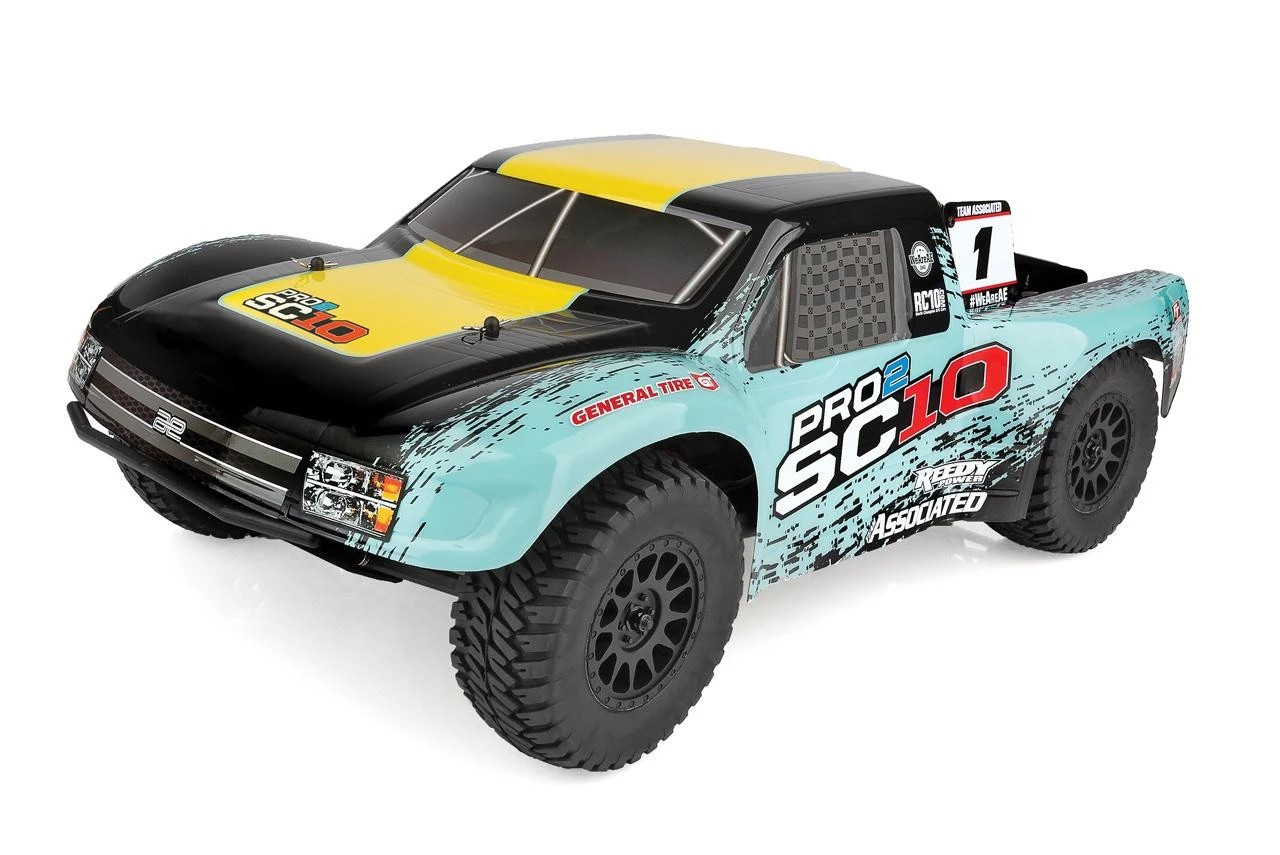
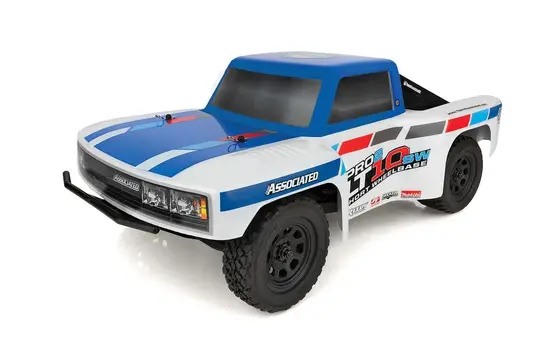
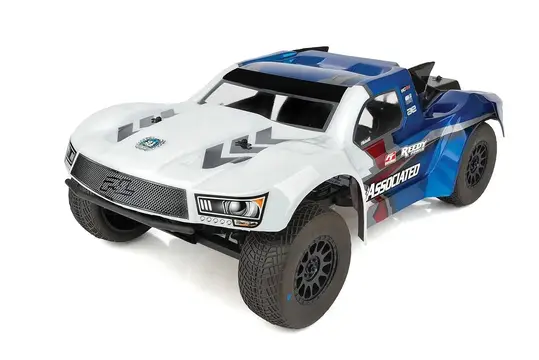
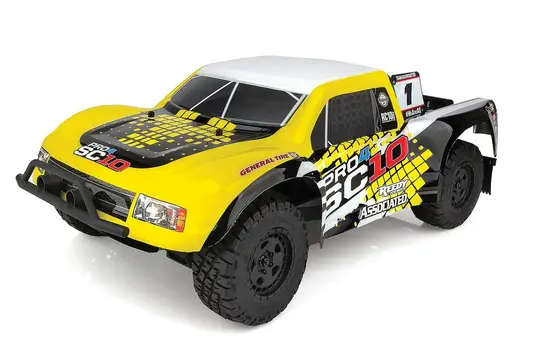
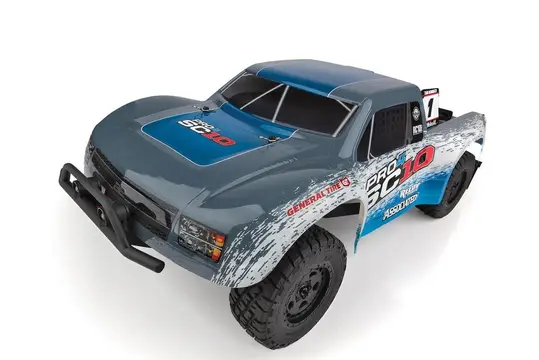
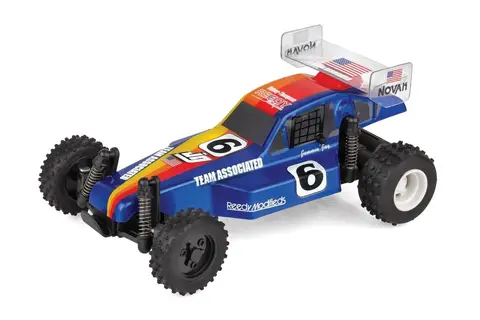
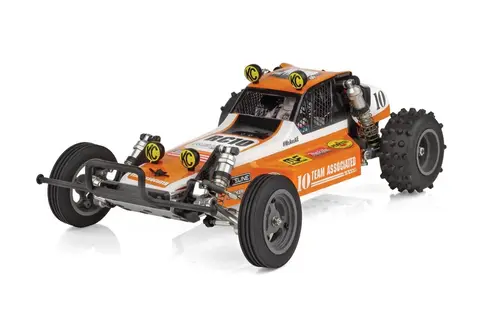
The Pro2 SC10 translates part of Team Associated’s short-course racing background into an assembled rear-motor truck. Its chassis uses components from the RC10SC5M platform, but the package is aimed at getting a complete truck onto dirt with the radio and brushless system installed. A finished race-truck body and Method-style wheels give it the familiar short-course silhouette, while the underlying adjustability leaves room for learning setup as the driver’s ambitions develop. Pro2 architecture and race-platform lineage (opens in a new tab)
Read moreShow less
A 3300 Kv Reedy motor drives through a sealed gear differential and an adjustable V2 slipper clutch, with CVA driveshafts at the rear. Aluminum big-bore shocks, steel turnbuckles and adjustable roll centers provide more useful tuning choices than the RTR label alone might suggest. The DVC receiver adds adjustable gyro assistance, supported by a metal-gear digital steering servo. Mechanical alignment and rear traction still have to be established; assistance cannot make an unsuitable tire compound work on a different surface. Pro2 architecture and race-platform lineage (opens in a new tab)
For ownership, the standard 70020 and battery-equipped 70020C are distinct purchases. The former needs a suitable driving battery and charger, so compare complete operating packages rather than just truck prices. Once running, the Pro2 rewards attention to tire choice, shock travel and the slipper’s delivery of power to the rear wheels. Keeping its original motor while finding a repeatable setup gives those adjustments a useful reference. Replacement suspension parts should be selected for the actual Series 5 assembly, with full compression and droop checked after installation. The broad SC10 name spans other platforms and does not establish interchangeable shocks or arms. Pro2 architecture and race-platform lineage (opens in a new tab)
Pros
Its receiver runs Dynamic Vehicle Control, which Team Associated says improves stability by automatically counter-steering when the truck starts to slide.1
The kind of vehicle the maker sells it as. It sets what the car is built to do and which cars it is fair to compare it with.
Short course trucks copy full-size desert race trucks, with bodies that cover the wheels so they can bump each other without tangling.
Drive
Only one axle is driven, the rear on almost every 2WD RC car.
It is lighter and simpler, and it takes more throttle control on loose ground.
Power
A brushless motor has no brushes to wear, so it makes more power and runs more efficiently than a brushed one.
It needs a brushless ESC.
Build
Ready to run: built at the factory with the electronics installed.
Some come without a battery or charger; the maker's box contents say which.
Scale
The maker's nominal size compared with a full-size vehicle. It works more as a class label than a measurement.
A 1/10 monster truck is far bigger than a 1/10 touring car, so compare length and weight for real size.
This one is 538 mm long.
Part number
The maker's product number for this exact version.
A V2, a new color, or a kit instead of an RTR usually has a different number, and parts can differ between them.
Check it against your box or receipt before ordering parts.
Class
Short course
Drive
2WD
Power
Brushless
Build
Ready to run
Scale
1/10
Part number
70020
Drivetrain
Pinion
The small gear on the motor shaft. Fewer teeth gear the car shorter: quicker acceleration, lower top speed and a cooler motor. More teeth do the opposite.
On this car one tooth changes the gearing by about 5.6%.
A bigger pinion loads the motor and ESC harder, so check the maker's gearing chart and feel the motor temperature after a run.
Spur
The large gear the pinion drives. A bigger spur with the same pinion gears the car shorter.
Pinion and spur need matching pitch, or explicit manufacturer confirmation that the exact gears are compatible.
The Gearing parts table below shows this car's pitch and part numbers.
Transmission & axle
Every reduction after the spur, multiplied together: transmission, differentials and axle gears.
It is fixed by the design; the gearing you change is the pinion and spur.
Spur ÷ pinion
Spur teeth divided by pinion teeth: the part of the gearing that a pinion or spur swap changes.
Here it is 4.833:1.
Final drive
How many times the motor turns for one turn of the wheels. A higher number is shorter gearing: more acceleration and pulling power, less top speed.
Among 1/10 short course trucks in the catalog, the middle half run between 10.2:1 and 12.1:1 on stock gearing; this one is 12.6:1, shorter than most.
Differentials
The type of each differential, as the maker states it.
A gear or ball diff lets the wheels on one axle turn at different speeds in a corner; a spool or locked diff turns them together for straight-line drive and climbing, at the cost of steering.
Slipper clutch
A slipper clutch sits on the spur gear and slips under a sudden load, a hard landing or full throttle on grip, to protect the gears.
Set it too loose and it wastes power; too tight and it protects nothing.
Hub bearing size
Hub bearing size: The documented drivetrain connection or size for this exact model. Match the mating component before buying a replacement.
Pinion bore
The nominal size of the hole that mates with the motor shaft.
Match the pinion mounting method as well as its size. A press-fit hole cannot be inferred from motor shaft diameter.
Pinion pitch
The tooth spacing of the fitted gear, stated as metric module or diametral pitch.
Pinion and spur need matching pitch or explicit manufacturer confirmation of compatibility for the exact parts. Mod 0.8 and 32P are different standards; a compatibility statement for particular gears does not apply to every gear. A missing pitch can be inferred from the other fitted gear; module and diametral pitch are not silently converted.
Spur pitch
The tooth spacing of the fitted gear, stated as metric module or diametral pitch.
Pinion and spur need matching pitch or explicit manufacturer confirmation of compatibility for the exact parts. Mod 0.8 and 32P are different standards; a compatibility statement for particular gears does not apply to every gear. A missing pitch can be inferred from the other fitted gear; module and diametral pitch are not silently converted.
The outside diameter of the mounted tire, tread to tread. A taller tire covers more ground each turn, which gears the car taller.
At high speed tires can balloon and grow, so the real gearing gets taller as the car goes faster.
Wheel hex
The hex on the axle that the wheel locks onto and is driven by. A wheel must match the hex size to fit.
12 mm is the common size on 1/10 cars, so most 1/10 wheels fit; offset and width still vary.
The wheel nut is a separate size, so check its thread too before buying nuts.
Stock wheel width
Stock wheel width: A documented stock wheel, tire, or axle measurement. Stock dimensions alone do not establish the largest size that will clear the body and suspension.
Stock wheel offset
Stock wheel offset: A documented stock wheel, tire, or axle measurement. Stock dimensions alone do not establish the largest size that will clear the body and suspension.
What the main chassis is made of and how it is built, as stated for this car. Braces, stiffeners and skid plates are not counted.
Composite is the makers' word for molded plastic, usually nylon with glass or other fibers: it flexes and shrugs off hits, and it is light and cheap to replace.
Shocks
What the shocks are and how they are built, as the maker describes them.
Oil-filled shocks damp with silicone oil; friction shocks, found on some entry-level cars, damp with a sprung plunger and cannot be tuned with oil.
A bigger bore moves more oil for the same travel, which damps more consistently and runs cooler.
The shaft size matters when buying seals, ends and rebuild kits.
Shock bore
The inside diameter of the shock body, where the piston moves through oil.
It is a shock measurement, separate from the motor pinion bore. Match the actual shock part when ordering pistons, seals or a replacement body.
Shock length, front
The stated length of the complete shock assembly. Sources may use mounting-eye centers or a nominal assembly length.
Compare fully extended mounting-eye spacing, compressed length and mounting hardware before ordering. A longer shock changes ride height and travel, and can bind at full droop or bottom out.
Shock length, rear
The same measure at the rear, which differs from the front on this car.
Longer rear shocks are common: they give the rear more travel for landings and put power down over rough ground.
Shock stroke, front
How far the shaft travels from fully extended to fully compressed.
More stroke means more suspension travel, which soaks up bigger bumps and landings.
Shock stroke, rear
The same measure at the rear, which differs from the front on this car.
Spring, front
The stock springs, in the maker's own wording: a color, a rate or a length.
A stiffer spring holds the car up and resists bottoming out; a softer one lets it squat and follow rough ground.
Rates are not comparable across makers unless they state the same unit.
Spring, rear
The same measure at the rear, which differs from the front on this car.
Shock oil
The oil in the shocks slows how fast the suspension moves. Thicker oil settles the car more slowly and resists bottoming out; thinner oil lets the wheels follow bumps.
Front and rear run the same oil on this car, so both ends respond alike. Changing one end at a time is the usual way to shift the balance.
It is graded in wt here. A wt number is the oil maker's own grade and differs between brands, so match the brand, or use the oil maker's chart to convert.
540-SL4; 52 × 36 mm listed size4-pole; Maker-listed dimensions of the identified Reedy 907 motor; axes and shaft inclusion are unstated. This is not chassis clearance.; Original Reedy 540-SL4 motor.Stock
Team Associated XP-R4 DVC4-channel, 2.4 GHz; Team Associated specifies the adjustable DVC receiver for this RTR. The linked XP120 manual gives the DVC unit as #29256.Stock
Calculated final drive ratio for each pinion and spur pair
Pinion
85T spur
87T spur
89T spur
16T
17T
18T
19T
20T
21T
Select a pair to compare wheel travel per motor turn with stock. Other cells are mathematical examples, not verified gears or fits. Check pitch, mesh, clearance and motor temperature before changing parts.
About these specs
The 5-Series RTR manual, which covers the Pro2 SC10 (70020), lists an 18T pinion and 87T spur as the stock gearing for the 3300kV motor, with a 2.60:1 transmission and a 12.57:1 final drive (gear chart, p. 23).
Read moreShow less
The manual suggests a 17T pinion (part 1335) as a starting point on 3S LiPo.
Associated does not publish the diameter of the Multi-Terrain tires (71058), so the tire size is left blank.
The 3S LiPo limit comes from the Reedy SC600-BL ESC manual linked on the product page.
The Trophy Rat (70019) shares the manual, gearing, electronics and tires with a different body and bumpers.
How to read these figures
Stock is as the vehicle ships.
Calculated is worked from the recorded figures on this page.
Single report uses one outside source. It is useful as a starting figure, with the source and calculation described in the note.
Not published means it exists but no source we could find prints it.
Checked task pages, documented requirements and recorded fluid references for this model. Follow the manufacturer's procedure for the exact assembly and revision.
Maintenance bundles
Manual pages, documented requirements and relevant specifications, together by task.
Use the cited instructions for your fitted equipment. These references are not a complete rebuild kit.
DifferentialsReference
Own differential service reference
Exact 70020 manufacturer-linked edition; retain own axle and body branches.
Own gear differential assembly and black grease; free outdrive rotation before installation. Own panel does not specify fluid viscosity; do not borrow LT10SW500k setting.
No separate parts, tools or prerequisites have been indexed for this task. Read the cited reference before starting.
This is a partial service reference. Check the cited instructions for the full procedure and configuration-specific requirements. Mechanical tasks may need additional parts, quantities and reused hardware beyond the items listed here. Manual reviewed 2026-10-09.
DrivetrainReference
Own drivetrain service reference
Exact 70020 manufacturer-linked edition; retain own axle and body branches.
Own87T48P V2 slipper, gearbox lube6591 and rearCVA assembly. Own24 slipper tuning: shaft flush, adjust1/8turn until faint slip1-2feet. 71016 rearCVA, notLT65mm.
No separate parts, tools or prerequisites have been indexed for this task. Read the cited reference before starting.
This is a partial service reference. Check the cited instructions for the full procedure and configuration-specific requirements. Mechanical tasks may need additional parts, quantities and reused hardware beyond the items listed here. Manual reviewed 2026-10-09.
ShocksProcedure
Own shock service reference
Exact 70020 manufacturer-linked edition; retain own axle and body branches.
Own front/rear30wt shocks. Purge bubbles, fill top, cap; release cap3/4turn and compress to expel excess, close compressed and recheck. Front26/rear35mm stroke.
No separate parts, tools or prerequisites have been indexed for this task. Read the cited reference before starting.
This is a partial service reference. Check the cited instructions for the full procedure and configuration-specific requirements. Mechanical tasks may need additional parts, quantities and reused hardware beyond the items listed here. Manual reviewed 2026-10-09.
Steering servoReference
Own servo service reference
Exact 70020 manufacturer-linked edition; retain own axle and body branches.
Own steering servo mount91391 and spring saver71047. Horn90degrees, adjust trim after assembly. Actual spline and internal gear replacement not documented.
No separate parts, tools or prerequisites have been indexed for this task. Read the cited reference before starting.
This is a partial service reference. Check the cited instructions for the full procedure and configuration-specific requirements. Mechanical tasks may need additional parts, quantities and reused hardware beyond the items listed here. Manual reviewed 2026-10-09.
MotorReference
Own motor service reference
Exact 70020 manufacturer-linked edition; retain own axle and body branches.
Own3300kV motor installation with18T48P1336 pinion; main23 explains gear mesh. Main6 suggests17T1335 for3S, gearing depends surface; no complete motor rebuild.
No separate parts, tools or prerequisites have been indexed for this task. Read the cited reference before starting.
This is a partial service reference. Check the cited instructions for the full procedure and configuration-specific requirements. Mechanical tasks may need additional parts, quantities and reused hardware beyond the items listed here. Manual reviewed 2026-10-09.
For installed XP120 after transmitter/receiver replacement: power receiver, Pair connector, transmitter on, remove connector and confirm solid LED. RTR radio already bound; receiver DVC variant must be identified.
No separate parts, tools or prerequisites have been indexed for this task. Read the cited reference before starting.
This is a partial service reference. Check the cited instructions for the full procedure and configuration-specific requirements. Mechanical tasks may need additional parts, quantities and reused hardware beyond the items listed here. Manual reviewed 2026-10-09.
Indexed tasks link to checked physical PDF pages. Other links open full documents. Tasks and rebuild requirements not shown here still need review.
Upgrades and setup
Prioritize tires and a consistent suspension setup before replacing the 3300kV power system. The Pro2 already has rear CVAs, aluminum shock bodies and an adjustable slipper. Start from its 18/87 gearing, check gear mesh and free suspension movement, then change one setup variable at a time. Match grip and gearing to the surface rather than adding power to compensate for a truck that cannot put it down.[1] Exact 70020 equipment and options (opens in a new tab)[2] Series 5 manual including exact 70020 (opens in a new tab)
Buy replacement shocks by extended length, usable stroke and mounting fit. The factory targets are 86.25mm length with 26mm stroke at the front, and 103.5mm with 35mm stroke at the rear. Shorter-travel replacements can run out of movement before the chassis reaches the ground. Check full compression and droop after installation, and use the correct shock tool when rebuilding the supplied units. Plain SC10 compatibility labels are insufficient for this Series 5 platform.[2] Series 5 manual including exact 70020 (opens in a new tab)[3] Installed replacement shocks and fit problem (opens in a new tab)
Read moreRead less about upgrades and setup for Pro2 SC10
This installs a matched Octalock slipper clutch with its specified pads and hubs. Choose it when rebuilding the clutch as a complete system, then adjust how much it slips for the car's power and available grip.
Manufacturer-documented option for the specified vehicle configuration.
This replaces the transmission gears and top shaft with a matched metal-gear package. It is an option when renewing the gearbox's internal components, retaining the compatible housing and setting the slipper and gear mesh after assembly.
Manufacturer-documented option for the specified vehicle configuration.
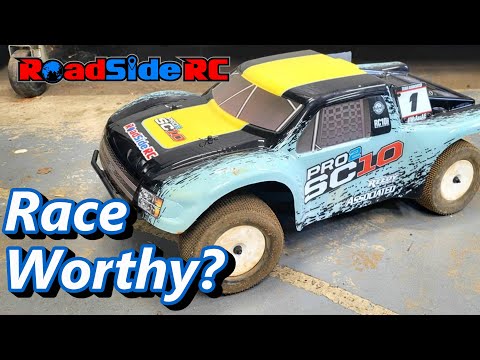
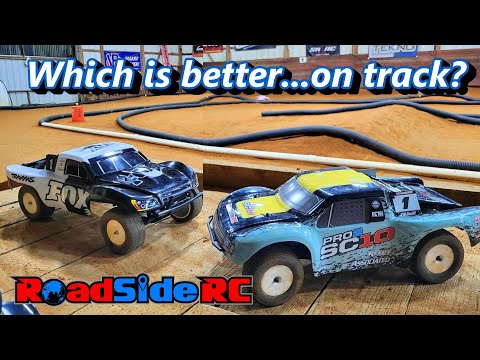
Compares the Pro2 SC10 and Slash 2WD VXL on a racetrack. It is the driving portion of a three-part series, with bench and bashing videos linked separately.