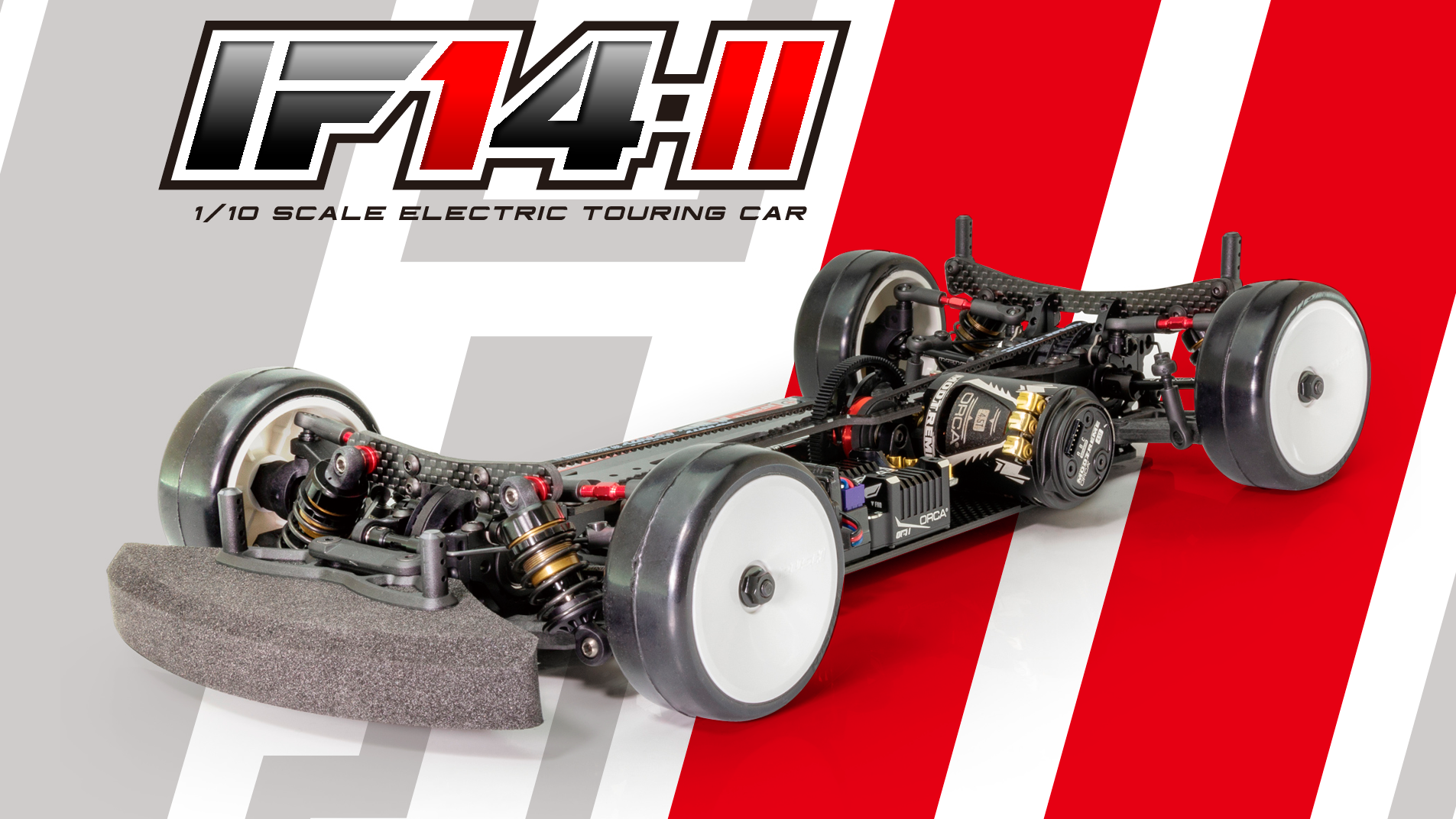
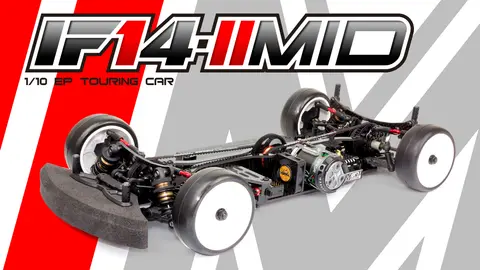
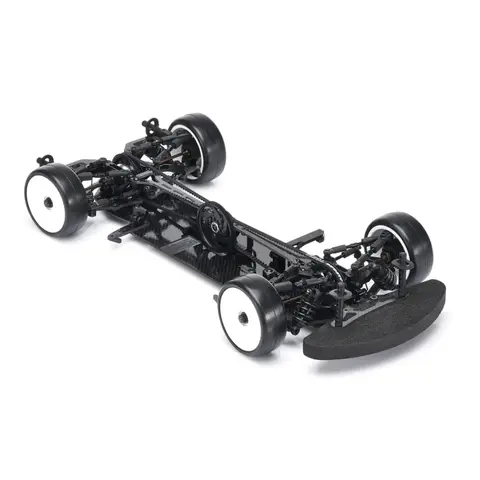
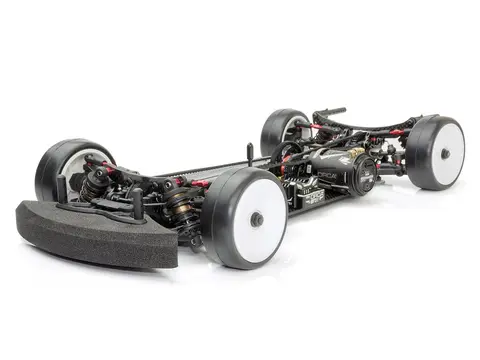
The IF14-II develops the original IF14 through revised lower arms, shock towers and an adjustable shock-lever-ratio arrangement. The leverage can be changed without also changing the shock mounting angle, separating two suspension setup choices. Its Ultra Short Profile shocks are 3.5mm shorter than the original IF14’s, a physical generation difference to retain when ordering shock assemblies. Use the II-specific arms and towers together rather than assuming the older IF14 installation gives the same geometry. Infinity source (opens in a new tab)
The kind of vehicle the maker sells it as. It sets what the car is built to do and which cars it is fair to compare it with.
Touring cars are 4WD on-road cars for asphalt and carpet tracks, often raced in classes with fixed motor and battery rules.
Power
Sold without a motor, so you choose the motor, ESC and battery yourself.
Rows that depend on the motor say so.
Build
A kit you build yourself from parts.
Most kits come without motor, ESC, servo, radio and battery, and many without tires or a painted body.
The manual lists what to add.
Scale
The maker's nominal size compared with a full-size vehicle. It works more as a class label than a measurement.
A 1/10 monster truck is far bigger than a 1/10 touring car, so compare length and weight for real size.
Part number
The maker's product number for this exact version.
A V2, a new color, or a kit instead of an RTR usually has a different number, and parts can differ between them.
Check it against your box or receipt before ordering parts.
Class
Touring
Power
Motor not included
Build
Kit
Scale
1/10
Part number
CM-00006
Drivetrain
Pinion
The small gear on the motor shaft. Fewer teeth gear the car shorter: quicker acceleration, lower top speed and a cooler motor. More teeth do the opposite.
On a chassis sold as kits, each kit brings its own.
Spur
The large gear the pinion drives. A bigger spur with the same pinion gears the car shorter.
Pinion and spur need matching pitch, or explicit manufacturer confirmation that the exact gears are compatible.
The Gearing parts table below shows this car's pitch and part numbers.
Transmission & axle
Every reduction after the spur, multiplied together: transmission, differentials and axle gears.
It is fixed by the design; the gearing you change is the pinion and spur.
Final drive
How many times the motor turns for one turn of the wheels. A higher number is shorter gearing: more acceleration and pulling power, less top speed.
On-road racers often compare gearing by rollout instead, because tire sizes differ between cars.
Differentials
The type of each differential, as the maker states it.
A gear or ball diff lets the wheels on one axle turn at different speeds in a corner; a spool or locked diff turns them together for straight-line drive and climbing, at the cost of steering.
Spur pitch
The tooth spacing of the fitted gear, stated as metric module or diametral pitch.
Pinion and spur need matching pitch or explicit manufacturer confirmation of compatibility for the exact parts. Mod 0.8 and 32P are different standards; a compatibility statement for particular gears does not apply to every gear. A missing pitch can be inferred from the other fitted gear; module and diametral pitch are not silently converted.
The outside diameter of the mounted tire, tread to tread. A taller tire covers more ground each turn, which gears the car taller.
Race tires wear down over a day, and a smaller tire gears the car shorter.
Wheel hex
The hex on the axle that the wheel locks onto and is driven by. A wheel must match the hex size to fit.
12 mm is the common size on 1/10 cars, so most 1/10 wheels fit; offset and width still vary.
The wheel nut is a separate size, so check its thread too before buying nuts.
Axle thread
Axle thread: A documented stock wheel, tire, or axle measurement. Stock dimensions alone do not establish the largest size that will clear the body and suspension.
What the main chassis is made of and how it is built, as stated for this car. Braces, stiffeners and skid plates are not counted.
Carbon fiber is light and stiff, and costs more; edges can chip in a crash.
Shocks
What the shocks are and how they are built, as the maker describes them.
Oil-filled shocks damp with silicone oil; friction shocks, found on some entry-level cars, damp with a sprung plunger and cannot be tuned with oil.
Spring
The stock springs, in the maker's own wording: a color, a rate or a length.
A stiffer spring holds the car up and resists bottoming out; a softer one lets it squat and follow rough ground.
Rates are not comparable across makers unless they state the same unit.
Front shock lengths
Front shock lengths: A documented shock mounting interface at the named end and eye. A ball stud or standoff is distinct from a through-bolt. Match the mounting type, thread and eye dimensions when choosing a replacement shock.
Rear shock lengths
Rear shock lengths: A documented shock mounting interface at the named end and eye. A ball stud or standoff is distinct from a through-bolt. Match the mounting type, thread and eye dimensions when choosing a replacement shock.
Motor KV is the RPM a motor turns per volt with no load.
This vehicle comes without a motor, so there is no stock KV; it depends on the one you fit.
Motor shaft
The diameter of the motor's output shaft, which a pinion's bore must match.
This vehicle comes without a motor, so it depends on the one you fit.
Battery
The highest LiPo cell count the maker rates the electronics for.
This vehicle comes without electronics, so it depends on the ESC and motor you fit.
Motor
Not applicable
Motor shaft
Not applicable
Battery
Not applicable
Performance
Theoretical top speed
It needs a motor KV, and this vehicle comes without a motor. Fit one and the calculator works it out from the motor's KV and the gearing.
Theoretical top speed
Not applicable
About these specs
Touring car kit: the manual's required items list a 64 pitch pinion, motor, speed controller, battery, tires and wheels, so the pinion, KV and cell rating do not apply and the tire size is left blank.
Read moreShow less
The manual's 64 pitch gear chart prints 1.810 as its second reduction and lists totals from it, for example 112/25 x 1.810 = 8.107.
Bag C supplies a 112T 64 pitch spur (T304).
How to read these figures
Stock is as the vehicle ships.
Derived from replacement part uses the listed dimensions of a replacement advertised for the identified OEM part. Treat it as an approximate working size; the factory-fitted part may differ. Calculated performance uses that approximation.
Not applicable means the vehicle does not come with it, like the motor on a roller or the tires on a race kit.
Use the original IF14-II's differential fill procedure to make oil changes comparable. Weigh the dry differential, then add about 1.4g of oil; the manual's illustrated assembly goes from roughly 11.0g to 12.4g. Close it in the specified crosswise screw order. Its oil chart runs from thinner choices for very low grip to thicker choices for high grip, rather than one viscosity for every surface.[1] IF14-II factory assembly and setup manual (opens in a new tab)
Before changing springs, work trapped air out of each shock and match the rebound set during cap assembly. Recheck the belt adjustment when moving the eccentric bearing holders between upper and lower differential positions. The belt guide should touch lightly, without pressing hard enough to add drag. These instructions concern the original IF14-II, rather than the later MID or Team Edition.[1] IF14-II factory assembly and setup manual (opens in a new tab)