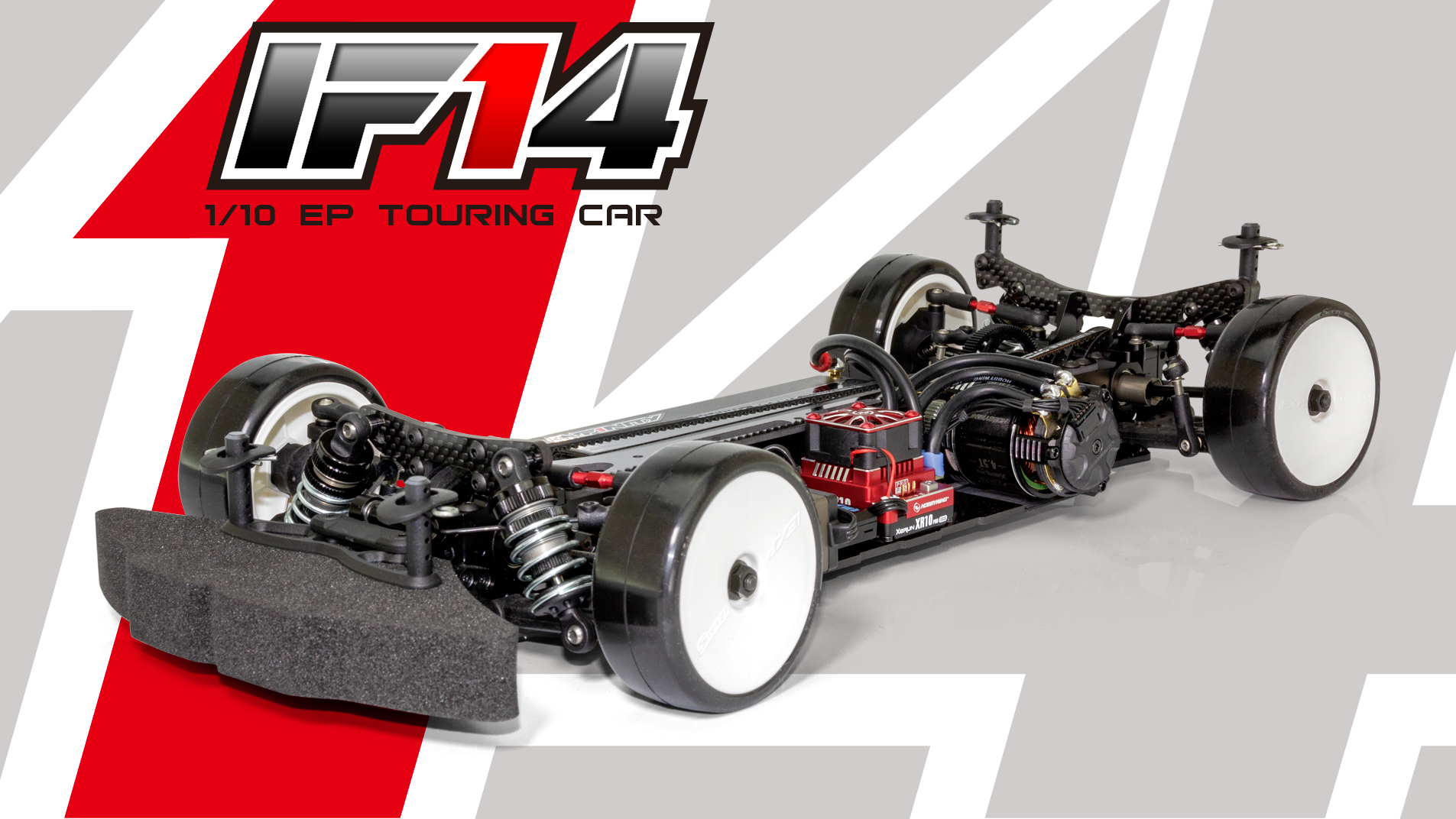
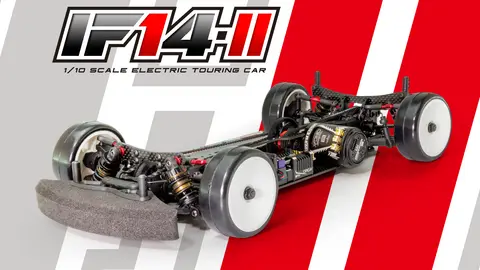
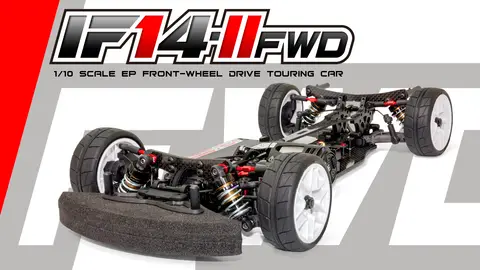
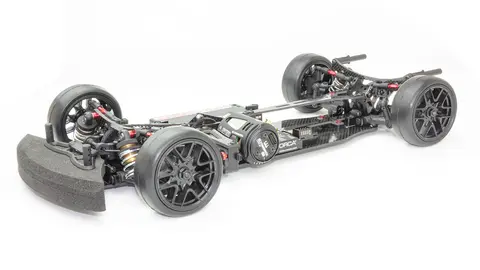
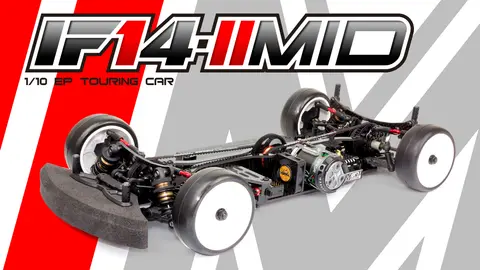
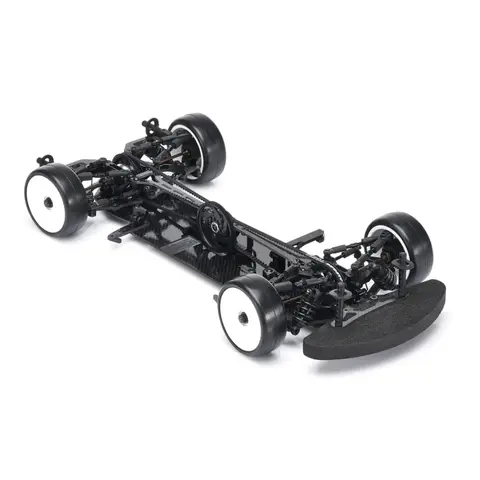
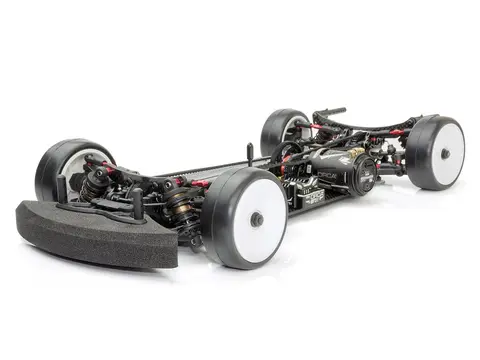
The original IF14 uses a symmetrical graphite chassis and top deck, with the lower suspension arms attached to the aluminum bulkheads rather than directly to the lower plate. Its drive uses a solid front axle, rear oil-filled gear differential and aluminum center pulley. Those architecture details distinguish it from the almost-new IF14-II platform that followed. Keep the exact generation’s suspension mounts and shock components with the parts order, rather than relying on the common IF14 family name. Infinity source (opens in a new tab)Infinity source (opens in a new tab)
The kind of vehicle the maker sells it as. It sets what the car is built to do and which cars it is fair to compare it with.
Touring cars are 4WD on-road cars for asphalt and carpet tracks, often raced in classes with fixed motor and battery rules.
Power
Sold without a motor, so you choose the motor, ESC and battery yourself.
Rows that depend on the motor say so.
Scale
The maker's nominal size compared with a full-size vehicle. It works more as a class label than a measurement.
A 1/10 monster truck is far bigger than a 1/10 touring car, so compare length and weight for real size.
Class
Touring
Power
Motor not included
Scale
1/10
Drivetrain
Pinion
The small gear on the motor shaft. Fewer teeth gear the car shorter: quicker acceleration, lower top speed and a cooler motor. More teeth do the opposite.
On a chassis sold as kits, each kit brings its own.
Spur
The large gear the pinion drives. A bigger spur with the same pinion gears the car shorter.
Pinion and spur need matching pitch, or explicit manufacturer confirmation that the exact gears are compatible.
Transmission & axle
Every reduction after the spur, multiplied together: transmission, differentials and axle gears.
It is fixed by the design; the gearing you change is the pinion and spur.
Final drive
How many times the motor turns for one turn of the wheels. A higher number is shorter gearing: more acceleration and pulling power, less top speed.
On-road racers often compare gearing by rollout instead, because tire sizes differ between cars.
Differentials
The type of each differential, as the maker states it.
A gear or ball diff lets the wheels on one axle turn at different speeds in a corner; a spool or locked diff turns them together for straight-line drive and climbing, at the cost of steering.
Motor KV is the RPM a motor turns per volt with no load.
This vehicle comes without a motor, so there is no stock KV; it depends on the one you fit.
Motor shaft
The diameter of the motor's output shaft, which a pinion's bore must match.
This vehicle comes without a motor, so it depends on the one you fit.
Battery
The highest LiPo cell count the maker rates the electronics for.
This vehicle comes without electronics, so it depends on the ESC and motor you fit.
Motor
Not applicable
Motor shaft
Not applicable
Battery
Not applicable
Performance
Theoretical top speed
It needs a motor KV, and this vehicle comes without a motor. Fit one and the calculator works it out from the motor's KV and the gearing.
Theoretical top speed
Not applicable
About these specs
The original IF14.
Read moreShow less
Touring car kit: the manual's required items list a 64 pitch pinion, motor, speed controller, battery, tires and wheels, so the pinion, KV and cell rating do not apply and the tire size is left blank.
The manual's 64 pitch gear chart prints 1.9 as the second reduction, which matches the 38T spool pulley and 20T center pulley in its parts list.
The IF14 manual on Infinity's own shop labels the kit's spur 'Spur Gear 64P 112T'.
How to read these figures
Stock is as the vehicle ships.
Single report uses one outside source. It is useful as a starting figure, with the source and calculation described in the note.
Not applicable means the vehicle does not come with it, like the motor on a roller or the tires on a race kit.
Make the original IF14's rear-differential fill repeatable before comparing oil choices. The factory drawing fills to the top of the differential cross shaft and gives about 1.4g as its normal oil quantity. Keep the O-ring and shims in their illustrated positions when closing the case. The oil chart moves toward thicker choices as grip increases, so an oil change should be tied to the surface rather than treated as a general upgrade.[1] IF14 factory assembly and setup manual (opens in a new tab)
Use the eccentric bearing holders to adjust belt tension and differential height together, then recheck both ends. The factory diagram associates a lower differential position with more traction and a higher position with more steering on higher-grip tracks. Record the holder orientation before changing it. Start from this original IF14 drawing when servicing the car, because later IF14-II and MID instructions describe different assemblies.[1] IF14 factory assembly and setup manual (opens in a new tab)