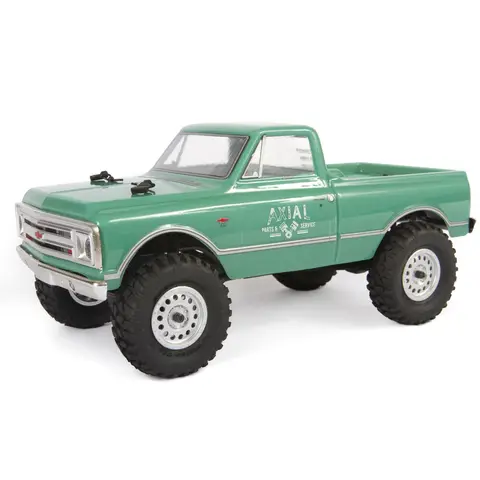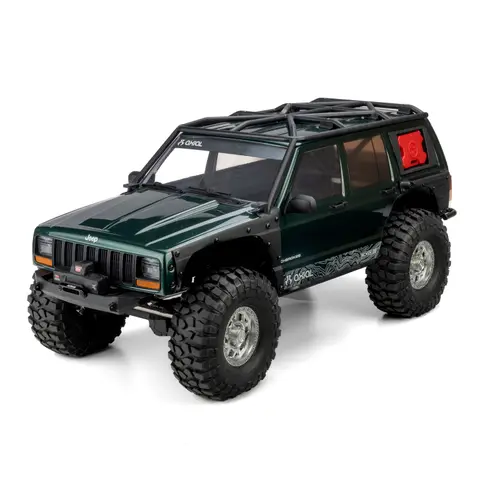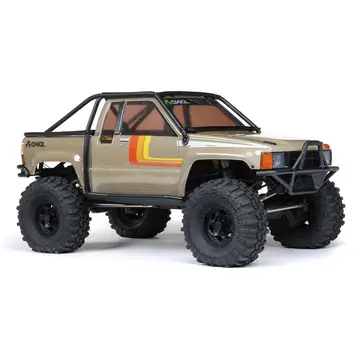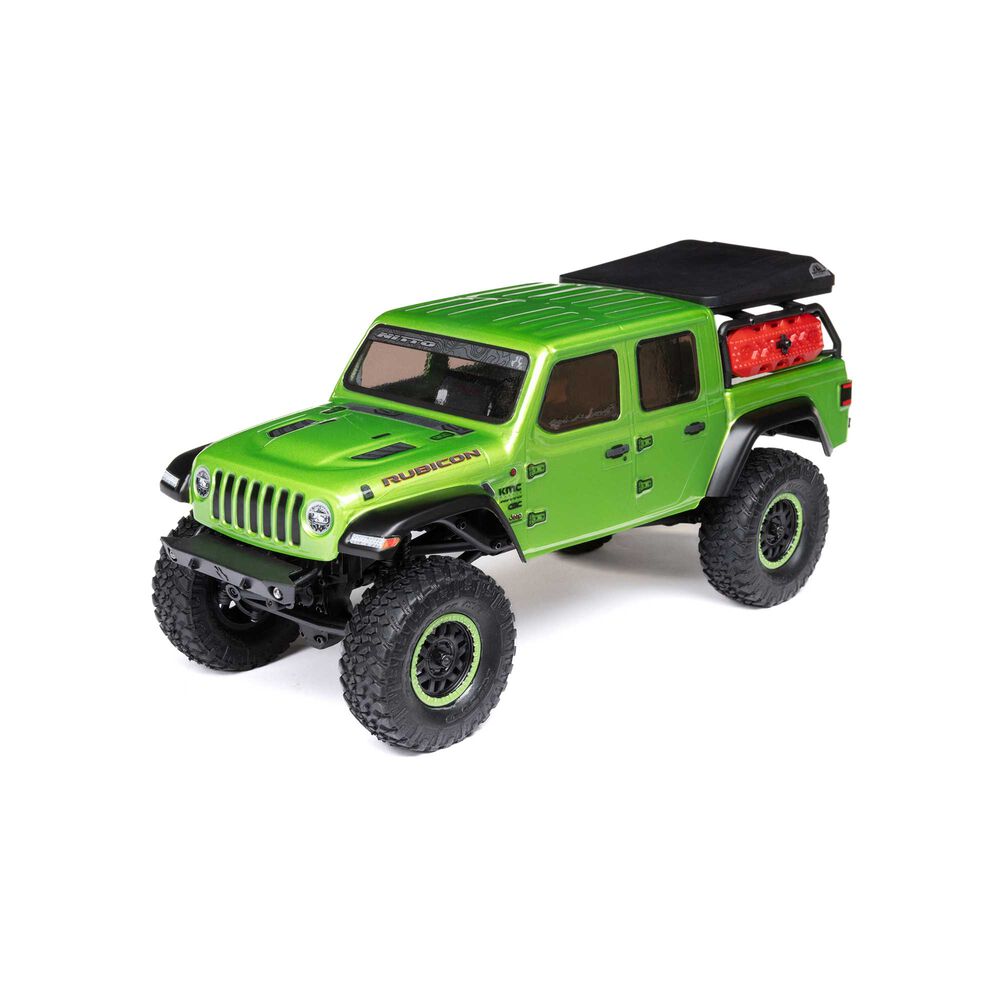
The SCX24 Gladiator makes a convincing small overlanding truck because its proportions are part of the experience. The Jeep pickup body stretches across a 155 mm wheelbase, with a bed and accessories that give it a purposeful trail-ready outline. That length also creates a practical balance to explore: climbing a ledge and leaving it are different tasks for a pickup with rear bodywork beyond the axle. Model and background reference (opens in a new tab)
Read moreShow less
The SCX24 Jeep Gladiator is the refreshed version, equipped with oil-filled shocks and Spektrum SLT2 electronics. It continues the Gladiator idea while changing two areas that older SCX24 owners often modified. The revised control system also matters when the build becomes more ambitious, because its external-controller connection gives a motor conversion a different starting point from an early blue-label Gladiator. Model and background reference (opens in a new tab)
Pros
The SCX24 Gladiator is widely rated as a favorite small crawler for indoor fun.3,4
This V2 version runs oil-filled shocks and Spektrum electronics, upgrades over the earlier SCX24 Gladiator.1
Metal worm gear differentials front and rear add durability, higher ground clearance, and strong drag brakes.1
Cons
It isn't rated water resistant, so keep it away from puddles and wet trails.1
The kind of vehicle the maker sells it as. It sets what the car is built to do and which cars it is fair to compare it with.
Crawlers are built for slow, controlled climbing over rocks: very low gearing, flexible suspension and locked axles.
Drive
All four wheels are driven. That gives more grip under power, especially on loose ground.
The cost is more parts to maintain.
A crawler needs every wheel pulling to climb.
Power
A brushed motor carries current through carbon brushes that rub on the commutator.
It is cheaper and smooth at low speed.
The brushes wear and the motor loses power over time.
That low-speed smoothness is why so many crawlers use one.
Build
Ready to run: built at the factory with the electronics installed.
Some come without a battery or charger; the maker's box contents say which.
Scale
The maker's nominal size compared with a full-size vehicle. It works more as a class label than a measurement.
A 1/10 monster truck is far bigger than a 1/10 touring car, so compare length and weight for real size.
This one is 250 mm long.
Part number
The maker's product number for this exact version.
A V2, a new color, or a kit instead of an RTR usually has a different number, and parts can differ between them.
Check it against your box or receipt before ordering parts.
Class
Crawler
Drive
4WD
Power
Brushed
Build
Ready to run
Scale
1/24
Part number
AXI00005V2
Drivetrain
Pinion
The small gear on the motor shaft. Fewer teeth gear the car shorter: quicker acceleration, lower top speed and a cooler motor. More teeth do the opposite.
On this car one tooth changes the gearing by about 10%.
Crawlers run small pinions for slow, precise wheel speed on climbs; a bigger one is quicker on the trail but harder to control on rocks.
Spur
The large gear the pinion drives. A bigger spur with the same pinion gears the car shorter.
Pinion and spur need matching pitch, or explicit manufacturer confirmation that the exact gears are compatible.
The Gearing parts table below shows this car's pitch and part numbers.
Transmission & axle
Every reduction after the spur, multiplied together: transmission, transfer case and axle gears.
That chain is why a crawler's figure is much higher than other classes'.
It is fixed by the design; the gearing you change is the pinion and spur.
Spur ÷ pinion
Spur teeth divided by pinion teeth: the part of the gearing that a pinion or spur swap changes.
Here it is 5.500:1.
Final drive
How many times the motor turns for one turn of the wheels. A higher number is shorter gearing: more acceleration and pulling power, less top speed.
Among 1/24 crawlers & trail trucks in the catalog, the middle half run between 43.7:1 and 118.1:1 on stock gearing; this one is 118.1:1, shorter than most.
Crawlers run far higher ratios than other classes, so the truck can creep and hold on a climb.
Hub bearing size
Hub bearing size: The documented drivetrain connection or size for this exact model. Match the mating component before buying a replacement.
Pinion bore
The nominal size of the hole that mates with the motor shaft.
A nominal shaft fit comes from the exact replacement pinion listing. It does not specify a measured finished hole or manufacturing tolerance.
Match the pinion mounting method as well as its size. A press-fit hole cannot be inferred from motor shaft diameter.
Pinion pitch
The tooth spacing of the fitted gear, stated as metric module or diametral pitch.
Pinion and spur need matching pitch or explicit manufacturer confirmation of compatibility for the exact parts. Mod 0.8 and 32P are different standards; a compatibility statement for particular gears does not apply to every gear. A missing pitch can be inferred from the other fitted gear; module and diametral pitch are not silently converted.
Spur pitch
The tooth spacing of the fitted gear, stated as metric module or diametral pitch.
Pinion and spur need matching pitch or explicit manufacturer confirmation of compatibility for the exact parts. Mod 0.8 and 32P are different standards; a compatibility statement for particular gears does not apply to every gear. A missing pitch can be inferred from the other fitted gear; module and diametral pitch are not silently converted.
The outside diameter of the mounted tire, tread to tread. A taller tire covers more ground each turn, which gears the car taller.
This approximate diameter comes from a replacement advertised for the identified OEM tire. Calculated speed and rollout use this working size; measure your fitted tires for a closer comparison.
Crawler wheels are named by rim size, such as 1.9 or 2.2 inches; that is the wheel, not this tire diameter.
Rollout
How far the car moves for one turn of the motor: tire circumference divided by final drive.
It lets you compare gearing across different tire sizes; more rollout is taller gearing.
Here it is 1.4 mm.
Wheel hex
The hex on the axle that the wheel locks onto and is driven by. A wheel must match the hex size to fit.
A small hex like this is used on mini and micro cars.
The wheel nut is a separate size, so check its thread too before buying nuts.
Stock wheel diameter
Stock wheel diameter: A documented stock wheel, tire, or axle measurement. Stock dimensions alone do not establish the largest size that will clear the body and suspension.
Stock wheel width
Stock wheel width: A documented stock wheel, tire, or axle measurement. Stock dimensions alone do not establish the largest size that will clear the body and suspension.
Axle thread
Axle thread: A documented stock wheel, tire, or axle measurement. Stock dimensions alone do not establish the largest size that will clear the body and suspension.
What the main chassis is made of and how it is built, as stated for this car. Braces, stiffeners and skid plates are not counted.
Steel is heavy and strong; on a crawler that weight sits low and steadies it on climbs.
A ladder frame is two rails joined by cross members, as on a full-size truck.
Shocks
What the shocks are and how they are built, as the maker describes them.
Oil-filled shocks damp with silicone oil; friction shocks, found on some entry-level cars, damp with a sprung plunger and cannot be tuned with oil.
Shock length
The stated length of the complete shock assembly. Sources may use mounting-eye centers or a nominal assembly length.
Compare fully extended mounting-eye spacing, compressed length and mounting hardware before ordering. A longer shock changes ride height and travel, and can bind at full droop or bottom out.
This length is from one outside source. Check the linked listing and measure the fitted shocks before buying.
Spring
The stock springs, in the maker's own wording: a color, a rate or a length.
A stiffer spring holds the car up and resists bottoming out; a softer one lets it squat and follow rough ground.
Rates are not comparable across makers unless they state the same unit.
32mm listed length, front and rear; Retailer-listed nominal AXI203002 assembly length; endpoints and extension are unstated. Axial separately lists 24 to 33.4 mm without defining the range.Single report
Catalog stock FDR: 118.09:1. The grid uses the listed tooth counts and internal ratio, so rounding or source differences may change the result slightly.
Calculated final drive ratio for each pinion and spur pair
Pinion
53T spur
55T spur
57T spur
8T
9T
10T
11T
12T
13T
Select a pair to compare wheel travel per motor turn with stock. Other cells are mathematical examples, not verified gears or fits. Check pitch, mesh, clearance and motor temperature before changing parts.
About these specs
Driveline sharing with the SCX24 Deadbolt is documented: both manuals list identical part numbers for the transmission and both axles (AXI31608, AXI31609, AXI31610) and the same DYNS1217 motor, and Axial's spec sheets give both models 10T/55T with worm 16T/4T axles.
Read moreShow less
The 21.47 is therefore carried over from the SCX24 Deadbolt rather than taken from Axial, which publishes no numeric ratio for either model.
Tire outside diameter uses Hobbies Direct’s 51 mm specification for the stock AXI40004 Nitto tire; Axial does not publish the outside diameter.
The manual's parts table calls AXI40004 a '2.0 Nitto Trail Grappler', which is a typo for the 1.0 tire Axial's own product page names.
Mofo RC identifies the stock motor shaft as 1.5 mm and the transmission gear pitch as Mod 0.3; these dimensions are aftermarket specifications.
The7mm stock wheel hex is identified by Hot Racing’s SCX24 stock-hub specification.
How to read these figures
Stock is as the vehicle ships.
Calculated is worked from the recorded figures on this page.
Derived from replacement part uses the listed dimensions of a replacement advertised for the identified OEM part. Treat it as an approximate working size; the factory-fitted part may differ. Calculated performance uses that approximation.
Aftermarket spec is a direct, exact-stock-part statement from an established aftermarket maker. The maker of this vehicle has not confirmed it.
Single report uses one outside source. It is useful as a starting figure, with the source and calculation described in the note.
Not published means it exists but no source we could find prints it.
Instruction manual (Horizon PDF) (opens in a new tab)horizonhobby.comPDFSupports 12 specificationsparts list Replacement parts p. 11Used forGearingMotor shaftWeightSizeBattery fitFluidsElectronicsWheels & tiresPowerSteering & radioIn the boxDrivetrain
Checked task pages, documented requirements and recorded fluid references for this model. Follow the manufacturer's procedure for the exact assembly and revision.
Radio bindingProcedure
Original transmitter and receiver binding
Axial SCX24 Jeep Gladiator, AXI00005V2; original equipment covered by the cited edition.
Open the cited manufacturer reference for the assembly, sequence and checks. Replacement needs depend on inspection and the fitted components.
No separate parts, tools or prerequisites have been indexed for this task. Read the cited reference before starting.
This is a partial service reference. Check the cited instructions for the full procedure and configuration-specific requirements. Mechanical tasks may need additional parts, quantities and reused hardware beyond the items listed here. Manual reviewed 2026-10-08.
DrivetrainReference
Drivetrain inspection after wet use
Axial SCX24 Jeep Gladiator, AXI00005V2; original equipment covered by the cited edition.
Manufacturer maintenance guidance after wet operation. This does not establish an oil-filled differential or a complete axle rebuild procedure.
No separate parts, tools or prerequisites have been indexed for this task. Read the cited reference before starting.
This is a partial service reference. Check the cited instructions for the full procedure and configuration-specific requirements. Mechanical tasks may need additional parts, quantities and reused hardware beyond the items listed here. Manual reviewed 2026-10-08.
No fluid grades are recorded here. That does not establish whether this vehicle uses oil, grease or friction components.
Indexed tasks link to checked physical PDF pages. Other links open full documents. Tasks and rebuild requirements not shown here still need review.
Upgrades and setup
Use the first runs to decide how much of the overlanding presentation you want to keep. A creator's written transcript describes the long wheelbase helping climbs and the bed catching on departures. Removing the camper shell and bed accessories is a reversible experiment when climbing takes priority. Compare the same obstacle before and after, keeping the arrangement that suits your use of the truck.[1] Cape Crawlers refreshed Gladiator (opens in a new tab)
Read moreRead less about upgrades and setup for Axial SCX24 Jeep Gladiator
Plan brushless power around both the wiring and the mechanical interfaces. The V2 manual shows a throttle output for an external controller, allowing that route with the existing radio when the new controller's instructions support the connection. A V2 owner's Hobbywing conversion also encountered a motor-mount conflict, with mounting-hole spacing and pinion bore raised in the replies. Compare those dimensions before ordering, and keep the original brushed system until finer low-speed control is worth the extra fitting work.[3] Factory wiring and controls (opens in a new tab)[5] Gladiator V2 motor-mount discussion (opens in a new tab)
Conversions & shared parts
Brass cover and front steering knuckles
This replaces selected front-axle parts with brass components, concentrating extra mass low at the front. It is a crawling setup choice when you want more front-axle weight, allowing for the weight of the original parts being removed.
Manufacturer-documented option for the specified vehicle configuration.
This replaces both stock axles with a matched aftermarket pair that widens the vehicle by 8mm overall. Choose it when you want that wider axle package and its included steering hardware, checking body clearance and keeping the maker's matched parts together.
Manufacturer-documented option for the specified vehicle configuration.
This replaces the stock steering servo and horn with a matched aftermarket pair while keeping the original servo mount and radio. It is an option when renewing the steering servo without also changing the mounting system, provided the power supply suits the new servo.
Manufacturer-documented option for the specified vehicle configuration.
This replaces the motor and transmission with a complete brushed powertrain and matched helical gears. It offers a coordinated powertrain replacement while retaining the original 2S brushed controller and radio, with the longer motor checked for clearance.
Manufacturer-documented option for the specified vehicle configuration.
Cape Crawlers introduces the refreshed Gladiator with oil-filled shocks and Spektrum electronics, then takes it crawling. It also explains the long wheelbase and rear-overhang tradeoff.
BigSung Hobbies covers a modified earlier Gladiator focused on weight distribution and lowering the center of gravity. Its older electronics and friction-shock baseline differ from the refreshed V2, so use it for build ideas rather than a direct parts recipe.