
VehiclesAxial SCX10 III Coyote 4X4

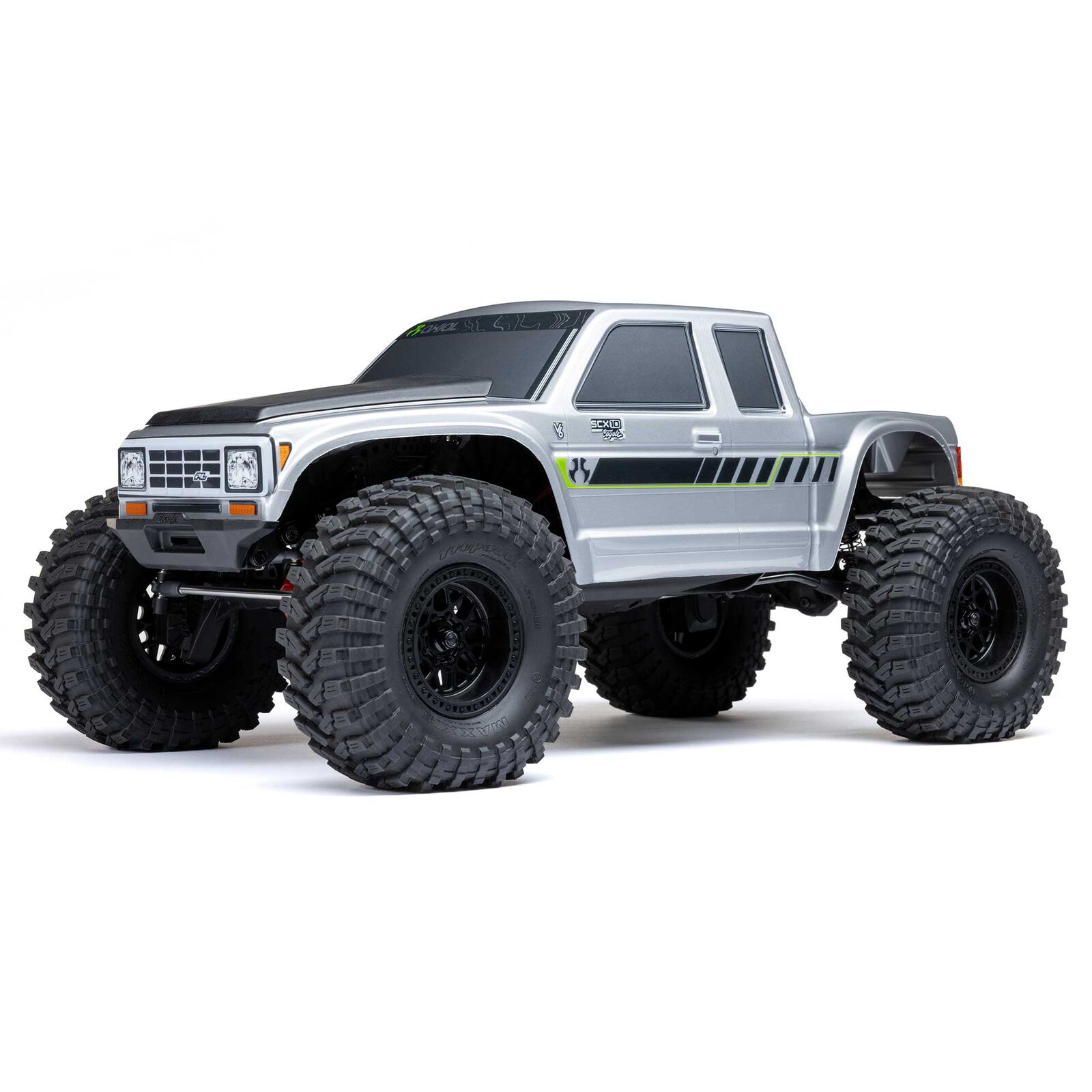
Specifications
Last modified
| Spec | Value | Basis |
|---|---|---|
| Drivetrain | ||
| Pinion | 14TStock | Stock |
| Spur | 56TStock | Stock |
| Transmission & axle | Not applicable | |
| Final drive | Not applicable | |
| Wheels & tires | ||
| Tire diameter | 124.5mmStock | Stock |
| Wheel hex | 12 mmStock | Stock |
| Power | ||
| Motor | Not applicable | |
| Motor shaft | Not published | |
| Battery | Up to 3SLiPoStock | Stock |
| Stock motor | Axial 35T 540 Brushed MotorStock | Stock |
| Stock ESC | Spektrum Firma 40A Brushed Waterproof ESCStock | Stock |
| Battery connector | IC3Stock | Stock |
| Performance | ||
| Theoretical top speed | Not applicable | |
| Chassis | ||
| Weight | 2.38 kg (5.2 lb)with batteryStock | Stock |
| Length | 445 mm17.5 inStock | Stock |
| Width | 235 mm9.3 inStock | Stock |
| Height | 197 mm7.8 inStock | Stock |
| Wheelbase | 312 mm12.3 inStock | Stock |
| Vehicle | ||
| Part number | AXI-2036 | |
| Scale | 1/10 | |
| Class | Scale crawler | |
Stock is as the vehicle ships. Calculated is worked from the stock figures on this page rather than stored beside them, so the two cannot drift apart. Not applicable means the vehicle does not come with it, like the motor on a roller or the tires on a race kit, or does not have one, like a KV rating on a brushed motor. Not published means it exists but no source we could find prints it.
Gearing parts
| Component | Teeth | Pitch | Bore | Part number |
|---|---|---|---|---|
| Fitted at the factory | ||||
| Pinion | 14T | 32P | 3 mm | AXIC0725 (opens in a new tab) |
| Spur | 56T | 32P | Not applicable | AXI232065 (opens in a new tab) |
Tooth counts are the ones in the specifications above. Pitch is given as metric module (Mod 1, Mod 0.8) or diametral pitch (32P, 48P). They are different standards and are not interchangeable, even where the numbers look close. Bore is the pinion’s hole, listed separately from the motor shaft. Linked part numbers go to the maker's or official distributor's page for that part.
How these numbers were settled
The Coyote runs AR45P portal axles with overdrive gears in the front axle, so the front wheels turn faster than the rear and no single final drive applies.
- The manual's exploded views show the 27/8 overdrive gear set (AXI-3012) in the front axle and the 30/8 gear set (AXI232003) in the rear, with the 23T/12T portal gears (AXI232007) at both ends.
- Axial publishes no gear chart for this model and no tooth counts for the LCXU transmission, so the transmission and axle ratio and the final drive are left blank.
- The exploded view shows the 14T 32P pinion AXIC0725 on the 35T brushed motor and the 56T 32P LCXU spur AXI232065.
- Axial's spec table lists a 25T spur, which no part in the manual supports.
- The tire diameter is the 4.9 in height Pro-Line prints for the stock Maxxis Trepador G8 tire (PRO1022714).
- The brushed motor has no KV, and the Firma 40A ESC is rated for 2S to 3S LiPo.
- Both axles carry a differential locker (AXI232002), so there is no diff oil.
- The RTR Basic (AXI-2036) and the version with battery and charger (AXI-3071) share one manual and the same running gear.
Documents
- ManualInstruction manual, AXI-2036 and AXI-3071 (Axial PDF) (opens in a new tab)
- Exploded viewExploded views, in manual (Axial PDF) (opens in a new tab)Front axle p. 56, rear axle p. 57, transmission p. 58
- Parts listParts list, in manual (Axial PDF) (opens in a new tab)p. 60-62, optional parts p. 63-67
Sources
- AXI-2036axialadventure.com (opens in a new tab)
- Manual (PDF)axialadventure.com (opens in a new tab)
- AXI-2036horizonhobby.com (opens in a new tab)
- AXIC0725axialadventure.com (opens in a new tab)
- AXI232065axialadventure.com (opens in a new tab)
- AXI-3012axialadventure.com (opens in a new tab)
- AXI232003axialadventure.com (opens in a new tab)
- AXI232007axialadventure.com (opens in a new tab)
- PRO1022714axialadventure.com (opens in a new tab)
- AXI-1376axialadventure.com (opens in a new tab)
Every figure on this page traces to one of these. Where they disagreed, the note above says which was used and why.