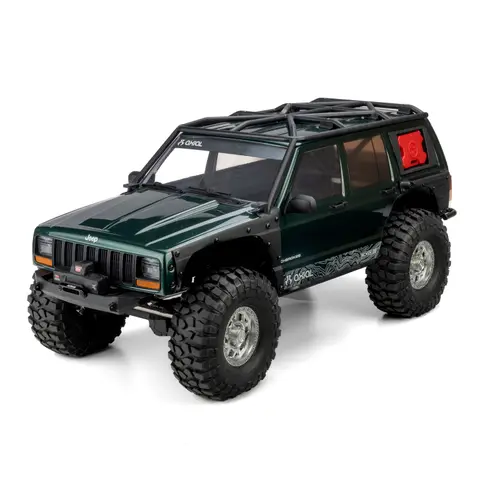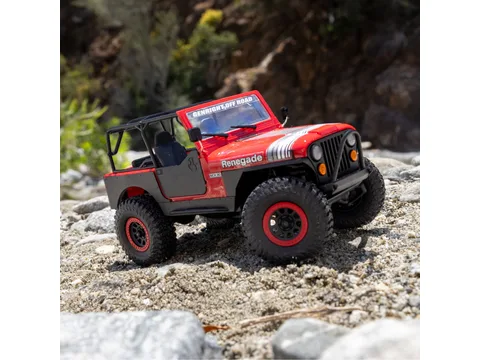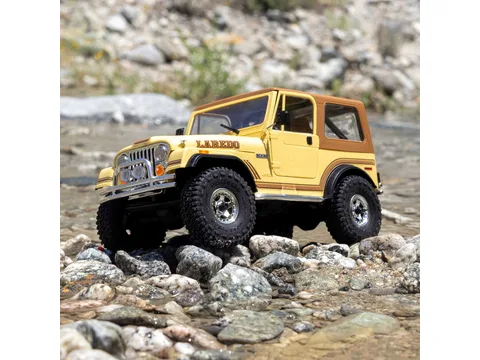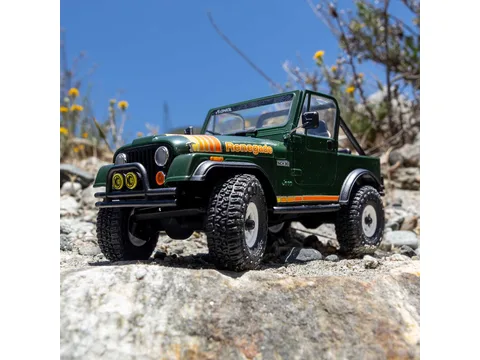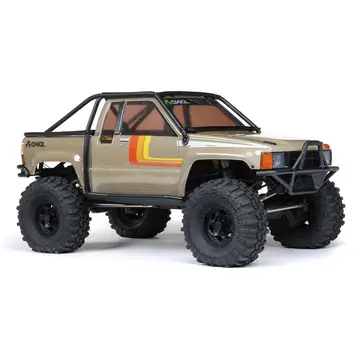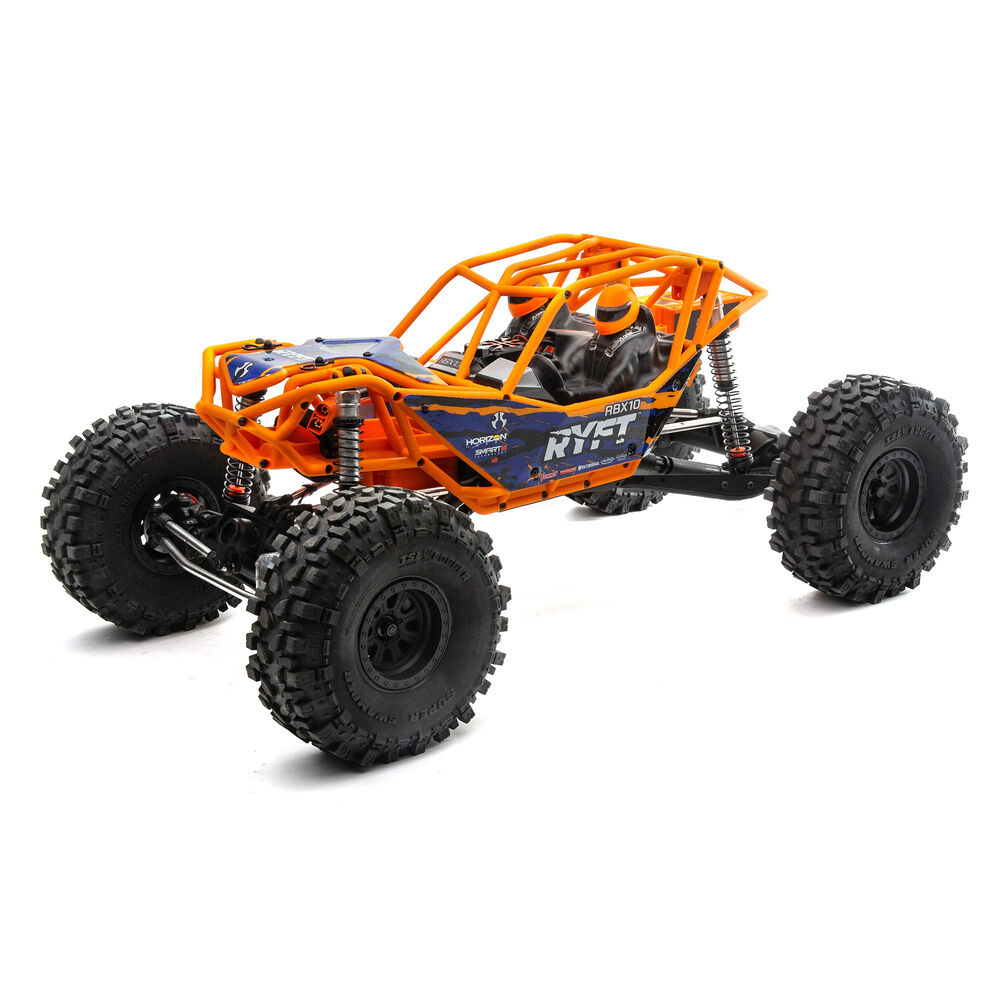




The Ryft takes Axial into rock bouncing, with a tube-style chassis intended for fast approaches over rough ground. Its solid axles, long shocks and large Bogger-pattern tires give it the outline of a full-size bouncer. Throttle response and the transition between climbing and landing become central to that kind of driving. Model and background reference (opens in a new tab)
Read moreShow less
The original AXI03005 RTR supplies a 2200Kv brushless motor, Firma 130A controller and DX3 radio with an SR6100AT receiver. AVC assistance is available within that package. The kit is a different equipment starting point, especially when comparing transmission and suspension parts. Model and background reference (opens in a new tab)
Pros
Long-travel, oil-filled shocks support the Ryft’s rock-bouncing layout.1
AVC traction technology adds stability when climbing hills or launching off ledges without lifting off the throttle.1
The kind of vehicle the maker sells it as. It sets what the car is built to do and which cars it is fair to compare it with.
Crawlers are built for slow, controlled climbing over rocks: very low gearing, flexible suspension and locked axles.
Drive
All four wheels are driven. That gives more grip under power, especially on loose ground.
The cost is more parts to maintain.
A crawler needs every wheel pulling to climb.
Power
A brushless motor has no brushes to wear, so it makes more power and runs more efficiently than a brushed one.
It needs a brushless ESC.
Crawler brushless systems are usually sensored, so the motor turns smoothly from a standstill.
Build
Ready to run: built at the factory with the electronics installed.
Some come without a battery or charger; the maker's box contents say which.
Scale
The maker's nominal size compared with a full-size vehicle. It works more as a class label than a measurement.
A 1/10 monster truck is far bigger than a 1/10 touring car, so compare length and weight for real size.
This one is 546 mm long.
Part number
The maker's product number for this exact version.
A V2, a new color, or a kit instead of an RTR usually has a different number, and parts can differ between them.
Check it against your box or receipt before ordering parts.
Class
Crawler
Drive
4WD
Power
Brushless
Build
Ready to run
Scale
1/10
Part number
AXI03005
Drivetrain
Pinion
The small gear on the motor shaft. Fewer teeth gear the car shorter: quicker acceleration, lower top speed and a cooler motor. More teeth do the opposite.
On this car one tooth changes the gearing by about 5.9%.
Crawlers run small pinions for slow, precise wheel speed on climbs; a bigger one is quicker on the trail but harder to control on rocks.
Spur
The large gear the pinion drives. A bigger spur with the same pinion gears the car shorter.
Pinion and spur need matching pitch, or explicit manufacturer confirmation that the exact gears are compatible.
The Gearing parts table below shows this car's pitch and part numbers.
Transmission & axle
Every reduction after the spur, multiplied together: transmission, transfer case and axle gears.
That chain is why a crawler's figure is much higher than other classes'.
It is fixed by the design; the gearing you change is the pinion and spur.
This one is worked out from the tooth counts the maker publishes.
Spur ÷ pinion
Spur teeth divided by pinion teeth: the part of the gearing that a pinion or spur swap changes.
Here it is 3.118:1.
Final drive
How many times the motor turns for one turn of the wheels. A higher number is shorter gearing: more acceleration and pulling power, less top speed.
Among 1/10 crawlers & trail trucks in the catalog, the middle half run between 30.2:1 and 49.5:1 on stock gearing; this one is 9.5:1, taller than most.
Crawlers run far higher ratios than other classes, so the truck can creep and hold on a climb.
Differentials
The type of each differential, as the maker states it.
A gear or ball diff lets the wheels on one axle turn at different speeds in a corner; a spool or locked diff turns them together for straight-line drive and climbing, at the cost of steering.
Crawlers often lock both axles so every tire pulls on a climb.
Pinion bore
The nominal size of the hole that mates with the motor shaft.
Match the pinion mounting method as well as its size. A press-fit hole cannot be inferred from motor shaft diameter.
Pinion pitch
The tooth spacing of the fitted gear, stated as metric module or diametral pitch.
Pinion and spur need matching pitch or explicit manufacturer confirmation of compatibility for the exact parts. Mod 0.8 and 32P are different standards; a compatibility statement for particular gears does not apply to every gear. A missing pitch can be inferred from the other fitted gear; module and diametral pitch are not silently converted.
Spur pitch
The tooth spacing of the fitted gear, stated as metric module or diametral pitch.
Pinion and spur need matching pitch or explicit manufacturer confirmation of compatibility for the exact parts. Mod 0.8 and 32P are different standards; a compatibility statement for particular gears does not apply to every gear. A missing pitch can be inferred from the other fitted gear; module and diametral pitch are not silently converted.
Diff oil, front
Silicone oil sealed inside the differential. A diff lets the wheels on one axle turn at different speeds in a corner; thicker oil makes it act more like a solid axle.
At the front, thicker oil keeps both front wheels pulling out of a corner but makes the car turn in less willingly; thinner oil steers more easily.
This is the maker's printed oil grade. Its viscosity unit has not been established, so it is not presented as cSt or cps. Grade numbers alone do not establish equivalent oils or relative thickness.
Diff oil, rear
The rear diff mostly shapes drive out of corners.
Thicker oil there puts power down more evenly on loose or slippery ground; thinner oil lets the car rotate more easily through a corner.
The outside diameter of the mounted tire, tread to tread. A taller tire covers more ground each turn, which gears the car taller.
Crawler wheels are named by rim size, such as 1.9 or 2.2 inches; that is the wheel, not this tire diameter.
Rollout
How far the car moves for one turn of the motor: tire circumference divided by final drive.
It lets you compare gearing across different tire sizes; more rollout is taller gearing.
Here it is 49.5 mm.
Wheel hex
The hex on the axle that the wheel locks onto and is driven by. A wheel must match the hex size to fit.
12 mm is the common size on 1/10 cars, so most 1/10 wheels fit; offset and width still vary.
The wheel nut is a separate size, so check its thread too before buying nuts.
Stock wheel width
Stock wheel width: A documented stock wheel, tire, or axle measurement. Stock dimensions alone do not establish the largest size that will clear the body and suspension.
Stock wheel diameter
Stock wheel diameter: A documented stock wheel, tire, or axle measurement. Stock dimensions alone do not establish the largest size that will clear the body and suspension.
Stock tire width
Stock tire width: A documented stock wheel, tire, or axle measurement. Stock dimensions alone do not establish the largest size that will clear the body and suspension.
This working size comes from a replacement advertised for the identified OEM part. Confirm the fitted part before ordering; a replacement's size may differ.
What the main chassis is made of and how it is built, as stated for this car. Braces, stiffeners and skid plates are not counted.
Composite is the makers' word for molded plastic, usually nylon with glass or other fibers: it flexes and shrugs off hits, and it is light and cheap to replace.
Shocks, front
What the shocks are and how they are built, as the maker describes them.
Oil-filled shocks damp with silicone oil; friction shocks, found on some entry-level cars, damp with a sprung plunger and cannot be tuned with oil.
A bigger bore moves more oil for the same travel, which damps more consistently and runs cooler.
The shaft size matters when buying seals, ends and rebuild kits.
Shocks, rear
The same measure at the rear, which differs from the front on this car.
Shock length, front
The stated length of the complete shock assembly. Sources may use mounting-eye centers or a nominal assembly length.
Compare fully extended mounting-eye spacing, compressed length and mounting hardware before ordering. A longer shock changes ride height and travel, and can bind at full droop or bottom out.
Shock length, rear
The same measure at the rear, which differs from the front on this car.
Longer rear shocks are common: they give the rear more travel for landings and put power down over rough ground.
Spring, front
The stock springs, in the maker's own wording: a color, a rate or a length.
A stiffer spring holds the car up and resists bottoming out; a softer one lets it squat and follow rough ground.
Rates are not comparable across makers unless they state the same unit.
Spring, rear
The same measure at the rear, which differs from the front on this car.
Shock oil
The oil in the shocks slows how fast the suspension moves. Thicker oil settles the car more slowly and resists bottoming out; thinner oil lets the wheels follow bumps.
Front and rear run the same oil on this car, so both ends respond alike. Changing one end at a time is the usual way to shift the balance.
It is graded in wt here. A wt number is the oil maker's own grade and differs between brands, so match the brand, or use the oil maker's chart to convert.
Oil-filledaluminum body, 3 mm shaft; Original bare body listing: 10 × 53.5 mm. Diameter convention unspecified. This is separate from bore and complete shock length.; One attributed GPM report states the original Ryft working shaft is 3.0 mm; its upgrade uses 4.0 mm. Factory diagram confirms the original axle-specific rod.Single report
Oil-filledaluminum body, 3 mm shaft; Original bare body listing: 10 × 59.5 mm. Diameter convention unspecified. This is separate from bore and complete shock length.; One attributed GPM report states the original Ryft working shaft is 3.0 mm; its upgrade uses 4.0 mm. Factory diagram confirms the original axle-specific rod.Single report
0.2s per 60°; Crawford Performance Engineering lists 0.20 s per 60° for SPMS614S. Rating voltage is unstated; no vehicle BEC output inferred.Single report
Spektrum SR6100AT6-channel, telemetry capable; Telemetry requires a compatible transmitter and Smart ESC; available readings depend on connected equipment.Stock
Calculated final drive ratio for each pinion and spur pair
Pinion
51T spur
53T spur
55T spur
15T
16T
17T
18T
19T
20T
Select a pair to compare wheel travel per motor turn with stock. Other cells are mathematical examples, not verified gears or fits. Check pitch, mesh, clearance and motor temperature before changing parts.
About these specs
Axial publishes pinion 17T and spur 53T but no gear ratio for this model, and neither manual has a gear chart.
Read moreShow less
The ratio after the spur is worked out from tooth counts Axial does print.
The kit manual (AXI03009, steps D5-D7) builds the single-speed transmission from the 'Trans, Gears (Hi Speed)' set AXI232058, a 23T and a 24T gear, and the RTR manual lists the same set as stock.
The axles are 38T/13T.
That gives 24/23 x 38/13 = 3.05 after the spur and 53/17 x 3.05 = 9.51 in total.
Which of the 23T and 24T drives the other is not printed: 23 driving 24 is inferred because it is the only direction that makes Axial's 'Hi Speed' pair the taller of the two in its optional two-speed set, so treat the ratio as a close reading rather than a printed figure.
The 149.86mm tire is the RTR manual's Interco TSL Bogger 5.9in.
Axial currently lists Mod 1 on both RTR trims.
The original RTR manual lists a 32P pinion.
A documented factory take-off set uses a Losi 17T Mod 1 pinion.
Check the installed gear before ordering.
How to read these figures
Stock is as the vehicle ships.
Calculated is worked from the recorded figures on this page.
Derived uses recorded dimensions or arithmetic. The row explains the inference. A nominal mating size is not a measured tolerance or a complete fitment guarantee.
Derived from replacement part uses the listed dimensions of a replacement advertised for the identified OEM part. Treat it as an approximate working size; the factory-fitted part may differ. Calculated performance uses that approximation.
Single report uses one outside source. It is useful as a starting figure, with the source and calculation described in the note.
The top speed is kinematic: an ideal no-load RPM with no slip and no loss under load, so a real car is slower.
RTR instruction manual (Horizon PDF) (opens in a new tab)horizonhobby.comPDFSupports 11 specificationsparts list Spur p. 44, pinion and motor p. 45, optional parts p. 46; exploded view From p. 47Used forMain specsGearingMotor shaftBattery fitFluidsElectronicsWheels & tiresSuspensionPowerSteering & radioIn the box
If steering will not center, separate linkage binding, servo play and saver movement before buying another saver. One replacement left residual play elsewhere. After hard tumbles, inspect axle straightness, driveshaft joints and differential action. A later diagnosis concerned internal differential binding, while the rear axle tube had also bent. Reinforcement does not replace identifying and repairing the damaged part.[1] Ryft RTR build and diagnosis (opens in a new tab)[2] Later axle and differential follow-up (opens in a new tab)
Option suppliers
Axial / Horizon Hobby
Factory Ryft parts and tuning options, including rear link plates and sway bar; check legacy availability.