VehiclesTamiya TRF211XM Chassis Kit

Tamiya TRF211XM Chassis Kit Chassis
1/10 scale · 2WD buggy chassis kit · 42288
Reference price≈ USD 464.80Converted from JPY 73,480
- Original listing
- JPY 73,480Price source (opens in a new tab)
Currency estimate using ECB rates (opens in a new tab) (2026-10-06). Regional taxes, shipping and import costs are not adjusted.
Reference prices; current prices may differ.
- Scale
- 1/10
- Drive
- 2WD
- Max LiPo
- -
- Power
- -
Background
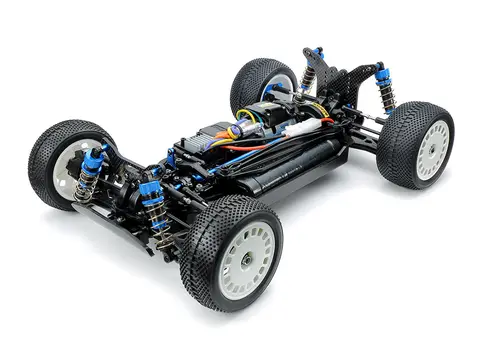
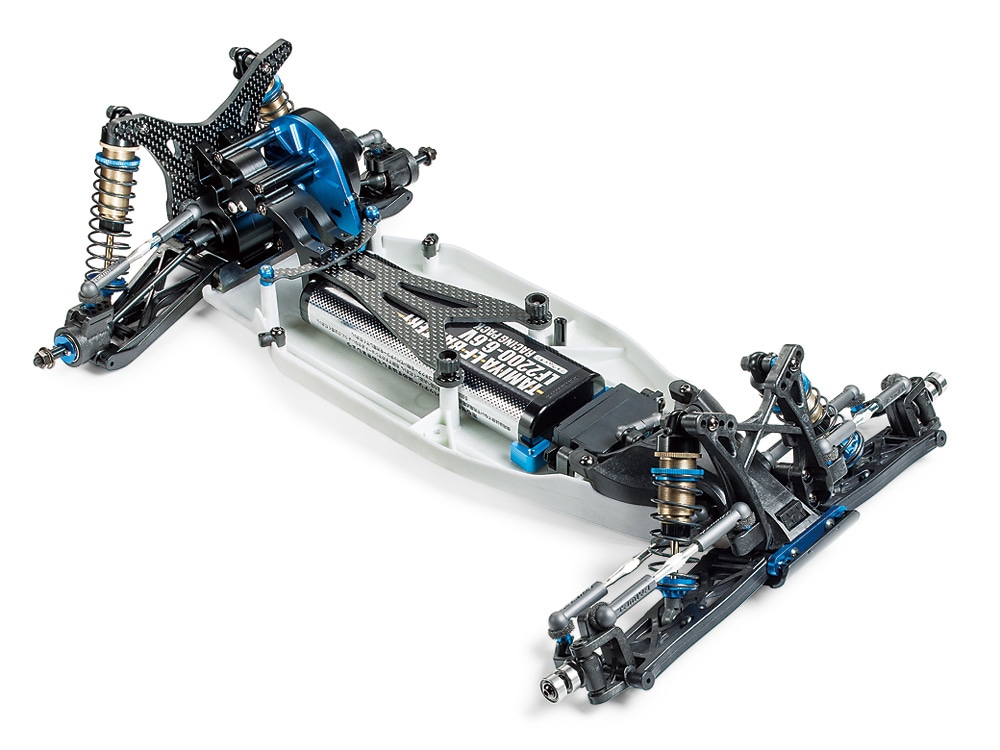
The TRF211XM arrived in June 2015 as a focused two-wheel-drive racing buggy, developing the TRF201XMW's competition platform. Tamiya used its Quick Form process for a lightweight molded lower deck, combining it with a rear stiffener and carbon battery reinforcement. The result is a chassis built around controlling stiffness as well as carrying the running gear.
Read moreShow less
A lightweight polycarbonate body and wing are included, while tires, wheels and the power system remain choices for the builder and the intended track. Development and chassis concept (opens in a new tab)
The equipment list already contains big-bore aeration dampers, full bearings, an aluminum gearbox and a cooling slipper plate. Both ball and gear differentials are provided as alternatives for different surfaces. Carbon battery hardware, a carbon rear damper stay and a brass rear suspension mount add to the competition specification. This is a setup-oriented kit whose supplied mechanisms offer considerable work before another collection of tuning parts is needed. Original racing equipment (opens in a new tab)
Choose the battery and servo together. The separate-pack layout is the basic completion arrangement, while a straight pack requires a low-profile servo. The manufacturer's motor requirements also exclude several ordinary Tamiya 540 types, so a familiar motor label alone is insufficient. Begin with tires appropriate to the surface, smooth suspension and a correctly assembled differential. Later wheel or seal conversions have their own parts and machining conditions. Retaining the standard dampers and a known drivetrain arrangement makes changes easier to assess as a complete racing setup. Completion and installation requirements (opens in a new tab)
Pros
Cons
- Tires, wheels, motor and radio are sold separately, and Tamiya rules out its stock 540, 540-J, Sport-Tuned and Torque-Tuned motors.1
Specifications
Jump to section
| Spec | Value | Basis |
|---|---|---|
| Vehicle | ||
| ||
| Class | Buggy | |
| Drive | 2WD | |
| Build | Kit | |
| Scale | 1/10 | |
| Part number | 42288 | |
| Drivetrain | ||
| ||
| Pinion | Not applicable | |
| Spur | Stock | |
| Transmission & axle | Stock | |
| Final drive | 8.56 to 9.34:1 on 24T to 22T pinionsMaker's chart | Maker's chart |
| Wheels & tires | ||
| ||
| Tire diameter | Not applicable | |
| Suspension | ||
| ||
| Chassis | CompositeStock | Stock |
| Shocks | Big borefront and rearStock | Stock |
| Shock bore | 12mm, front and rear; Nominal manufacturer-published 12 mm hydraulic bore for the service shock that contains this exact original cylinder. Bore does not vary with the different front and rear cylinder lengths.Derived from replacement part | Derived from replacement part |
| Power | ||
| ||
| Motor | Not applicable | |
| Motor shaft | Not applicable | |
| Battery | Not applicable | |
| Battery pack configuration | Separate/split pack; a straight pack requires a low-profile servoExact TRF211XM 42288 installation requirement. Battery dimensions, connector and electrical limits require separate checks.Stock | Stock |
| Performance | ||
| ||
| Theoretical top speed | Not applicable | |
| Size & weight | ||
| ||
| Length | 402 mm15.8 inStock | Stock |
| Width | 236 mm9.3 inStock | Stock |
| Wheelbase | 285 mm11.2 inStock | Stock |
About these specs
Rear-motor, rear-wheel-drive race buggy kit with a selectable gear or ball differential and a slipper clutch; the body and rear wing are included, the motor, tires, wheels and electronics are not.
Read moreShow less
- The manual names the '79T Spur gear' (BB31, PDF p. 6) and prints the formula 'Spur gear teeth (79T) / Pinion gear teeth x 2.60', with a chart for the 79T spur: 22T 9.34, 23T 8.93 and 24T 8.56 (PDF p. 19).
- It says to use a separately available 48 pitch pinion, so no pinion comes in the box and the final drive depends on the one fitted.
- Tamiya's page prints the same range, 'ギヤ比=8.56~9.34(キット標準24T 8.56:1)', and a 285mm wheelbase.
- The chart also lists an optional 77T spur, 9.10:1 on 22T to 8.01:1 on 25T.
How to read these figures
- Stock is as the vehicle ships.
- Derived from replacement part uses the listed dimensions of a replacement advertised for the identified OEM part. Treat it as an approximate working size; the factory-fitted part may differ. Calculated performance uses that approximation.
- Not applicable means the vehicle does not come with it, like the motor on a roller or the tires on a race kit.
- Maker’s chart is the ratios the maker prints for this chassis with the pinions it names.
Sources
9 source links for this model.
All sourcesShow less
Maker documents
1- TRF211XM instruction manual (Tamiya PDF) (opens in a new tab)Supports 2 specifications79T spur BB31, PDF p. 6; gearing chart Setting up, PDF p. 19Used forMain specsService
This vehicle
2- 1/10RC TRF211XM シャーシキット (opens in a new tab)Supports 4 specifications · Background 1Tamiya, Jun 2015Used forMain specsSizeSuspensionPowerBackgroundBackground 1
- Tamiya TRF211XM Chassis Kit product page (opens in a new tab)Supports 1 specificationUsed forSuspension
Parts and electronics
3- All (opens in a new tab)Supports 1 specificationUsed forSuspension
- RC buggy big bore damper front (opens in a new tab)Supports 1 specificationUsed forSuspension
- RC buggy big bore damper rear (opens in a new tab)Supports 1 specificationUsed forSuspension
Reviews and articles
3- TamiyaBase: TRF211XM chassis (opens in a new tab)Background reference 2Used forBackground 2
- TamiyaBase: TRF201XMW chassis (opens in a new tab)Background reference 3Used forBackground 3
- RedRC: Tamiya TRF211XM 1/10th 2WD buggy kit (opens in a new tab)Background reference 4Jun 2015Used forBackground 4
Service reference
Checked task pages, documented requirements and recorded fluid references for this model. Follow the manufacturer's procedure for the exact assembly and revision.
Maintenance bundles
Manual pages, documented requirements and relevant specifications, together by task.
Use the cited instructions for your fitted equipment. These references are not a complete rebuild kit.
DifferentialsReference
Kit differential assembly
TRF211XM Chassis Kit kit 42288; exact 28-page manufacturer PDF edition
Exact kit differential assembly reference. Follow the documented front/rear configurations; locked or direct front drives do not receive rear differential oil by inference.
- Tamiya 42288 instruction manual, PDF pp. 4-5 (opens in a new tab)Assembly drawing, not a rebuild procedure. Document: Tamiya 42288 TRF211XM Chassis Kit; 28-page PDF.
Documented parts and requirements
No separate parts, tools or prerequisites have been indexed for this task. Read the cited reference before starting.
This is a partial service reference. Check the cited instructions for the full procedure and configuration-specific requirements. Mechanical tasks may need additional parts, quantities and reused hardware beyond the items listed here. Manual reviewed 2026-10-10.
DrivetrainReference
Kit drivetrain
TRF211XM Chassis Kit kit 42288; exact 28-page manufacturer PDF edition
Drivetrain assembly reference for this exact kit. Follow the documented joints, bearings and shaft or belt arrangement.
- Tamiya 42288 instruction manual, PDF pp. 7-8 (opens in a new tab)Assembly drawing, not a rebuild procedure. Document: Tamiya 42288 TRF211XM Chassis Kit; 28-page PDF.
Documented parts and requirements
No separate parts, tools or prerequisites have been indexed for this task. Read the cited reference before starting.
This is a partial service reference. Check the cited instructions for the full procedure and configuration-specific requirements. Mechanical tasks may need additional parts, quantities and reused hardware beyond the items listed here. Manual reviewed 2026-10-10.
MotorReference
Motor mounting and pinion
TRF211XM Chassis Kit kit 42288; exact 28-page manufacturer PDF edition
Motor mounting and pinion installation reference. Refer to this kit's required equipment; these pages do not identify an owner-selected motor as factory equipment.
- Tamiya 42288 instruction manual, PDF p. 13 (opens in a new tab)Assembly drawing, not a rebuild procedure. Document: Tamiya 42288 TRF211XM Chassis Kit; 28-page PDF.
Documented parts and requirements
No separate parts, tools or prerequisites have been indexed for this task. Read the cited reference before starting.
This is a partial service reference. Check the cited instructions for the full procedure and configuration-specific requirements. Mechanical tasks may need additional parts, quantities and reused hardware beyond the items listed here. Manual reviewed 2026-10-10.
Steering servoReference
Steering servo installation
TRF211XM Chassis Kit kit 42288; exact 28-page manufacturer PDF edition
Servo neutral-position check, horn/linkage and mounting reference. This is chassis installation, not radio binding or internal servo rebuilding.
- Tamiya 42288 instruction manual, PDF pp. 14-15 (opens in a new tab)Assembly drawing, not a rebuild procedure. Document: Tamiya 42288 TRF211XM Chassis Kit; 28-page PDF.
Documented parts and requirements
No separate parts, tools or prerequisites have been indexed for this task. Read the cited reference before starting.
This is a partial service reference. Check the cited instructions for the full procedure and configuration-specific requirements. Mechanical tasks may need additional parts, quantities and reused hardware beyond the items listed here. Manual reviewed 2026-10-10.
No fluid grades are recorded here. That does not establish whether this vehicle uses oil, grease or friction components.
Manuals & assembly references
Indexed tasks link to checked physical PDF pages. Other links open full documents. Tasks and rebuild requirements not shown here still need review.
Upgrades and setup
The TRF211XM 42288 already includes big bore aeration dampers, full bearings, an aluminum gearbox and both ball and gear differentials. Start with suitable tires, a sound diff build and freely moving suspension. Choose the battery and servo together: a low-profile servo allows the straight-pack arrangement, while the other arrangement uses a split pack.[1] Exact supplied equipment and motor requirements (opens in a new tab)[2] Full assembly and actual astro running follow-ups (opens in a new tab)
Tune springs and damping for the actual surface before adding power. Softer springs can improve grip on astro, but too much grip can produce rollovers in fast corners. Check turnbuckles after impacts and let the motor cool between runs. The original motor requirements exclude Tamiya’s standard 540, 540-J, Sport-Tuned and Torque-Tuned motors.[1] Exact supplied equipment and motor requirements (opens in a new tab)[2] Full assembly and actual astro running follow-ups (opens in a new tab)[3] Independent completed 2024 running build (opens in a new tab)
Read moreRead less about upgrades and setup for TRF211XM Chassis Kit
For the gear differential, the 54428 steel bevel gears are a listed option, and two Kyosho ORG05 P5 seals have been installed in place of BA15 seals on a running TRF211XM. Check seal seating, smooth operation and leakage after assembly. Steel gears and replacement seals do not correct poor mesh, damaged housings or incorrect shimming.[4] Current steel bevel compatibility (opens in a new tab)[3] Independent completed 2024 running build (opens in a new tab)[5] Current original P5 seal listing (opens in a new tab)
Wheel conversions need separate front and rear decisions. Tamiya’s 54669 rear hex hubs require compatible 51581 or 54749 rear wheels. The Yokomo B-MAX2 front conversion uses B2-HCOV, B2-413 carriers and B2-414 pins, with the donor carrier holes reamed to 3mm. That conversion requires modified donor parts and verified wheel clearance; it is not a direct replacement for the stock front assembly.[6] Rear hex hub conversion and required wheels (opens in a new tab)[7] Exact rear wheel hub requirement (opens in a new tab)[2] Full assembly and actual astro running follow-ups (opens in a new tab)
Option suppliers

Tamiya
TRF211XM service parts, spring choices, differential parts and rear hex conversion equipment. Much race equipment is already included.
Browse parts at Tamiya (opens in a new tab)
Kyosho
ORG05 P5 differential seals used in a TRF211XM build. Check the seal groove and seating before assembly.
Browse parts at Kyosho (opens in a new tab)
Forums & communities
oOple
Full original owner discussion with actual running follow-ups. Archived 2015 settings and donor parts need current availability and track checks.
Read TRF211XM assembly, hex conversion and astro setup follow-ups (opens in a new tab)
Video reviews

ShortCourseWorld: Kit Review: Tamiya TRF211XM 1/10 buggy (opens in a new tab)
Reviews the TRF211XM kit and equipment. Check any setup choices against your motor, tires and running surface.
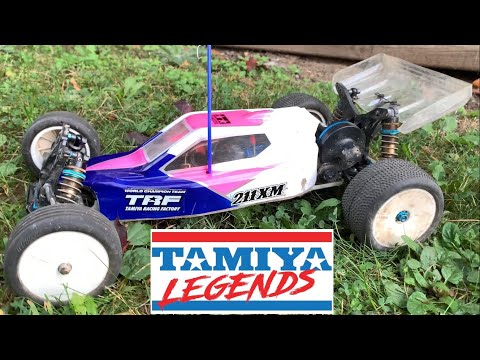
TAMIYA Legends: Tamiya TRF211XM (opens in a new tab)
A creator TRF211XM overview, adding a different perspective to the existing assembly coverage.
OEM parts
Loading parts…
Related vehicles
No reviewed platform or substantial structural connection is recorded for this exact model yet.
More from Tamiya
Browse 7 more Tamiya models.