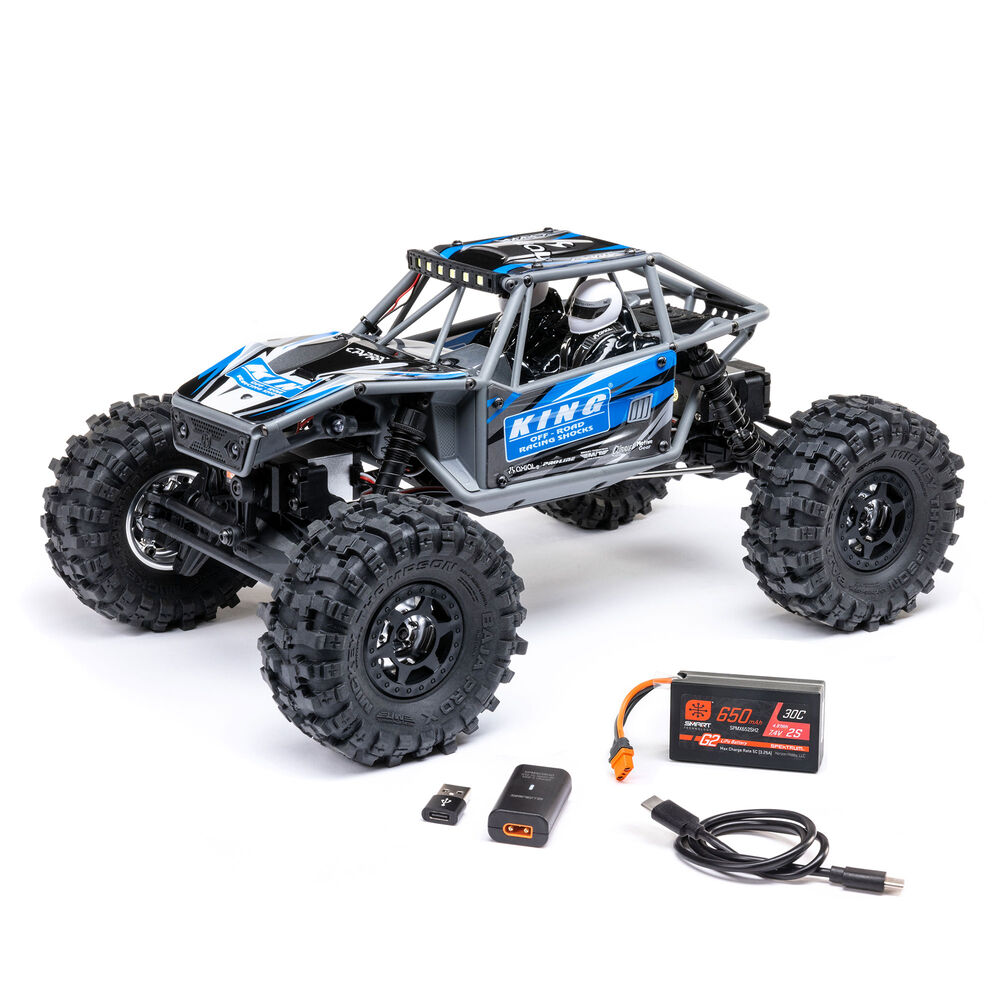
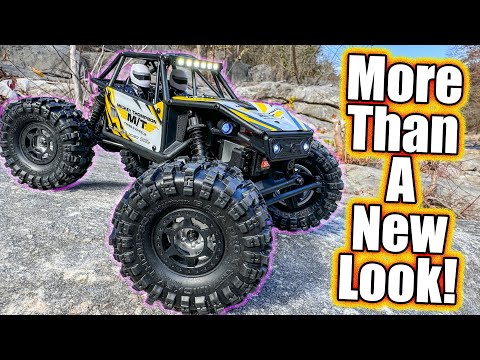
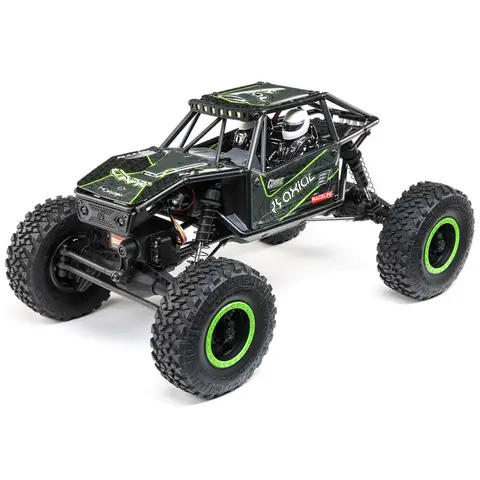
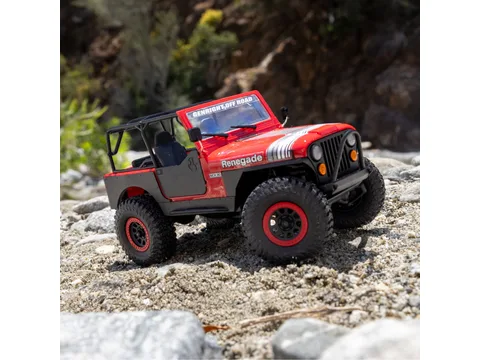
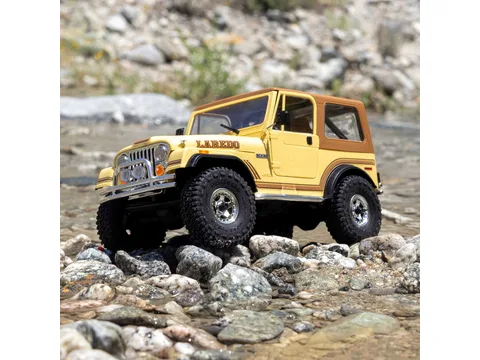
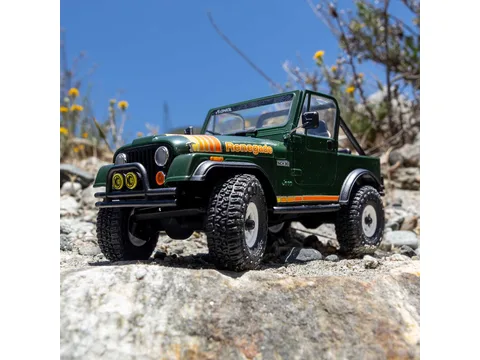
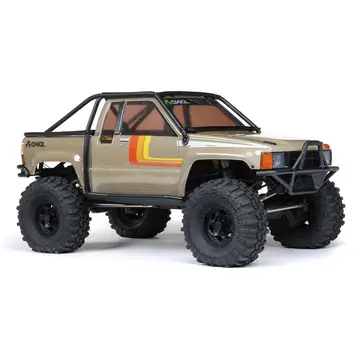
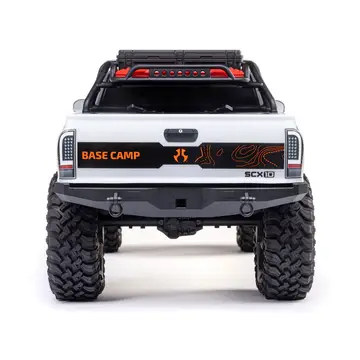
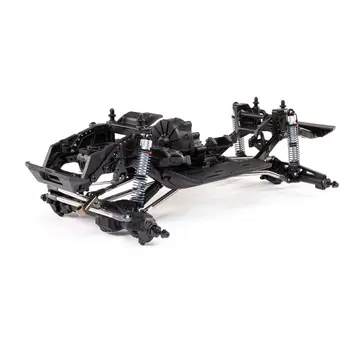
The UTB18 4WS builds rear steering into Axial's smaller Capra package. The supplied radio offers front-only, mirrored and crab modes, making axle placement a control choice before additional hardware is bought. Its portal axles and cage-body format keep the emphasis on negotiating a compact crawling route. Model and background reference (opens in a new tab)
Read moreShow less
AXI-1750 separates the Firma 25A controller from its SR515 receiver and supplies two 25T S664 servos. These are meaningful differences from the original front-steered UTB18. A brief owner's modified build had only an initial run reported, leaving the stock system a useful baseline without an established longer-term upgrade result. Model and background reference (opens in a new tab)Model and background reference (opens in a new tab)
Pros
Portal axles built around a Currie F9 center section increase ground clearance.1
Three steering modes, no rear input, mirrored rear input, or a sideways crab crawl, run from a 3-channel Spektrum SLT3 transmitter.1
The kind of vehicle the maker sells it as. It sets what the car is built to do and which cars it is fair to compare it with.
Crawlers are built for slow, controlled climbing over rocks: very low gearing, flexible suspension and locked axles.
Drive
All four wheels are driven. That gives more grip under power, especially on loose ground.
The cost is more parts to maintain.
A crawler needs every wheel pulling to climb.
Power
A brushed motor carries current through carbon brushes that rub on the commutator.
It is cheaper and smooth at low speed.
The brushes wear and the motor loses power over time.
That low-speed smoothness is why so many crawlers use one.
Build
Ready to run: built at the factory with the electronics installed.
Some come without a battery or charger; the maker's box contents say which.
Scale
The maker's nominal size compared with a full-size vehicle. It works more as a class label than a measurement.
A 1/10 monster truck is far bigger than a 1/10 touring car, so compare length and weight for real size.
This one is 434 mm long.
Part number
The maker's product number for this exact version.
A V2, a new color, or a kit instead of an RTR usually has a different number, and parts can differ between them.
Check it against your box or receipt before ordering parts.
Class
Crawler
Drive
4WD
Power
Brushed
Build
Ready to run
Scale
1/18
Part number
AXI-1750
Drivetrain
Pinion
The small gear on the motor shaft. Fewer teeth gear the car shorter: quicker acceleration, lower top speed and a cooler motor. More teeth do the opposite.
On this car one tooth changes the gearing by about 7.7%.
Crawlers run small pinions for slow, precise wheel speed on climbs; a bigger one is quicker on the trail but harder to control on rocks.
Spur
The large gear the pinion drives. A bigger spur with the same pinion gears the car shorter.
Pinion and spur need matching pitch, or explicit manufacturer confirmation that the exact gears are compatible.
The Gearing parts table below shows this car's pitch and part numbers.
Transmission & axle
Every reduction after the spur, multiplied together: transmission, transfer case and axle gears.
That chain is why a crawler's figure is much higher than other classes'.
It is fixed by the design; the gearing you change is the pinion and spur.
It includes the portal reduction shown below.
This one is worked out from the tooth counts the maker publishes.
Portal reduction (included above)
Portal axles add a gear reduction at each wheel, which raises the axle above the wheel center for more ground clearance.
This one reduces 1.73:1.
It is part of the transmission and axle ratio above, not an extra step, so do not multiply it in again.
Spur ÷ pinion
Spur teeth divided by pinion teeth: the part of the gearing that a pinion or spur swap changes.
Here it is 3.077:1.
Final drive
How many times the motor turns for one turn of the wheels. A higher number is shorter gearing: more acceleration and pulling power, less top speed.
Among 1/18 crawlers & trail trucks in the catalog, the middle half run between 20.4:1 and 42.8:1 on stock gearing; this one is 44.9:1, shorter than most.
Crawlers run far higher ratios than other classes, so the truck can creep and hold on a climb.
Differentials
The type of each differential, as the maker states it.
A gear or ball diff lets the wheels on one axle turn at different speeds in a corner; a spool or locked diff turns them together for straight-line drive and climbing, at the cost of steering.
Crawlers often lock both axles so every tire pulls on a climb.
Pinion bore
The nominal size of the hole that mates with the motor shaft.
Match the pinion mounting method as well as its size. A press-fit hole cannot be inferred from motor shaft diameter.
Pinion pitch
The tooth spacing of the fitted gear, stated as metric module or diametral pitch.
Pinion and spur need matching pitch or explicit manufacturer confirmation of compatibility for the exact parts. Mod 0.8 and 32P are different standards; a compatibility statement for particular gears does not apply to every gear. A missing pitch can be inferred from the other fitted gear; module and diametral pitch are not silently converted.
Spur pitch
The tooth spacing of the fitted gear, stated as metric module or diametral pitch.
Pinion and spur need matching pitch or explicit manufacturer confirmation of compatibility for the exact parts. Mod 0.8 and 32P are different standards; a compatibility statement for particular gears does not apply to every gear. A missing pitch can be inferred from the other fitted gear; module and diametral pitch are not silently converted.
The outside diameter of the mounted tire, tread to tread. A taller tire covers more ground each turn, which gears the car taller.
Crawler wheels are named by rim size, such as 1.9 or 2.2 inches; that is the wheel, not this tire diameter.
Rollout
How far the car moves for one turn of the motor: tire circumference divided by final drive.
It lets you compare gearing across different tire sizes; more rollout is taller gearing.
Here it is 6.9 mm.
Wheel hex
The hex on the axle that the wheel locks onto and is driven by. A wheel must match the hex size to fit.
12 mm is the common size on 1/10 cars, so most 1/10 wheels fit; offset and width still vary.
The wheel nut is a separate size, so check its thread too before buying nuts.
Stock wheel diameter
Stock wheel diameter: A documented stock wheel, tire, or axle measurement. Stock dimensions alone do not establish the largest size that will clear the body and suspension.
Stock tire width
Stock tire width: A documented stock wheel, tire, or axle measurement. Stock dimensions alone do not establish the largest size that will clear the body and suspension.
Axle thread
Axle thread: A documented stock wheel, tire, or axle measurement. Stock dimensions alone do not establish the largest size that will clear the body and suspension.
What the main chassis is made of and how it is built, as stated for this car. Braces, stiffeners and skid plates are not counted.
Composite is the makers' word for molded plastic, usually nylon with glass or other fibers: it flexes and shrugs off hits, and it is light and cheap to replace.
Shocks
What the shocks are and how they are built, as the maker describes them.
Oil-filled shocks damp with silicone oil; friction shocks, found on some entry-level cars, damp with a sprung plunger and cannot be tuned with oil.
A bigger bore moves more oil for the same travel, which damps more consistently and runs cooler.
Shock length
The stated length of the complete shock assembly. Sources may use mounting-eye centers or a nominal assembly length.
Compare fully extended mounting-eye spacing, compressed length and mounting hardware before ordering. A longer shock changes ride height and travel, and can bind at full droop or bottom out.
Spring
The stock springs, in the maker's own wording: a color, a rate or a length.
A stiffer spring holds the car up and resists bottoming out; a softer one lets it squat and follow rough ground.
Rates are not comparable across makers unless they state the same unit.
Frontupper shock mount
Front upper shock mount: A documented shock mounting interface at the named end and eye. A ball stud or standoff is distinct from a through-bolt. Match the mounting type, thread and eye dimensions when choosing a replacement shock.
Frontlower shock mount
Front lower shock mount: A documented shock mounting interface at the named end and eye. A ball stud or standoff is distinct from a through-bolt. Match the mounting type, thread and eye dimensions when choosing a replacement shock.
Rearupper shock mount
Rear upper shock mount: A documented shock mounting interface at the named end and eye. A ball stud or standoff is distinct from a through-bolt. Match the mounting type, thread and eye dimensions when choosing a replacement shock.
Rearlower shock mount
Rear lower shock mount: A documented shock mounting interface at the named end and eye. A ball stud or standoff is distinct from a through-bolt. Match the mounting type, thread and eye dimensions when choosing a replacement shock.
Oil-filledcomposite body, front and rear; Original bare body listing: 10 × 33 mm. Diameter convention unspecified. This is separate from bore and complete shock length.Stock
78.5mm listed length, front and rear; Upper endpoint of the 55–78.5 mm Axial range. Both UTB18 versions share the same original shock body, shaft, spring and molded end/cap parts.Stock
Catalog stock FDR: 44.88:1. The grid uses the listed tooth counts and internal ratio, so rounding or source differences may change the result slightly.
Calculated final drive ratio for each pinion and spur pair
Pinion
38T spur
40T spur
42T spur
11T
12T
13T
14T
15T
16T
Select a pair to compare wheel travel per motor turn with stock. Other cells are mathematical examples, not verified gears or fits. Check pitch, mesh, clearance and motor temperature before changing parts.
About these specs
A different model from the UTB18 Capra 4WD, which has its own page (four-wheel steering, spool diffs, Mickey Thompson tires).
Read moreShow less
Brushed 37T 380 motor; its published Kv rating remains unknown.
The stock tire is the Pro-Line Mickey Thompson Baja Pro X G8 1.55 (PRO1028214, manual parts list p. 19); its Horizon page prints a product height of 3.85 in (98 mm) but no figure labelled diameter, so the tire is shown as an estimate.
Do not trust Axial's separately printed 'Internal Gear Ratio 10.2:1' for this platform, it does not reconcile with the 44.88 total.
Portal axles.
Portal gear set AXI212001 is 26T/15T = 1.73333:1 (Axial manual parts list).
The stock Dynamite Tazer 37T motor is brushed, so its published Kv rating remains unknown.
The tire diameter is the 3.85 in (98 mm) height Pro-Line prints for the Class 0 Mickey Thompson Baja Pro X 1.55 in tires (PRO1028214) that the manual's parts list names and Horizon lists as the standard part for this buggy.
The stock 380 motor is brushed, so its published Kv rating remains unknown.
How to read these figures
Stock is as the vehicle ships.
Calculated is worked from the recorded figures on this page.
Derived uses recorded dimensions or arithmetic. The row explains the inference. A nominal mating size is not a measured tolerance or a complete fitment guarantee.
Not published means it exists but no source we could find prints it.
Owner's manual (Axial PDF) (opens in a new tab)axialadventure.comPDFSupports 9 specificationsexploded view Transmission, PDF p. 17; parts list PDF p. 18-19Used forMain specsGearingMotor shaftElectronicsWheels & tiresSuspensionPowerSteering & radioIn the box
This changes the gearing inside the front portal hubs so the front wheels turn faster than the rear wheels. Choose it when you want front-biased crawling behavior while retaining the original rear gearing.
Manufacturer-documented option for the specified vehicle configuration.
Common numbers cover selected core components, not every part. A shared family, manual or listing does not mean the parts fit both vehicles. Check the comparison and upgrade notes before ordering.
More connections & sourcesShow less
Platform family
UTB18 Capra chassis family. UTB18 tube-chassis crawler architecture. The 4WS version changes the rear steering axle, controls, wheels and tires. Source (opens in a new tab)