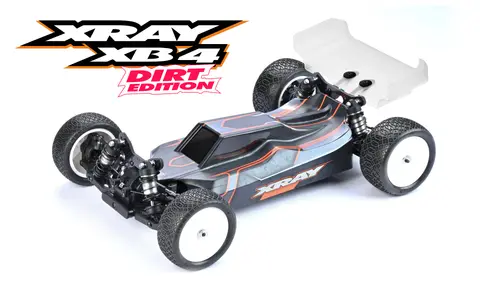
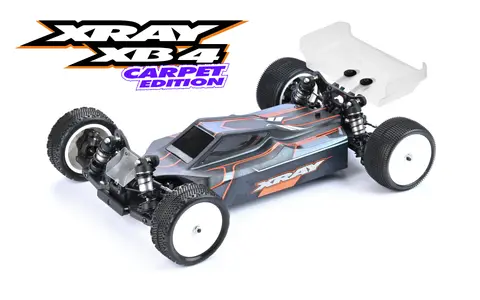
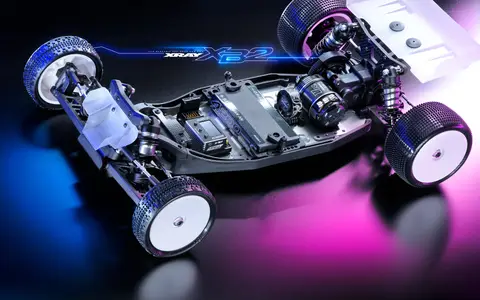
The Dirt edition of the XB4 ’27 starts with a gear-driven center differential and surface-specific suspension settings. The kit is sized for competitive 1/10 buggy racing and shares its assembly documentation with the other surface edition. The build instructions mark the hardware assigned to each surface. Model reference (opens in a new tab)
Read moreShow less
The gearing chart gives a useful starting point when fitting the motor. This kit supplies a 75-tooth spur, and the driver chooses the pinion and tires for the track. Use the exact edition’s instructions for adjustment or service, especially in areas where the dirt and carpet layouts use different parts. Technical reference (opens in a new tab)
The kind of vehicle the maker sells it as. It sets what the car is built to do and which cars it is fair to compare it with.
Buggies are low, light off-road cars built for jumps and fast corners on dirt, clay or turf tracks.
Drive
All four wheels are driven. That gives more grip under power, especially on loose ground.
The cost is more parts to maintain.
Power
Sold without a motor, so you choose the motor, ESC and battery yourself.
Rows that depend on the motor say so.
Build
A kit you build yourself from parts.
Most kits come without motor, ESC, servo, radio and battery, and many without tires or a painted body.
The manual lists what to add.
Scale
The maker's nominal size compared with a full-size vehicle. It works more as a class label than a measurement.
A 1/10 monster truck is far bigger than a 1/10 touring car, so compare length and weight for real size.
Part number
The maker's product number for this exact version.
A V2, a new color, or a kit instead of an RTR usually has a different number, and parts can differ between them.
Check it against your box or receipt before ordering parts.
Class
Buggy
Drive
4WD
Power
Motor not included
Build
Kit
Scale
1/10
Part number
360022
Drivetrain
Pinion
The small gear on the motor shaft. Fewer teeth gear the car shorter: quicker acceleration, lower top speed and a cooler motor. More teeth do the opposite.
It depends on the motor you fit, so the maker does not list one.
Spur
The large gear the pinion drives. A bigger spur with the same pinion gears the car shorter.
Pinion and spur need matching pitch, or explicit manufacturer confirmation that the exact gears are compatible.
The Gearing parts table below shows this car's pitch and part numbers.
On this car the spur is mounted on the center differential.
Transmission & axle
Every reduction after the spur, multiplied together: transmission, differentials and axle gears.
It is fixed by the design; the gearing you change is the pinion and spur.
This one is worked out from the tooth counts the maker publishes.
Final drive
How many times the motor turns for one turn of the wheels. A higher number is shorter gearing: more acceleration and pulling power, less top speed.
Differentials
The type of each differential, as the maker states it.
A gear or ball diff lets the wheels on one axle turn at different speeds in a corner; a spool or locked diff turns them together for straight-line drive and climbing, at the cost of steering.
Spur pitch
The tooth spacing of the fitted gear, stated as metric module or diametral pitch.
Pinion and spur need matching pitch or explicit manufacturer confirmation of compatibility for the exact parts. Mod 0.8 and 32P are different standards; a compatibility statement for particular gears does not apply to every gear. A missing pitch can be inferred from the other fitted gear; module and diametral pitch are not silently converted.
Diff oil, center
Silicone oil sealed inside the differential.
The center diff splits power between front and rear. Thicker oil there sends more drive to the end that has grip and helps acceleration; thinner oil lets the car steer more easily off the throttle.
It is graded in cSt (centistokes), a measure of thickness that means the same across brands. K means thousands, so 100K cSt is 100,000 cSt.
What the shocks are and how they are built, as the maker describes them.
Oil-filled shocks damp with silicone oil; friction shocks, found on some entry-level cars, damp with a sprung plunger and cannot be tuned with oil.
A bigger bore moves more oil for the same travel, which damps more consistently and runs cooler.
Shock bore
The inside diameter of the shock body, where the piston moves through oil.
It is a shock measurement, separate from the motor pinion bore. Match the actual shock part when ordering pistons, seals or a replacement body.
Shock oil, front
The oil in the shocks slows how fast the suspension moves. Thicker oil settles the car more slowly and resists bottoming out; thinner oil lets the wheels follow bumps.
At the front it mostly shapes the steering: thicker oil makes the car turn in more calmly and dive less under braking; thinner oil turns in sharper and keeps the front tires on the ground over bumps.
Racers go thicker for big, smooth jumps and thinner for rough, choppy tracks.
It is graded in cSt (centistokes), a measure of thickness that is the same across brands.
Shock oil, rear
The rear shocks mostly shape grip under power and how the car lands.
Thicker oil at the rear holds the back up on landings and keeps it steadier on the throttle; thinner oil lets it squat and follow rough or loose ground for more grip.
This car runs thicker oil at the front (350 cSt) than the rear (300 cSt). The front reacts more slowly, which steadies the steering, while the rear follows the ground more freely for grip under power.
Motor KV is the RPM a motor turns per volt with no load.
This vehicle comes without a motor, so there is no stock KV; it depends on the one you fit.
Motor shaft
The diameter of the motor's output shaft, which a pinion's bore must match.
This vehicle comes without a motor, so it depends on the one you fit.
Battery
The highest LiPo cell count the maker rates the electronics for.
This vehicle comes without electronics, so it depends on the ESC and motor you fit.
Motor
Not applicable
Motor shaft
Not applicable
Battery
Not applicable
Performance
Theoretical top speed
It needs a motor KV, and this vehicle comes without a motor. Fit one and the calculator works it out from the motor's KV and the gearing.
Theoretical top speed
Not applicable
About these specs
The XB4D ’27 is a 1/10 four-wheel-drive electric buggy kit for dirt.
How to read these figures
Stock is as the vehicle ships.
Derived uses recorded dimensions or arithmetic. The row explains the inference. A nominal mating size is not a measured tolerance or a complete fitment guarantee.
Not applicable means the vehicle does not come with it, like the motor on a roller or the tires on a race kit.