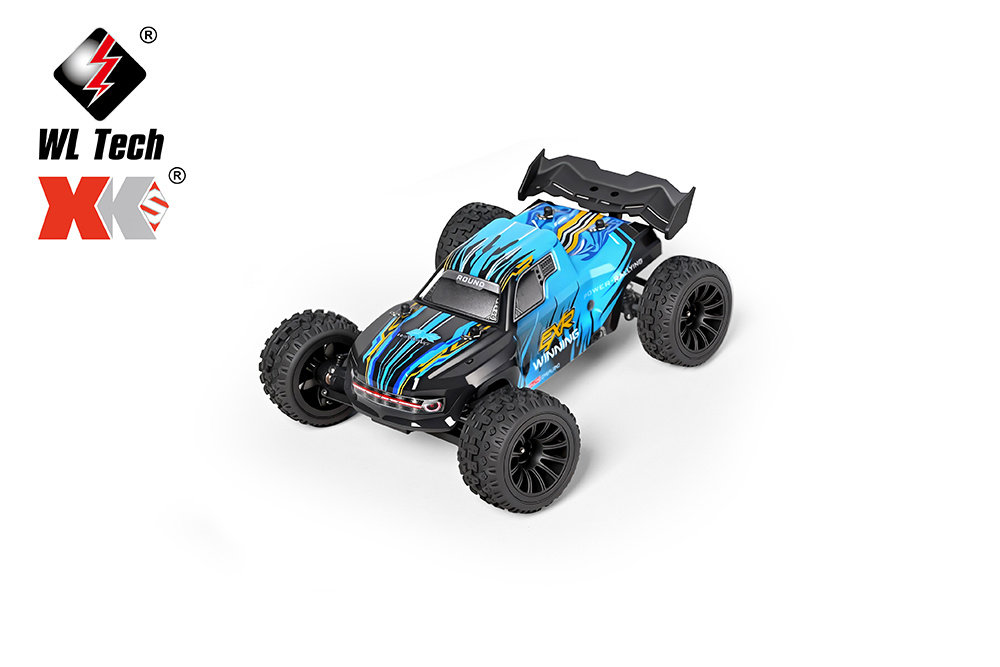
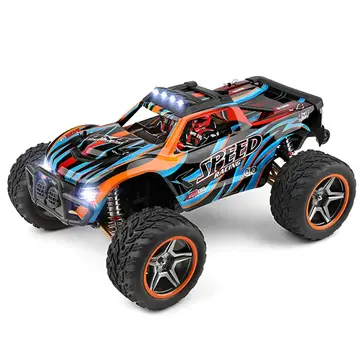
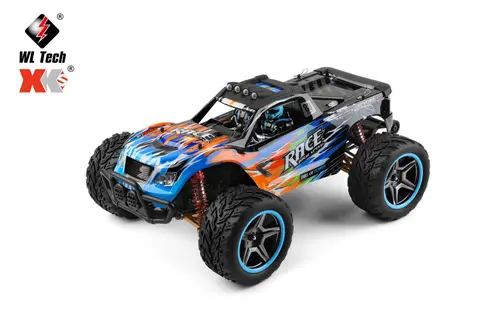
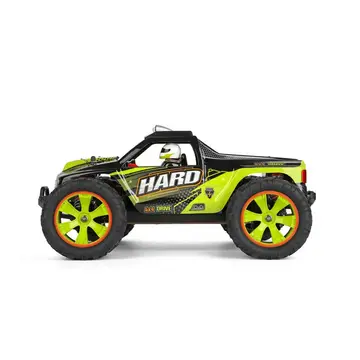
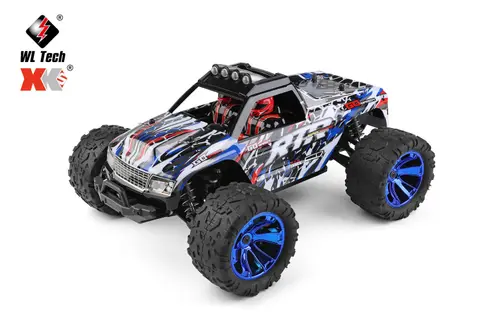
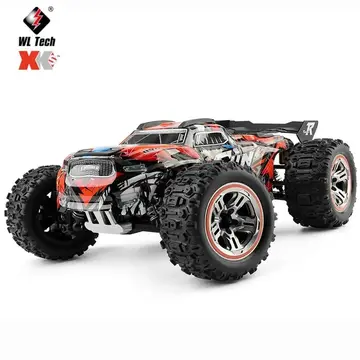
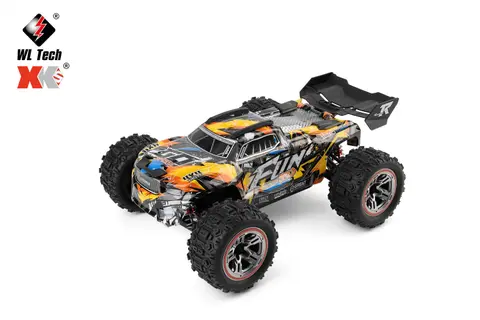
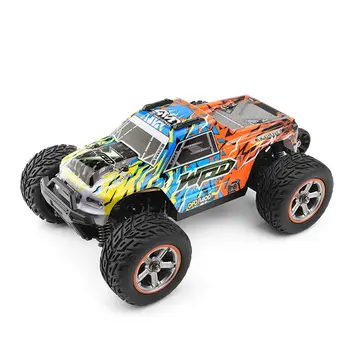
The 244018 brings a monster-truck body and treaded rubber tires to WLtoys' 1/24 range. It uses two-wheel drive, an 050 brushed motor and independent suspension. Proportional throttle and steering give you control over both speed and direction, while the built-in electronic gyro supports handling. Manufacturer specifications (opens in a new tab).
Read moreShow less
The supplied configuration pairs a 7.4V 350mAh battery with USB charging. Three selectable speed settings are listed, with the lowest selected at startup. Those control settings do not establish a three-ratio mechanical gearbox. Red and blue bodies are color choices for the same model number. Model details (opens in a new tab).
The kind of vehicle the maker sells it as. It sets what the car is built to do and which cars it is fair to compare it with.
Monster trucks have tall tires and long suspension travel, built for jumping and rough ground rather than a race track.
Drive
Only one axle is driven, the rear on almost every 2WD RC car.
It is lighter and simpler, and it takes more throttle control on loose ground.
Power
A brushed motor carries current through carbon brushes that rub on the commutator.
It is cheaper and smooth at low speed.
The brushes wear and the motor loses power over time.
Build
Ready to run: built at the factory with the electronics installed.
Some come without a battery or charger; the maker's box contents say which.
Scale
The maker's nominal size compared with a full-size vehicle. It works more as a class label than a measurement.
A 1/10 monster truck is far bigger than a 1/10 touring car, so compare length and weight for real size.
This one is 170 mm long.
Part number
The maker's product number for this exact version.
A V2, a new color, or a kit instead of an RTR usually has a different number, and parts can differ between them.
Check it against your box or receipt before ordering parts.
Class
Monster truck
Drive
2WD
Power
Brushed
Build
Ready to run
Scale
1/24
Part number
244018
Drivetrain
Pinion
The small gear on the motor shaft. Fewer teeth gear the car shorter: quicker acceleration, lower top speed and a cooler motor. More teeth do the opposite.
It depends on the motor you fit, so the maker does not list one.
Spur
The large gear the pinion drives. A bigger spur with the same pinion gears the car shorter.
Pinion and spur must have the same pitch, or tooth size, to mesh.
Transmission & axle
Every reduction after the spur, multiplied together: transmission, differentials and axle gears.
It is fixed by the design; the gearing you change is the pinion and spur.
Final drive
How many times the motor turns for one turn of the wheels. A higher number is shorter gearing: more acceleration and pulling power, less top speed.
Pinion
Not published
Spur
Not published
Transmission & axle
Not published
Final drive
Not published
Wheels & tires
Tire diameter
The outside diameter of the mounted tire, tread to tread. A taller tire covers more ground each turn, which gears the car taller.
At high speed tires can balloon and grow, so the real gearing gets taller as the car goes faster.
Tire diameter
Not published
Power
Motor
Brushed motors are commonly described by can size and turns. No motor KV is published for this vehicle; turns alone cannot supply an exact value.
Battery
The highest LiPo cell count the maker rates the electronics for.
The maker does not publish it.
Stock motor
The motor fitted at the factory, as the maker names it.
Brushed motors are often named by can size, such as 540 or 550, and by turns: fewer turns is faster.
Theoretical top speed is unavailable because motor KV, rated battery cell count, stock tire outside diameter and complete final drive ratio are missing.
Enter the missing inputs in the calculator to work out a theoretical speed.
Theoretical top speed
Not published
Size & weight
Weight
The vehicle's weight as the maker states it.
The maker does not say whether it includes a battery.
More weight takes more power to accelerate and lands harder on the parts; it changes top speed very little.
Length
Overall length as the maker states it, usually with the body fitted.
Useful for comparing real size, since scale labels are loose.
Width
Overall width as the maker states it, usually with the body fitted.
A wider car is more stable in corners and harder to roll over.
Height
Overall height as the maker states it, usually with the body fitted.
Useful when checking it fits a shelf, a bag or a car trunk.