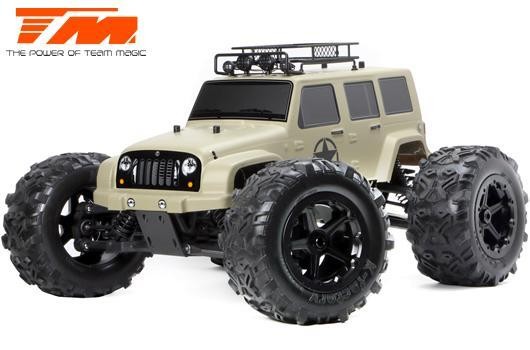
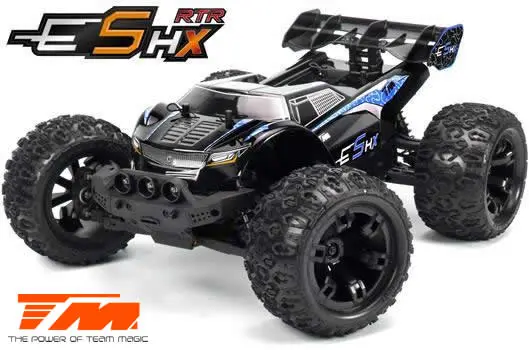
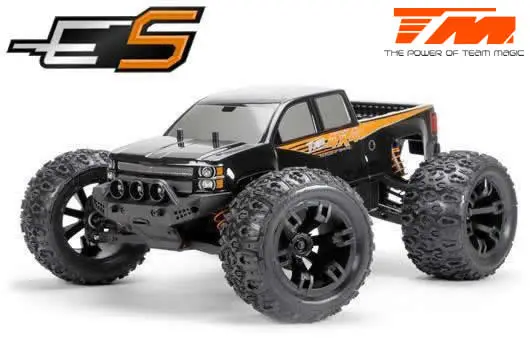
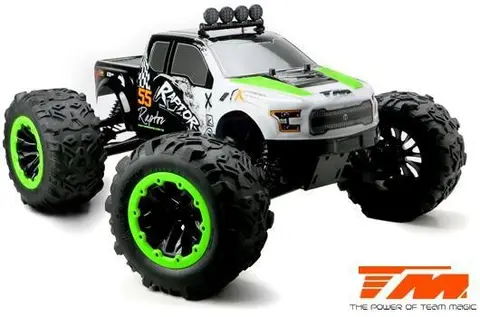
The J-Star package supplies a 2250Kv motor and 150A 4S to 6S controller, with the radio and steering servo installed. Hardened steel driveshafts and a center-drive dust cover identify chassis details beyond the body trim. The listing identifies reinforced axle differentials; keep the exact rear and center assemblies with its parts reference. The selected paired batteries and charger remain separate, so match the exact electrical package when comparing these E6 RTR editions. Team Magic source (opens in a new tab)
The kind of vehicle the maker sells it as. It sets what the car is built to do and which cars it is fair to compare it with.
Monster trucks have tall tires and long suspension travel, built for jumping and rough ground rather than a race track.
Drive
All four wheels are driven. That gives more grip under power, especially on loose ground.
The cost is more parts to maintain.
Power
A brushless motor has no brushes to wear, so it makes more power and runs more efficiently than a brushed one.
It needs a brushless ESC.
Build
Ready to run: built at the factory with the electronics installed.
Some come without a battery or charger; the maker's box contents say which.
Part number
The maker's product number for this exact version.
A V2, a new color, or a kit instead of an RTR usually has a different number, and parts can differ between them.
Check it against your box or receipt before ordering parts.
Class
Monster truck
Drive
4WD
Power
Brushless
Build
Ready to run
Part number
TM505008
Drivetrain
Pinion
The small gear on the motor shaft. Fewer teeth gear the car shorter: quicker acceleration, lower top speed and a cooler motor. More teeth do the opposite.
On this car one tooth changes the gearing by about 9.1%.
A bigger pinion loads the motor and ESC harder, so check the maker's gearing chart and feel the motor temperature after a run.
Spur
The large gear the pinion drives. A bigger spur with the same pinion gears the car shorter.
Pinion and spur need matching pitch, or explicit manufacturer confirmation that the exact gears are compatible.
The Gearing parts table below shows this car's pitch and part numbers.
Transmission & axle
Every reduction after the spur, multiplied together: transmission, differentials and axle gears.
It is fixed by the design; the gearing you change is the pinion and spur.
Final drive
How many times the motor turns for one turn of the wheels. A higher number is shorter gearing: more acceleration and pulling power, less top speed.
Pinion bore
The nominal size of the hole that mates with the motor shaft.
Match the pinion mounting method as well as its size. A press-fit hole cannot be inferred from motor shaft diameter.
Pinion pitch
The tooth spacing of the fitted gear, stated as metric module or diametral pitch.
Pinion and spur need matching pitch or explicit manufacturer confirmation of compatibility for the exact parts. Mod 0.8 and 32P are different standards; a compatibility statement for particular gears does not apply to every gear. A missing pitch can be inferred from the other fitted gear; module and diametral pitch are not silently converted.
Spur pitch
The tooth spacing of the fitted gear, stated as metric module or diametral pitch.
Pinion and spur need matching pitch or explicit manufacturer confirmation of compatibility for the exact parts. Mod 0.8 and 32P are different standards; a compatibility statement for particular gears does not apply to every gear. A missing pitch can be inferred from the other fitted gear; module and diametral pitch are not silently converted.
The E6 J-STAR manual lists an 11T pinion and a 47T spur.
Read moreShow less
Team Magic Europe lists a 2250KV motor and a 150A speed control for 4S to 6S.
The manual does not print the tooth counts of the reduction gears after the spur, so the overall ratio is not published.
Team Magic does not publish the tire diameter.
How to read these figures
Stock is as the vehicle ships.
Derived uses recorded dimensions or arithmetic. The row explains the inference. A nominal mating size is not a measured tolerance or a complete fitment guarantee.
Not published means it exists but no source we could find prints it.
Team Magic source (opens in a new tab)teammagiceurope.netPart pageSupports 7 specificationsUsed forMain specsWeightSizeBattery fitElectronicsPowerSteering & radioBackground
Keep the J-STAR's axle and center differential service separate. Its own factory drawing gives the center a substantially heavier fill than the front and rear. Identify the fitted center assembly before ordering parts, especially on a used truck, and keep each unit's seals, outdrives and oil choice with its service notes.[1] E6 J-STAR factory setup manual (opens in a new tab)
Preserve the roof rack, extended body supports and lateral supports when servicing the chassis. The J-STAR handbook identifies these body-specific pieces separately from the E6 drivetrain. Check their fasteners and tire clearance after refitting the shell before testing a suspension change.[1] E6 J-STAR factory setup manual (opens in a new tab)
Read moreRead less about build and setup for E6 J-STAR
Recalibrate the fitted WP-8BL controller after changing radio endpoints, and use the dedicated programming/fan port with a program box. The handbook separates launch punch, drag brake and maximum braking force. Compare those settings one at a time and identify the actual controller before using either column of its rating table.[1] E6 J-STAR factory setup manual (opens in a new tab)