
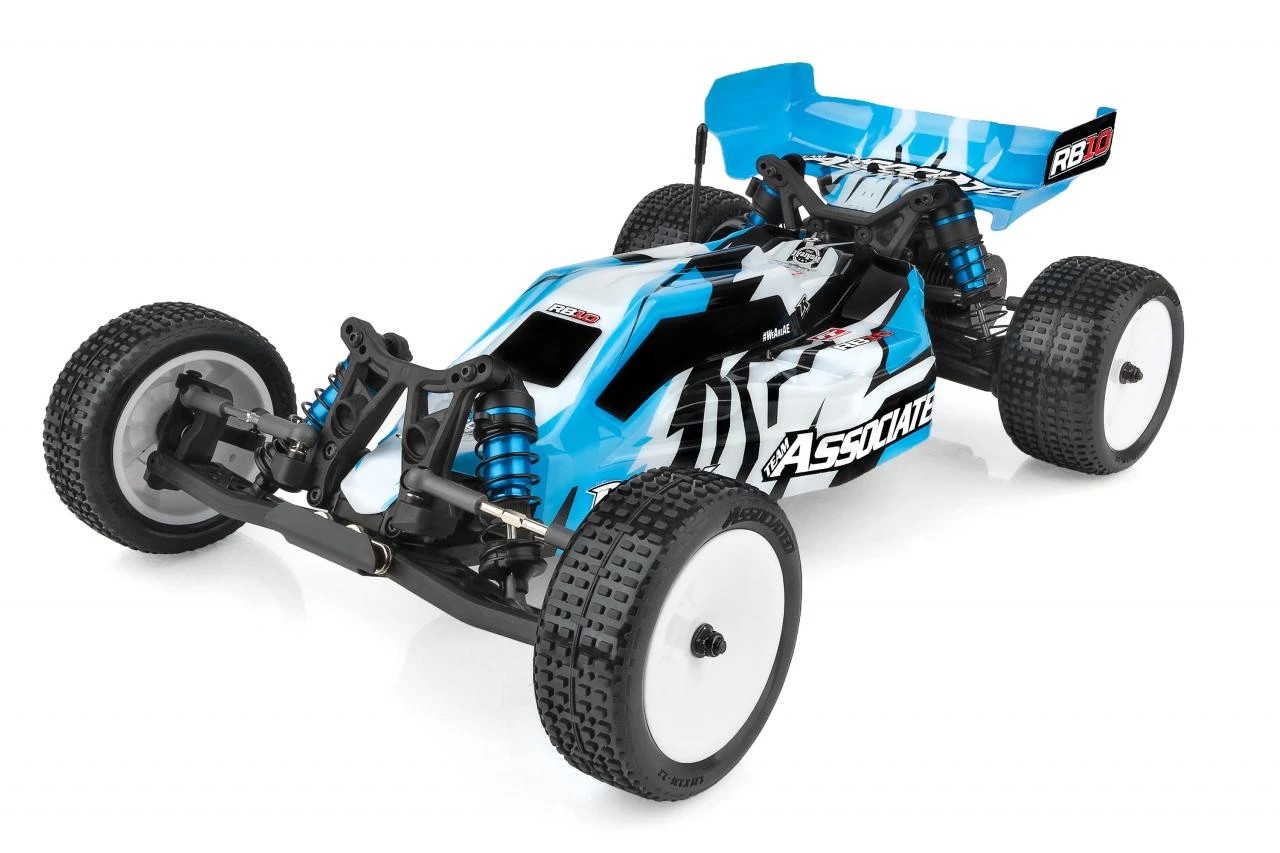
VehiclesTeam Associated RB10 RTR

Specifications
Last modified
| Spec | Value | Basis |
|---|---|---|
| Drivetrain | ||
| Pinion | 18TStock | Stock |
| Spur | 87TStock | Stock |
| Transmission & axle | 2.60:1Stock | Stock |
| Final drive | 12.57:1Stock | Stock |
| Wheels & tires | ||
| Tire diameter | Not published | |
| Wheel hex | 12 mmStock | Stock |
| Power | ||
| Motor | 3300KVStock | Stock |
| Motor shaft | 3.17 mmStock | Stock |
| Battery | Up to 3SLiPoStock | Stock |
| Stock motor | Reedy 540-SL4 Sensorless Brushless MotorStock | Stock |
| Stock ESC | Reedy SC600-BLStock | Stock |
| Battery connector | T-PlugStock | Stock |
| Performance | ||
| Theoretical top speed | Not published | |
| Chassis | ||
| Weight | 1.41 kg (3.1 lb)Stock | Stock |
| Length | 400 mm15.7 inStock | Stock |
| Width | 248 mm9.8 inStock | Stock |
| Wheelbase | 278 mm10.9 inStock | Stock |
| Shock oil, front | 30 wtStock | Stock |
| Shock oil, rear | 30 wtStock | Stock |
| Vehicle | ||
| Part number | 90031 | |
| Scale | 1/10 | |
| Class | Buggy | |
Stock is as the vehicle ships. Calculated is worked from the stock figures on this page rather than stored beside them, so the two cannot drift apart. Not published means it exists but no source we could find prints it.
Gearing parts
| Component | Teeth | Pitch | Bore | Part number |
|---|---|---|---|---|
| Fitted at the factory | ||||
| Pinion | 18T | 48P | 3.175 mm | 1336 (opens in a new tab) |
| Spur | 87T | 48P | Not applicable | 9654 (opens in a new tab) |
Tooth counts are the ones in the specifications above. Pitch is given as metric module (Mod 1, Mod 0.8) or diametral pitch (32P, 48P). They are different standards and are not interchangeable, even where the numbers look close. Bore is the pinion’s hole, listed separately from the motor shaft (3.17 mm on the stock motor). Linked part numbers go to the maker's or official distributor's page for that part.
How these numbers were settled
The RTR manual's gear chart (p. 20) lists the 18T pinion on the 87T spur for the stock 3300kV motor at 12.57:1, over a 2.60:1 transmission.
- The build steps fit the 18T 48P pinion (1336, p. 18) and the 87T 48P spur (9654, p. 13).
- The maker does not publish the diameter of the stock tires, so it is left blank.
- The manual suggests the 17T pinion (1335) as a starting point on 3S LiPo.
- The gear differential is packed with black grease (6588) rather than diff oil.
- The red RTR (90032) and the LiPo Combo versions (90031C, 90032C) share this chassis and gearing.
- The SR10 Dirt Oval RTR (70030) uses the same chassis, 18T/87T gearing, motor and speed control under a street stock body, on street stock tires whose diameter is not published either.
Documents
- ManualRB10 RTR instruction manual (Associated PDF) (opens in a new tab)Spur p. 13, pinion p. 18
- Gearing chartGear ratio chart, in the RTR manual (Associated PDF) (opens in a new tab)p. 20
- Parts listParts catalog, in the RTR manual (Associated PDF) (opens in a new tab)pp. 22-29
Sources
- rb10-ready-to-run60years.associatedelectrics.com (opens in a new tab)
- Manual (PDF)img2.associatedelectrics.com (opens in a new tab)
- Manual (PDF)img2.associatedelectrics.com (opens in a new tab)
- specsportal.associatedelectrics.com (opens in a new tab)
- parts_accessoriesportal.associatedelectrics.com (opens in a new tab)
- Manual (PDF)img2.associatedelectrics.com (opens in a new tab)
- 907-ASC907-reedy_540-sl4_se…portal.associatedelectrics.com (opens in a new tab)
- sr10-dirt-oval-rtr60years.associatedelectrics.com (opens in a new tab)
- Manual (PDF)img2.associatedelectrics.com (opens in a new tab)
- 1336-ASC1336-ft_aluminum_pi…portal.associatedelectrics.com (opens in a new tab)
- 9654-ASC9654-spur_gear_87t_…portal.associatedelectrics.com (opens in a new tab)
Every figure on this page traces to one of these. Where they disagreed, the note above says which was used and why.