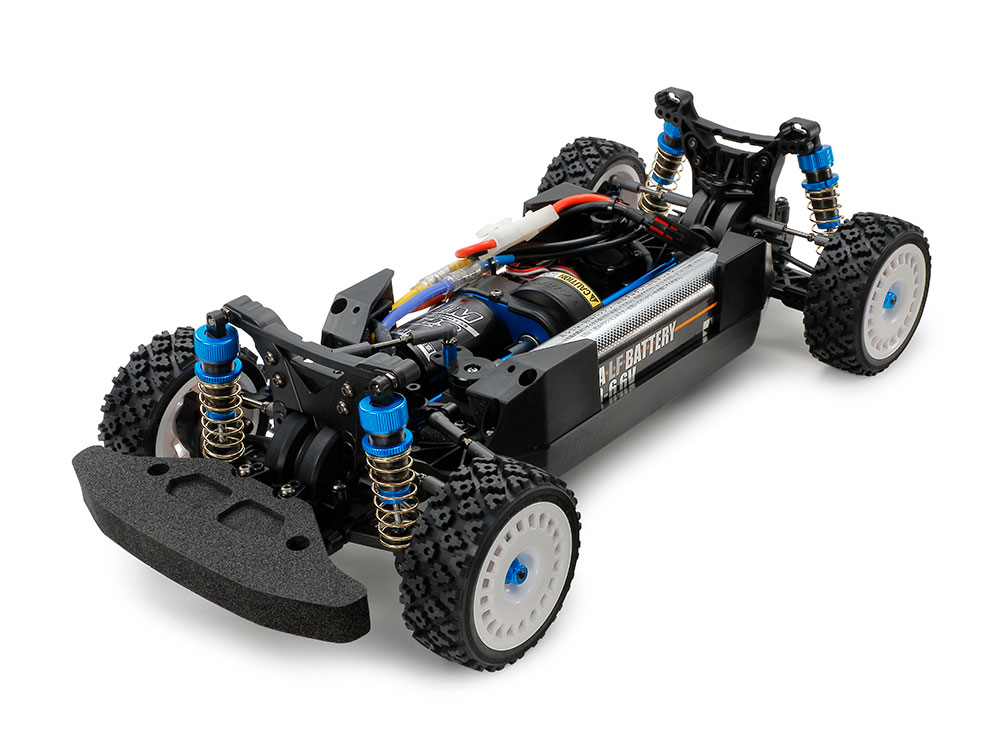
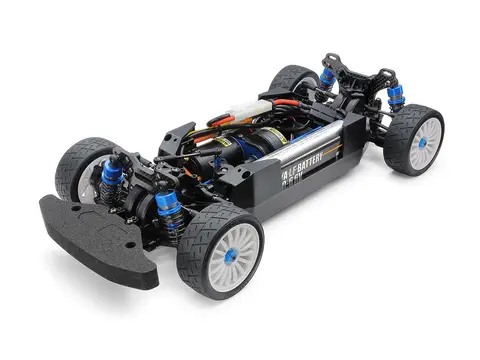
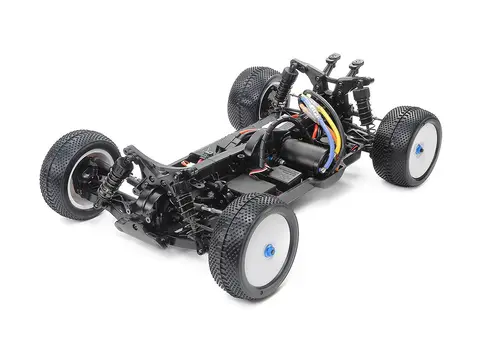
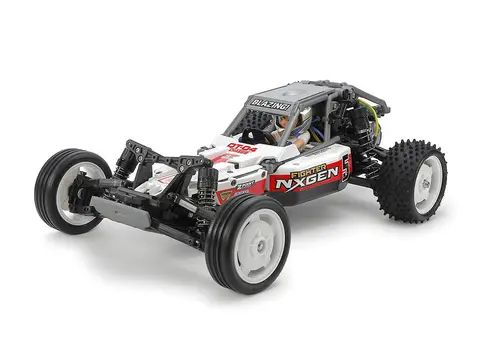
Tamiya's XV-02 PRO Chassis Kit is a 1/10 four-wheel-drive, shaft-driven chassis kit with a front mid-mounted motor, built for tarmac and gravel.
It comes with a 19T pinion on the 70T spur, and the 2.60:1 gearbox and axle stage gives a 9.58:1 final drive. It is 368 mm long on a 257 mm wheelbase. On dirt, stay near the kit pinion; on smooth tarmac, a larger one gives more top speed.
The kind of vehicle the maker sells it as. It sets what the car is built to do and which cars it is fair to compare it with.
Rally cars are 4WD cars with more suspension travel and treaded tires, for dirt, gravel and broken pavement.
The maker does not name a class for this one, so this is the site's judgment from its design.
Drive
All four wheels are driven. That gives more grip under power, especially on loose ground.
The cost is more parts to maintain.
Build
A kit you build yourself from parts.
Most kits come without motor, ESC, servo, radio and battery, and many without tires or a painted body.
The manual lists what to add.
Scale
The maker's nominal size compared with a full-size vehicle. It works more as a class label than a measurement.
A 1/10 monster truck is far bigger than a 1/10 touring car, so compare length and weight for real size.
This one is 368 mm long.
Part number
The maker's product number for this exact version.
A V2, a new color, or a kit instead of an RTR usually has a different number, and parts can differ between them.
Check it against your box or receipt before ordering parts.
Class
Rallyour call
Drive
4WD
Build
Kit
Scale
1/10
Part number
58707
Drivetrain
Pinion
The small gear on the motor shaft. Fewer teeth gear the car shorter: quicker acceleration, lower top speed and a cooler motor. More teeth do the opposite.
On this car one tooth changes the gearing by about 5.3%.
A bigger pinion loads the motor and ESC harder, so check the maker's gearing chart and feel the motor temperature after a run.
Spur
The large gear the pinion drives. A bigger spur with the same pinion gears the car shorter.
Pinion and spur must have the same pitch, or tooth size, to mesh.
Transmission & axle
Every reduction after the spur, multiplied together: transmission, differentials and axle gears.
It is fixed by the design; the gearing you change is the pinion and spur.
This one is worked out from the tooth counts the maker publishes.
Final drive
How many times the motor turns for one turn of the wheels. A higher number is shorter gearing: more acceleration and pulling power, less top speed.
Pinion
19TStock
Stock
Spur
70TStock
Stock
Transmission & axle
2.60:1Derived
Derived
Final drive
9.58:1Stock
Stock
Wheels & tires
Tire diameter
The outside diameter of the mounted tire, tread to tread. A taller tire covers more ground each turn, which gears the car taller.
At high speed tires can balloon and grow, so the real gearing gets taller as the car goes faster.
Tire diameter
Not published
Power
Motor
Motor KV is the RPM a motor turns per volt with no load.
This vehicle comes without a motor, so there is no stock KV; it depends on the one you fit.
Battery
The highest LiPo cell count the maker rates the electronics for.
This vehicle comes without electronics, so it depends on the ESC and motor you fit.
Motor
Not applicable
Battery
Not applicable
Performance
Theoretical top speed
It needs a motor KV, and this vehicle comes without a motor. Fit one and the calculator works it out from the motor's KV and the gearing.
Theoretical top speed
Not applicable
Size & weight
Length
Overall length as the maker states it, usually with the body fitted.
Useful for comparing real size, since scale labels are loose.
Width
Overall width as the maker states it, usually with the body fitted.
A wider car is more stable in corners and harder to roll over.
Wheelbase
The distance between the front and rear axle centers. A longer wheelbase is steadier at speed and over bumps; a shorter one turns more tightly.
Length
368 mm14.5 inStock
Stock
Width
180 mm7.1 inStock
Stock
Wheelbase
257 mm10.1 inStock
Stock
How to read these figures
Stock is as the vehicle ships.
Calculated is worked from the stock figures on this page rather than stored beside them, so the two cannot drift apart.
Derived is worked out from gear tooth counts the maker publishes rather than printed as a ratio; the notes below say how.
Not applicable means the vehicle does not come with it, like the motor on a roller or the tires on a race kit, or does not have one, like a KV rating on a brushed motor.
Not published means it exists but no source we could find prints it.
Shaft-driven 4WD chassis kit with a front mid-mounted motor, built for tarmac and flat dirt; body, motor and speed controller are sold separately, and rally block tires on dish wheels are included.
Tamiya prints 'ギヤレシオ=キット付属の19Tピニオン使用時は9.58 :1', with 13 ratios from 10.71:1 to 6.28:1 on separately sold pinions.
The 70T spur is the XV-02 06 spur gear (70T), a spare part released with the chassis, and Tamiya's 2026 All-Japan rules list the XV-02 and XV-02RS on 70T/25T at 7.28:1; both give a 2.6 stage after the spur, derived as 7.28 x 25/70 = 2.600 and matching (70/19) x 2.6 = 9.58.
Tamiya does not print the tire diameter, so it is left blank.
Sources
Every figure on this page traces to one of these; where they disagreed, the note above says which was used and why. Links open in a new tab.