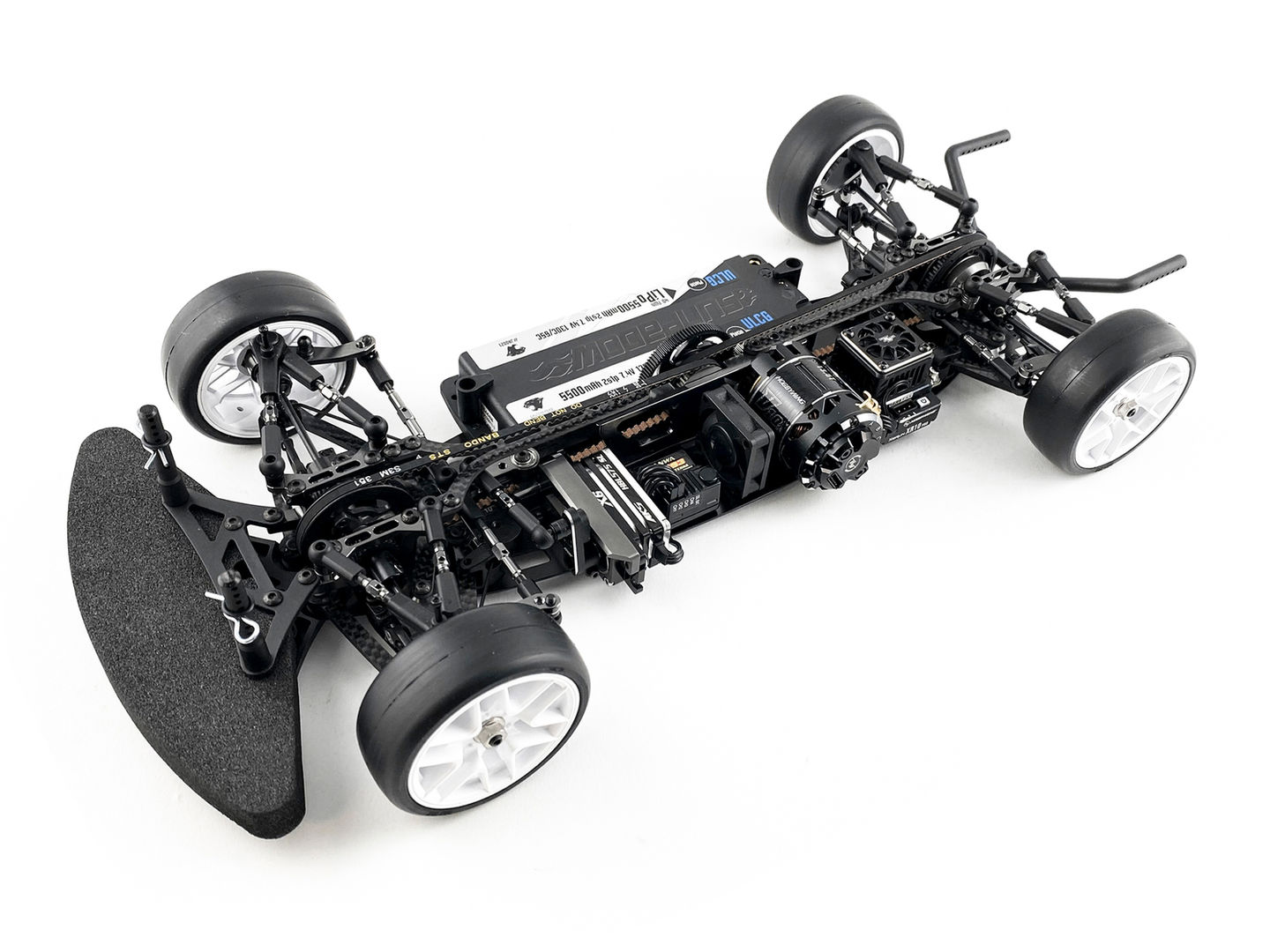
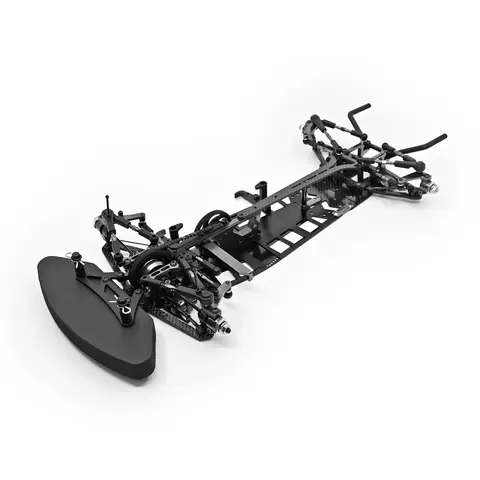
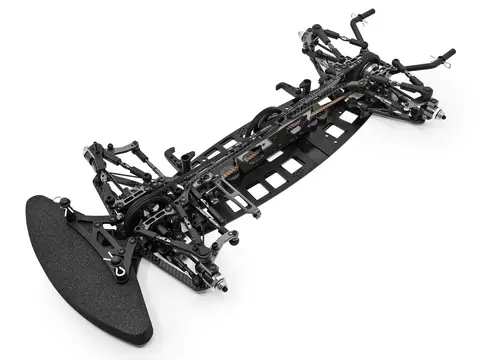
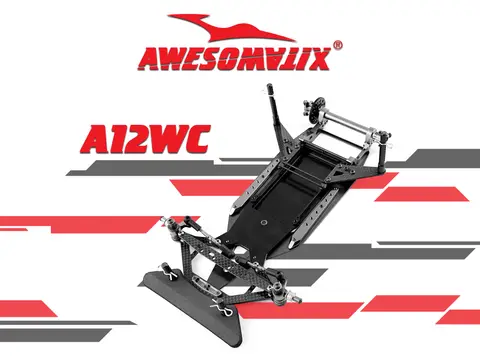
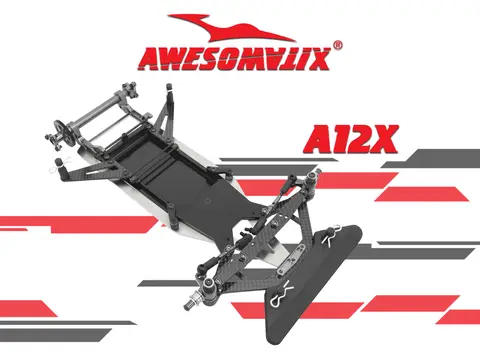
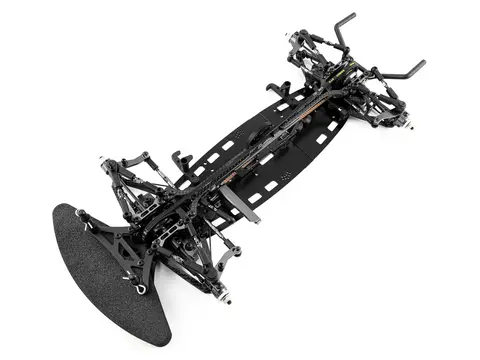
The later A800RR retains the shortened chassis and suspension geometry while changing to D4 dampers. A800RR development (opens in a new tab) The A800R’s D3 damper layout keeps damping adjustment separate from spring adjustment, so a damping change does not also change the spring rate. Its belt drivetrain retains a front spool and rear gear differential. The shorter chassis needed different suspension arms to retain the wheelbase, making that geometry more informative than the body appearance when identifying this generation. Both spur and pinion are excluded, so class-appropriate gearing is part of completing the kit. Awesomatix source (opens in a new tab)
Pros
Damping and spring-rate adjustments are independent.1
The kind of vehicle the maker sells it as. It sets what the car is built to do and which cars it is fair to compare it with.
Touring cars are 4WD on-road cars for asphalt and carpet tracks, often raced in classes with fixed motor and battery rules.
Power
Sold without a motor, so you choose the motor, ESC and battery yourself.
Rows that depend on the motor say so.
Build
A kit you build yourself from parts.
Most kits come without motor, ESC, servo, radio and battery, and many without tires or a painted body.
The manual lists what to add.
Scale
The maker's nominal size compared with a full-size vehicle. It works more as a class label than a measurement.
A 1/10 monster truck is far bigger than a 1/10 touring car, so compare length and weight for real size.
Part number
The maker's product number for this exact version.
A V2, a new color, or a kit instead of an RTR usually has a different number, and parts can differ between them.
Check it against your box or receipt before ordering parts.
Class
Touring
Power
Motor not included
Build
Kit
Scale
1/10
Part number
A800R
Drivetrain
Pinion
The small gear on the motor shaft. Fewer teeth gear the car shorter: quicker acceleration, lower top speed and a cooler motor. More teeth do the opposite.
On a chassis sold as kits, each kit brings its own.
Spur
The large gear the pinion drives. A bigger spur with the same pinion gears the car shorter.
Pinion and spur need matching pitch, or explicit manufacturer confirmation that the exact gears are compatible.
Transmission & axle
Every reduction after the spur, multiplied together: transmission, differentials and axle gears.
It is fixed by the design; the gearing you change is the pinion and spur.
Final drive
How many times the motor turns for one turn of the wheels. A higher number is shorter gearing: more acceleration and pulling power, less top speed.
On-road racers often compare gearing by rollout instead, because tire sizes differ between cars.
Differentials
The type of each differential, as the maker states it.
A gear or ball diff lets the wheels on one axle turn at different speeds in a corner; a spool or locked diff turns them together for straight-line drive and climbing, at the cost of steering.
Diff oil, rear
Silicone oil sealed inside the differential. A diff lets the wheels on one axle turn at different speeds in a corner; thicker oil makes it act more like a solid axle.
At the rear, thicker oil puts power down more evenly on loose or slippery ground; thinner oil lets the car rotate more easily through a corner.
It is graded in cSt (centistokes), a measure of thickness that means the same across brands. K means thousands, so 5K cSt is 5,000 cSt.
The stock springs, in the maker's own wording: a color, a rate or a length.
A stiffer spring holds the car up and resists bottoming out; a softer one lets it squat and follow rough ground.
Rates are not comparable across makers unless they state the same unit.
Shock oil, front
The oil in the shocks slows how fast the suspension moves. Thicker oil settles the car more slowly and resists bottoming out; thinner oil lets the wheels follow bumps.
At the front it mostly shapes the steering: thicker oil makes the car turn in more calmly and dive less under braking; thinner oil turns in sharper and keeps the front tires on the ground over bumps.
On smooth tracks racers change oil in small steps to fine-tune how the car rolls into a corner.
It is graded in cSt (centistokes), a measure of thickness that is the same across brands.
Shock oil, rear
The rear shocks mostly shape grip under power and how the car lands.
Thicker oil at the rear holds the back up on landings and keeps it steadier on the throttle; thinner oil lets it squat and follow rough or loose ground for more grip.
This car runs thicker oil at the rear (500 cSt) than the front (400 cSt). The rear stays steadier on landings and under power, while the front follows bumps and turns in more readily.
Motor KV is the RPM a motor turns per volt with no load.
This vehicle comes without a motor, so there is no stock KV; it depends on the one you fit.
Motor shaft
The diameter of the motor's output shaft, which a pinion's bore must match.
This vehicle comes without a motor, so it depends on the one you fit.
Battery
The highest LiPo cell count the maker rates the electronics for.
This vehicle comes without electronics, so it depends on the ESC and motor you fit.
Motor
Not applicable
Motor shaft
Not applicable
Battery
Not applicable
Performance
Theoretical top speed
It needs a motor KV, and this vehicle comes without a motor. Fit one and the calculator works it out from the motor's KV and the gearing.
Theoretical top speed
Not applicable
About these specs
4WD touring kit, the predecessor of the A800RR and still listed by Awesomatix.
Read moreShow less
The manual's final drive ratio chart states the drive train ratio is 1.9.
Awesomatix states that the pinion and spur gear, motor and tyres are not included in the kit, so there is no stock spur, pinion or total ratio, and the tyre size is left blank.
How to read these figures
Stock is as the vehicle ships.
Single report uses one outside source. It is useful as a starting figure, with the source and calculation described in the note.
Not applicable means the vehicle does not come with it, like the motor on a roller or the tires on a race kit.
The A800R's D3 rotary dampers give you separate spring-rate, preload and damping adjustments, so a handling change doesn't automatically call for different springs or oil. Get the dampers assembled and bled as the manual describes, then establish a baseline with the carbon kit's SPR01 springs and C127 top decks. Check that the lower arms and ball joints move freely before tuning around a car that binds. A good assembly and a repeatable setup are the starting point for making useful comparisons.[1] Awesomatix A800R / A800RA instruction manual (opens in a new tab)[2] A800R setup and maintenance discussion (opens in a new tab)
Body supports, bumper plates, roll-centre shims, steering arms and chassis weights. The collection also mixes RR/FX parts, so select listings explicitly compatible with A800R.
Awesomatix team driver Lucas Urbain explains the D3 damper build, from preparation and filling to sealing and spring installation. This factory assembly guide is useful alongside the manual when building or servicing the original A800R dampers.
Lucas Urbain's factory guide covers the motor mount, bulkheads and top-deck tightening, then a check for tweak. It complements the damper guide by focusing on the chassis assembly.