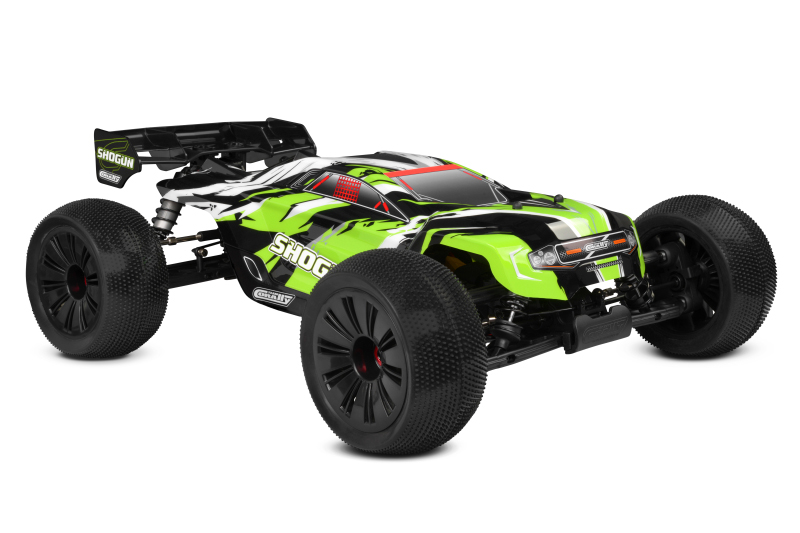
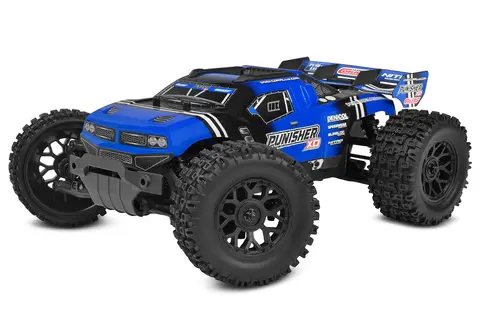
The original Shogun XP 6S packages Team Corally's large electric running gear as a truggy, with a low truck body, rear wing and wide suspension. Its factory showroom gives a 384 mm wheelbase, distinguishing it from the shorter Python buggy. It arrives with the Kuron 2050Kv motor, Torox 185 controller, CR-7220-MG steering servo and Varioprop radio installed. A 4S or 6S driving pack and charger are separate completion choices. Design and factory equipment (opens in a new tab)
Read moreShow less
Three fluid-filled gear differentials distribute drive through the aluminum-chassis platform. Pivot-ball front suspension, front CVD shafts, anti-roll bars and threaded aluminum shocks provide the mechanical baseline. A sliding motor mount allows gear-mesh adjustment, while the center differential can be serviced separately. These are useful features to retain while learning the car's suspension and traction adjustments, before replacing sound assemblies with a collection of tuning parts. Design and factory equipment (opens in a new tab)
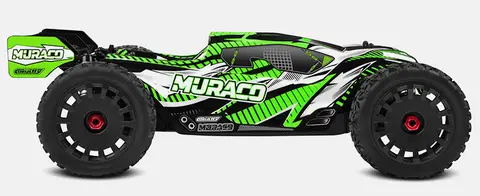
Its wheel and body proportions suit a different job from a compact stunt truck. Compare clearance at full steering and suspension travel when changing either, and consider the extra load of heavier tires alongside gearing. A later Muraco or Shogun variant can provide ideas without settling the original car's mounting details. Repair the immediate damage, check the adjacent fasteners and record the installed setup before combining a body conversion, servo replacement and chassis-brace change. That leaves a usable reference for judging each project. Design and factory equipment (opens in a new tab)
The kind of vehicle the maker sells it as. It sets what the car is built to do and which cars it is fair to compare it with.
A truggy is a 1/8 buggy with wider arms and truck tires: more stable and more forgiving on rough ground.
Drive
All four wheels are driven. That gives more grip under power, especially on loose ground.
The cost is more parts to maintain.
Power
A brushless motor has no brushes to wear, so it makes more power and runs more efficiently than a brushed one.
It needs a brushless ESC.
Build
Ready to run: built at the factory with the electronics installed.
Some come without a battery or charger; the maker's box contents say which.
Scale
The maker's nominal size compared with a full-size vehicle. It works more as a class label than a measurement.
A 1/10 monster truck is far bigger than a 1/10 touring car, so compare length and weight for real size.
This one is 584 mm long.
Part number
The maker's product number for this exact version.
A V2, a new color, or a kit instead of an RTR usually has a different number, and parts can differ between them.
Check it against your box or receipt before ordering parts.
Class
Truggy
Drive
4WD
Power
Brushless
Build
Ready to run
Scale
1/8
Part number
C-00175
Drivetrain
Pinion
The small gear on the motor shaft. Fewer teeth gear the car shorter: quicker acceleration, lower top speed and a cooler motor. More teeth do the opposite.
On this car one tooth changes the gearing by about 7.7%.
A bigger pinion loads the motor and ESC harder, so check the maker's gearing chart and feel the motor temperature after a run.
Spur
The large gear the pinion drives. A bigger spur with the same pinion gears the car shorter.
Pinion and spur need matching pitch, or explicit manufacturer confirmation that the exact gears are compatible.
The Gearing parts table below shows this car's pitch and part numbers.
Transmission & axle
Every reduction after the spur, multiplied together: transmission, differentials and axle gears.
It is fixed by the design; the gearing you change is the pinion and spur.
Spur ÷ pinion
Spur teeth divided by pinion teeth: the part of the gearing that a pinion or spur swap changes.
Here it is 3.538:1.
Final drive
How many times the motor turns for one turn of the wheels. A higher number is shorter gearing: more acceleration and pulling power, less top speed.
Among 1/8 truggies in the catalog, the middle half run between 13.5:1 and 15.9:1 on stock gearing; this one is 10.9:1, taller than most.
Differentials
The type of each differential, as the maker states it.
A gear or ball diff lets the wheels on one axle turn at different speeds in a corner; a spool or locked diff turns them together for straight-line drive and climbing, at the cost of steering.
Pinion bore
The nominal size of the hole that mates with the motor shaft.
Match the pinion mounting method as well as its size. A press-fit hole cannot be inferred from motor shaft diameter.
Pinion pitch
The tooth spacing of the fitted gear, stated as metric module or diametral pitch.
Pinion and spur need matching pitch or explicit manufacturer confirmation of compatibility for the exact parts. Mod 0.8 and 32P are different standards; a compatibility statement for particular gears does not apply to every gear. A missing pitch can be inferred from the other fitted gear; module and diametral pitch are not silently converted.
Spur pitch
The tooth spacing of the fitted gear, stated as metric module or diametral pitch.
Pinion and spur need matching pitch or explicit manufacturer confirmation of compatibility for the exact parts. Mod 0.8 and 32P are different standards; a compatibility statement for particular gears does not apply to every gear. A missing pitch can be inferred from the other fitted gear; module and diametral pitch are not silently converted.
The outside diameter of the mounted tire, tread to tread. A taller tire covers more ground each turn, which gears the car taller.
At high speed tires can balloon and grow, so the real gearing gets taller as the car goes faster.
Rollout
How far the car moves for one turn of the motor: tire circumference divided by final drive.
It lets you compare gearing across different tire sizes; more rollout is taller gearing.
Here it is 41.8 mm.
Wheel hex
The hex on the axle that the wheel locks onto and is driven by. A wheel must match the hex size to fit.
17 mm is the standard size on 1/8 cars.
The wheel nut is a separate size, so check its thread too before buying nuts.
Stock tire width
Stock tire width: A documented stock wheel, tire, or axle measurement. Stock dimensions alone do not establish the largest size that will clear the body and suspension.
What the shocks are and how they are built, as the maker describes them.
Oil-filled shocks damp with silicone oil; friction shocks, found on some entry-level cars, damp with a sprung plunger and cannot be tuned with oil.
Threaded bodies set ride height with a collar you turn, rather than clips.
The shaft size matters when buying seals, ends and rebuild kits.
Shock bore
The inside diameter of the shock body, where the piston moves through oil.
It is a shock measurement, separate from the motor pinion bore. Match the actual shock part when ordering pistons, seals or a replacement body.
Shock length, rear
The stated length of the complete shock assembly. Sources may use mounting-eye centers or a nominal assembly length.
Compare fully extended mounting-eye spacing, compressed length and mounting hardware before ordering. A longer shock changes ride height and travel, and can bind at full droop or bottom out.
This length is from one outside source. Check the linked listing and measure the fitted shocks before buying.
Oil-filledthreaded, aluminum body, 3.5 mm shaft, front and rear; Manufacturer-listed 3.5 mm nominal shaft thickness, interpreted as the diameter of the cylindrical shock shaft.Stock
Catalog stock FDR: 10.89:1. The grid uses the listed tooth counts and internal ratio, so rounding or source differences may change the result slightly.
Calculated final drive ratio for each pinion and spur pair
Pinion
44T spur
46T spur
48T spur
11T
12T
13T
14T
15T
16T
Select a pair to compare wheel travel per motor turn with stock. Other cells are mathematical examples, not verified gears or fits. Check pitch, mesh, clearance and motor temperature before changing parts.
About these specs
Corally’s original Shogun guide lists a 13T pinion, 46T spur and 3.08 internal ratio, for a 10.89:1 final drive.
Read moreShow less
Corally lists a 145 mm mounted tire diameter.
One listing for the original tires gives 142 mm, so measure a mounted tire if the small difference matters.
How to read these figures
Stock is as the vehicle ships.
Calculated is worked from the recorded figures on this page.
Derived uses recorded dimensions or arithmetic. The row explains the inference. A nominal mating size is not a measured tolerance or a complete fitment guarantee.
Single report uses one outside source. It is useful as a starting figure, with the source and calculation described in the note.
The top speed is kinematic: an ideal no-load RPM with no slip and no loss under load, so a real car is slower.
Shogun XP 6S user guide (Team Corally PDF) (opens in a new tab)world.corally.comPDFSupports 5 specificationsStartup p. 7; shocks and differential service pp. 10-12; gearing chart Gearing p. 14Used forMain specsGearingMotor shaftWheels & tiresSuspension
Parts and electronics
16
Product (opens in a new tab)redwingrc.comPart pageSupports 4 specificationsUsed forMain specsBattery fitWheel hexElectronics
Keep the original Shogun’s 145mm wheels and 17mm hexes as the reference before changing tire size. Assess traction, ground clearance and suspension behavior on the surface you use. A larger or heavier wheel adds load and can change steering and body clearance, so check the complete travel and temperature after short runs.[1] Original Xjeepguy owner report (opens in a new tab)[2] Factory model information (opens in a new tab)
The owner project lists XTR-derived chassis parts, a Reefs RAW 500 servo, Backflip 6S wheels and a Silverado shell. Its later tire update covers only about 50 feet of driving. That establishes an assembled project, not a useful durability comparison or a verified C-00175 conversion recipe. Exact component codes and the donor revision are missing.[1] Original Xjeepguy owner report (opens in a new tab)[2] Factory model information (opens in a new tab)
Read moreRead less about upgrades and setup for Shogun XP 6S
Separate the three projects before pricing a similar build. A shell swap needs mounting and clearance checks; a servo needs electrical rating, response, mount and horn checks; towers and braces alter the structure and service access. A combined list cannot show which purchase improves the stock car or whether all donor parts fit this original edition.[1] Original Xjeepguy owner report (opens in a new tab)[2] Factory model information (opens in a new tab)
Use the factory suspension adjustment and differential access before replacing assemblies. Repair worn parts and establish smooth travel first, then make a focused change for repeated bottoming, poor grip or steering load. Keep later Shogun LE and 2021 / 2022 hardware separate. The limited owner tire test is background, so no better-handling promise is made for that wheel conversion.[1] Original Xjeepguy owner report (opens in a new tab)[2] Factory model information (opens in a new tab)
Conversions & shared parts
Steering rack doubler
This adds a second stiffener to support the steering rack. It is an option when you want to reduce flex in that part of the steering, with free movement checked after fitting the matching fasteners.
Manufacturer-documented option for the specified vehicle configuration.
The title identifies an original Shogun XP 6S unboxing, and the description lists Torox 185, Kuron 2050KV and the original radio equipment. It provides packaging and factory-equipment context for the old Shogun rather than the new LE.
The title frames the original Shogun against a Talion 6S, while the description lists the earlier Shogun equipment. This offers truggy comparison context; it does not confirm cross-model parts fit or a comparative durability result.