VehiclesTamiya SW-01

Tamiya SW-01 Chassis
1/24 scale · 4WD chassis · sold as kits
- Scale
- 1/24
- Drive
- 4WD
- Max LiPo
- -
- Power
- -
Background
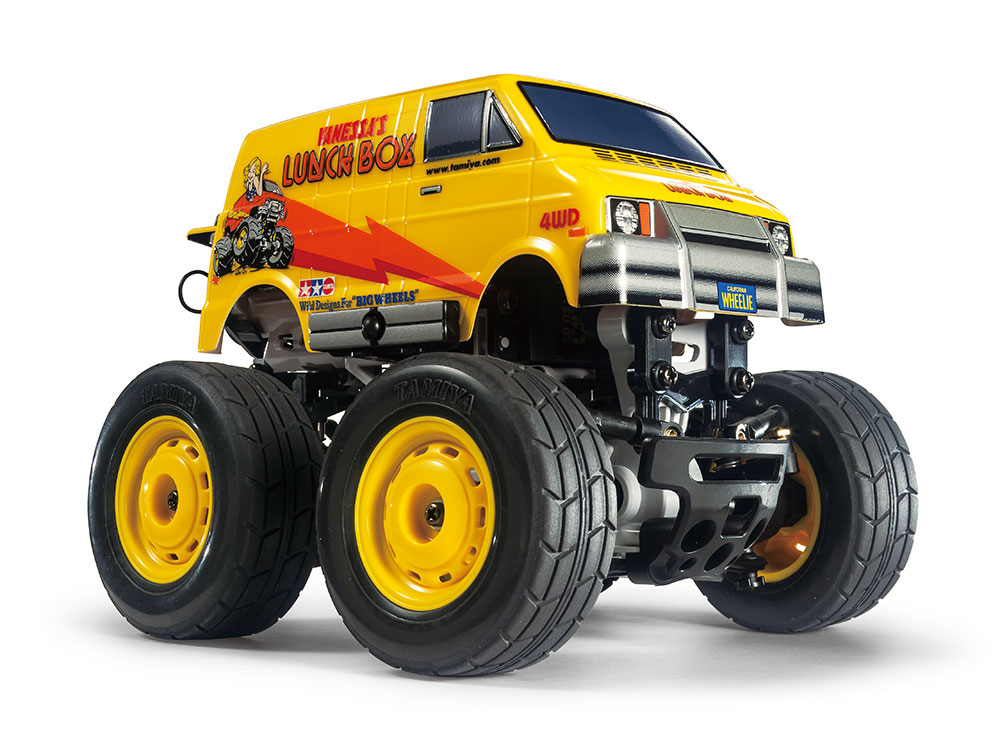
The SW-01 shrinks Tamiya's wheelie-machine idea into a compact four-wheel-drive model with its own engineering. The Mudmad body was designed by Takayuki Yamazaki, using a caricatured cross-country shape finished in light blue. Its 190 mm length and large tires give it a different presence from the full-size Lunch Box chassis. Prepainted, cut bodywork and magnetic catches make the exterior approachable while leaving the owner to assemble the small drivetrain and controls. Mudmad design and body (opens in a new tab)
Read moreShow less
A central type 370 motor powers front and rear planetary differentials through gears. The power source sits high in the monocoque to encourage wheelies, and the strut suspension links steering movement with chassis lean. The Mudmad's block tires and track differ from the Lunch Box Mini's configuration. Lunch Box Mini specification (opens in a new tab) An optional upper-arm connector can transmit that movement to the rear, producing a further steering effect without adding a second steering servo. SW-01 layout and operating features (opens in a new tab)
The compact mechanisms reward free movement and tidy wiring before a faster motor is selected. Fit the intended bearings while the cases are accessible, check the small universal-joint fasteners and keep leads clear of the steering. Choose the power source and controller together around the actual compartment and manufacturer requirements. The supplied motor, spring struts and wheelie bar already establish the model's character. More speed or another steering arrangement should be chosen for the running space and desired behaviour, with the exact small-chassis parts retained in the plan. Factory configuration (opens in a new tab)
Pros
- Upper arms linked to the steering suppress roll in turns and, with differentials front and rear, give a tight turning circle.1
- The power source sits high on the chassis, so it wheelies under hard acceleration, with a wheelie bar to catch it.1
- Takes a standard-size steering servo and ESC, so no special electronics are needed.3
Specifications
Chassis figures are shared references. Motors, electronics, pinions and tires depend on the exact numbered kit.
Kits on this chassis (2)
| Kit | Part no. | Maker page |
|---|---|---|
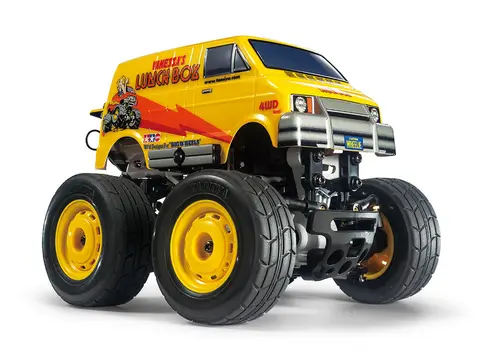 Comical Wheelie Lunch Box Mini (Assembly Kit) | 57409 | tamiya.comPage (opens in a new tab) |
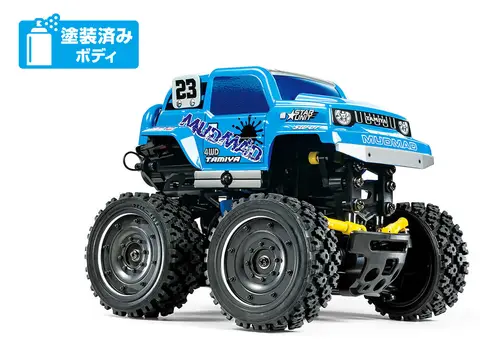 Comical Wheelie Mudmad (Assembly Kit) | 57412 | tamiya.comPage (opens in a new tab) |
Jump to section
| Spec | Value | Basis |
|---|---|---|
| Vehicle | ||
| ||
| Drive | 4WD | |
| Build | Kit | |
| Scale | 1/24 | |
| Drivetrain | ||
| ||
| Pinion | With each kit | |
| Spur | Not published | |
| Transmission & axle | Not published | |
| Final drive | 21.88:1 on 16TMaker's chart | Maker's chart |
| Wheels & tires | ||
| ||
| Tire diameter | With each kit | |
| Power | ||
| ||
| Motor | With each kit | |
| Battery | With each kit | |
| Size & weight | ||
| ||
| Wheelbase | Stock | |
About these specs
The SW-01 is Tamiya's gear-driven 4WD Star Unit chassis with a 370 motor and planetary differentials.
Read moreShow less
- Tamiya publishes neither the spur tooth count nor the ratio of the gear train after it: the Lunch Box Mini manual (57409.pdf) shows the 16T pinion (step 3, p. 5), and its options box (p. 22) says 16T and 18T pinions fit (SP.354 16T/17T, SP.355 18T/19T) without printing their ratios.
- Both kit pages print 'ギヤレシオ=21.88:1', which is the kit's 16T pinion, and a 92mm wheelbase.
- Kits: the Lunch Box Mini assembly kit is a standard product and the Mudmad assembly kit a spot re-run first sold in 2020 (std.csv); the built-up versions (57410, 57413) are left off.
- The pinion, motor and tires come with each kit, so they are not part of the chassis figures: enter yours in the gearing tool.
How to read these figures
- Stock is as the vehicle ships.
- Not published means it exists but no source we could find prints it.
- With each kit means each kit on this chassis brings its own, so enter yours in the gearing tool.
- Maker’s chart is the ratios the maker prints for this chassis with the pinions it names.
Sources
8 source links for this model.
All sourcesShow less
Maker documents
1- Comical Wheelie Lunch Box Mini (SW-01) instruction manual (Tamiya PDF) (opens in a new tab)Supports 2 specifications16T pinion step 3 p. 5; pinion options p. 22Used forMain specsService
Parts and electronics
6- Product info EX (opens in a new tab)Supports 1 specificationUsed forMain specs
- 1/24 コミカルウイリー ランチボックスミニ (組立キット)(SW-01シャーシ) (opens in a new tab)Supports 2 specifications · Background 2Tamiya, Aug 2019Used forMain specsSizeBackgroundBackground 2
- 1/24 コミカルウイリー マッドマッド (組立キット) (SW-01シャーシ) (opens in a new tab)Supports 2 specifications · Background 4Tamiya, Aug 2020Used forMain specsSizeBackground 4
- 1/24 SCALE R/C VEHICLE STAR UNIT COMICAL WHEELIE MUDMAD (ASSEMBLY KIT) (SW-01 CHASSIS) (opens in a new tab)Supports 2 specifications · Background 1TamiyaUsed forMain specsSizeBackgroundBackground 1
- Std.csv (opens in a new tab)Supports 1 specificationUsed forMain specs
- 57412 (PDF) (opens in a new tab)Supports 1 specificationUsed forService
Reviews and articles
1- TamiyaBlog: A classic renewed - The Tamiya Lunch Box Mini SW-01 (opens in a new tab)Background reference 3Oct 2019Used forBackground 3
Service reference
Checked task pages, documented requirements and recorded fluid references for this model. Follow the manufacturer's procedure for the exact assembly and revision.
Kit equipment can differ. Match the manual's box number to your kit before servicing it.
ShocksReference
Factory coil-spring struts
SW01 family mechanicalreference scopedonly to exact57409 LunchBoxMini edition11056776. Exact57412 edition reviewed separately;kit electronics notinherited.
Front6/rear8,C14 uprights,C11 upperarms,C1 inserts,BA11 springs,BA3 3x21mm screws,BA6 large3mm/BA7 2.6mm washers. FollowBA7 position diagram. No oil-filled damper/seal basket;optional54899 springs excluded.
- Exact numbered manufacturer assembly, PDF pp. 6-8 (opens in a new tab)Assembly drawing, not a rebuild procedure. Document: 57409 exact SW01 11056776.
Documented parts and requirements
No separate parts, tools or prerequisites have been indexed for this task. Read the cited reference before starting.
This is a partial service reference. Check the cited instructions for the full procedure and configuration-specific requirements. Mechanical tasks may need additional parts, quantities and reused hardware beyond the items listed here. Manual reviewed 2026-10-09.
DifferentialsReference
Factory front/rear planetary differentials
SW01 family mechanicalreference scopedonly to exact57409 LunchBoxMini edition11056776. Exact57412 edition reviewed separately;kit electronics notinherited.
Front7/rear8:40T cases,12T joints,8T pinions,BA14 2x13mm shafts,G1 bearings. Invert complete assembly andretain gears duringinstallation,A4/A5 covers7/9. No oil viscosity ormandatory replacement basket specified.
- Exact numbered manufacturer assembly, PDF pp. 7-9 (opens in a new tab)Assembly drawing, not a rebuild procedure. Document: 57409 exact SW01 11056776.
Documented parts and requirements
No separate parts, tools or prerequisites have been indexed for this task. Read the cited reference before starting.
This is a partial service reference. Check the cited instructions for the full procedure and configuration-specific requirements. Mechanical tasks may need additional parts, quantities and reused hardware beyond the items listed here. Manual reviewed 2026-10-09.
DrivetrainReference
Factory gear train and universal shafts
SW01 family mechanicalreference scopedonly to exact57409 LunchBoxMini edition11056776. Exact57412 edition reviewed separately;kit electronics notinherited.
A8/A9 case,30-14T gears/BA13 shafts,49-12T gears/BA12 shafts/G3 bearings4. UniversalC16/BA10/BA5/C8/C15 assembly5,2mm hex andflat alignment;C14/G2 uprights6/8. Fitdogbones into differential recesses9-10. Optional54900 fullbearings excluded.
- Exact numbered manufacturer assembly, PDF pp. 4-10 (opens in a new tab)Assembly drawing, not a rebuild procedure. Document: 57409 exact SW01 11056776.
Documented parts and requirements
No separate parts, tools or prerequisites have been indexed for this task. Read the cited reference before starting.
This is a partial service reference. Check the cited instructions for the full procedure and configuration-specific requirements. Mechanical tasks may need additional parts, quantities and reused hardware beyond the items listed here. Manual reviewed 2026-10-09.
Comical Wheelie Lunch Box Mini (Assembly Kit)Kit 57409
References apply to kit 57409. Match your box number and the cited configuration.
ShocksReference
Factory coil-spring struts
Exact electric SW01 kit57409,factory370/16T,planetary front/rear differentials andcoil-spring struts. Optionalparts excluded.
Front6/rear8,C14 uprights,C11 upperarms,C1 inserts,BA11 springs,BA3 3x21mm screws,BA6 large3mm/BA7 2.6mm washers. FollowBA7 position diagram. No oil-filled damper/seal basket;optional54899 springs excluded.
- Exact numbered manufacturer assembly, PDF pp. 6-8 (opens in a new tab)Assembly drawing, not a rebuild procedure. Document: 57409 exact SW01 11056776.
Documented parts and requirements
No separate parts, tools or prerequisites have been indexed for this task. Read the cited reference before starting.
This is a partial service reference. Check the cited instructions for the full procedure and configuration-specific requirements. Mechanical tasks may need additional parts, quantities and reused hardware beyond the items listed here. Manual reviewed 2026-10-09.
DifferentialsReference
Factory front/rear planetary differentials
Exact electric SW01 kit57409,factory370/16T,planetary front/rear differentials andcoil-spring struts. Optionalparts excluded.
Front7/rear8:40T cases,12T joints,8T pinions,BA14 2x13mm shafts,G1 bearings. Invert complete assembly andretain gears duringinstallation,A4/A5 covers7/9. No oil viscosity ormandatory replacement basket specified.
- Exact numbered manufacturer assembly, PDF pp. 7-9 (opens in a new tab)Assembly drawing, not a rebuild procedure. Document: 57409 exact SW01 11056776.
Documented parts and requirements
No separate parts, tools or prerequisites have been indexed for this task. Read the cited reference before starting.
This is a partial service reference. Check the cited instructions for the full procedure and configuration-specific requirements. Mechanical tasks may need additional parts, quantities and reused hardware beyond the items listed here. Manual reviewed 2026-10-09.
DrivetrainReference
Factory gear train and universal shafts
Exact electric SW01 kit57409,factory370/16T,planetary front/rear differentials andcoil-spring struts. Optionalparts excluded.
A8/A9 case,30-14T gears/BA13 shafts,49-12T gears/BA12 shafts/G3 bearings4. UniversalC16/BA10/BA5/C8/C15 assembly5,2mm hex andflat alignment;C14/G2 uprights6/8. Fitdogbones into differential recesses9-10. Optional54900 fullbearings excluded.
- Exact numbered manufacturer assembly, PDF pp. 4-10 (opens in a new tab)Assembly drawing, not a rebuild procedure. Document: 57409 exact SW01 11056776.
Documented parts and requirements
No separate parts, tools or prerequisites have been indexed for this task. Read the cited reference before starting.
This is a partial service reference. Check the cited instructions for the full procedure and configuration-specific requirements. Mechanical tasks may need additional parts, quantities and reused hardware beyond the items listed here. Manual reviewed 2026-10-09.
MotorReference
Factory370/16T mounting
Exact electric SW01 kit57409,factory370/16T,planetary front/rear differentials andcoil-spring struts. Optionalparts excluded.
Factory370,16T push-fit pinion,A3 mount/BA1 3x6mm screws at16holes,BA16 3x10mm casefasteners. Match depicted pinionposition. Optional16/18T AVpinion/adaptor/grubconversion22 excluded;no copied380/540 pinionprocedure.
- Exact numbered manufacturer assembly, PDF pp. 5-5 (opens in a new tab)Assembly drawing, not a rebuild procedure. Document: 57409 exact SW01 11056776.
Documented parts and requirements
No separate parts, tools or prerequisites have been indexed for this task. Read the cited reference before starting.
This is a partial service reference. Check the cited instructions for the full procedure and configuration-specific requirements. Mechanical tasks may need additional parts, quantities and reused hardware beyond the items listed here. Manual reviewed 2026-10-09.
Steering servoReference
Selected standard-servo interface
Exact electric SW01 kit57409,factory370/16T,planetary front/rear differentials andcoil-spring struts. Optionalparts excluded.
Span48-50mm,above12-16/below15-29mm on2;smallservo cannotfit. NeutralP5/P6 andactualhornscrew13,C7/B4 mounts14. B1 spacer conditional12-14mm servoheight11;link4/0mm exposure16. No includedservo orradio-binding assumption.
- Exact numbered manufacturer assembly, PDF pp. 13-16 (opens in a new tab)Assembly drawing, not a rebuild procedure. Document: 57409 exact SW01 11056776.
Documented parts and requirements
No separate parts, tools or prerequisites have been indexed for this task. Read the cited reference before starting.
This is a partial service reference. Check the cited instructions for the full procedure and configuration-specific requirements. Mechanical tasks may need additional parts, quantities and reused hardware beyond the items listed here. Manual reviewed 2026-10-09.
Comical Wheelie Mudmad (Assembly Kit)Kit 57412
References apply to kit 57412. Match your box number and the cited configuration.
ShocksReference
Factory coil-spring struts
Exact electric SW01 kit57412,factory370/16T,planetary front/rear differentials andcoil-spring struts. Optionalparts excluded.
Front6/rear8,C14 uprights,C11 upperarms,C1 inserts,BA11 springs,BA3 3x21mm screws,BA6 large3mm/BA7 2.6mm washers. FollowBA7 position diagram. No oil-filled damper/seal basket;optional54899 springs excluded.
- Exact numbered manufacturer assembly, PDF pp. 6-8 (opens in a new tab)Assembly drawing, not a rebuild procedure. Document: 57412 exact SW01 11056891.
Documented parts and requirements
No separate parts, tools or prerequisites have been indexed for this task. Read the cited reference before starting.
This is a partial service reference. Check the cited instructions for the full procedure and configuration-specific requirements. Mechanical tasks may need additional parts, quantities and reused hardware beyond the items listed here. Manual reviewed 2026-10-09.
DifferentialsReference
Factory front/rear planetary differentials
Exact electric SW01 kit57412,factory370/16T,planetary front/rear differentials andcoil-spring struts. Optionalparts excluded.
Front7/rear8:40T cases,12T joints,8T pinions,BA14 2x13mm shafts,G1 bearings. Invert complete assembly andretain gears duringinstallation,A4/A5 covers7/9. No oil viscosity ormandatory replacement basket specified.
- Exact numbered manufacturer assembly, PDF pp. 7-9 (opens in a new tab)Assembly drawing, not a rebuild procedure. Document: 57412 exact SW01 11056891.
Documented parts and requirements
No separate parts, tools or prerequisites have been indexed for this task. Read the cited reference before starting.
This is a partial service reference. Check the cited instructions for the full procedure and configuration-specific requirements. Mechanical tasks may need additional parts, quantities and reused hardware beyond the items listed here. Manual reviewed 2026-10-09.
DrivetrainReference
Factory gear train and universal shafts
Exact electric SW01 kit57412,factory370/16T,planetary front/rear differentials andcoil-spring struts. Optionalparts excluded.
A8/A9 case,30-14T gears/BA13 shafts,49-12T gears/BA12 shafts/G3 bearings4. UniversalC16/BA10/BA5/C8/C15 assembly5,2mm hex andflat alignment;C14/G2 uprights6/8. Fitdogbones into differential recesses9-10. Optional54900 fullbearings excluded.
- Exact numbered manufacturer assembly, PDF pp. 4-10 (opens in a new tab)Assembly drawing, not a rebuild procedure. Document: 57412 exact SW01 11056891.
Documented parts and requirements
No separate parts, tools or prerequisites have been indexed for this task. Read the cited reference before starting.
This is a partial service reference. Check the cited instructions for the full procedure and configuration-specific requirements. Mechanical tasks may need additional parts, quantities and reused hardware beyond the items listed here. Manual reviewed 2026-10-09.
MotorReference
Factory370/16T mounting
Exact electric SW01 kit57412,factory370/16T,planetary front/rear differentials andcoil-spring struts. Optionalparts excluded.
Factory370,16T push-fit pinion,A3 mount/BA1 3x6mm screws at16holes,BA16 3x10mm casefasteners. Match depicted pinionposition. Optional16/18T AVpinion/adaptor/grubconversion22 excluded;no copied380/540 pinionprocedure.
- Exact numbered manufacturer assembly, PDF pp. 5-5 (opens in a new tab)Assembly drawing, not a rebuild procedure. Document: 57412 exact SW01 11056891.
Documented parts and requirements
No separate parts, tools or prerequisites have been indexed for this task. Read the cited reference before starting.
This is a partial service reference. Check the cited instructions for the full procedure and configuration-specific requirements. Mechanical tasks may need additional parts, quantities and reused hardware beyond the items listed here. Manual reviewed 2026-10-09.
Steering servoReference
Selected standard-servo interface
Exact electric SW01 kit57412,factory370/16T,planetary front/rear differentials andcoil-spring struts. Optionalparts excluded.
Span48-50mm,above12-16/below15-29mm on2;smallservo cannotfit. NeutralP5/P6 andactualhornscrew13,C7/B4 mounts14. B1 spacer conditional12-14mm servoheight11;link4/0mm exposure16. No includedservo orradio-binding assumption.
- Exact numbered manufacturer assembly, PDF pp. 13-16 (opens in a new tab)Assembly drawing, not a rebuild procedure. Document: 57412 exact SW01 11056891.
Documented parts and requirements
No separate parts, tools or prerequisites have been indexed for this task. Read the cited reference before starting.
This is a partial service reference. Check the cited instructions for the full procedure and configuration-specific requirements. Mechanical tasks may need additional parts, quantities and reused hardware beyond the items listed here. Manual reviewed 2026-10-09.
No fluid grades are recorded here. That does not establish whether this vehicle uses oil, grease or friction components.
Manuals & assembly references
Indexed tasks link to checked physical PDF pages. Other links open full documents. Tasks and rebuild requirements not shown here still need review.
Comical Wheelie Lunch Box Mini (Assembly Kit)57409
Upgrades and setup
Comical Wheelie Lunch Box Mini (Assembly Kit) 57409 uses a 370 motor, gear-driven four-wheel drive and a 92mm wheelbase. The planetary differentials and spring struts belong to this small SW-01 chassis, so full-size Lunch Box suspension advice does not carry over. The Lunch Box Mini has a yellow painted body, 70mm tires and a 122mm track. The current Japan kit has cut wheel arches and drilled body-catch holes; check the finishing still needed on the kit in hand.[1] Exact SW01 kit equipment and finishing (opens in a new tab)
Fit bearings while the gearbox is open. Tamiya 54900 replaces the bushings with twenty bearings: four 1280, eight 1060 and eight 630. Keep the assembled universal joints moving freely and check their small fasteners before running. The compact gearbox is harder to revisit once the electronics and body supports are installed.[2] SW01 full bearing set (opens in a new tab)[3] SW01 complete original assembly (opens in a new tab)[4] SW01 full build running and setup review (opens in a new tab)
Read moreRead less about upgrades and setup for Comical Wheelie Lunch Box Mini (Assembly Kit)
Keep the steering-linked struts free to move, with matching settings on both sides. If the truck feels too abrupt to steer, adjust toe and servo travel gradually before adding power. Tamiya 54898 links the front and rear upper arms to make the rear wheels steer through the suspension’s lean. It can add directional control during wheelies without a second steering servo.[4] SW01 full build running and setup review (opens in a new tab)[5] Installed arm connectors and complete followup (opens in a new tab)[6] SW01 upper arm steering connectors (opens in a new tab)
Check the battery compartment, connector access and controller’s supported supply before buying electronics. A standard full-size car pack will not fit this chassis. Route wires clear of the steering and leave the body free to tilt. The magnets make body removal quick; use the additional catch pins when firmer retention is needed. Keep wheelie-bar movement and the spring struts as the handling baseline.[3] SW01 complete original assembly (opens in a new tab)[4] SW01 full build running and setup review (opens in a new tab)[1] Exact SW01 kit equipment and finishing (opens in a new tab)
If changing to Tamiya 54919 Torque-Tuned 370, use the listed 54900 bearing set and 54928 metal cross joints. The supported pinions are 16T from 50354 or 18T from 50355; the companion 17T and 19T gears are not listed choices. Follow the motor’s specified LF1100-6.6V M-size pack or four Neo Champ NiMH cells and check controller compatibility. Taller gearing trades wheelie torque for speed, so decide which behavior matters before changing it.[7] 370 Torque Tuned required companion parts (opens in a new tab)[8] Metal cross joints required by Torque Tuned motor (opens in a new tab)[3] SW01 complete original assembly (opens in a new tab)
Option suppliers

Tamiya
SW-01 bearings, steering connectors, springs and 370 motor options. Check motor companion parts and battery requirements.
Browse parts at Tamiya (opens in a new tab)
FastEddy Bearings
Lunch Box Mini sealed bearing set. Compare its twenty bearings with the parts in the kit.
Browse parts at FastEddy Bearings (opens in a new tab)
Comical Wheelie Mudmad (Assembly Kit)57412
Upgrades and setup
Comical Wheelie Mudmad (Assembly Kit) 57412 uses a 370 motor, gear-driven four-wheel drive and a 92mm wheelbase. The planetary differentials and spring struts belong to this small SW-01 chassis, so full-size Lunch Box suspension advice does not carry over. The Mudmad has a light-blue painted body, 69mm block tires and a 130mm track. The current Japan kit has cut wheel arches and drilled body-catch holes; check the finishing still needed on the kit in hand.[1] Exact SW01 kit equipment and finishing (opens in a new tab)
Fit bearings while the gearbox is open. Tamiya 54900 replaces the bushings with twenty bearings: four 1280, eight 1060 and eight 630. Keep the assembled universal joints moving freely and check their small fasteners before running. The compact gearbox is harder to revisit once the electronics and body supports are installed.[2] SW01 full bearing set (opens in a new tab)[3] SW01 complete original assembly (opens in a new tab)[4] SW01 full build running and setup review (opens in a new tab)
Read moreRead less about upgrades and setup for Comical Wheelie Mudmad (Assembly Kit)
Keep the steering-linked struts free to move, with matching settings on both sides. If the truck feels too abrupt to steer, adjust toe and servo travel gradually before adding power. Tamiya 54898 links the front and rear upper arms to make the rear wheels steer through the suspension’s lean. It can add directional control during wheelies without a second steering servo.[4] SW01 full build running and setup review (opens in a new tab)[5] Installed arm connectors and complete followup (opens in a new tab)[6] SW01 upper arm steering connectors (opens in a new tab)
Check the battery compartment, connector access and controller’s supported supply before buying electronics. A standard full-size car pack will not fit this chassis. Route wires clear of the steering and leave the body free to tilt. The magnets make body removal quick; use the additional catch pins when firmer retention is needed. Keep wheelie-bar movement and the spring struts as the handling baseline.[3] SW01 complete original assembly (opens in a new tab)[4] SW01 full build running and setup review (opens in a new tab)[1] Exact SW01 kit equipment and finishing (opens in a new tab)
If changing to Tamiya 54919 Torque-Tuned 370, use the listed 54900 bearing set and 54928 metal cross joints. The supported pinions are 16T from 50354 or 18T from 50355; the companion 17T and 19T gears are not listed choices. Follow the motor’s specified LF1100-6.6V M-size pack or four Neo Champ NiMH cells and check controller compatibility. Taller gearing trades wheelie torque for speed, so decide which behavior matters before changing it.[7] 370 Torque Tuned required companion parts (opens in a new tab)[8] Metal cross joints required by Torque Tuned motor (opens in a new tab)[3] SW01 complete original assembly (opens in a new tab)
Option suppliers
Tamiya
SW-01 bearings, steering connectors, springs and 370 motor options. Check motor companion parts and battery requirements.
Browse parts at Tamiya (opens in a new tab)FastEddy Bearings
Mudmad ceramic bearing set. Compare sizes and bearing type with the OEM set.
Browse parts at FastEddy Bearings (opens in a new tab)
Comical Wheelie Lunch Box Mini (Assembly Kit)57409
Forums & communities

TamiyaClub
Tamiya build logs, setup discussions and hop-up advice, including questions about parts for specific numbered kits.
Browse the TamiyaClub forum (opens in a new tab)
Video reviews
RCDriver_Online: Instant Wheelies & 4WD Fun! Tamiya Lunchbox Mini SW-01 Review | RC Driver (opens in a new tab)
Explains the Lunch Box Mini chassis and options. The later publisher note clarifies the steering connectors’ behavior at low speed on smooth surfaces.

TheRcRacer: Tamiya SW-01 Mini Lunchbox Review (opens in a new tab)
Shows the Lunch Box Mini driving and performing stunts alongside the full build and setup article.
Comical Wheelie Mudmad (Assembly Kit)57412
Forums & communities
TamiyaClub
Tamiya build logs, setup discussions and hop-up advice, including questions about parts for specific numbered kits.
Browse the TamiyaClub forum (opens in a new tab)
Video reviews
RCDriver_Online: Instant Wheelies & 4WD Fun! Tamiya Lunchbox Mini SW-01 Review | RC Driver (opens in a new tab)
Explains the Lunch Box Mini chassis and options. The later publisher note clarifies the steering connectors’ behavior at low speed on smooth surfaces.
TheRcRacer: Tamiya SW-01 Mini Lunchbox Review (opens in a new tab)
Shows the Lunch Box Mini driving and performing stunts alongside the full build and setup article.
OEM parts
Loading parts…
Related vehicles
No reviewed platform or substantial structural connection is recorded for this exact model yet.
More from Tamiya
Browse 7 more Tamiya models.