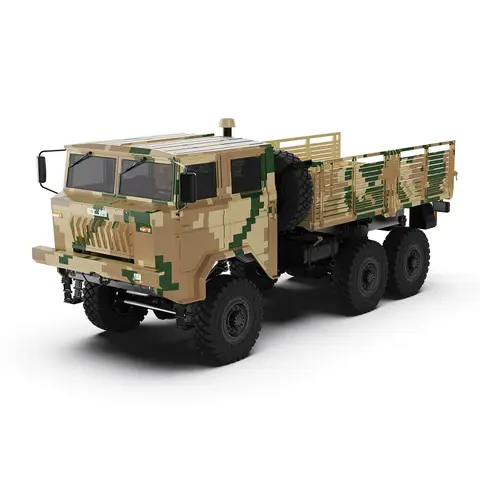
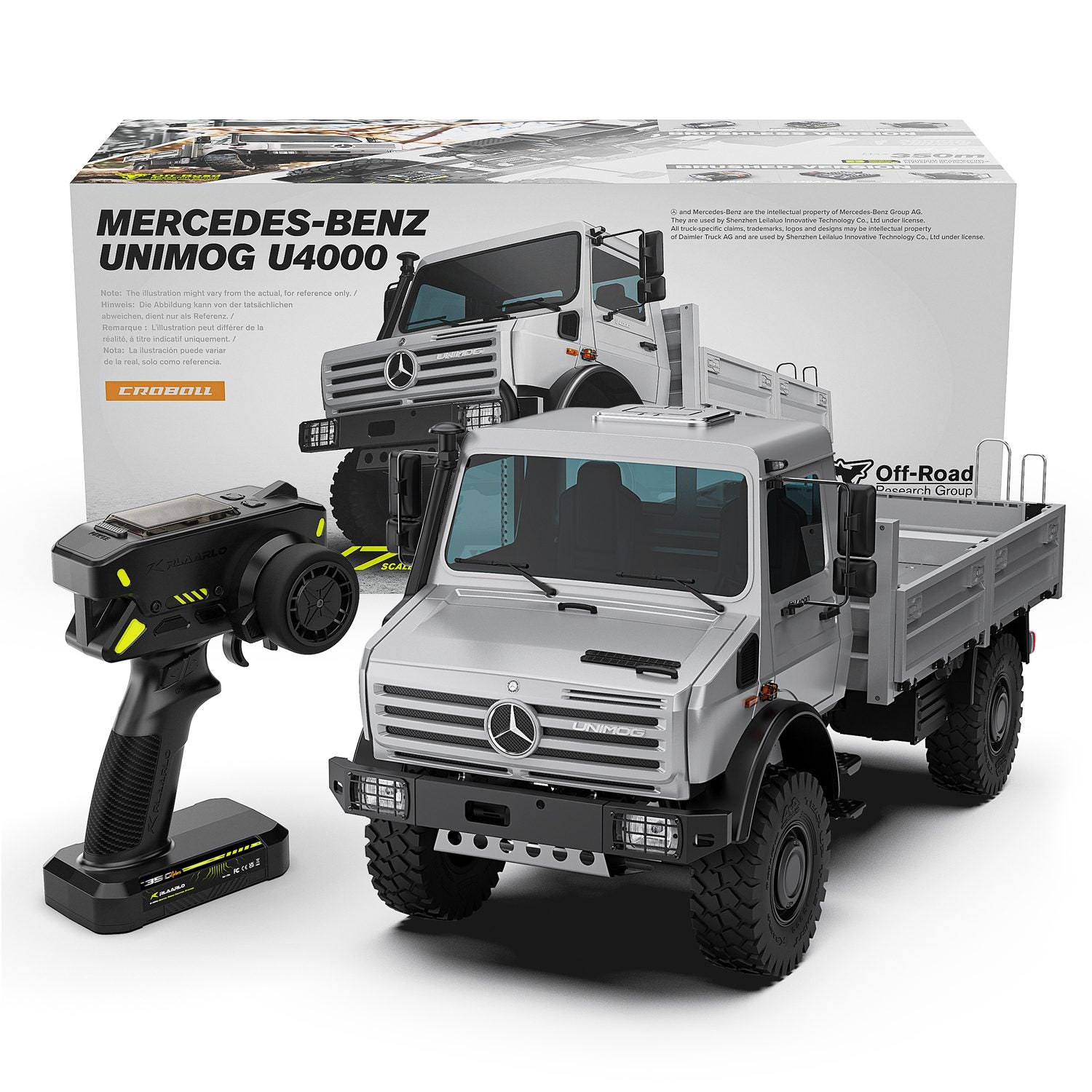
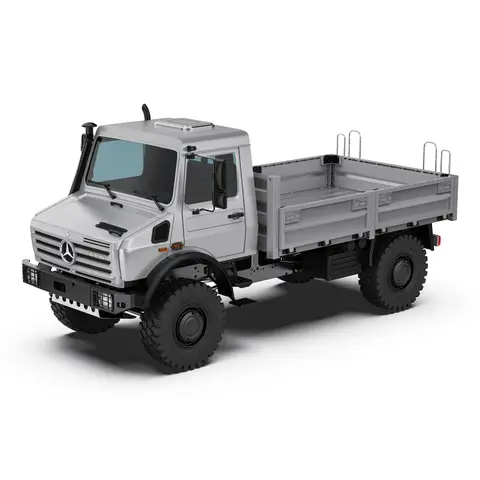
The Unimog U4000 UM07 Brushed is a 1/7-scale four-wheel-drive trail and crawling model in Rlaarlo's range. It is supplied assembled with factory running equipment. Source details (opens in a new tab)
Read moreShow less
Portal reduction gears sit at the wheel ends rather than using a straight axle layout. Keep the portal gear assemblies and their covers in mind when identifying axle service parts. Source details (opens in a new tab)
Selectable differential locks let the drivetrain retain ordinary differential action or lock the axles for an obstacle. Check the lock controls and their servo travel before changing the radio setup. Source details (opens in a new tab)
A two-speed transmission gives the model separate low and high ranges. Use the low range for slow obstacle work, and confirm which range is selected before comparing gearing or fitting a different motor. Source details (opens in a new tab)
The Unimog U4000 UM07 Brushed uses the brushed running package. Its motor is 5280 brushed motor. Keep the body and power-system edition distinct when comparing the related trucks. A brushed-to-brushless change needs the matching motor and controller installation, not just another battery. Source details (opens in a new tab)
The kind of vehicle the maker sells it as. It sets what the car is built to do and which cars it is fair to compare it with.
Crawlers are built for slow, controlled climbing over rocks: very low gearing, flexible suspension and locked axles.
Drive
All four wheels are driven. That gives more grip under power, especially on loose ground.
The cost is more parts to maintain.
A crawler needs every wheel pulling to climb.
Power
A brushed motor carries current through carbon brushes that rub on the commutator.
It is cheaper and smooth at low speed.
The brushes wear and the motor loses power over time.
That low-speed smoothness is why so many crawlers use one.
Build
Ready to run: built at the factory with the electronics installed.
Some come without a battery or charger; the maker's box contents say which.
Scale
The maker's nominal size compared with a full-size vehicle. It works more as a class label than a measurement.
A 1/10 monster truck is far bigger than a 1/10 touring car, so compare length and weight for real size.
This one is 854 mm long.
Part number
The maker's product number for this exact version.
A V2, a new color, or a kit instead of an RTR usually has a different number, and parts can differ between them.
Check it against your box or receipt before ordering parts.
Class
Crawler
Drive
4WD
Power
Brushed
Build
Ready to run
Scale
1/7
Part number
UM07S-RTR-BR
Drivetrain
Pinion
The small gear on the motor shaft. Fewer teeth gear the car shorter: quicker acceleration, lower top speed and a cooler motor. More teeth do the opposite.
It depends on the motor you fit, so the maker does not list one.
Spur
The large gear the pinion drives. A bigger spur with the same pinion gears the car shorter.
Pinion and spur need matching pitch, or explicit manufacturer confirmation that the exact gears are compatible.
The Gearing parts table below shows this car's pitch and part numbers.
Transmission & axle
Every reduction after the spur, multiplied together: transmission, transfer case and axle gears.
That chain is why a crawler's figure is much higher than other classes'.
It is fixed by the design; the gearing you change is the pinion and spur.
This one is worked out from the tooth counts the maker publishes.
Final drive
How many times the motor turns for one turn of the wheels. A higher number is shorter gearing: more acceleration and pulling power, less top speed.
Crawlers run far higher ratios than other classes, so the truck can creep and hold on a climb.
Pinion pitch
The tooth spacing of the fitted gear, stated as metric module or diametral pitch.
Pinion and spur need matching pitch or explicit manufacturer confirmation of compatibility for the exact parts. Mod 0.8 and 32P are different standards; a compatibility statement for particular gears does not apply to every gear. A missing pitch can be inferred from the other fitted gear; module and diametral pitch are not silently converted.
The outside diameter of the mounted tire, tread to tread. A taller tire covers more ground each turn, which gears the car taller.
Crawler wheels are named by rim size, such as 1.9 or 2.2 inches; that is the wheel, not this tire diameter.
Wheel hex
The hex on the axle that the wheel locks onto and is driven by. A wheel must match the hex size to fit.
17 mm is the standard size on 1/8 cars.
The wheel nut is a separate size, so check its thread too before buying nuts.
Stock tire width
Stock tire width: A documented stock wheel, tire, or axle measurement. Stock dimensions alone do not establish the largest size that will clear the body and suspension.
Stock wheel diameter
Stock wheel diameter: A documented stock wheel, tire, or axle measurement. Stock dimensions alone do not establish the largest size that will clear the body and suspension.
What the shocks are and how they are built, as the maker describes them.
Oil-filled shocks damp with silicone oil; friction shocks, found on some entry-level cars, damp with a sprung plunger and cannot be tuned with oil.
Front upper shock bolt
Front upper shock bolt: A documented shock mounting interface at the named end and eye. A ball stud or standoff is distinct from a through-bolt. Match the mounting type, thread and eye dimensions when choosing a replacement shock.
Front lower shock bolt
Front lower shock bolt: A documented shock mounting interface at the named end and eye. A ball stud or standoff is distinct from a through-bolt. Match the mounting type, thread and eye dimensions when choosing a replacement shock.
Shock oil
The oil in the shocks slows how fast the suspension moves. Thicker oil settles the car more slowly and resists bottoming out; thinner oil lets the wheels follow bumps.
Front and rear run the same oil on this car, so both ends respond alike. Changing one end at a time is the usual way to shift the balance.
It is graded in cSt (centistokes), a measure of thickness that means the same across brands. K means thousands, so 10K cSt is 10,000 cSt.
The factory manual lists a 35T main gear and the four downstream reductions.
Read moreShow less
Their combined ratio is 12.27:1 in high, before accounting for the motor pinion.
The figures are about 30.7:1 with the 14T pinion shown in the specifications or 28.6:1 with the 15T pinion identified in the parts list.
The low range adds a 26:14 reduction.
The supplied electronics support 2S to 3S, and the battery compartment measures 184 × 51 × 16.5 mm.
The replacement motor part number identifies the nominal 5 mm shaft.
Other listed dimensions come from the factory manual.
How to read these figures
Stock is as the vehicle ships.
Derived uses recorded dimensions or arithmetic. The row explains the inference. A nominal mating size is not a measured tolerance or a complete fitment guarantee.
Derived from replacement part uses the listed dimensions of a replacement advertised for the identified OEM part. Treat it as an approximate working size; the factory-fitted part may differ. Calculated performance uses that approximation.
Not published means it exists but no source we could find prints it.
Use the UM07 receiver map when reconnecting drivetrain servos. The front and rear differential locks are on CH3 and CH4, high/low range is on CH7 and drive-mode selection is on CH8. Those last two assignments differ from the JK07Pro map. Match each function to the Unimog's actual receiver port and linkage before changing settings to compensate for the wrong actuator responding.[1] Unimog U4000 UM07 Brushed factory chassis and service manual (opens in a new tab)
The Unimog's factory light board uses MX1.25 connectors, and its body drawings route the headlamp, dashboard and side-light wiring through separate openings. Keep those routes and labels with the repair record when removing the cab or replacing a lamp. The receiver also has a separately identified voltage-feedback port; it should not be treated as an unlabeled spare lighting output.[1] Unimog U4000 UM07 Brushed factory chassis and service manual (opens in a new tab)
Read moreRead less about build and setup for Unimog U4000 UM07 Brushed
Follow the UM07 damper's own filling drawing during a rebuild. It specifies headspace, movement of the shaft and a rest period before closure, rather than filling the body completely to the top. Keep the seals, bleed screw and spring arrangement with that drawing, and record any oil change separately from ride-height changes. The shared handbook covers both brushed and brushless trucks, but its separate motor and controller columns still govern electrical replacements.[1] Unimog U4000 UM07 Brushed factory chassis and service manual (opens in a new tab)
Common numbers cover selected core components, not every part. A shared family, manual or listing does not mean the parts fit both vehicles. Check the comparison and upgrade notes before ordering.
More connections & sourcesShow less
Platform family
UM07 Unimog chassis family. UM07 Unimog brushed and brushless versions share the vehicle frame and axle architecture. Motor, controller and related equipment vary. Source (opens in a new tab)


 RlaarloMercedes-Benz Unimog U4000 UM07 Brushless RTR