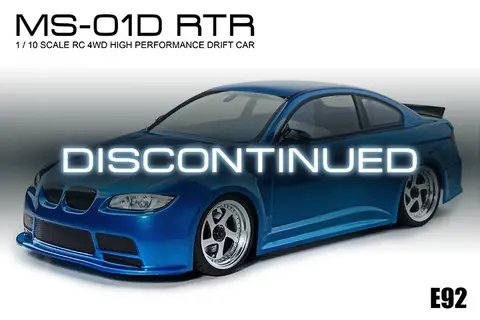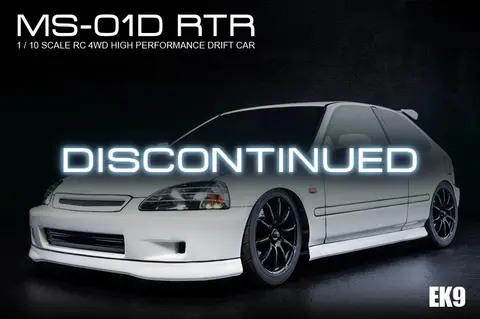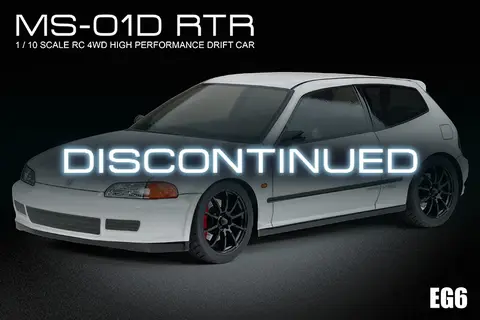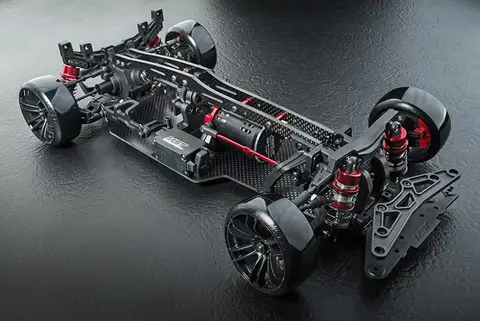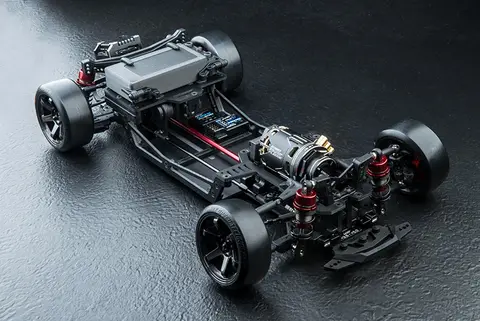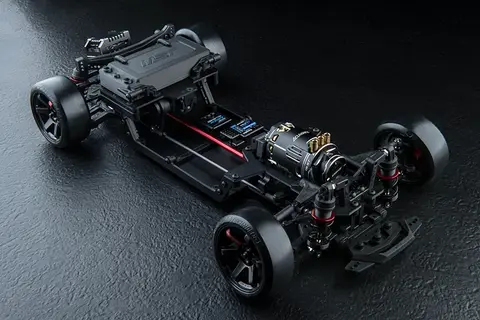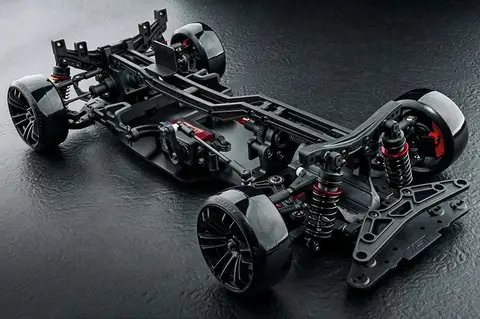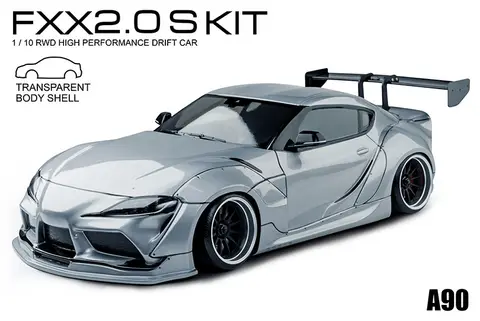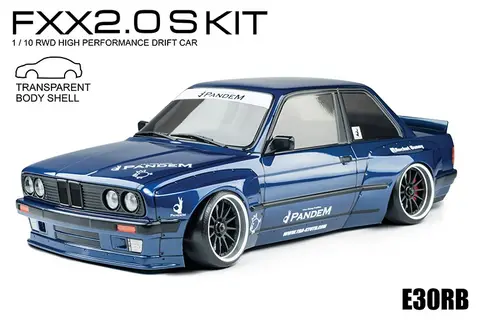
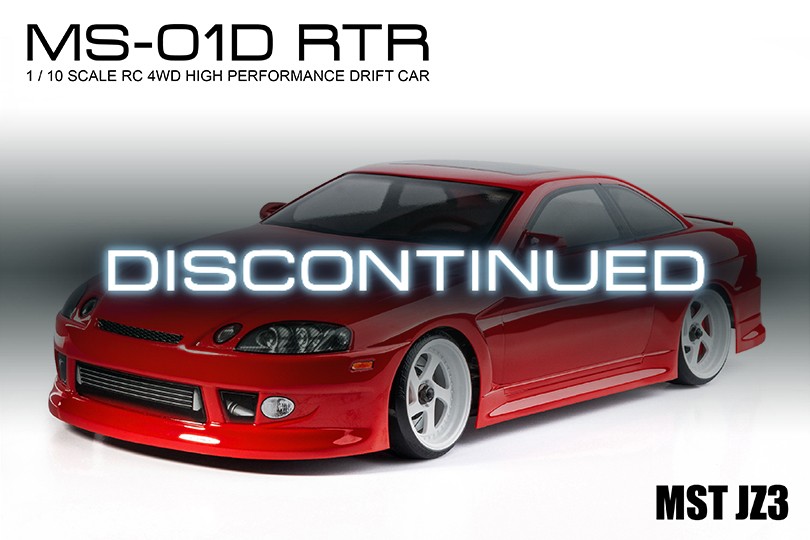
MST's MS-01D brushed 4WD RTR JZ3 is a 1/10 four-wheel-drive drift ready-to-run car. Its supplied body and power package are part of this edition, so match the product number when comparing it with a chassis kit or another body version. Model and chassis reference (opens in a new tab)
Read moreShow less
The MS-01D uses two belts to drive all four wheels, with a front differential and a rear spool. Its front-center motor position and independent double-arm suspension belong to a four-wheel-drive drift layout, rather than a rear-drive RMX configuration. Hydraulic shocks and adjustable steering geometry provide the starting points for setup. Match tires to the intended drift surface and check both belt drives before attributing inconsistent handling to motor power. Design and configuration (opens in a new tab)
The kind of vehicle the maker sells it as. It sets what the car is built to do and which cars it is fair to compare it with.
Drift cars are set up to slide through corners on hard plastic tires, with the rear wheels turning faster than the front or driven alone.
Drive
All four wheels are driven, which puts power down more evenly and keeps the car steadier accelerating out of corners.
The cost is more parts to maintain.
Some drift cars are 4WD with the rear geared to turn faster than the front, which is the counter-steer ratio.
Power
A brushed motor carries current through carbon brushes that rub on the commutator.
It is cheaper and smooth at low speed.
The brushes wear and the motor loses power over time.
Build
Ready to run: built at the factory with the electronics installed.
Some come without a battery or charger; the maker's box contents say which.
Scale
The maker's nominal size compared with a full-size vehicle. It works more as a class label than a measurement.
A 1/10 monster truck is far bigger than a 1/10 touring car, so compare length and weight for real size.
Part number
The maker's product number for this exact version.
A V2, a new color, or a kit instead of an RTR usually has a different number, and parts can differ between them.
Check it against your box or receipt before ordering parts.
Class
Drift
Drive
4WD
Power
Brushed
Build
Ready to run
Scale
1/10
Part number
531051
Drivetrain
Pinion
The small gear on the motor shaft. Fewer teeth gear the car shorter: quicker acceleration, lower top speed and a cooler motor. More teeth do the opposite.
On this car one tooth changes the gearing by about 3.8%.
A bigger pinion loads the motor and ESC harder, so check the maker's gearing chart and feel the motor temperature after a run.
Spur
The large gear the pinion drives. A bigger spur with the same pinion gears the car shorter.
Pinion and spur need matching pitch, or explicit manufacturer confirmation that the exact gears are compatible.
The Gearing parts table below shows this car's pitch and part numbers.
Transmission & axle
Every reduction after the spur, multiplied together: transmission, differentials and axle gears.
It is fixed by the design; the gearing you change is the pinion and spur.
On a belt-driven drift chassis it takes in the pulley ratios as well.
Spur ÷ pinion
Spur teeth divided by pinion teeth: the part of the gearing that a pinion or spur swap changes.
Here it is 3.385:1.
Final drive
How many times the motor turns for one turn of the wheels. A higher number is shorter gearing: more acceleration and pulling power, less top speed.
Among 1/10 drift cars in the catalog, the middle half run between 7.7:1 and 10.9:1 on stock gearing; this one is 6.8:1, taller than most.
Drift cars are geared for fine throttle control through a slide more than for top speed.
Pinion bore
The nominal size of the hole that mates with the motor shaft.
A nominal shaft fit comes from the exact replacement pinion listing. It does not specify a measured finished hole or manufacturing tolerance.
Match the pinion mounting method as well as its size. A press-fit hole cannot be inferred from motor shaft diameter.
Pinion pitch
The tooth spacing of the fitted gear, stated as metric module or diametral pitch.
Pinion and spur need matching pitch or explicit manufacturer confirmation of compatibility for the exact parts. Mod 0.8 and 32P are different standards; a compatibility statement for particular gears does not apply to every gear. A missing pitch can be inferred from the other fitted gear; module and diametral pitch are not silently converted.
Spur pitch
The tooth spacing of the fitted gear, stated as metric module or diametral pitch.
Pinion and spur need matching pitch or explicit manufacturer confirmation of compatibility for the exact parts. Mod 0.8 and 32P are different standards; a compatibility statement for particular gears does not apply to every gear. A missing pitch can be inferred from the other fitted gear; module and diametral pitch are not silently converted.
What the shocks are and how they are built, as the maker describes them.
Oil-filled shocks damp with silicone oil; friction shocks, found on some entry-level cars, damp with a sprung plunger and cannot be tuned with oil.
The shaft size matters when buying seals, ends and rebuild kits.
Shock bore
The inside diameter of the shock body, where the piston moves through oil.
It is a shock measurement, separate from the motor pinion bore. Match the actual shock part when ordering pistons, seals or a replacement body.
Shock length
The stated length of the complete shock assembly. Sources may use mounting-eye centers or a nominal assembly length.
Compare fully extended mounting-eye spacing, compressed length and mounting hardware before ordering. A longer shock changes ride height and travel, and can bind at full droop or bottom out.
Shock oil
The oil in the shocks slows how fast the suspension moves. Thicker oil settles the car more slowly and resists bottoming out; thinner oil lets the wheels follow bumps.
Front and rear run the same oil on this car, so both ends respond alike. Changing one end at a time is the usual way to shift the balance.
This is the maker's printed oil grade. Its viscosity unit has not been established, so it is not presented as cSt or cps. Grade numbers alone do not establish equivalent oils or relative thickness.
Calculated final drive ratio for each pinion and spur pair
Pinion
86T spur
88T spur
90T spur
24T
25T
26T
27T
28T
29T
Select a pair to compare wheel travel per motor turn with stock. Other cells are mathematical examples, not verified gears or fits. Check pitch, mesh, clearance and motor temperature before changing parts.
About these specs
Every MS-01D brushed RTR body variant ships the 26T 48-pitch pinion and 88T spur that the MS-01D RTR exploded manual prints on its parts page and setup sheet, and the car's product page lists the same pinion (148026) and spur (210013) in its parts tab.
Read moreShow less
The setup sheet prints the complete ratio as 88 divided by 26 times the 2.0 belt stage (the 18T/36T pulley set), 6.77.
The stock motor is rated for up to 8.4 V, the full-charge voltage of a standard 2S LiPo.
The XB60 controller alone accepts 2S or 3S.
MST does not publish a KV for the M54-26T brushed motor, only 17500 rpm at best efficiency on 6.0 to 8.4 V.
The product page names a special drift tire but no tire part or diameter.
The 12mm wheel hex is derived from the original MST 230041 replacement hub listing, matched to the front and rear hubs in the manual.
How to read these figures
Stock is as the vehicle ships.
Calculated is worked from the recorded figures on this page.
Derived from replacement part uses the listed dimensions of a replacement advertised for the identified OEM part. Treat it as an approximate working size; the factory-fitted part may differ. Calculated performance uses that approximation.
Single report uses one outside source. It is useful as a starting figure, with the source and calculation described in the note.
Not published means it exists but no source we could find prints it.
Establish the MS-01D RTR's steering linkage before changing electronics. Its manual gives a 46 mm steering-rod assembly reference, then requires the servo to be centered before the horn and saver are attached. Select the 23T or 25T horn insert for the actual servo spline. That measurement describes the illustrated rod assembly, not a replacement servo's dimensions.[1] MS-01D brushed 4WD RTR JZ3 factory setup manual (opens in a new tab)
Record motor gearing and counter-steer configuration separately. The RTR handbook's illustrated baseline uses an 88T spur, 26T pinion and 2.0 reduction, while its setup sheet provides separate fields for differential type and counter-steer ratio. A list of tick-box options is not proof that every option is fitted. Check the installed belts, pulleys and front/rear drive units before copying a different setup.[1] MS-01D brushed 4WD RTR JZ3 factory setup manual (opens in a new tab)
Read moreRead less about build and setup for MS-01D brushed 4WD RTR JZ3
The factory electronics diagram identifies the M54 motor and XB60 brushed controller. If the radio or throttle settings change, use the controller's own neutral-calibration and battery-jumper instructions. Check drivetrain drag and belt condition before adding motor power, and keep the numbered body version's tire clearance in the comparison; the shared chassis handbook is not evidence that every shell fits every wheel offset.[1] MS-01D brushed 4WD RTR JZ3 factory setup manual (opens in a new tab)
Common numbers cover selected core components, not every part. A shared family, manual or listing does not mean the parts fit both vehicles. Check the comparison and upgrade notes before ordering.
More connections & sourcesShow less
Platform family
MS-01D RTR chassis family. MS-01D RTR body packages share the belt-driven four-wheel-drive chassis. Body shells and supplied equipment vary. Source (opens in a new tab)