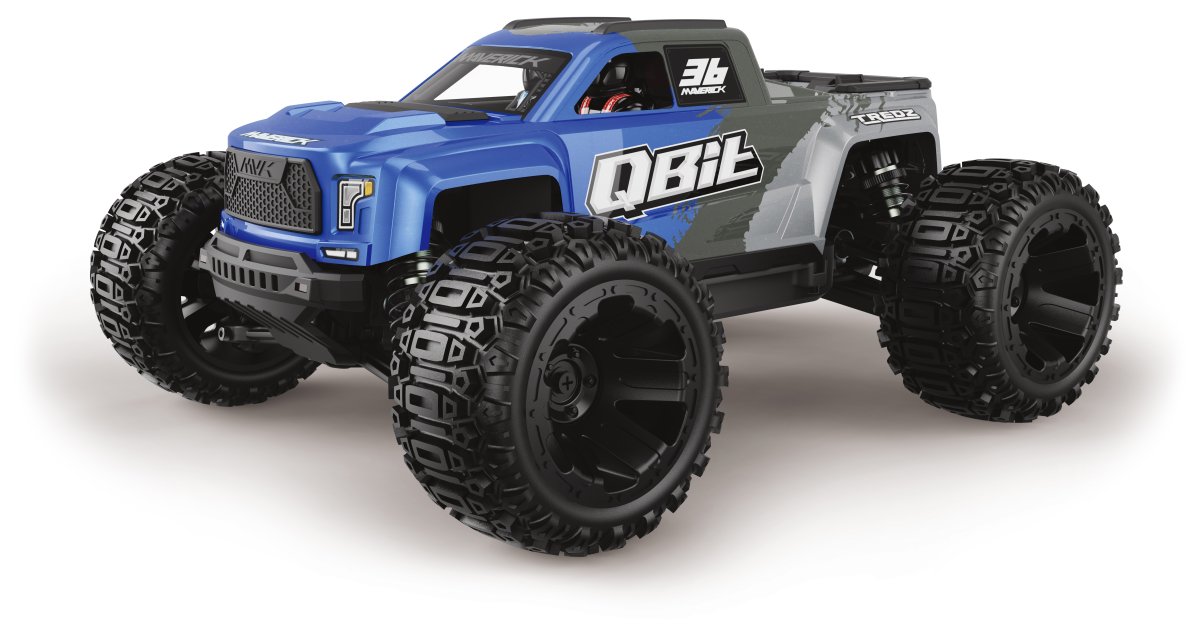
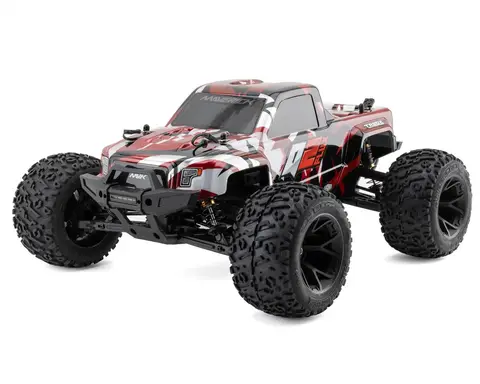
Maverick's Qbit MT is a ready-to-run 1/16 four-wheel-drive monster truck with a brushed motor.
The technical guide identifies a 14T pinion and 50T spur. Combined with the documented axle gears, these give a calculated 10.7143:1 final drive. Measure the tire outside diameter before estimating road speed or comparing a tire change. Repeat the measurement after fitting different tires.
The kind of vehicle the maker sells it as. It sets what the car is built to do and which cars it is fair to compare it with.
Monster trucks have tall tires and long suspension travel, built for jumping and rough ground rather than a race track.
Drive
All four wheels are driven. That gives more grip under power, especially on loose ground.
The cost is more parts to maintain.
Power
A brushed motor carries current through carbon brushes that rub on the commutator.
It is cheaper and smooth at low speed.
The brushes wear and the motor loses power over time.
Build
Ready to run: built at the factory with the electronics installed.
Some come without a battery or charger; the maker's box contents say which.
Scale
The maker's nominal size compared with a full-size vehicle. It works more as a class label than a measurement.
A 1/10 monster truck is far bigger than a 1/10 touring car, so compare length and weight for real size.
This one is 292 mm long.
Part number
The maker's product number for this exact version.
A V2, a new color, or a kit instead of an RTR usually has a different number, and parts can differ between them.
Check it against your box or receipt before ordering parts.
Class
Monster truck
Drive
4WD
Power
Brushed
Build
Ready to run
Scale
1/16
Part number
151000
Drivetrain
Pinion
The small gear on the motor shaft. Fewer teeth gear the car shorter: quicker acceleration, lower top speed and a cooler motor. More teeth do the opposite.
On this car one tooth changes the gearing by about 7.1%.
A bigger pinion loads the motor and ESC harder, so check the maker's gearing chart and feel the motor temperature after a run.
Spur
The large gear the pinion drives. A bigger spur with the same pinion gears the car shorter.
Pinion and spur must have the same pitch, or tooth size, to mesh.
The Gearing parts table below shows this car's pitch and part numbers.
Transmission & axle
Every reduction after the spur, multiplied together: transmission, differentials and axle gears.
It is fixed by the design; the gearing you change is the pinion and spur.
This one is worked out from the tooth counts the maker publishes.
Final drive
How many times the motor turns for one turn of the wheels. A higher number is shorter gearing: more acceleration and pulling power, less top speed.
Differentials
The type of each differential, as the maker states it.
A gear or ball diff lets the wheels on one axle turn at different speeds in a corner; a spool or locked diff turns them together for straight-line drive and climbing, at the cost of steering.
Pinion
14TStock
Stock
Spur
50TStock
Stock
Transmission & axle
3.00:1Derived
Derived
Final drive
10.71:1Stock
Stock
Differentials
Gearfront and rearStock
Stock
Wheels & tires
Tire diameter
The outside diameter of the mounted tire, tread to tread. A taller tire covers more ground each turn, which gears the car taller.
At high speed tires can balloon and grow, so the real gearing gets taller as the car goes faster.
Wheel hex
The hex on the axle that the wheel locks onto and is driven by. A wheel must match the hex size to fit.
12 mm is the common size on 1/10 cars, so most 1/10 wheels fit; offset and width still vary.
The wheel nut is a separate size, so check its thread too before buying nuts.
Tire diameter
Not published
Wheel hex
12 mmStock
Stock
Suspension
Chassis
What the main chassis is made of and how it is built, as stated for this car. Braces, stiffeners and skid plates are not counted.
Composite is the makers' word for molded plastic, usually nylon with glass or other fibers: it flexes and shrugs off hits, and it is light and cheap to replace.
A tub is one molded piece with raised sides that hold the parts and keep dirt out.
Shocks
What the shocks are and how they are built, as the maker describes them.
Oil-filled shocks damp with silicone oil; friction shocks, found on some entry-level cars, damp with a sprung plunger and cannot be tuned with oil.
Threaded bodies set ride height with a collar you turn, rather than clips.
Chassis
CompositetubStock
Stock
Shocks
Oil-filledthreaded, composite body, front and rearStock
Stock
Power
Motor
Brushed motors are rated by can size and turns rather than KV, so there is no KV to show.
Battery
The highest LiPo cell count the maker rates the electronics for.
The maker does not publish it.
Stock motor
The motor fitted at the factory, as the maker names it.
Brushed motors are often named by can size, such as 540 or 550, and by turns: fewer turns is faster.
Stock ESC
The electronic speed control. It feeds power from the battery to the motor as you work the throttle, and usually powers the receiver and servo too.
An amp figure in its name is normally the maker's continuous rating.
A brushed ESC cannot run a brushless motor.
Set its low-voltage cutoff for LiPo, so a pack is not run flat.
Motor size
The size of the stock motor's can, as the maker names it.
390 is a standard can size; a larger number is a longer can with more torque.
Water resistance
What the maker says about water, in its own words.
Waterproof electronics survive splashes, puddles and wet grass; they are not meant to be submerged.
After a wet run, dry the car and check the bearings, which rust.
Motor
Not applicable
Battery
Not published
Stock motor
390 Brushed MotorStock
Stock
Stock ESC
MSRS-313Stock
Stock
Motor size
390canStock
Stock
Water resistance
Splashproof ElectronicsStock
Stock
Performance
Theoretical top speed
A brushed motor has no KV rating, so no theoretical top speed is worked out. Compare gearing by rollout instead.
Theoretical top speed
Not applicable
Size & weight
Length
Overall length as the maker states it, usually with the body fitted.
Useful for comparing real size, since scale labels are loose.
Width
Overall width as the maker states it, usually with the body fitted.
A wider car is more stable in corners and harder to roll over.
Height
Overall height as the maker states it, usually with the body fitted.
Useful when checking it fits a shelf, a bag or a car trunk.
Wheelbase
The distance between the front and rear axle centers. A longer wheelbase is steadier at speed and over bumps; a shorter one turns more tightly.
Length
292 mm11.5 inStock
Stock
Width
225 mm8.9 inStock
Stock
Height
127 mm5 inStock
Stock
Wheelbase
180 mm7.1 inStock
Stock
How to read these figures
Stock is as the vehicle ships.
Calculated is worked from the stock figures on this page rather than stored beside them, so the two cannot drift apart.
Derived is worked out from gear tooth counts the maker publishes rather than printed as a ratio; the notes below say how.
Not applicable means the vehicle does not come with it, like the motor on a roller or the tires on a race kit, or does not have one, like a KV rating on a brushed motor.
Not published means it exists but no source we could find prints it.
Pinion and spur dimensions for the Maverick Qbit MT: fitted, and optional gearing supplied in the box
Component
Teeth
Pitch
Bore
Fitted at the factory
Pinion
14T
Mod 0.6
2.3 mm
Spur
50T
Mod 0.6
Not applicable
About teeth, pitch and bore
Tooth counts are the ones in the specifications above.
Pitch is given as metric module (Mod 1, Mod 0.8) or diametral pitch (32P, 48P). They are different standards and are not interchangeable, even where the numbers look close.
Bore is the pinion’s hole, listed separately from the motor shaft.