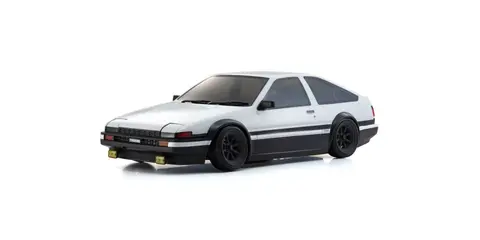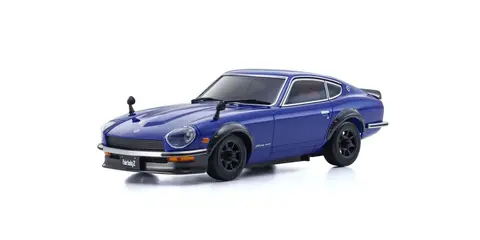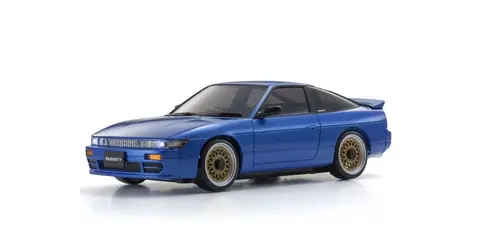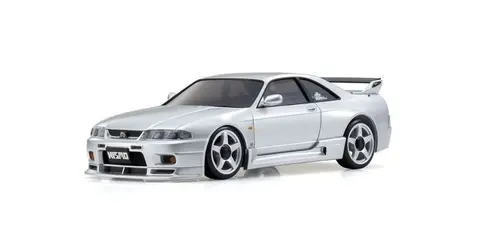
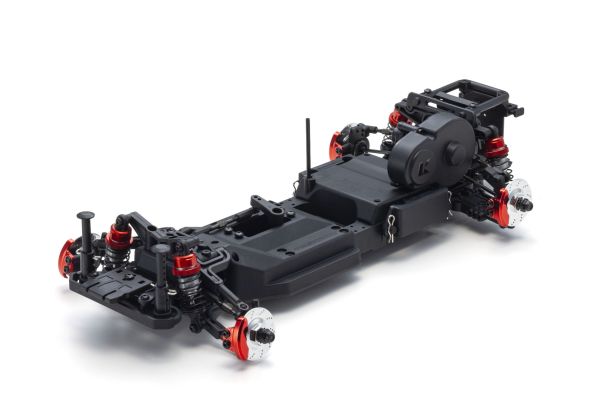



The Fazer D2 chassis kit gives Kyosho's rear-wheel-drive drift platform a build-it-yourself form. Introduced in July 2026 as 34551, it leaves the body, radio and power system to the builder while including several components offered as options for the assembled cars. That makes its appeal partly mechanical: you can choose the electronics and shell around the running you want, then assemble a chassis whose motor position, steering and rear suspension offer meaningful setup choices.
The high-mounted motor and long suspension arms serve controlled sliding. A split resin chassis provides wheelbase adjustment, and the rear motor mounting can be moved forward or backward to change the weight distribution. Aluminum oil shocks, adjustable links, steering crank pins, machine screws and 22 bearings are included. The rear uses a spool, which drives both wheels together without differential action, and the kit's steel spool cup and universal shafts also accommodate an optional differential at the stock rear width. Model and equipment details (opens in a new tab)
Body choice belongs at the start of the build. Check wheelbase, wheel offset, mounting and tire clearance together, then choose tires for the surface or circuit rules. Conventional posts and concealed mounts are both supplied. Widening the rear suspension requires matching optional shafts, so that change affects more than appearance. With the included dampers and drive hardware already in place, the useful first investment is a compatible servo, gyro and power system, followed by time spent setting their response. Setup and service guidance (opens in a new tab)
The kind of vehicle the maker sells it as. It sets what the car is built to do and which cars it is fair to compare it with.
Drift cars are set up to slide through corners on hard plastic tires, with the rear wheels turning faster than the front or driven alone.
Drive
Only the rear wheels are driven.
Modern drift chassis are mostly rear-wheel drive and use a steering gyro to hold the car at an angle through a slide.
Power
Sold without a motor, so you choose the motor, ESC and battery yourself.
Rows that depend on the motor say so.
Build
A kit you build yourself from parts.
Most kits come without motor, ESC, servo, radio and battery, and many without tires or a painted body.
The manual lists what to add.
Scale
The maker's nominal size compared with a full-size vehicle. It works more as a class label than a measurement.
A 1/10 monster truck is far bigger than a 1/10 touring car, so compare length and weight for real size.
Part number
The maker's product number for this exact version.
A V2, a new color, or a kit instead of an RTR usually has a different number, and parts can differ between them.
Check it against your box or receipt before ordering parts.
Class
Drift
Drive
2WD
Power
Motor not included
Build
Kit
Scale
1/10
Part number
34551
Drivetrain
Pinion
The small gear on the motor shaft. Fewer teeth gear the car shorter: quicker acceleration, lower top speed and a cooler motor. More teeth do the opposite.
On this car one tooth changes the gearing by about 4.2%.
A bigger pinion loads the motor and ESC harder, so check the maker's gearing chart and feel the motor temperature after a run.
Spur
The large gear the pinion drives. A bigger spur with the same pinion gears the car shorter.
Pinion and spur need matching pitch, or explicit manufacturer confirmation that the exact gears are compatible.
The Gearing parts table below shows this car's pitch and part numbers.
Transmission & axle
Every reduction after the spur, multiplied together: transmission, differentials and axle gears.
It is fixed by the design; the gearing you change is the pinion and spur.
This one is worked out from the tooth counts the maker publishes.
On a belt-driven drift chassis it takes in the pulley ratios as well.
Spur ÷ pinion
Spur teeth divided by pinion teeth: the part of the gearing that a pinion or spur swap changes.
Here it is 3.500:1.
Final drive
How many times the motor turns for one turn of the wheels. A higher number is shorter gearing: more acceleration and pulling power, less top speed.
Among 1/10 drift cars in the catalog, the middle half run between 7.7:1 and 10.9:1 on stock gearing; this one is 9.1:1.
Drift cars are geared for fine throttle control through a slide more than for top speed.
Differentials
The type of each differential, as the maker states it.
A gear or ball diff lets the wheels on one axle turn at different speeds in a corner; a spool or locked diff turns them together for straight-line drive and climbing, at the cost of steering.
Pinion bore
The nominal size of the hole that mates with the motor shaft.
A nominal shaft fit comes from the exact replacement pinion listing. It does not specify a measured finished hole or manufacturing tolerance.
Match the pinion mounting method as well as its size. A press-fit hole cannot be inferred from motor shaft diameter.
Pinion pitch
The tooth spacing of the fitted gear, stated as metric module or diametral pitch.
Pinion and spur need matching pitch or explicit manufacturer confirmation of compatibility for the exact parts. Mod 0.8 and 32P are different standards; a compatibility statement for particular gears does not apply to every gear. A missing pitch can be inferred from the other fitted gear; module and diametral pitch are not silently converted.
Spur pitch
The tooth spacing of the fitted gear, stated as metric module or diametral pitch.
Pinion and spur need matching pitch or explicit manufacturer confirmation of compatibility for the exact parts. Mod 0.8 and 32P are different standards; a compatibility statement for particular gears does not apply to every gear. A missing pitch can be inferred from the other fitted gear; module and diametral pitch are not silently converted.
Calculated final drive ratio for each pinion and spur pair
Pinion
82T spur
84T spur
86T spur
22T
23T
24T
25T
26T
27T
Select a pair to compare wheel travel per motor turn with stock. Other cells are mathematical examples, not verified gears or fits. Check pitch, mesh, clearance and motor temperature before changing parts.
About these specs
July2026 chassis kit derived from FAZER D2 Readysets, with aluminum shocks and steering pins, steel spool cups and universal shafts.
Read moreShow less
Manufacturer product narratives and Japanese specs give240–273mm adjustment; English specs and manual guidance reach274mm, so the maximum remains held.
Default wheelbase260mm is consistent.
The exact34551 manual page28 marks24T pinion and84T spur as standard, giving9.10:1 overall and a derived2.60 internal ratio.
Motor, tires, body and electronics are excluded; optional differential conversions are not stock.
Nominal 3.175 mm (1/8 in) fit, derived from the factory application and Kyosho’s compatible steel pinion.
How to read these figures
Stock is as the vehicle ships.
Calculated is worked from the recorded figures on this page.
Derived uses recorded dimensions or arithmetic. The row explains the inference. A nominal mating size is not a measured tolerance or a complete fitment guarantee.
Derived from replacement part uses the listed dimensions of a replacement advertised for the identified OEM part. Treat it as an approximate working size; the factory-fitted part may differ. Calculated performance uses that approximation.
Single report uses one outside source. It is useful as a starting figure, with the source and calculation described in the note.
Not applicable means the vehicle does not come with it, like the motor on a roller or the tires on a race kit.
Checked task pages, documented requirements and recorded fluid references for this model. Follow the manufacturer's procedure for the exact assembly and revision.
Maintenance bundles
Manual pages, documented requirements and relevant specifications, together by task.
Use the cited instructions for your fitted equipment. These references are not a complete rebuild kit.
Steering servoProcedure
Owner-selected steering servo and horn
34551 chassis kit with stock aluminum shocks and rear spool; owner-selected electronics
Horn tooth selection,29.5mm rod reference, horn orientation and mounting are shown. Optional aluminum horns remain separate; no internal servo rebuild procedure is supplied.
No separate parts, tools or prerequisites have been indexed for this task. Read the cited reference before starting.
This is a partial service reference. Check the cited instructions for the full procedure and configuration-specific requirements. Mechanical tasks may need additional parts, quantities and reused hardware beyond the items listed here. Manual reviewed 2026-10-09.
No fluid grades are recorded here. That does not establish whether this vehicle uses oil, grease or friction components.
Indexed tasks link to checked physical PDF pages. Other links open full documents. Tasks and rebuild requirements not shown here still need review.
Upgrades and setup
The Fazer D2 chassis kit starts with 22 bearings, aluminum oil shocks, adjustable links and universal shafts. Add a drift servo, gyro, motor, ESC, radio, battery, body and wheels to complete it. Choose tires for the actual driving surface before buying more aluminum; the kit already includes several parts that are optional on the Readysets.[1] Exact 34551 RWD equipment (opens in a new tab)[2] Exact manufacturer-linked D2 manual (opens in a new tab)