
ResearchSlash 4X4 gearing: fitted vs optional
Slash 4X4 gearing: fitted vs optional
A speed figure is useful only when its gearing and battery assumptions are visible. This example is the Slash 4X4 VXL Ultimate 68277-4, not every Slash.
Published . Reference figures are a dated catalog snapshot; linked sheets carry the sources and subsequent corrections.
First, make sure this is your Slash
This example is the Slash 4X4 VXL Ultimate 68277-4. Slash 2WD, BL-2s and other VXL revisions need their own references. Match your model code and installed motor before using the numbers below, particularly if you bought the truck used.
Two questions matter: what gears are fitted now, and what conditions apply to the optional speed gearing? A pinion supplied in the box can belong to a different driving setup from the one installed at the factory.
The fitted setup and the optional setup
Same truck, two documented gear sets
Scroll sideways to see all columns.
| Item | Fitted reference | Optional speed gearing |
|---|---|---|
| Pinion | 13T, Traxxas 3943X | 18T, Traxxas 3948X |
| Spur | 54T, Traxxas 3956 | 54T, Traxxas 3956 |
| Internal reduction used | 2.85:1 | 2.85:1 |
| Calculated final drive | 11.84:1 | 8.55:1 |
| Nominal 3S ideal speed | About 42 mph | About 58 mph |
The owner’s manual, page 27 (opens in a new tab), distinguishes the fitted and optional combinations. Its rounded table gives 11.82:1 and 8.54:1. Calculating directly with the displayed 2.85 reduction gives 11.84:1 and 8.55:1, a small rounding difference.
The parts list (opens in a new tab) identifies the gear numbers and uses bold type for optional accessories. Use that distinction when checking a replacement. Finding a gear in the model’s list does not, by itself, mean it was fitted out of the box.
What the larger pinion changes
Final drive is spur teeth ÷ pinion teeth × internal reduction. With the 13T pinion, 54 ÷ 13 × 2.85 gives about 11.84 motor turns per wheel turn. With 18T, the wheel turns once for about 8.55 motor turns.
At the same motor RPM, the larger pinion raises theoretical road speed by 18 ÷ 13, or about 38%. That is a substantial change. At the same motor torque and ignoring losses, the lower reduction also provides less torque at the wheels. Actual acceleration depends on traction, current limits and the motor operating point.
There is no fixed “38% faster” promise on the ground. Grass, repeated acceleration and a short run-up can prevent the motor reaching the RPM assumed by the calculation. A setup aimed at maximum speed can be less useful for the way you normally drive.
Keep the battery assumption visible
With fitted gearing, the same ideal calculation gives about 28 mph on nominal 2S and 42 mph on nominal 3S. That difference comes from the voltage input, not a gear change. A 3S pack is 11.1 V nominal; 12.6 V is its full-charge basis.
Optional gearing at full-charge voltage gives about 66 mph in this ideal model, compared with about 58 mph at nominal voltage. Neither is a measured speed. Label the voltage basis when saving or sharing a setup so another owner can reproduce the calculation.
Before ordering or installing a pinion
- Identify the fitted gears. Read their markings or count the teeth. Keep your personal setup separate from the factory reference.
- Check the exact part specifications. The fitted 3943X reference is 32-pitch with a 3 mm bore. Verify those dimensions for the replacement and your installed motor.
- Read the gearing chart restrictions. Use the battery, tire and surface conditions that apply to your combination. The optional speed setup is not a general recommendation for continuous off-road driving.
- Check the installation. Follow the manual for motor position, clearance, gear mesh and retaining hardware before running.
- Compare a controlled run. Keep the surface and battery comparable, measure temperatures against the equipment manufacturer’s limits, and record what changed.
In the speed calculator, save a fitted baseline before trying the optional pinion. A useful setup name includes the gearing and battery, such as “Slash 13/54, 3S nominal.” You can then compare the calculation with a GPS result without confusing the two.
Reference sheets
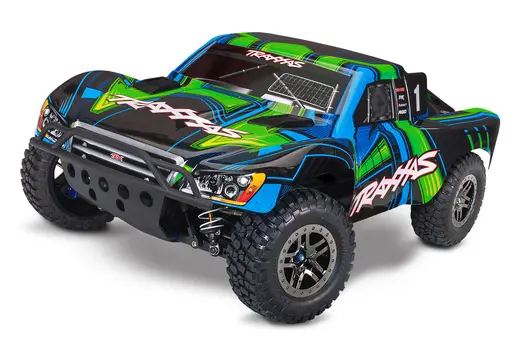 Traxxas Slash 4X4 VXL UltimateOpen the sourced specification sheetPhoto: Traxxas
Try it with your model
Loading a vehicle changes the working setup shared by the car calculators. Save your current setup first if you want to keep it.
Sources and corrections
Reference figures above come from the linked vehicle sheets and their manufacturer documents. No hands-on fitment or speed test is claimed. For the evidence standard, see Methodology. Send a correction with the exact model and source to hello@rctunelab.com.