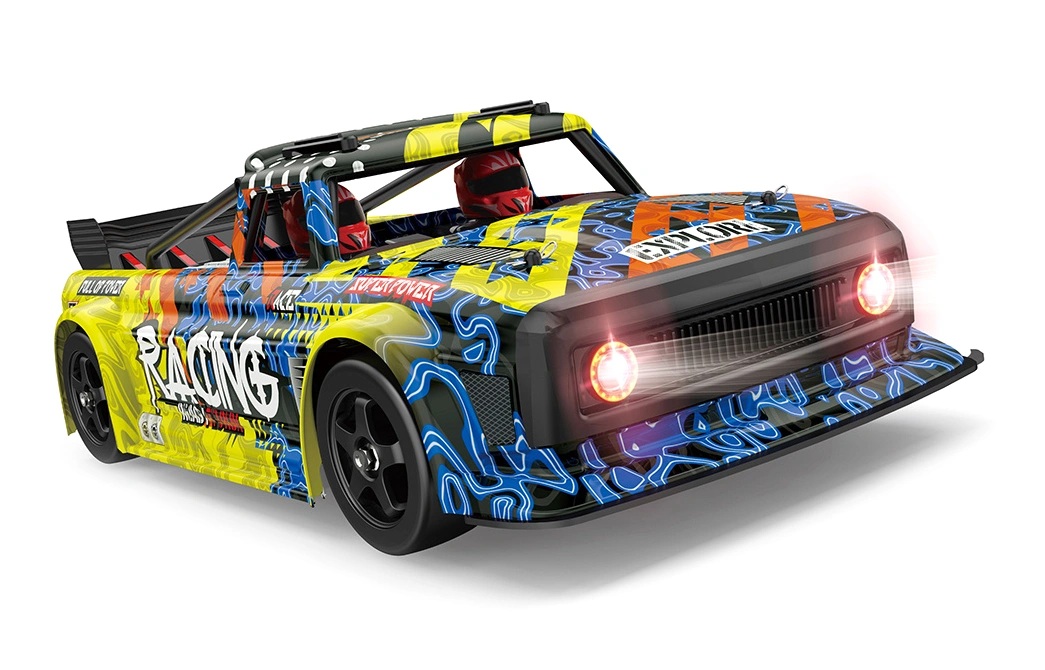
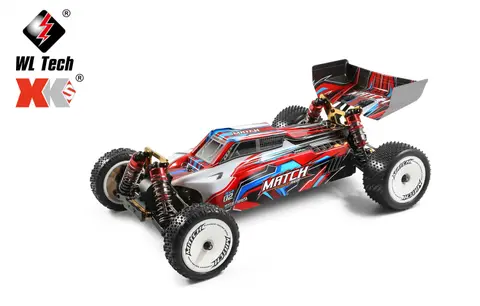
The 124020 gives WLtoys' 1/12 range a four-wheel-drive road car with a 2845 brushless motor. A metal chassis plate, ball bearings and independent suspension underpin the low road-car body. Its lighting includes controllable headlights, turn signals and brake lights. Manufacturer specifications (opens in a new tab).
Read moreShow less
This entry covers the assembled configuration with a 7.4V 2200mAh lithium-ion battery and USB charger. The manufacturer specifies 2S power only and offers a choice of road or drift tires. It also lists a bare frame, so check which package is being sold before comparing included equipment or ordering replacements. Configuration details (opens in a new tab).
The kind of vehicle the maker sells it as. It sets what the car is built to do and which cars it is fair to compare it with.
Street covers on-road bashers: speed-run, muscle and drag cars built for straight-line speed rather than racing.
Drive
All four wheels are driven, which puts power down more evenly and keeps the car steadier accelerating out of corners.
The cost is more parts to maintain.
Power
A brushless motor has no brushes to wear, so it makes more power and runs more efficiently than a brushed one.
It needs a brushless ESC.
Build
Ready to run: built at the factory with the electronics installed.
Some come without a battery or charger; the maker's box contents say which.
Scale
The maker's nominal size compared with a full-size vehicle. It works more as a class label than a measurement.
A 1/10 monster truck is far bigger than a 1/10 touring car, so compare length and weight for real size.
This one is 392 mm long.
Part number
The maker's product number for this exact version.
A V2, a new color, or a kit instead of an RTR usually has a different number, and parts can differ between them.
Check it against your box or receipt before ordering parts.
Class
Street
Drive
4WD
Power
Brushless
Build
Ready to run
Scale
1/12
Part number
124020
Drivetrain
Pinion
The small gear on the motor shaft. Fewer teeth gear the car shorter: quicker acceleration, lower top speed and a cooler motor. More teeth do the opposite.
It depends on the motor you fit, so the maker does not list one.
Spur
The large gear the pinion drives. A bigger spur with the same pinion gears the car shorter.
Pinion and spur must have the same pitch, or tooth size, to mesh.
Transmission & axle
Every reduction after the spur, multiplied together: transmission, differentials and axle gears.
It is fixed by the design; the gearing you change is the pinion and spur.
Final drive
How many times the motor turns for one turn of the wheels. A higher number is shorter gearing: more acceleration and pulling power, less top speed.
Pinion
Not published
Spur
Not published
Transmission & axle
Not published
Final drive
Not published
Wheels & tires
Tire diameter
The outside diameter of the mounted tire, tread to tread. A taller tire covers more ground each turn, which gears the car taller.
At high speed tires can balloon and grow, so the real gearing gets taller as the car goes faster.
Tire diameter
Not published
Power
Motor
Motor KV is the RPM a motor turns per volt with no load.
The maker does not publish it.
Battery
The highest LiPo cell count the maker rates the electronics for. Each cell is 3.7 V nominal and 4.2 V fully charged.
2S is 7.4 V nominal and 8.4 V off the charger.
Running more cells than this risks the ESC and motor.
Many cars also run on fewer cells, only slower.
Stock motor
The motor fitted at the factory, as the maker names it.
In a name like 2845, the digits usually give the can size: 28 mm across and 45 mm long. A bigger can makes more torque and sheds heat better.