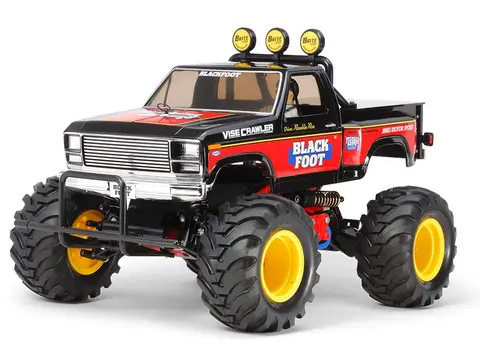
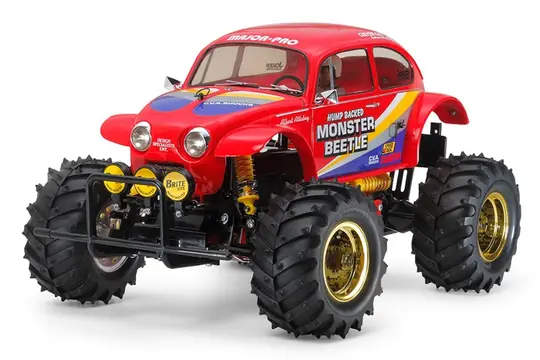
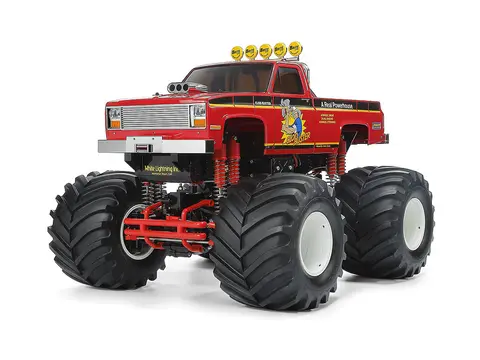
The original Blackfoot brought a Ford F-150 pickup body and oversized tires to Tamiya's off-road range in 1986. Its molded body, open space frame and tall stance made it visibly different from the company's racing buggies. This is the original 58058 kit, separate from Blackfoot (2016) and the later Blackfoot-named chassis. Original instructions (opens in a new tab). Rerelease history (opens in a new tab).
Read moreShow less
The original manual specifies independent front double-wishbone and rear trailing-arm suspension, a 540 motor and a three-step mechanical speed controller. Its cover gives 125 mm tires. That figure belongs to the original package and should not be replaced with the dimensions of a later tire simply because the truck name is shared. Original instructions (opens in a new tab).
Restoration priorities depend on whether the truck will remain period-correct or become a runner. Inspect the frame, rear joints, suspension pivots and mechanical controller before buying cosmetic additions. The original parts drawings identify its molded groups and body components; modern electronic-control and drivetrain changes need their own installation checks. Original instructions (opens in a new tab).
The kind of vehicle the maker sells it as. It sets what the car is built to do and which cars it is fair to compare it with.
Monster trucks have tall tires and long suspension travel, built for jumping and rough ground rather than a race track.
Drive
Only one axle is driven, the rear on almost every 2WD RC car.
It is lighter and simpler, and it takes more throttle control on loose ground.
Power
A brushed motor carries current through carbon brushes that rub on the commutator.
It is cheaper and smooth at low speed.
The brushes wear and the motor loses power over time.
Build
A kit you build yourself from parts.
Most kits come without motor, ESC, servo, radio and battery, and many without tires or a painted body.
The manual lists what to add.
Scale
The maker's nominal size compared with a full-size vehicle. It works more as a class label than a measurement.
A 1/10 monster truck is far bigger than a 1/10 touring car, so compare length and weight for real size.
Part number
The maker's product number for this exact version.
A V2, a new color, or a kit instead of an RTR usually has a different number, and parts can differ between them.
Check it against your box or receipt before ordering parts.
Class
Monster truck
Drive
2WD
Power
Brushed
Build
Kit
Scale
1/10
Part number
58058
Drivetrain
Pinion
The small gear on the motor shaft. Fewer teeth gear the car shorter: quicker acceleration, lower top speed and a cooler motor. More teeth do the opposite.
It depends on the motor you fit, so the maker does not list one.
Spur
The large gear the pinion drives. A bigger spur with the same pinion gears the car shorter.
Pinion and spur must have the same pitch, or tooth size, to mesh.
Transmission & axle
Every reduction after the spur, multiplied together: transmission, differentials and axle gears.
It is fixed by the design; the gearing you change is the pinion and spur.
Final drive
How many times the motor turns for one turn of the wheels. A higher number is shorter gearing: more acceleration and pulling power, less top speed.
Pinion
Not published
Spur
Not published
Transmission & axle
Not published
Final drive
Not published
Wheels & tires
Tire diameter
The outside diameter of the mounted tire, tread to tread. A taller tire covers more ground each turn, which gears the car taller.
At high speed tires can balloon and grow, so the real gearing gets taller as the car goes faster.
Theoretical top speed is unavailable because motor KV, rated battery cell count and complete final drive ratio are missing.
Enter the missing inputs in the calculator to work out a theoretical speed.
Theoretical top speed
Not published
How to read these figures
Stock is as the vehicle ships.
Calculated is worked from the stock figures on this page rather than stored beside them, so the two cannot drift apart.
Not applicable means the vehicle does not come with it, like the motor on a roller or the tires on a race kit.
Not published means it exists but no source we could find prints it.
Upgrades and setup
The rear drive joints and body mounts deserve attention before cosmetic upgrades. A detailed restoration described an incomplete truck, worn-looking rear joints and a bearing substitution inside the gearbox, while another running report highlighted front body-mount damage. Inspect those areas on the actual car first. A complete replacement assembly may be more useful than a stronger motor when the original rear end already has play.[1] TamiyaClub 58058 original-model reports (opens in a new tab)
Forums & communities
TamiyaClub
Historical original-model reviews; individual modified cars and old availability claims are not universal facts.
11 collected part numbers. Collected . Unmarked parts are recorded listings, without a claim about factory installation; optional and upgrade listings are tagged. Key assemblies include recorded gear and shock identifiers. Open a part for its listing sources.
About these specs
Original 58058 edition. Do not substitute later rerelease gearing, body finish or installed equipment without an exact component bridge.