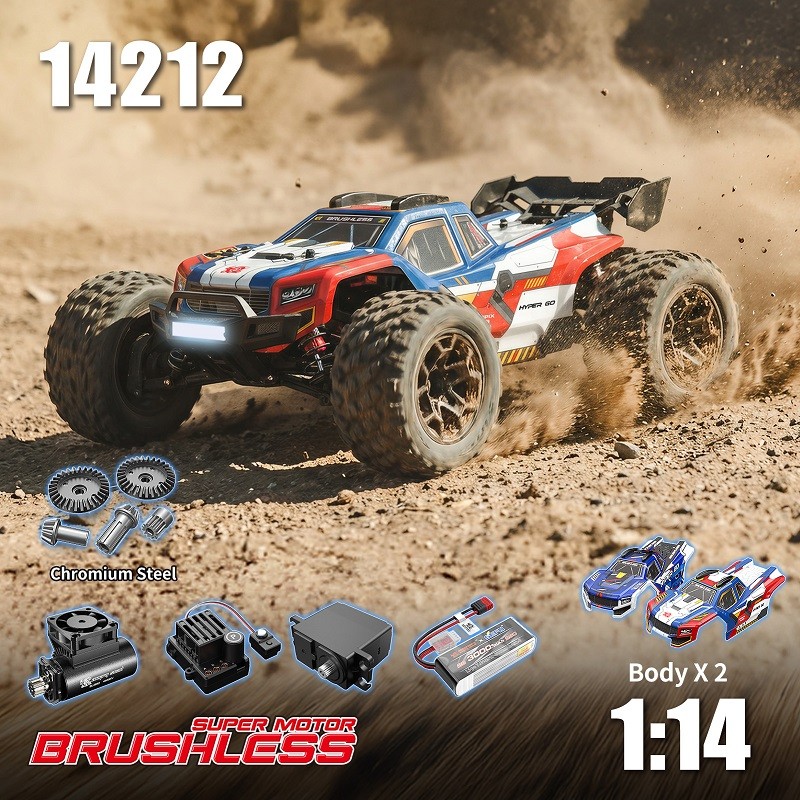
The Hyper Go 14212 is a compact 1/14 brushless truggy with an independent speed controller, a wide stance and a rear wing fixed to the shock tower. The illustrated wing and four body clips are useful things to check on a used car because they are shown as separate pieces. Before choosing a different shell or wing, match its mounting points to this chassis. Wing and body mounting (opens in a new tab)Body clips (opens in a new tab)
The kind of vehicle the maker sells it as. It sets what the car is built to do and which cars it is fair to compare it with.
A truggy is a 1/8 buggy with wider arms and truck tires: more stable and more forgiving on rough ground.
Power
A brushless motor has no brushes to wear, so it makes more power and runs more efficiently than a brushed one.
It needs a brushless ESC.
Scale
The maker's nominal size compared with a full-size vehicle. It works more as a class label than a measurement.
A 1/10 monster truck is far bigger than a 1/10 touring car, so compare length and weight for real size.
This one is 310 mm long.
Part number
The maker's product number for this exact version.
A V2, a new color, or a kit instead of an RTR usually has a different number, and parts can differ between them.
Check it against your box or receipt before ordering parts.
Class
Truggy
Power
Brushless
Scale
1/14
Part number
14212
Drivetrain
Pinion
The small gear on the motor shaft. Fewer teeth gear the car shorter: quicker acceleration, lower top speed and a cooler motor. More teeth do the opposite.
On this car one tooth changes the gearing by about 7.1%.
A bigger pinion loads the motor and ESC harder, so check the maker's gearing chart and feel the motor temperature after a run.
Spur
The large gear the pinion drives. A bigger spur with the same pinion gears the car shorter.
Pinion and spur need matching pitch, or explicit manufacturer confirmation that the exact gears are compatible.
The Gearing parts table below shows this car's pitch and part numbers.
Transmission & axle
Every reduction after the spur, multiplied together: transmission, differentials and axle gears.
It is fixed by the design; the gearing you change is the pinion and spur.
Final drive
How many times the motor turns for one turn of the wheels. A higher number is shorter gearing: more acceleration and pulling power, less top speed.
Hub bearing size
Hub bearing size: The documented drivetrain connection or size for this exact model. Match the mating component before buying a replacement.
This working size comes from a replacement advertised for the identified OEM part. Confirm the fitted part before ordering; a replacement's size may differ.
Pinion bore
The nominal size of the hole that mates with the motor shaft.
A nominal shaft fit comes from the exact replacement pinion listing. It does not specify a measured finished hole or manufacturing tolerance.
Match the pinion mounting method as well as its size. A press-fit hole cannot be inferred from motor shaft diameter.
Pinion pitch
The tooth spacing of the fitted gear, stated as metric module or diametral pitch.
Pinion and spur need matching pitch or explicit manufacturer confirmation of compatibility for the exact parts. Mod 0.8 and 32P are different standards; a compatibility statement for particular gears does not apply to every gear. A missing pitch can be inferred from the other fitted gear; module and diametral pitch are not silently converted.
Spur pitch
The tooth spacing of the fitted gear, stated as metric module or diametral pitch.
Pinion and spur need matching pitch or explicit manufacturer confirmation of compatibility for the exact parts. Mod 0.8 and 32P are different standards; a compatibility statement for particular gears does not apply to every gear. A missing pitch can be inferred from the other fitted gear; module and diametral pitch are not silently converted.
The outside diameter of the mounted tire, tread to tread. A taller tire covers more ground each turn, which gears the car taller.
At high speed tires can balloon and grow, so the real gearing gets taller as the car goes faster.
Wheel hex
The hex on the axle that the wheel locks onto and is driven by. A wheel must match the hex size to fit.
12 mm is the common size on 1/10 cars, so most 1/10 wheels fit; offset and width still vary.
The wheel nut is a separate size, so check its thread too before buying nuts.
Stock wheel diameter
Stock wheel diameter: A documented stock wheel, tire, or axle measurement. Stock dimensions alone do not establish the largest size that will clear the body and suspension.
This working size comes from a replacement advertised for the identified OEM part. Confirm the fitted part before ordering; a replacement's size may differ.
Stock tire width
Stock tire width: A documented stock wheel, tire, or axle measurement. Stock dimensions alone do not establish the largest size that will clear the body and suspension.
This working size comes from a replacement advertised for the identified OEM part. Confirm the fitted part before ordering; a replacement's size may differ.
What the shocks are and how they are built, as the maker describes them.
Oil-filled shocks damp with silicone oil; friction shocks, found on some entry-level cars, damp with a sprung plunger and cannot be tuned with oil.
Threaded bodies set ride height with a collar you turn, rather than clips.
Shock length, front
The stated length of the complete shock assembly. Sources may use mounting-eye centers or a nominal assembly length.
Compare fully extended mounting-eye spacing, compressed length and mounting hardware before ordering. A longer shock changes ride height and travel, and can bind at full droop or bottom out.
This approximate length comes from a replacement listed for the identified OEM shock set. Check the fitted shocks; their original dimensions may differ.
Shock length, rear
The same measure at the rear, which differs from the front on this car.
Longer rear shocks are common: they give the rear more travel for landings and put power down over rough ground.
Frontupper shock bolt
Front upper shock bolt: A documented shock mounting interface at the named end and eye. A ball stud or standoff is distinct from a through-bolt. Match the mounting type, thread and eye dimensions when choosing a replacement shock.
Frontlower shock bolt
Front lower shock bolt: A documented shock mounting interface at the named end and eye. A ball stud or standoff is distinct from a through-bolt. Match the mounting type, thread and eye dimensions when choosing a replacement shock.
Rearupper shock bolt
Rear upper shock bolt: A documented shock mounting interface at the named end and eye. A ball stud or standoff is distinct from a through-bolt. Match the mounting type, thread and eye dimensions when choosing a replacement shock.
Rearlower shock bolt
Rear lower shock bolt: A documented shock mounting interface at the named end and eye. A ball stud or standoff is distinct from a through-bolt. Match the mounting type, thread and eye dimensions when choosing a replacement shock.
Nominal shaft fit inferred from the fitted 16392G pinion (derived from replacement part input). Confirm adapters and mounting fit before ordering; this is not a shaft measurement.
Nominal shaft fit inferred from the fitted 16392G pinion (derived from replacement part input). Confirm adapters and mounting fit before ordering; this is not a shaft measurement.
The complete motor-to-wheel reduction is unspecified.
How to read these figures
Stock is as the vehicle ships.
Derived uses recorded dimensions or arithmetic. The row explains the inference. A nominal mating size is not a measured tolerance or a complete fitment guarantee.
Derived from replacement part uses the listed dimensions of a replacement advertised for the identified OEM part. Treat it as an approximate working size; the factory-fitted part may differ. Calculated performance uses that approximation.
Single report uses one outside source. It is useful as a starting figure, with the source and calculation described in the note.
Community uses independent outside reports that agree.
Part listing uses independent part specifications for an identified stock component.
Not published means it exists but no source we could find prints it.
Start with the 14212's T3D radio settings before changing the motor or gearing. Center throttle trim so the car remains stationary with the trigger released, then set the steering trim for straight running. Steering travel and throttle travel adjust the available response separately from trim, which sets the neutral position. Check those controls with the wheels raised before a driving test.[1] Hyper Go 14212 factory setup manual (opens in a new tab)
A new transmitter needs its throttle range matched to the illustrated E45P controller. Set throttle trim to center and throttle-channel travel to full, hold SET while switching the controller on, then release it when the calibration indication starts. Save neutral, full forward and full reverse in that order, returning the trigger to neutral at the end. The manual distinguishes this process from holding SET for five seconds while already powered, which resets the throttle range.[1] Hyper Go 14212 factory setup manual (opens in a new tab)
Read moreRead less about build and setup for Hyper Go 14212
Use the controller's status light to narrow down a loss of drive. Slow flashing identifies low voltage, two flashes identify overheating protection, and a dark indicator identifies stall protection in this manual. Rapid flashing can occur while operating the throttle as well as with no signal. Check the indication and the fitted equipment before treating an interruption as a failed ESC.[1] Hyper Go 14212 factory setup manual (opens in a new tab)
Common numbers cover selected core components, not every part. A shared family, manual or listing does not mean the parts fit both vehicles. Check the comparison and upgrade notes before ordering.
More connections & sourcesShow less
Other documented connections
MJX 14209/14212 manual connections. Manufacturer manuals list matching chassis, driveline, suspension and steering components for these exact models. Body details and equipment vary. This documents common listed assemblies, without a factory-fitment claim.