
ResearchTyphon 3S vs 223S: check the revision
Typhon 3S vs 223S: check the revision
The Typhon 223S adds a center differential, steering assistance and easier body access. Here’s what changes in driving, durability, power and ownership cost compared with the 3S BLX V3, followed by the parts differences behind those changes.
Published . Updated . Reference figures are a dated catalog snapshot; linked sheets carry the sources and subsequent corrections.
What changes between the two Typhons?
The lower motor KV on the 223S tells only part of the story. Its larger fitted pinion changes the gearing balance, while the center differential and combined ESC/receiver change the drivetrain and electronics. Some familiar differential and shock numbers still appear in both parts lists, giving owners a useful starting point for repairs.
The two editions here are ARA4306V3, the 3S BLX V3, and ARA4306V4, the 223S BLX DSC. Those model codes distinguish them from other Typhon platforms. On a used buggy, the installed equipment also matters because a previous owner may have mixed revisions.
The stock setups side by side
Scroll sideways to see all columns.
| Item | 3S BLX V3 | 223S BLX V4 |
|---|---|---|
| Model code | ARA4306V3 | ARA4306V4 |
| Motor rating | 3200 KV | 3100 KV |
| Speed control | BLX100; separate receiver | SLT 80A ESC/receiver with DSC |
| Pinion / spur | 15T / 57T | 16T / 57T |
| Spur part number | ARA310947 | ARA311167 |
| Calculated final drive | 10.83:1 | 10.15:1 |
The V3 product listing (opens in a new tab) names its motor and BLX100 electronics. The V4 exploded view (opens in a new tab) identifies the newer motor, combined ESC/receiver and center differential assembly.
How does the newer Typhon drive?
The 223S keeps 2S/3S capability and adds DSC steering assistance. The move to a center differential also lets the front and rear driveline speeds vary, giving the car a different way to manage drive as grip changes. Adjusting DSC gives you another way to tune how much steering correction you want on a loose surface.
In Elefun's February 2026 retailer test (opens in a new tab), the 223S felt stable and predictable on a prepared ski slope, with strong acceleration on 3S. Ice exposed the limits of grip, with full throttle causing wheelspin and loss of direction. That is useful driving context for those winter conditions, rather than a measured handling advantage over the V3.
Durability and everyday ownership
The metal center-differential spur and revised drive module are substantial changes, but they don't establish that every part of the newer buggy lasts longer. Both cars still need tires, suspension and driveline bearings checked after hard running. Shared differential and front-shock listings are useful when keeping a V3 going, while the center mechanism needs its own repair parts.
There is a smaller everyday improvement too: the newer clipless body makes battery and electronics access easier. Elefun particularly appreciated the release button in cold weather. Its car completed repeated snow runs without reported trouble, although that short winter test cannot establish long-term reliability or replace the manual's wet-running maintenance instructions.
Typhon 223S winter test and body access (opens in a new tab). 223S equipment and manufacturer support (opens in a new tab).
What did the price change buy?
The July 2020 V3 announcement (opens in a new tab) listed US$319.99. Horizon's 223S U.S. listing (opens in a new tab) checked on 15 October 2026 was US$339.99. That US$20 gap compares an older launch listing with a later offer; the 223S launch price hasn't been confirmed here, so it shouldn't be described as the original generation-change premium.
The newer car brings a center differential, DSC-equipped electronics, revised steering equipment and clipless body access. Those are useful conveniences and control changes, while the calculated speed increase is only modest. If you own a sound V3, compare the improvements you actually want with the cost of keeping it; both RTR editions still need a driving battery and charger.
The center drive changes how the gear is used
The V3 reference uses ARA310947, a composite 57T 0.8Mod spur (opens in a new tab). The V4 uses ARA311167, a metal 57T 0.8Mod center differential spur (opens in a new tab). Tooth count and pitch match, but the part number and assembly role differ.
The V4 places its spur in the ARA311165 center differential, alongside the case and outdrives. For a repair, that assembly number helps identify the right replacement gear. Converting a V3 to the newer mechanism is a larger project involving the mount, housing, bearings and surrounding hardware.
A slipper allows controlled slip at its friction surfaces, limiting the torque passed through the drivetrain. A center differential instead allows the front and rear driveline speeds to differ. The common 57T tooth count describes the gearing, while the mechanism around it determines how the drive is managed.
Familiar spares remain useful, within their scope
AR310775 differential outdrives, AR310865 differential planet gears and AR330550 front shock sets appear in both model-specific lists. If you already have a spares box, those shared numbers can help identify parts worth checking against a repair. The overlap applies to the named components rather than every assembly around them.
Open the parts comparison with Recorded on all selected to inspect shared maker part numbers. Switch to Recorded on some for listings that need closer investigation. The initial Major assemblies scope helps you find substantial changes before including screws, bearings and other hardware.
The listing role helps distinguish supplied equipment from an optional upgrade. Where a number appears for only one edition, the missing entry can reflect incomplete references or a superseded number. The exact assembly drawing is the next place to look before treating it as a physical difference.
The larger pinion offsets the lower KV
Using the same 57T spur and 2.85 internal reduction, changing from 15T to 16T raises wheel speed at a fixed motor RPM by about 6.7%. The motor rating falls from 3200 to 3100 KV. Combining both changes, at the same voltage and tire diameter, gives only about 3.3% more ideal road speed: 3100 × 16 ÷ (3200 × 15).
The two changes leave the ideal speed figures much closer than either motor KV or pinion size suggests on its own. Motor load, battery voltage and traction still affect the result on the ground, so that small theoretical increase doesn't establish a measured speed advantage. It gives you a useful baseline for comparing the complete setups.
Which Typhon makes sense for you?
The 223S is the more relevant starting point if you want the center differential and DSC-equipped controls together. For a V3 owner, the shared replacement numbers can simplify individual repairs, while a conversion needs the complete drivetrain and electronics plan. The choice depends on which changes you actually want to use.
- For a repair, start with the installed assembly. Match its number and revision to the exploded view. A confirmed shared replacement may let you reuse a spare.
- For a conversion, price the complete job. Include supporting mounts, hardware and electronics compatibility, not just the most visible component.
- For a purchase, name the benefit you want. Compare the center drive and control features you will use rather than assuming every newer part is an upgrade for your driving.
- Keep uncertain fitment out of the order. Ask the manufacturer or a knowledgeable supplier about the exact pair of model codes and part numbers.
Reference sheets
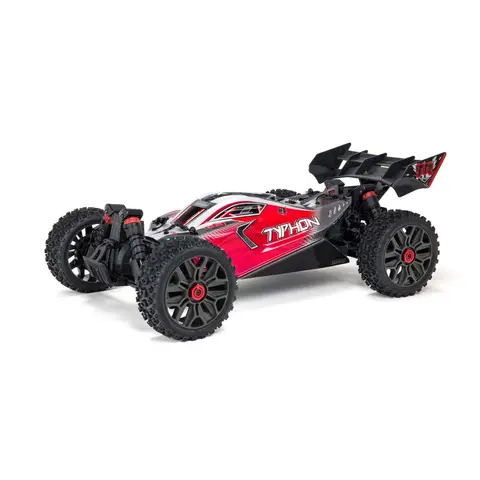 Arrma Typhon 3S BLXOpen the vehicle specificationsPhoto: Horizon Hobby
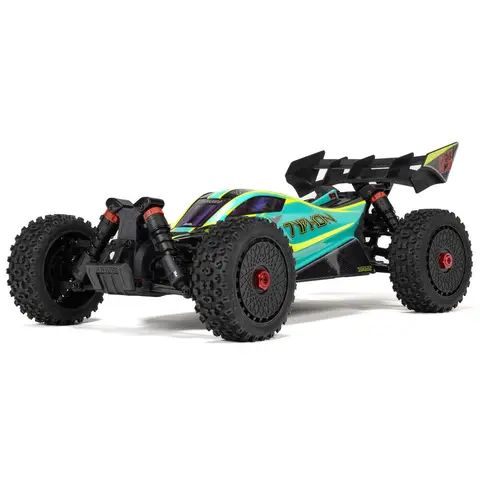 Arrma Typhon 223S BLX DSCOpen the vehicle specificationsPhoto: Horizon Hobby
Try it with your model
Loading a vehicle changes the working setup shared by the car calculators. Save your current setup first if you want to keep it.
Sources and corrections
Reference figures above come from the linked vehicle sheets and their manufacturer documents. No hands-on fitment or speed test is claimed. For the evidence standard, see Methodology. Send a correction with the exact model and source to hello@rctunelab.com.