
ResearchIdentify your RC revision before buying parts
Identify your RC revision before buying parts
A familiar model name is not enough to select parts. Use the product code and the installed assembly to narrow the reference.
Published . Updated . Reference figures are a dated catalog snapshot; linked sheets carry the sources and subsequent corrections.
Start with a code, not the body shell
A model name identifies a family; a product code narrows the version. Body shells, wheels and electronics can all be replaced, so a familiar color scheme is weak evidence when buying parts for a used car.
Record the full maker and model name, the product code or SKU, any version printed on the manual, and what the seller says was changed. Keep photographs of the box label and the installed components. Those details make a parts question much easier to answer than a photograph of the whole car alone.
Clues to keep, and what each can establish
Scroll sideways to see all columns.
| Clue | Useful for | Limit |
|---|---|---|
| Box or purchase SKU | Finding the original package | Box or receipt may belong to a different car |
| Manual model code and revision | Choosing the right diagrams | Family manuals can cover several configurations |
| Installed component number | Identifying the part in your hand | May be an upgrade rather than the original part |
| Body, wheels or paint | Narrowing possible versions | Easy to swap; insufficient for fitment |
Build a small document set
Open the exact-model product page, instruction manual, exploded view and parts list from the vehicle sheet. Check the model code on each document, not just the title of the download link. If a manual covers several models, read the column or diagram for yours.
Each document answers a different question. The manual describes operation and permitted setup choices. An exploded view shows how an assembly fits together. A parts list supplies ordering numbers and can distinguish standard equipment from options. A general product page may summarize the package without identifying every installed component.
Keep the URL and document revision with your notes. If the manufacturer replaces a download later, you still have a record of which version supported your decision.
A Typhon example: the names are close, the spur is not
The Typhon 3S BLX reference is ARA4306V3. The Typhon 223S BLX DSC reference is ARA4306V4. Both references use a 57T spur, so “Typhon 57T gear” is not a specific enough description for an order.
The V3 reference names ARA310947. The V4 exploded view (opens in a new tab) places ARA311167 in its center differential assembly. Inspect the assembly installed in your buggy, then match its number and neighboring parts to the appropriate diagram. The generation comparison explains why the common tooth count is not enough.
Separate the original car from its current setup
A used car can have a replacement motor, a different center drive and aftermarket tires while retaining its original chassis. Write “base model” and “installed parts” as separate notes instead of forcing everything into one factory configuration.
For gearing, record the pinion and spur tooth counts, pitch, motor shaft diameter and any identifiable transmission parts. For wheels, check the attachment and dimensions, not just the advertised scale. Photograph an assembly before taking it apart so the relationship between parts remains clear.
A part number that appears on a mold or component can identify only that subpart, not a complete assembly sold under another number. Compare it with the exploded view before assuming it is the orderable replacement.
What if the model code is missing?
- Keep plausible candidates. Note the evidence for each rather than choosing the newest version by default.
- Compare the assembly you need to repair. Mounting points, part markings and the surrounding components can be more useful than the body.
- Ask a precise question. Supply clear photos, any visible numbers, candidate model codes and the exact replacement you are considering.
- Hold the purchase if the mounting details remain unresolved. A similar photograph or a matching tooth count does not settle them.
Once you have a supported identity, use the vehicle reference as the factory baseline and save your actual gearing separately. Send a site correction when the reference is wrong; a personal modification belongs in your setup notes.
Reference sheets
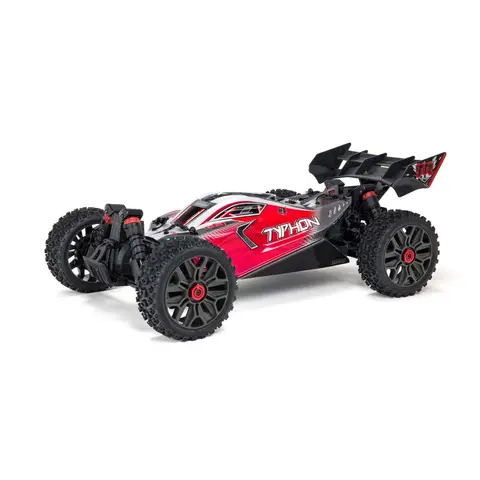 Arrma Typhon 3S BLXOpen the sourced specification sheetPhoto: Horizon Hobby
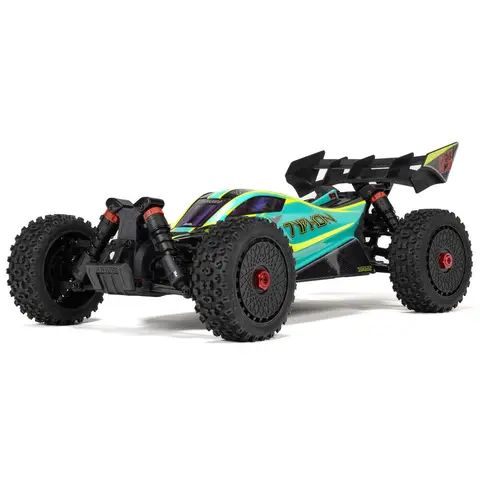 Arrma Typhon 223S BLX DSCOpen the sourced specification sheetPhoto: Horizon Hobby
Try it with your model
Loading a vehicle changes the working setup shared by the car calculators. Save your current setup first if you want to keep it.
Sources and corrections
Reference figures above come from the linked vehicle sheets and their manufacturer documents. No hands-on fitment or speed test is claimed. For the evidence standard, see Methodology. Send a correction with the exact model and source to hello@rctunelab.com.